Criminal Defense Attorney Marketing: 17 Tactics That Work
Categories: Legal Marketing Strategies
 Abram Ninoyan
Founder & Senior Performance Marketer
Credentials: Google Partner, Google Ads Search Certified, Google Ads Display Certified, Google Ads Measurement Certified, Google Analytics (IQ) Certified, HubSpot Inbound Certified, HubSpot Social Media Marketing Certified, Conversion Optimization Certified
Expertise: Google Ads, Meta Ads, Conversion Rate Optimization, GA4 & Google Tag Manager, Lead Generation, Marketing Funnel Optimization, PPC Management
LinkedIn Profile
Effective criminal defense attorney marketing comes down to being visible at the exact moment someone needs a lawyer, and then converting that visibility into a signed retainer, not just a form fill....
Key Takeaways
- Criminal Defense Attorney Marketing: 17 Tactics That Work
- Why does criminal defense marketing feel so hard?
- Step 1. Which cases and clients do you want?
- Step 2. How do you turn clicks into calls?
Criminal Defense Attorney Marketing: 17 Tactics That Work
Effective criminal defense attorney marketing comes down to being visible at the exact moment someone needs a lawyer, and then converting that visibility into a signed retainer, not just a form fill. Most firms get the first part partially right but lose cases in the gap between lead and intake.
Criminal defense has a unique urgency problem. Someone facing a DUI, assault charge, or warrant isn't browsing casually, they need representation now, often outside business hours. According to Clio's 2024 Legal Trends Report, 42% of law firms don't return initial client calls within three days. For criminal defense, where cases are won or lost in the first hours of contact, that delay is a dealbreaker. Meanwhile, firms pouring $5K–$30K/month into Google Ads often can't answer a basic question: which campaigns actually produce signed clients, not just clicks?
That's the gap we built GavelGrow to close. Our platform tracks every lead from first ad click through signed retainer, with built-in call tracking, intake automation that fires within 60 seconds, and modelled practice-area benchmarks so you can see how your cost-per-signed-case stacks up against other criminal defense firms your size.
This guide covers 17 specific tactics that work for criminal defense firms right now, from Google Ads structure and local SEO to intake speed optimization and review generation. No generic advice borrowed from dentist marketing playbooks. Every recommendation maps to the realities of defending clients against criminal charges in competitive local markets.
Key Takeaways:
- Criminal defense leads demand sub-5-minute response times to convert
- Track cost-per-signed-case, not cost-per-lead, to measure real ROI
- Google Ads and Local Services Ads drive the highest-intent criminal defense leads
- Your intake process matters as much as your ad spend
- Benchmarking against peer firms reveals hidden performance gaps
Why does criminal defense marketing feel so hard?
Criminal defense sits in one of the most competitive paid search verticals in legal. A single DUI defense click in Los Angeles can cost $80–$200 on Google Ads, and criminal defense consistently ranks among the top five most expensive keyword categories nationally. You're not just competing with other local firms. You're also fighting for visibility against aggregator sites like FindLaw and Avvo, which dominate organic results with massive content budgets built over decades of aggressive SEO investment.
The firms that win in criminal defense marketing aren't necessarily spending the most. They convert at a higher rate at every stage of the funnel.
The compliance layer slows everything down
State bar advertising rules add friction that most generic marketing agencies never account for. Every jurisdiction carries specific rules around attorney advertising: disclaimers required in video ads, restrictions on words like "best" or "top-rated," limits on client testimonials in certain states, and requirements around past-results disclosures. If your marketing agency also manages roofers and dentists, they're almost certainly not checking your ads against your state's Rules of Professional Conduct before publishing them.
The result is that you either slow your campaigns down waiting for legal review, or you run ads that could trigger a bar complaint. Effective criminal defense attorney marketing requires a foundational understanding of what you can and can't say, and that needs to be built into your ad copy, landing page templates, and intake forms from day one, not patched in after the fact.
The attribution gap makes ROI invisible
Most criminal defense firms have no reliable way to connect their marketing spend to their signed cases. They know roughly how much they spent on Google Ads last month, and they have a vague sense of how many new clients came in. But they can't tell you which campaign, keyword, or ad drove a signed retainer versus a time-wasting call that went nowhere. Without that data, every budget decision is a guess dressed up as strategy.
This gap gets worse because criminal defense leads almost always come through phone calls, not web forms. Someone arrested at 11pm doesn't fill out a contact form. They call the first number they see. If your call tracking setup doesn't capture the campaign source, record the call outcome, and link that call to a case file, you're operating blind. Clio's 2024 Legal Trends Report found that phone calls remain the dominant first-contact method for new legal matters, yet most firms still can't attribute those calls to a specific ad or keyword.
Urgency compounds every one of these problems. Criminal defense prospects search at all hours, often from mobile devices in high-stress situations. A person arrested on a Friday night needs representation before Monday's arraignment. If your intake system only responds during business hours, or if your landing page takes four seconds to load on a phone, you lose those cases before you ever speak to the prospect. Research consistently shows that leads contacted within five minutes are 21 times more likely to qualify than leads reached after thirty minutes. In criminal defense, where someone may call three firms before retaining one, speed and availability aren't competitive advantages. They're the minimum standard.
Step 1. Which cases and clients do you want?
Before you spend a dollar on criminal defense attorney marketing, you need to define exactly what a good case looks like for your firm. Vague targeting produces vague results: high lead volume, low conversion, and a calendar full of consultations that never sign. Your marketing strategy should be built backwards from the cases you actually want to win.
Define your case mix by practice sub-area
Criminal defense is not one practice area. It's a collection of distinct sub-markets, and each one has different economics, different search behavior, and different competition levels. DUI and DWI defense tends to generate the highest search volume and attracts the most price-sensitive clients. Federal criminal defense and white-collar cases carry longer sales cycles but significantly higher retainer values. Drug charges, assault, domestic violence, expungements, and juvenile defense each pull from different demographics and require different ad copy.
The sub-areas you exclude matter just as much as the ones you pursue. Trying to rank for everything often means ranking for nothing.
Start by mapping your current case mix against your revenue. Use this table as a template:
Fill in your own numbers. Where your retainer value is high and your current lead volume is low, that's a targeting gap worth closing with paid campaigns.
Build your ideal client profile
Once you know which cases you want, build a one-paragraph profile of the person most likely to hire you. Demographic specifics matter here: age range, employment status, whether they were arrested for the first time or have prior charges, and how quickly they need representation. A first-time DUI arrest at 2am from a mobile phone search looks nothing like a business owner referred by their civil attorney for a federal investigation.
Your ideal client profile drives every downstream decision, from the keywords you bid on to the headline copy on your landing page. Write it down and share it with anyone who touches your campaigns.
Step 2. How do you turn clicks into calls?
Getting someone to click your ad is the easy part. Converting that click into a phone call requires a landing page built specifically for criminal defense prospects under pressure. Generic "contact us" pages with multi-field forms kill conversions. Your page needs to do one thing: make it effortless to call you right now.
Build a landing page that removes friction
Every criminal defense landing page should follow a tight structure. Above the fold: your headline, a trust signal (years of experience, cases dismissed, local court familiarity), and a click-to-call button. Nothing below that fold should distract from the call. Remove navigation menus and walls of body text. A prospect who was just arrested at midnight doesn't read; they scan for a phone number and a reason to trust you.
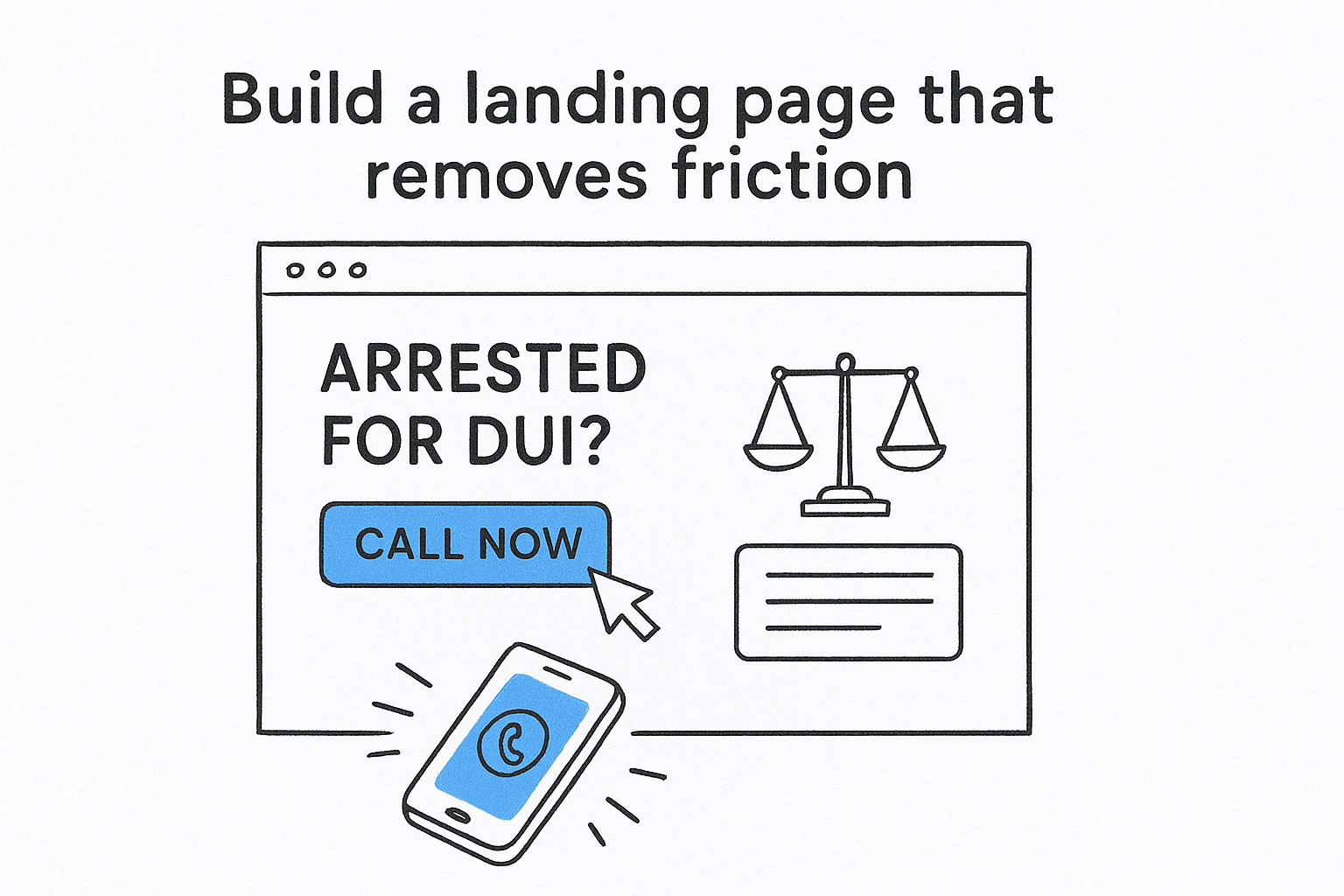
Use this landing page checklist before launching any paid campaign:
- Headline: mirrors the ad copy exactly ("Arrested for DUI in [City]? Call Now")
- Click-to-call button: visible on mobile without scrolling
- Social proof: bar admissions, case results, and client reviews compliant with your state bar rules
- Response promise: "Available 24/7" or "Call answered in 60 seconds"
- Form fields: name and phone number only, nothing more
A landing page that loads in under two seconds on mobile converts at nearly double the rate of one that loads in four seconds, according to Google's PageSpeed research.
Respond before the prospect calls someone else
Speed is where most criminal defense attorney marketing budgets go to waste. You pay for the click, the prospect fills out a form or leaves a voicemail, and then your front desk follows up the next morning. That case is already gone. GavelGrow's intake automation fires an SMS and email within 60 seconds of a form submission, with a direct link to book a consultation. Pair that with 24/7 call routing so after-hours calls reach an answering service trained on your intake script.
Train that service with a five-question intake script: case type, arrest date, court date if known, jurisdiction, and whether the prospect has spoken to another attorney. That call summary hits your inbox before the call ends, so your first callback is informed instead of starting from scratch and burning the prospect's trust before you've earned it.
Step 3. How do you win local search fast?
Local search dominates criminal defense attorney marketing because most prospects search for representation within their city or county. Someone searching "DUI attorney Austin" or "criminal defense lawyer near me" is ready to hire within hours, not weeks. Winning those searches requires a focused local SEO strategy, not a broad content push.
Claim and fully optimize your Google Business Profile
Your Google Business Profile (GBP) is the single highest-leverage local SEO asset you own. A fully completed profile outranks a thin one, and thin profiles are everywhere in criminal defense. Start by verifying your GBP through Google's Business Profile Manager, then fill out every field without exception.

Firms with complete Google Business Profiles, including photos, services, and consistent hours, receive significantly more direction requests and calls than incomplete listings, according to Google's own GBP research.
Use this checklist to fully optimize your profile before publishing:
- Business name: matches your bar registration exactly
- Primary category: "Criminal Justice Attorney" (add DUI, drug, and federal defense as secondary categories)
- Phone number: tracked number tied to your GavelGrow call tracking setup
- Hours: include after-hours and weekend availability if accurate
- Services: list each sub-area (DUI, assault, federal charges, expungements)
- Photos: add your office exterior, team headshots, and courtroom-appropriate images
- Posts: publish a short GBP post weekly covering recent case outcomes or legal updates, keeping state bar disclaimer requirements in mind
Earn reviews systematically, not randomly
Reviews on your GBP directly influence your local pack ranking and your conversion rate once prospects find you. Most firms ask for reviews inconsistently or not at all. Build a repeatable system: at every case close, send a two-step SMS sequence asking the client to share their experience on Google. The first message thanks them and explains the value of a review. The second, sent 48 hours later if they haven't posted, includes a direct link to your review form.
Respond to every review publicly within 48 hours. A short, professional reply signals to both Google and prospective clients that your firm is attentive. Never include case details in your responses, since that protects client confidentiality and keeps you compliant with professional conduct rules.
Step 4. Run content, social, and paid ads together
Most criminal defense firms run these three channels independently and wonder why none performs as well as competitors who spend less. Content drives organic authority, social builds name recognition, and paid ads capture immediate demand. When you sync all three, each channel reinforces the others and your cost-per-signed-case drops because you're no longer paying full price to introduce your firm to every prospect.
Create content that answers the questions your prospects actually search
Your blog and FAQ content serve two functions: they rank organically for long-tail search terms, and they give you material to repurpose across social and paid. Focus every piece on a specific charge type and jurisdiction. "What happens after a DUI arrest in [City]" outperforms "DUI defense" every time because it matches the exact search a frightened driver types at midnight.
Use this content calendar as a starting framework:
Use paid retargeting to close the prospects content warms up
Someone who reads your "what to do after an arrest" article is far more likely to call than a cold visitor from a generic keyword. Retargeting campaigns on Meta let you serve ads specifically to people who visited your blog or watched your video content. Set your retargeting window to 14 days for criminal defense, since most hiring decisions happen within two weeks of the triggering event.
Combining organic content with paid retargeting typically cuts cost-per-lead by 20-35% compared to cold paid traffic alone, because you're converting prospects already familiar with your firm.
Effective criminal defense attorney marketing treats content, social, and paid as one connected system rather than three separate budgets. Every blog post feeds your retargeting audiences, every social share extends your organic reach, and every paid dollar works harder because your firm's name is already familiar to the prospect before they click.
Frequently asked questions
The questions below cover what managing partners and marketing directors ask most when building or rebuilding their criminal defense attorney marketing strategy from the ground up.
How much should a criminal defense firm budget for Google Ads?
Your starting budget depends on your market size. In mid-sized cities, $3,000–$5,000 per month is a realistic floor to generate meaningful data. In major metros like Los Angeles or Chicago, competitive DUI keywords run $80–$200 per click, pushing minimum effective budgets toward $10,000. Start with one high-intent practice sub-area, track your cost-per-signed-case after 60 days, and scale the campaigns that produce retained clients rather than spreading budget thin across every keyword at once.
What is a realistic cost-per-signed-case for criminal defense?
Cost-per-signed-case varies by case type and market, but GavelGrow's modelled practice-area benchmarks show that criminal defense firms typically retain clients at $400–$1,200 per signed case through Google Ads. DUI cases trend toward the lower end because search volume is high and decisions happen fast. Federal defense and white-collar matters cost more to acquire but carry retainer values of $15,000 or more, which makes a higher acquisition cost entirely acceptable if your attribution data is accurate.
How fast does my firm need to respond to criminal defense leads?
Criminal defense prospects frequently contact two or three firms before retaining one, so a delayed response hands cases to competitors before you ever speak to the prospect. Research consistently shows that leads contacted within five minutes are 21 times more likely to qualify than those reached after 30 minutes. Use intake automation that sends an SMS confirmation within 60 seconds of a form submission, and route after-hours calls to a live answering service rather than voicemail.
Speed is not a competitive advantage in criminal defense intake. It is the minimum standard.
Does social media generate real cases for criminal defense attorneys?
Social media rarely produces direct cases at the same volume as Google Ads, but Meta retargeting campaigns generate significant value as a secondary channel. Your best use of Facebook and Instagram is retargeting visitors who already read your blog or watched your video content. A 14-day retargeting window keeps your firm visible to prospects still deciding, which lowers your cost-per-click when they return through paid search.
How do I track which marketing channel actually produces signed clients?
Your firm needs call tracking tied to campaign-level attribution that follows a lead through to a signed retainer, not just a form fill. Set up separate tracking numbers for each Google Ads campaign, your organic traffic, and your Local Services Ads. Then link each number to your case management system so you can calculate cost-per-signed-case by channel. GavelGrow's platform handles this natively without requiring Zapier integrations or manual spreadsheet reconciliation.
Your next steps
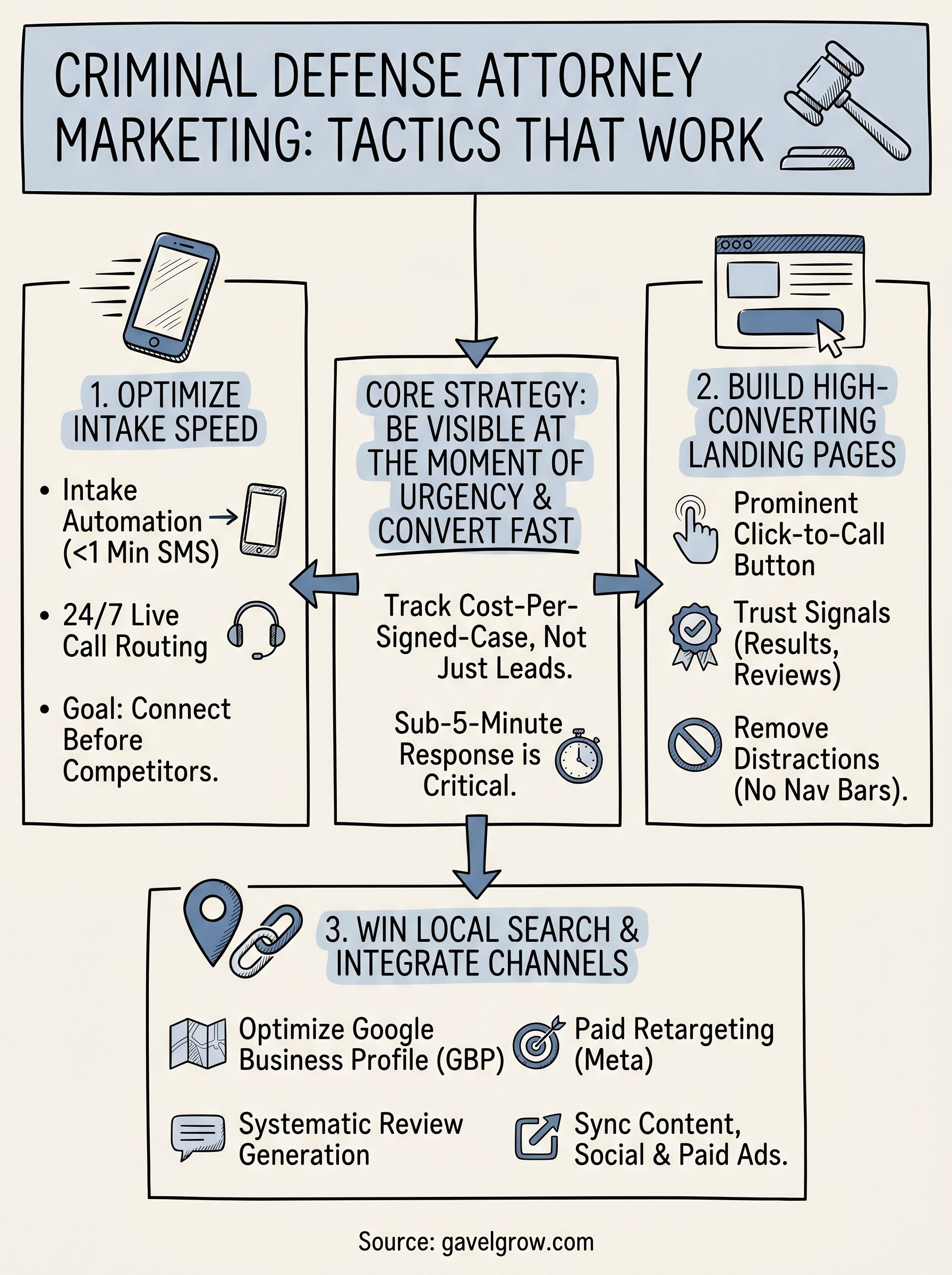
The 17 tactics in this guide give you a complete framework for criminal defense attorney marketing, but a framework only works if you execute it in the right order. Start with your intake speed and call tracking before increasing ad spend. If your firm can't respond within five minutes and can't trace a signed retainer back to a specific keyword, more budget won't fix the problem. It will magnify it.
Pick one section from this guide to act on this week. Fix your Google Business Profile, set up a tracking number, or rewrite your landing page headline to mirror your top keyword. Small, sequential improvements compound faster than a complete overhaul attempted all at once.
When you're ready to see exactly where your firm stands against 500+ peer criminal defense firms, run your free law firm marketing scorecard and get a clear picture of what to fix first.
Frequently Asked Questions
How much should a criminal defense firm budget for Google Ads?
Your starting budget depends on your market size. In mid-sized cities, $3,000–$5,000 per month is a realistic floor to generate meaningful data. In major metros like Los Angeles or Chicago, competitive DUI keywords run $80–$200 per click, pushing minimum effective budgets toward $10,000. Start with one high-intent practice sub-area, track your cost-per-signed-case after 60 days, and scale the campaigns that produce retained clients rather than spreading budget thin across every keyword at once.
What is a realistic cost-per-signed-case for criminal defense?
Cost-per-signed-case varies by case type and market, but GavelGrow's modelled practice-area benchmarks show that criminal defense firms typically retain clients at $400–$1,200 per signed case through Google Ads. DUI cases trend toward the lower end because search volume is high and decisions happen fast. Federal defense and white-collar matters cost more to acquire but carry retainer values of $15,000 or more, which makes a higher acquisition cost entirely acceptable if your attribution data is accurate.
How fast does my firm need to respond to criminal defense leads?
Criminal defense prospects frequently contact two or three firms before retaining one, so a delayed response hands cases to competitors before you ever speak to the prospect. Research consistently shows that leads contacted within five minutes are 21 times more likely to qualify than those reached after 30 minutes. Use intake automation that sends an SMS confirmation within 60 seconds of a form submission, and route after-hours calls to a live answering service rather than voicemail. Speed is not a competitive advantage in criminal defense intake. It is the minimum standard.
Does social media generate real cases for criminal defense attorneys?
Social media rarely produces direct cases at the same volume as Google Ads, but Meta retargeting campaigns generate significant value as a secondary channel. Your best use of Facebook and Instagram is retargeting visitors who already read your blog or watched your video content. A 14-day retargeting window keeps your firm visible to prospects still deciding, which lowers your cost-per-click when they return through paid search.
How do I track which marketing channel actually produces signed clients?
Your firm needs call tracking tied to campaign-level attribution that follows a lead through to a signed retainer, not just a form fill. Set up separate tracking numbers for each Google Ads campaign, your organic traffic, and your Local Services Ads. Then link each number to your case management system so you can calculate cost-per-signed-case by channel . GavelGrow's platform handles this natively without requiring Zapier integrations or manual spreadsheet reconciliation.