Landing Page Conversion Rate Optimization: 7 Tips for Law Firms
Categories: Legal Marketing Strategies
 Abram Ninoyan
Founder & Senior Performance Marketer
Credentials: Google Partner, Google Ads Search Certified, Google Ads Display Certified, Google Ads Measurement Certified, Google Analytics (IQ) Certified, HubSpot Inbound Certified, HubSpot Social Media Marketing Certified, Conversion Optimization Certified
Expertise: Google Ads, Meta Ads, Conversion Rate Optimization, GA4 & Google Tag Manager, Lead Generation, Marketing Funnel Optimization, PPC Management
LinkedIn Profile
Your Google Ads campaign is generating clicks, but your intake form is where most of that budget quietly disappears. A visitor lands on your page, reads the headline, and leaves without filling out a...
Key Takeaways
- Landing Page Conversion Rate Optimization: 7 Tips for Law Firms
- 1. Limit your landing page to one clear call to action
- 2. Optimize page speed and the mobile experience
- 3. Make your practice-area value proposition obvious
Landing Page Conversion Rate Optimization: 7 Tips for Law Firms
Your Google Ads campaign is generating clicks, but your intake form is where most of that budget quietly disappears. A visitor lands on your page, reads the headline, and leaves without filling out a single field. That gap between ad click and signed retainer is exactly what conversion rate optimization landing page work is meant to close, and for law firms it's often the cheapest lever available since you're already paying for the traffic.
If you want the direct answer: landing page conversion rate optimization means removing friction between the click and the completed intake form, matching the page's message to what the ad promised, and making it effortless to act on mobile, where most legal searches now happen. Get those three things right and your cost per signed case drops without spending another dollar on ads.
Below are seven tips built specifically for legal intake pages, covering form design, page speed, trust signals, and how to track which changes actually move the needle. Each one ties back to a specific problem we see across personal injury, family law, and criminal defense sites when we review call recordings and lead data in the GavelGrow platform.
1. Limit your landing page to one clear call to action
Most law firm landing pages ask visitors to do three things at once: call now, fill out a form, and download a free guide. Every extra option splits attention and gives a visitor a reason to hesitate. For landing page conversion optimization to work, the page needs exactly one job: get the visitor to submit the intake form or pick up the phone, and nothing else competing for that click.
Why it matters for law firm conversions
A visitor who just clicked a Google Ad for "car accident lawyer near me" is already in a decision moment. Give them a menu of five links, a blog roll, and a chat widget, and you've handed them an excuse to leave. This is the core idea behind conversion rate optimization landing page design: reduce the number of decisions a stressed, often injured, prospective client has to make before they reach out.
A landing page with one job converts better than a landing page trying to do five.
How to apply it on a legal landing page
Strip the page down to the essentials and build everything around a single next step:
- Remove the main site navigation from the landing page entirely, so there's nowhere else to click.
- Pick one primary action, either "Call now" or "Get your free case review," and repeat it in the headline, mid-page, and footer.
- Use a hosted intake form built for one purpose, not a general contact page that also handles job inquiries and vendor pitches.
- Keep secondary information, like attorney bios or firm history, below the fold where it supports the decision without distracting from it.
- If you run separate campaigns for personal injury and family law, send each to its own single-purpose landing page rather than a shared "contact us" page.
Common mistake to avoid
The most common error is treating the landing page like a mini homepage, complete with a full menu, a blog link, and a newsletter signup, which breaks nearly every landing page rule that actually boosts conversions. Firms do this because it feels safer to give visitors options. In practice, it does the opposite: analytics on pages like this consistently show visitors clicking away to "About" or "Practice Areas" instead of converting. If you're using GavelGrow's embeddable intake forms alongside your campaigns, keep the surrounding page as stripped-down as the form itself. The goal isn't more content on the page. It's fewer paths off of it.
2. Optimize page speed and the mobile experience
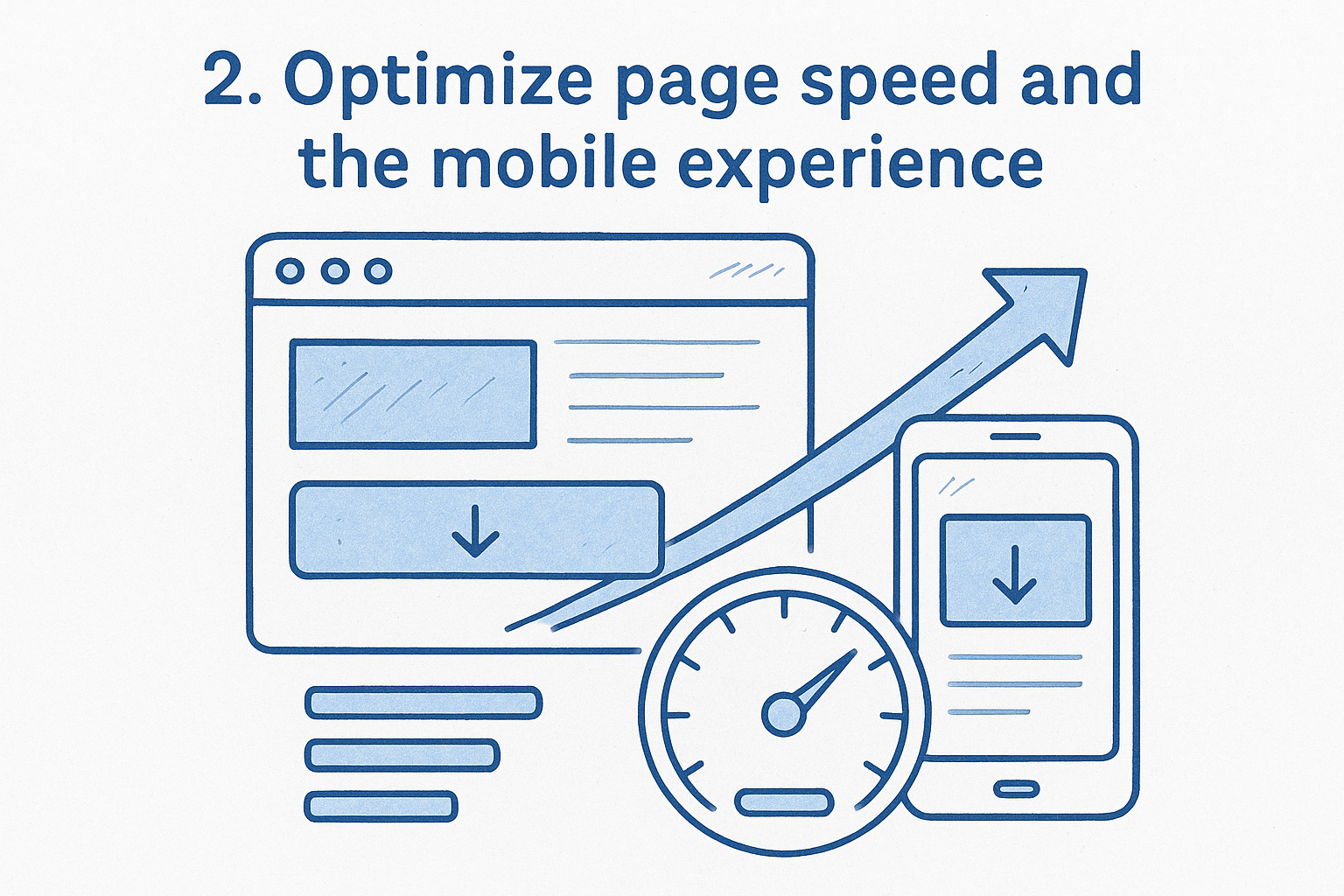
Slow-loading pages kill intake before a visitor ever sees your form. Most legal ad traffic now arrives on a phone, often from someone sitting in a parking lot or an ER waiting room, and a page that takes several seconds to load loses that person before your headline even renders. Landing page conversion rate optimization starts with speed because no amount of persuasive copy matters if the page never finishes loading.
Why it matters for law firm conversions
A prospective client searching for a DUI attorney at 11 p.m. isn't going to wait around. Mobile visitors tend to bail on slow or clunky pages faster than desktop visitors do, which means a page that performs fine on your office monitor can quietly be bleeding leads on the device most people actually use to find you.
If your landing page hasn't finished loading in the time it takes to glance at it, you've already lost the click.
How to apply it on a legal landing page
Check your page against a simple list before you launch any new campaign:
- Compress images and remove auto-playing video that isn't essential to the message.
- Use a mobile-first layout, not a desktop design that gets squeezed to fit a smaller screen.
- Make the phone number tappable and the form fields large enough to complete with a thumb.
- Test load time on an actual phone with cellular data, not just Wi-Fi in the office.
Common mistake to avoid
Firms often design the landing page on a desktop monitor, approve it there, and never test it on a phone before launch. If your hosted intake forms load slowly or misfire on mobile, fix that before you touch anything else on the page.
3. Make your practice-area value proposition obvious
A visitor who searched "medical malpractice attorney" and lands on a generic "personal injury lawyer" page immediately wonders if they're in the right place. Landing page conversion optimization for law firms depends on the visitor recognizing, within seconds, that this firm handles exactly their type of case. If the headline is vague or the page tries to serve every practice area at once, that recognition never happens.
Why it matters for law firm conversions
Legal problems are specific, and clients search that way. Someone dealing with a workplace injury wants a workers' comp attorney, not a general litigator. When your page mirrors the exact language of the ad that brought them there, you close the trust gap faster and get to the intake form sooner. This is where conversion rate optimization landing page work overlaps directly with your ad copy: the promise made in the ad has to be the first thing the visitor sees on the page.
A visitor should know within five seconds if your firm handles their exact type of case.
How to apply it on a legal landing page
Match page content to search intent with a few concrete moves:
- Mirror the ad's exact keyword phrase in the page headline.
- State the practice area, jurisdiction, and case type in the first sentence, not buried in a paragraph.
- Build a separate page per practice area rather than one page covering all of them, the way practice-area specific marketing is set up in GavelGrow's platform guides.
Common mistake to avoid
Running every campaign to a single "Contact Us" page is the most frequent offender here. It forces mismatched messaging on visitors and quietly raises your cost per signed case.
4. Shorten and simplify your intake form
Every field you add to an intake form is another reason for a visitor to give up before submitting. Name, phone, and a one-line description of the case are usually enough to start a conversation. Anything more, like asking for a full incident narrative or a preferred court date before you've even spoken to the person, belongs in a follow-up call, not the first form they see, and it's one of the most common places a firm's intake process breaks down. Landing page conversion rate optimization for legal intake almost always starts with cutting fields, not adding them.
Why it matters for law firm conversions
A prospective client filling out a form on their phone, often while stressed or in pain, will abandon a long form faster than a short one. Every extra field is a small decision point, and decision points cost you leads. This is especially true for landing page conversion optimization on mobile, where typing is slower and patience is shorter than on desktop.
The shorter the form, the more people finish it.
How to apply it on a legal landing page
Keep the form to what you actually need to start intake:
- Ask for name, phone number, and case type only, then move deeper questions to the call.
- Use a hosted intake form with carrier-level phone validation so bad numbers get caught before a case manager wastes time on them.
- Add a short consent line for SMS and calls, with a clear TCPA audit trail, rather than a dense legal paragraph nobody reads.
Common mistake to avoid
Don't copy your firm's general contact form onto a paid landing page. A form built for vendors and job applicants is not built for someone deciding whether to call a lawyer right now.
5. Add trust signals and case-relevant social proof
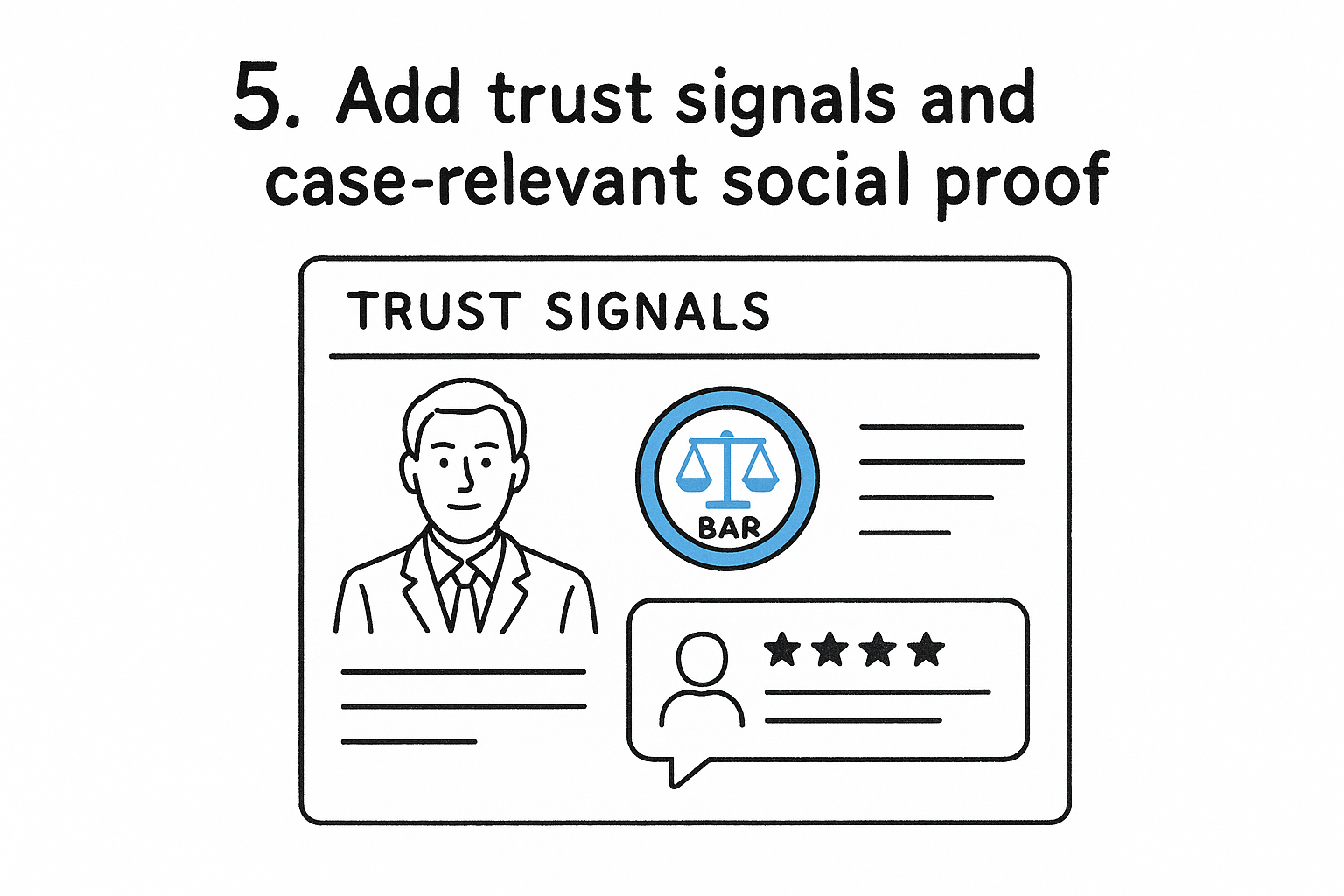
A visitor who has never worked with your firm needs a reason to believe you can actually help before they hand over their phone number. Trust signals that reassure prospective legal clients, like a bar association badge, years in practice, or a client review mentioning the exact type of case you handle, close that gap fast. This is where landing page conversion rate optimization stops being about layout and starts being about credibility.
Why it matters for law firm conversions
Someone searching for a truck accident lawyer at midnight is scared and doesn't know your firm from the next ad in the results. Seeing that other clients with similar cases got results, or that you're recognized by your state bar, moves them from browsing to acting. Generic stock photos and vague claims like "award-winning" do the opposite; they read as filler and slow the visitor down instead of reassuring them.
A specific client story about a case like theirs works harder than any stock photo ever will.
How to apply it on a legal landing page
Build trust with specifics, not decoration:
- Feature reviews that mention the practice area, not generic five-star praise.
- Show verifiable credentials: bar admissions, years handling that case type, notable results where your state bar allows it.
- Ask every client for a review, resolve complaints directly with the client, and follow ethical attorney reputation management practices when responding to public reviews rather than filtering who gets asked.
Common mistake to avoid
Don't stack unrelated testimonials, like a business law review on a personal injury page. It signals you handle everything a little, not one thing well, and always double-check what your state bar allows before publishing any results-based claim.
6. Track every call and lead back to its source page
Most legal leads still come in by phone, not by form, and if you can't tell which landing page or campaign generated that call, you're optimizing blind. Landing page conversion rate optimization only works if you can measure it, and measurement means tying every call, text, and form fill back to the retainer it produced and the exact page and ad behind it.
Why it matters for law firm conversions
Without call-level attribution, you're guessing which practice-area page is actually pulling weight. A page might look weak in your form-conversion numbers but be quietly generating most of your phone leads. Call tracking closes that blind spot by assigning a unique tracking number to each campaign or page, so every ring gets credited to the source that earned it.
If you can't trace a call back to its landing page, you're optimizing on half the data.
How to apply it on a legal landing page
Set up per-page attribution before you spend another dollar testing headlines:
- Assign a dedicated tracking number per source to each landing page or campaign, not one shared number across the whole site.
- Record and tag call outcomes as qualified, callback, unqualified, or spam so cost-per-lead numbers reflect real intake quality.
- Feed signed cases back into your Google Ads conversion tracking and bidding through Smart Conversions, so the campaigns producing real clients get more budget, not just more clicks.
Common mistake to avoid
Don't rely on form submissions alone to judge a page's performance. A page that drives phone calls but few form fills can look like a failure when it's actually your best performer, once you count every lead source instead of just one.
7. Test changes with A/B testing before you commit to them
Every tip above is a hypothesis, not a guarantee. A shorter form or a bolder headline might help your firm, or it might not, and the only way to know for sure is to run both versions against real traffic and let the leads decide. Landing page conversion rate optimization isn't a one-time project; it's a habit of testing the conversion fixes most worth trying one change at a time and keeping what works.
Why it matters for law firm conversions
Legal ad spend is expensive enough that guessing gets costly fast. A headline swap that seems obviously better in a meeting can quietly drop your qualified-lead rate for weeks before anyone notices. A/B testing protects you from that by putting the decision in front of actual prospective clients instead of the loudest opinion in the room.
Don't guess which version converts better. Test it and let the leads decide.
How to apply it on a legal landing page
Run tests with discipline, not guesswork:
- Change one element at a time, like the headline or the form length, so you know exactly what caused the shift.
- Split traffic evenly between versions and let each run long enough to collect a meaningful number of leads, not just a few days.
- Judge results by qualified leads and signed cases, not raw form-fill count, using outcome tags in your call tracking and lead pipeline.
Common mistake to avoid
Don't change five things at once and call it a test. Firms often redesign an entire page, see leads go up, and never learn which single change actually drove the result.
Putting these changes into practice
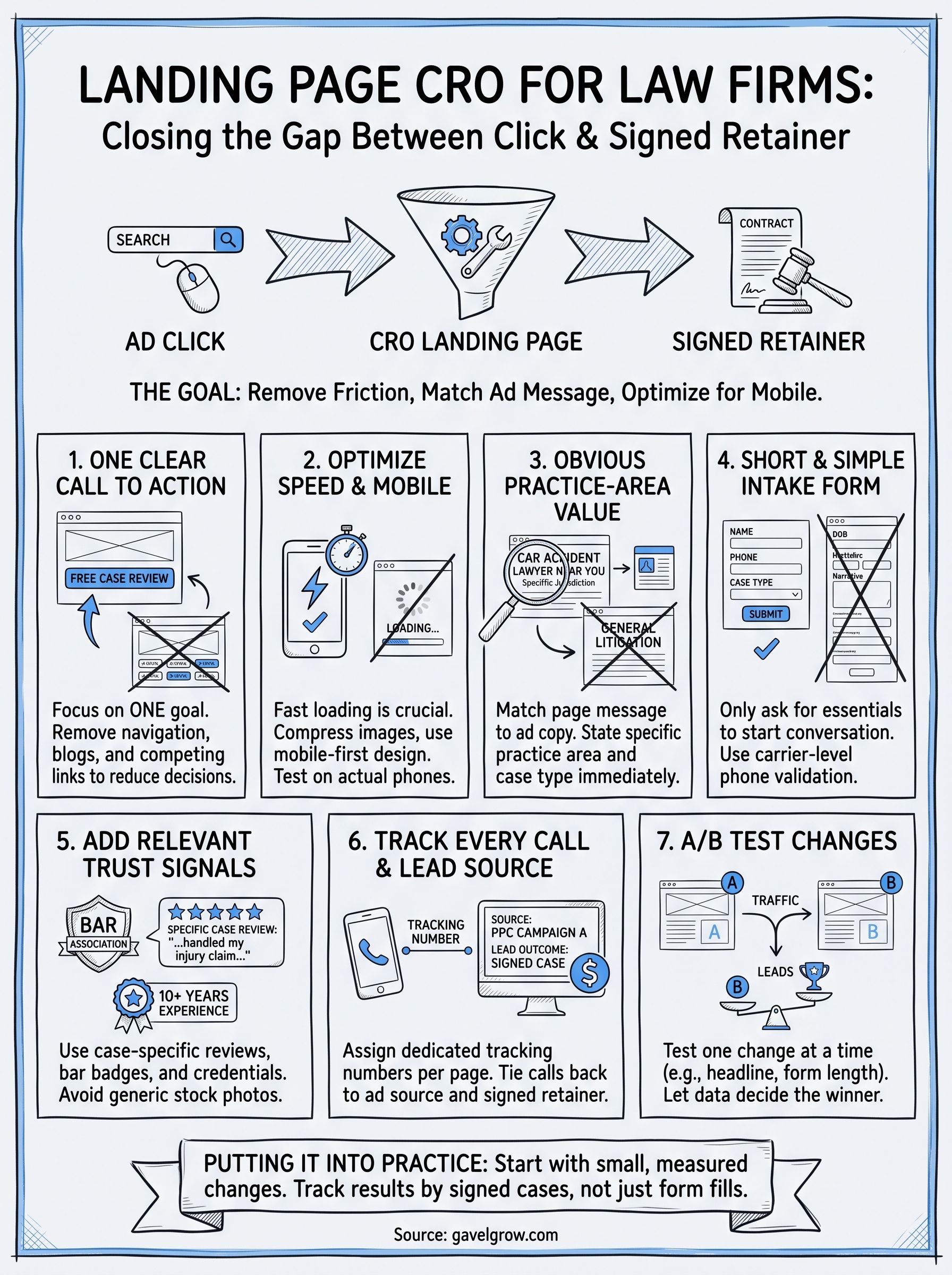
You don't need to tackle all seven tips this week. Pick the one costing you the most leads right now, whether that's a cluttered page with three competing calls to action or a form nobody finishes on a phone, and fix that first. Landing page conversion rate optimization works best as a sequence of small, measured changes, not a single redesign you launch and forget.
Once the obvious problems are handled, the harder work starts: tracking calls back to source pages, running real A/B tests, and reading results by signed cases instead of form fills. That's where most firms run out of time or tooling. If you'd rather have a legal-only team build and test these pages for you, with call tracking and attribution already wired in, see GavelGrow's CRO service for law firm landing pages and intake, which covers exactly this, from intake forms through lead-to-signed-case measurement.