Law Firm PPC Cost: What to Budget by Practice Area and Size
Categories: Legal Marketing Strategies
 Abram Ninoyan
Founder & Senior Performance Marketer
Credentials: Google Partner, Google Ads Search Certified, Google Ads Display Certified, Google Ads Measurement Certified, Google Analytics (IQ) Certified, HubSpot Inbound Certified, HubSpot Social Media Marketing Certified, Conversion Optimization Certified
Expertise: Google Ads, Meta Ads, Conversion Rate Optimization, GA4 & Google Tag Manager, Lead Generation, Marketing Funnel Optimization, PPC Management
LinkedIn Profile
If you run Google Ads for your law firm, you already know the bill can swing wildly from month to month. Law firm PPC cost depends on your practice area, your market, and whether you run campaigns you...
Key Takeaways
- Law Firm PPC Cost: What to Budget by Practice Area and Size
- Why does law firm PPC cost more than other industries?
- How much should you budget for PPC each month?
- Cost per click by practice area
Law Firm PPC Cost: What to Budget by Practice Area and Size
If you run Google Ads for your law firm, you already know the bill can swing wildly from month to month. Law firm PPC cost depends on your practice area, your market, and whether you run campaigns yourself or hand them to an agency. A personal injury firm in Los Angeles pays a different rate per click than a family law solo shop in a mid-size city, and that gap trips up a lot of managing partners building next year's marketing budget.
This article gives you a straight answer: what to expect in monthly ad spend, how cost-per-click ranges shift by practice area, and how agency pricing models compare to running campaigns in-house. You will not find made-up percentages here, just honest ranges and the variables that actually move your number up or down.
We will walk through budget benchmarks by practice area, break down flat-fee versus percentage-of-spend agency pricing, and show you where hidden costs like call tracking and intake tools quietly add to your real spend. By the end, you will have a realistic number to bring into your 2026 budget conversation, not a guess pulled from a sales pitch.
Why does law firm PPC cost more than other industries?
Legal keywords sit at the top of Google's cost-per-click charts, often several times higher than what a retailer or restaurant pays for the same click, which is why what law firms really pay for Google Ads surprises so many partners. That's not an accident of the auction. It reflects what a signed case is worth to your firm and how many other firms in your market are bidding for that same click.
High case value drives high bids
Google Ads runs on an auction, and every advertiser bids based on what a conversion is worth to them. A personal injury firm knows a single signed case can be worth tens of thousands of dollars, sometimes far more on a catastrophic injury or mass tort matter. That math lets a firm justify a bid of $75, $150, or more per click on a competitive term, because even a low intake-to-signed rate still pencils out. Practice areas with high case value push the whole auction higher, and every other firm bidding on that keyword pays the price of that competition, whether their average case is worth $5,000 or $500,000.
Compare that to an industry like home cleaning or pet grooming, where the lifetime value of a customer might be a few hundred dollars a year. Advertisers there simply cannot afford to bid what a law firm bids, so clicks in those industries stay cheap by comparison.
The keyword auction problem
Legal keywords are also crowded. In most metro areas, dozens of firms compete for the same handful of high-intent phrases: "car accident lawyer," "divorce attorney near me," "DUI lawyer." That density means the auction never cools off. Even a firm with a strong Quality Score, which lowers what you pay relative to competitors, still pays a premium simply because so many other bidders want the same click.
A law firm isn't paying for a click. It's paying for a shot at a case that could be worth six figures.
This is why law firm PPC cost benchmarks look nothing like benchmarks for other verticals. Any budget conversation that starts by comparing your legal cost per click to a general small-business average is starting from the wrong baseline.
Long, expensive client journeys
A law firm's sales cycle also runs longer than a typical e-commerce purchase. Someone searching for a divorce attorney or a criminal defense lawyer rarely signs on the first call. They might click your ad, browse your site, call twice, text once, and consult with two other firms before retaining anyone. Every one of those touchpoints costs money to support: the ad click itself, the intake staff time, the follow-up sequences that keep the lead warm.
Multi-touch journeys mean your cost per lead understates your real cost per case, and there are common mistakes in cost-per-lead math that make the gap look smaller than it is. A firm that only tracks cost per click or cost per lead is missing the intake attrition that happens between the click and the signature. That's a big reason firms move toward platforms that connect ad spend directly to signed cases rather than stopping the math at the lead stage. GavelGrow's ad-spend-to-signed-case tracking software was built around exactly this gap, tying every dollar of ad spend to whether a case actually got signed, not just whether a form got filled out.
Taken together, high case value, crowded auctions, and long client journeys explain why legal PPC sits at the expensive end of nearly every industry comparison you'll find. Understanding why the number is high is the first step to building a budget that actually accounts for it instead of fighting it.
How much should you budget for PPC each month?
Most managing partners ask this question backwards. They want a single number, but the honest answer starts with your practice area and market size, then adjusts from there. A solo family law practice in a secondary market and a mass tort shop running national campaigns are not playing the same game, and neither should budget the same way.
Minimum spend to get meaningful data
Google Ads needs volume to optimize. If you spend $500 a month on a competitive legal keyword, you might get two or three clicks a day, which is not enough data for the algorithm to learn who converts. Most firms need at least $3,000 to $5,000 a month in ad spend before Google's bidding systems have enough signal to start working in your favor. Below that threshold, you're often paying for impressions without ever collecting the volume needed to judge whether a campaign is actually working.
If your monthly ad spend can't buy enough clicks to learn from, you're not running a campaign, you're running an experiment with no data.
Budget ranges by firm size and market
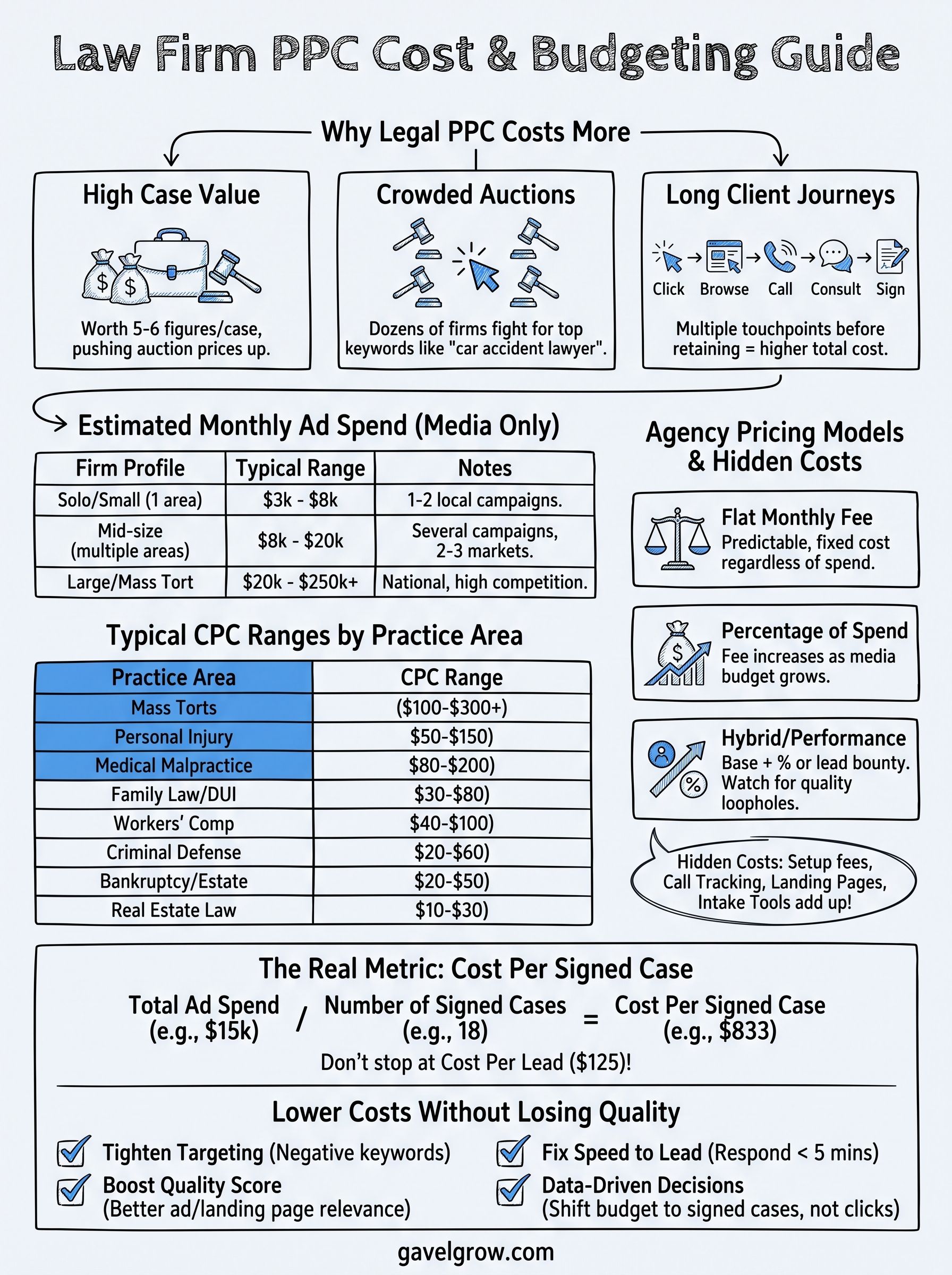
Once you clear that minimum, your realistic monthly ad spend scales with how competitive your practice area and metro area are, the same way your firm's overall marketing budget scales with revenue goals. These are broad, honest ranges, not guarantees, and your own numbers will move based on the variables covered later in this article.
Spend alone doesn't tell the whole story. On top of media spend, you're also paying for the platform or agency running the campaigns, whether that's a self-serve plan from $199 a month or a fully managed tier. GavelGrow's managed campaign management carries a $500-a-day media minimum specifically because that's roughly the floor where a firm's own campaigns start generating usable data, not because it's an arbitrary number pulled from a rate card.
Think of your total monthly commitment as two line items: your media budget, which goes straight into the ad auction, and your platform or management fee, which pays for the tooling and expertise that turns that spend into signed cases instead of wasted clicks.
Cost per click by practice area
Practice area is the single biggest lever on your cost per click, often bigger than your city or your Quality Score. Two firms bidding in the same metro can pay wildly different rates simply because one sells estate plans and the other signs car accident cases. Before you set a budget, you need to know roughly where your practice area sits on the spectrum, because a number that's healthy for a criminal defense firm would bankrupt a mass tort campaign in a week.
Where the highest and lowest CPCs land
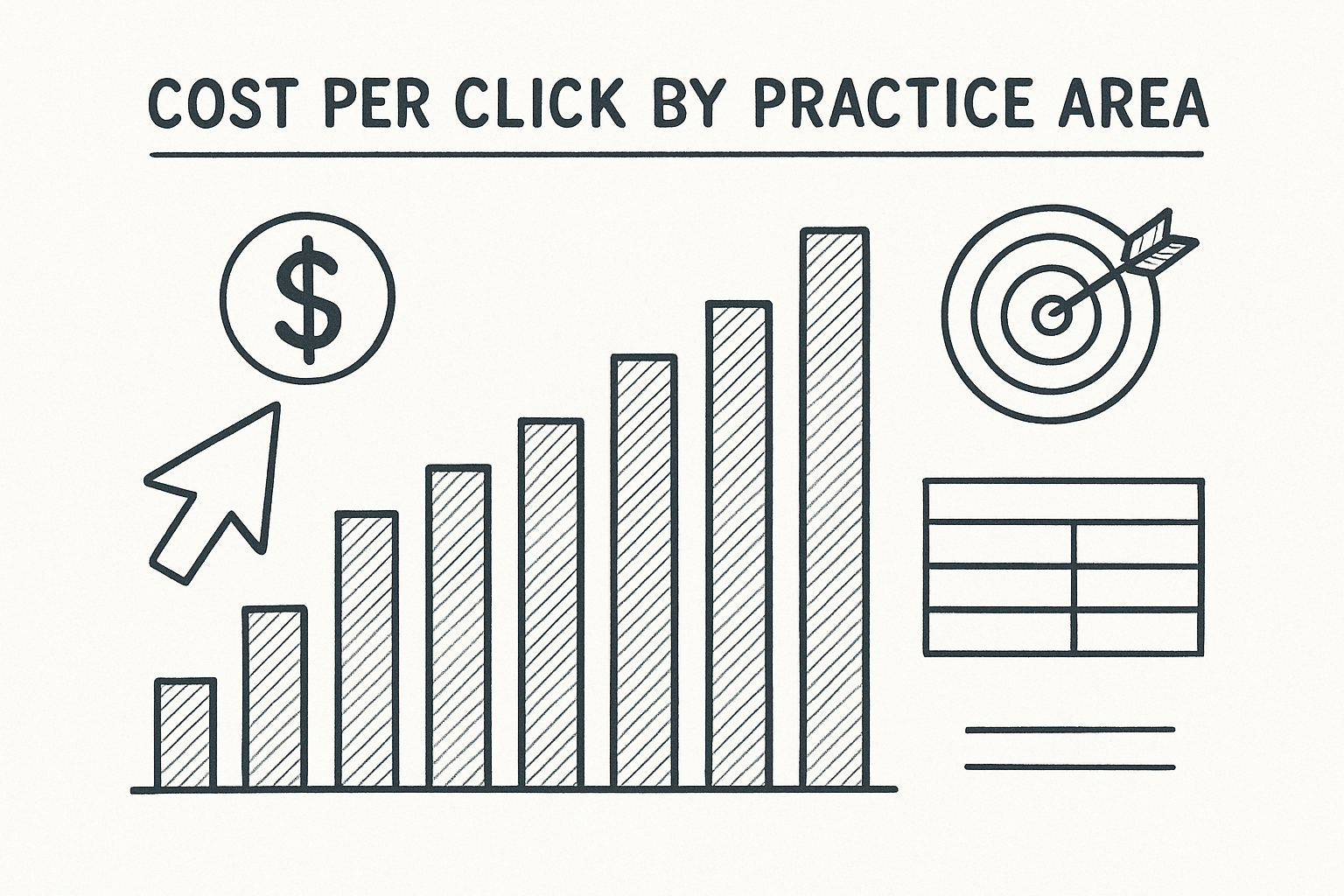
General, non-branded search terms behave differently across practice areas, and the gap between the top and bottom of the list is wide. These ranges reflect what firms typically see on competitive, non-branded keywords in mid-to-large U.S. markets. Your own numbers will move based on your city, your Quality Score, and how tightly you match ad copy to search intent.
Why mass tort and personal injury sit at the top
Questions about why one campaign costs triple another usually trace back to case value and national competition. Mass tort campaigns often bid nationwide against a small pool of well-funded firms, which keeps CPCs elevated even in smaller markets. Personal injury PPC costs follow close behind because nearly every metro area has multiple firms fighting for the same handful of high-intent terms.
A $250 click for a mass tort campaign and a $20 click for a real estate matter can both be a good deal, because you're not buying clicks, you're buying access to cases at different value tiers.
Lower-cost practice areas still add up
Cheaper doesn't mean cheap. Real estate and estate planning sit at the bottom of the range, but a firm running several campaigns across practice areas still needs a real monthly budget to see volume. If you're deciding which practice areas to prioritize with paid spend, GavelGrow's modelled benchmark ranges by practice area let you compare your own cost per lead and cost per signed case, so you're not budgeting blind.
Agency fees and pricing models that affect your total cost
Your media budget only tells half the story. On top of what you spend in the auction, you're paying someone (an agency, a freelancer, or a platform) to build, run, and optimize those campaigns, and that fee can swing your total monthly cost by thousands of dollars depending on the model. Before you sign anything, understand exactly how the fee is calculated, because two agencies quoting the same media budget can end up costing you very different amounts once you factor in their pricing structure.
The three common pricing models
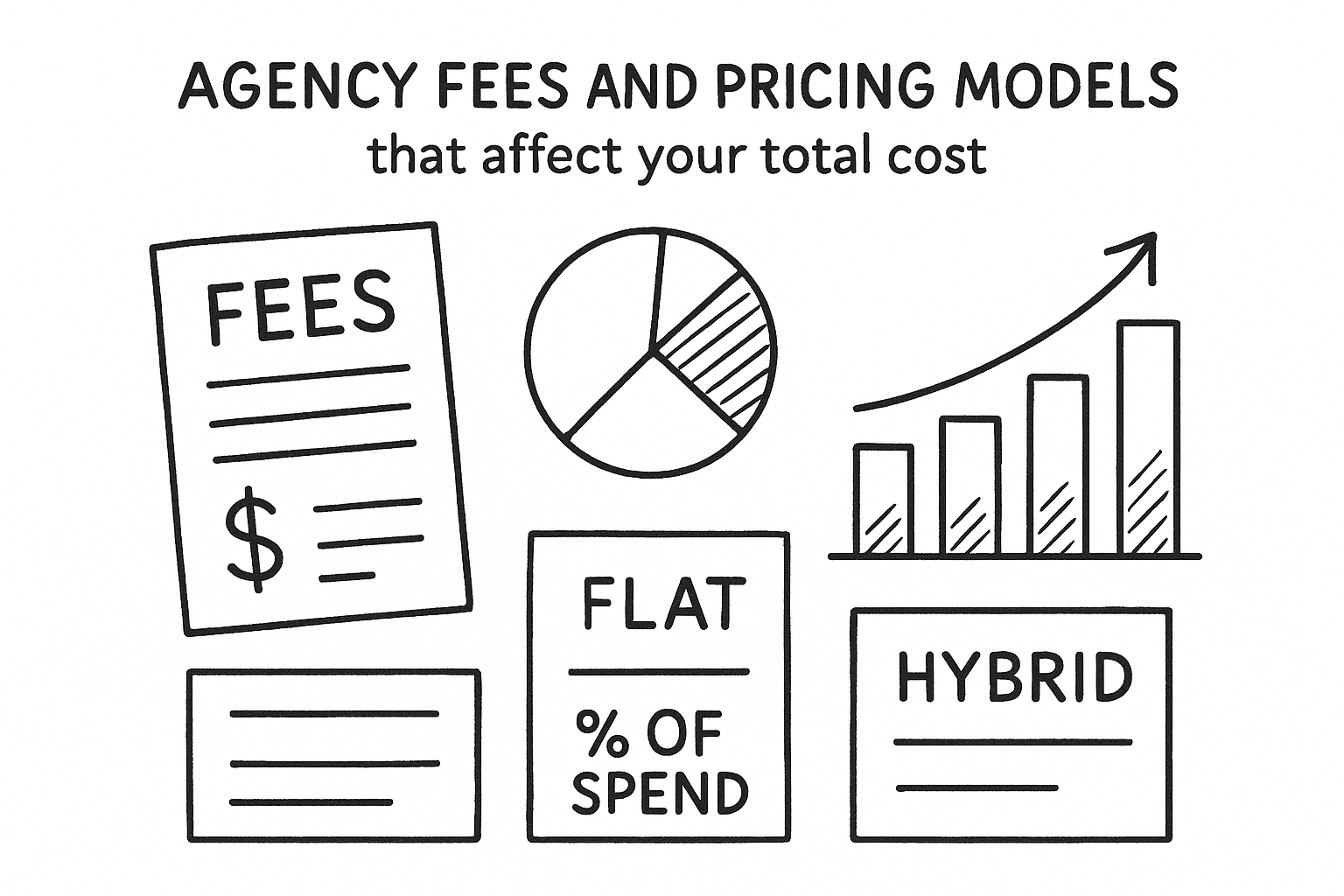
Agencies generally price their services one of three ways: a flat monthly fee, a percentage of ad spend, or a hybrid of the two. Percentage-of-spend pricing sounds simple, but it creates a built-in incentive problem: the agency earns more the more you spend, whether or not that extra spend produces more signed cases. Flat-fee pricing removes that conflict, since the fee stays the same whether your budget is $10,000 or $30,000 a month, which is why more firms are pushing agencies toward flat structures.
The best pricing model is the one that pays your agency for signed cases, not for spending your money.
Hidden costs that inflate the real number
Setup fees, minimum contract terms, and add-on charges for landing pages or call tracking often sit outside the headline number an agency quotes you, which is one of the ways agency retainers buy activity instead of signed cases. A firm that hears "$2,000 a month" and assumes that's the whole bill often finds a $500 setup fee and a separate call-tracking subscription tacked on within the first invoice. Reviewing a proposal line by line, not just the top-line fee, is the only way to compare offers honestly.
GavelGrow scopes its managed engagement on a strategy call rather than at a list price, with every platform feature, campaign management, and a named contact included rather than billed as extras. One relationship covers the platform and the management, which removes the guesswork of reconciling separate invoices for call tracking, intake tools, and reporting. If you're comparing legal PPC agencies on cost per signed case, ask each one to show you exactly what a $10,000-a-month media budget would cost all-in, fee included, before you commit.
How do you calculate cost per signed case?
Cost per lead, which runs anywhere from $55 to $600+ depending on practice area, is the easiest number to pull from any ad platform, but it's the wrong number to build a budget around. Cost per signed case is what tells you whether your PPC spend is actually working, because it accounts for every lead that never became a client. Two campaigns can post the same cost per lead and still deliver wildly different results once you follow the money through intake to a signed retainer.
The formula and what it captures
At its simplest, the cost-per-acquisition math is one division: total ad spend divided by the number of signed cases that spend produced. But getting a number you can trust means tracking every stage between the click and the signature, not just the first two.
Cost per signed case = Total ad spend / Number of signed cases
Example:
$15,000 monthly ad spend
120 leads generated
18 signed cases
Cost per lead = $15,000 / 120 = $125
Cost per signed case = $15,000 / 18 = $833
Notice how far apart those two numbers land. A firm that only reports cost per lead in its monthly meeting would call this campaign a bargain at $125 a lead. The real number, $833 per signed case, is the one that should drive whether you scale the campaign or pull the budget.
Cost per lead tells you what you paid for attention. Cost per signed case tells you what you paid for revenue.
Where firms get the math wrong
Many firms stop measuring at the lead stage because that's where their tools stop reporting. A call tracking system shows call volume, an intake form shows submissions, and neither one connects automatically to whether that person ever retained the firm. Without attribution that follows a click through to the retainer, you're guessing at which campaigns actually pay for themselves.
Spreadsheets built by hand rarely survive more than a quarter before someone stops updating them, and manual attribution breaks down fast once you're running campaigns across several practice areas or markets at once. This is exactly the gap GavelGrow's marketing dashboard was built to close: it ties every lead back to its originating campaign and carries that attribution through to a signed case, so your cost per signed case updates automatically instead of living in a spreadsheet someone forgot to touch.
Once you know your true cost per signed case by practice area, you have a number worth comparing against typical cost-per-signed-case ranges for law firms, and a real basis for deciding where to add budget and where to cut it.
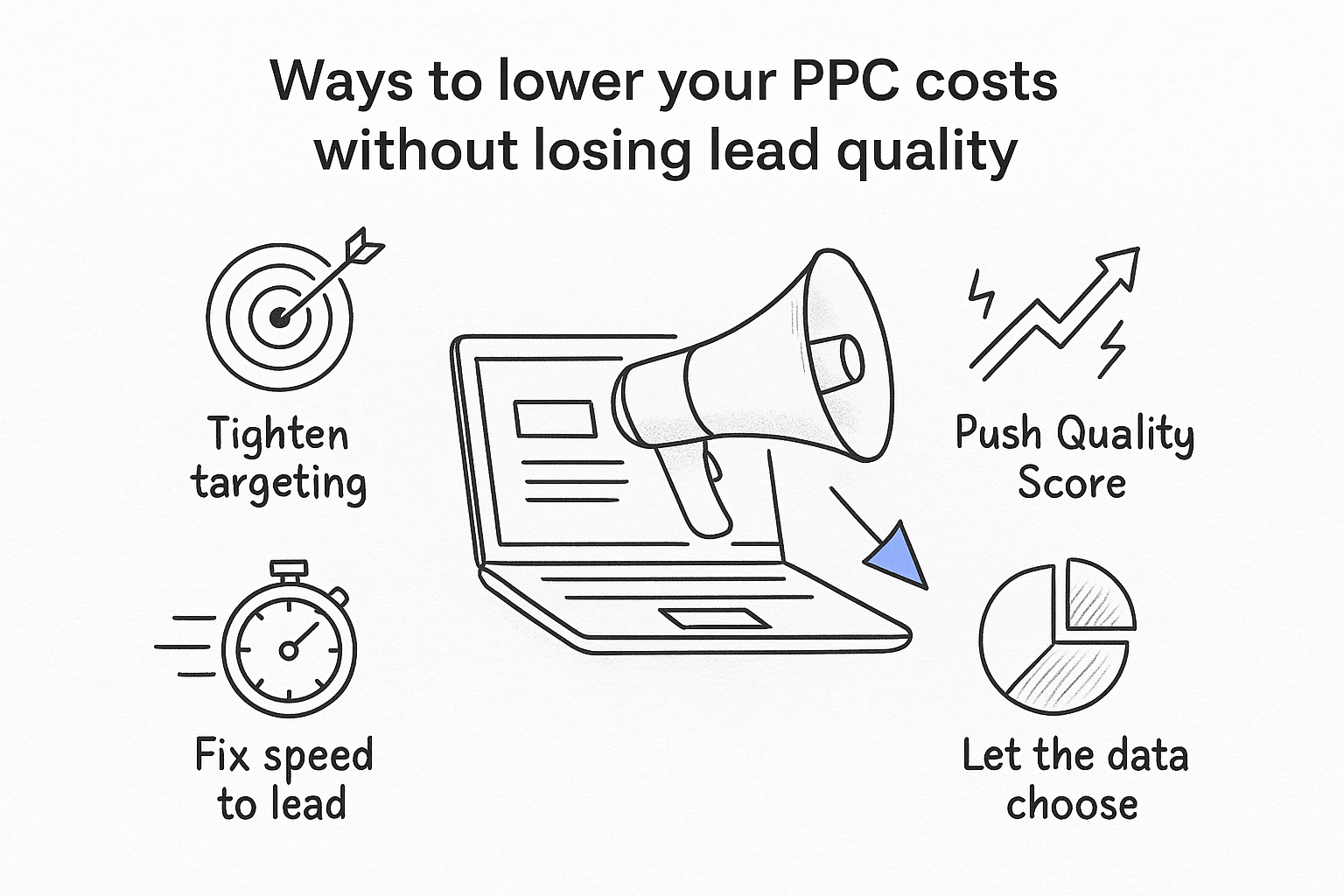
Ways to lower your PPC costs without losing lead quality
Cutting your client acquisition cost doesn't have to mean fewer leads or worse cases. Most firms overspend on the same three problems: loose keyword targeting, slow intake, and campaigns that optimize for clicks instead of signed retainers. Fix those before you touch your total budget, and you often free up money to reinvest in the channels already working rather than shrinking your presence altogether.
Tighten targeting before you touch your bid
Broad match keywords and thin negative keyword lists waste money on searches that were never going to convert. Someone searching "how to become a personal injury lawyer" or "free legal advice" clicks your ad and burns your budget without ever intending to hire anyone. Review your search terms report weekly, not monthly, and add negatives as soon as you spot irrelevant traffic. This single habit routinely cuts wasted spend by a noticeable margin without touching your bids at all.
Push Quality Score up instead of your budget
Google rewards ads that match searcher intent closely, and that reward shows up as a lower price per click, not just a better ranking. Landing pages that load fast, match the ad's promise, and speak directly to the practice area searched all push Quality Score higher. Improving these factors is often cheaper than raising your bid, and the savings compound across every click you buy afterward.
Raising your budget is the expensive fix. Raising your Quality Score is the free one.
Fix speed to lead first
Teams often chase cheaper clicks when the real leak is what happens after the click. The Lead Response Management Study found that leads contacted within five minutes are far more likely to be qualified than those first reached thirty minutes later, which means a slow intake team can quietly waste every dollar you spend on ads no matter how cheap the click was. Speed to lead and mobile-friendly intake forms matter more to your total cost than another round of bid adjustments, and they explain most cases of high traffic but no signed cases. GavelGrow's built-in intake sequences fire within 60 seconds of a lead landing, which closes that gap automatically instead of relying on staff to notice a new form submission.
Let the data choose where budget goes
Here's a short checklist worth running every month before you decide where to trim or add spend:
- Pause campaigns whose cost per signed case sits above your practice-area range
- Shift budget toward the keyword groups producing the most retainers, not the most clicks
- Test one new ad variation per campaign instead of rewriting everything at once
- Recheck negative keywords after every algorithm or landing page change
Extending your reporting past cost per lead into conversion tracking and case outcomes, which GavelGrow's marketing dashboard handles automatically, is what turns these cuts into real savings instead of guesses.
Frequently asked questions
How much does law firm PPC cost per month on average?
A reasonable planning range for a solo or small firm is $3,000 to $8,000 a month on media alone; mid-size firms running several practice areas often plan between $8,000 and $20,000; large firms in competitive metros and mass tort campaigns can run well past $50,000. These cover ad spend only, not the platform or agency fee that manages the campaigns. Your actual number depends heavily on practice area and market size, so treat these as a starting point rather than a target for your firm.
What is a good cost per click for a law firm?
There's no single "good" number, because cost per click varies enormously by practice area. A $20 click on real estate law terms and a $150 click on personal injury terms can both be reasonable, depending on what a signed case is worth in that practice area. Instead of chasing a lower CPC in isolation, judge your campaigns against cost per signed case within your own practice area range. A cheap click that never turns into a client is worse than an expensive click that does.
Should my firm run PPC in-house or hire an agency?
It depends on whether you have staff who can manage bids, write ad copy, and review search terms weekly. Firms with in-house marketing capacity often do well on self-serve tools starting around $199 a month, adding their own labor cost. Firms without that bandwidth usually get more consistent results from a managed engagement, where a dedicated team builds and runs campaigns for a fee scoped to the firm plus media spend. Either path works if someone is actively watching performance, not just letting campaigns run unattended.
Why is my cost per lead low but my cost per signed case high?
This usually means your ads are attracting clicks but your intake process is losing prospects before they sign. Slow response times, unanswered calls, and clunky intake forms all widen the gap between a cheap lead and an expensive signed case. Before cutting your ad budget, audit how fast your team responds to new leads and how many calls go to voicemail. Fixing intake often closes this gap faster than adjusting your campaigns.
How long before PPC campaigns start producing signed cases?
Most campaigns need several weeks to gather enough click and conversion data for Google's bidding algorithm to optimize effectively, and legal sales cycles add more time on top of that. A personal injury case might sign within a few weeks of the first click, while a business law matter can take months. Give a new campaign at least 60 to 90 days before judging its true cost per signed case, since early data rarely reflects steady-state performance.
Do I need call tracking to measure PPC cost accurately?
Yes, if a meaningful share of your leads call instead of filling out a form. Without call tracking tied to specific campaigns and keywords, you're measuring only part of your funnel and likely underestimating which campaigns actually work, so it's worth reviewing CallRail plans, add-ons, and real monthly cost before you choose a tool. Per-campaign tracking numbers let you connect a phone call back to the exact keyword or ad that generated it, which is essential for calculating an honest cost per signed case rather than guessing at attribution.
Building a PPC budget you can defend
A defensible law firm PPC cost budget starts with your practice area's real CPC range, adds a media minimum that actually generates data, and never stops measuring at cost per lead. The firms that waste money aren't the ones spending the most, they're the ones who can't explain why their number is what it is. Once you know your cost per signed case by practice area, every budget conversation gets easier, because you're defending a number backed by math instead of a gut feeling pulled from last year's invoice.
You don't have to build that tracking system by hand or guess at your next move. If you want a second set of eyes on your current spend and where it's leaking between click and signature, see GavelGrow's managed Google Ads for law firms and what a realistic budget looks like for your practice area and market.
Frequently Asked Questions
How much does law firm PPC cost per month on average?
A reasonable planning range for a solo or small firm is $3,000 to $8,000 a month on media alone; mid-size firms running several practice areas often plan between $8,000 and $20,000; large firms in competitive metros and mass tort campaigns can run well past $50,000. These cover ad spend only, not the platform or agency fee that manages the campaigns. Your actual number depends heavily on practice area and market size, so treat these as a starting point rather than a target for your firm.
What is a good cost per click for a law firm?
There's no single "good" number, because cost per click varies enormously by practice area. A $20 click on real estate law terms and a $150 click on personal injury terms can both be reasonable, depending on what a signed case is worth in that practice area. Instead of chasing a lower CPC in isolation, judge your campaigns against cost per signed case within your own practice area range. A cheap click that never turns into a client is worse than an expensive click that does.
Should my firm run PPC in-house or hire an agency?
It depends on whether you have staff who can manage bids, write ad copy, and review search terms weekly. Firms with in-house marketing capacity often do well on self-serve tools starting around $199 a month, adding their own labor cost. Firms without that bandwidth usually get more consistent results from a managed engagement, where a dedicated team builds and runs campaigns for a fee scoped to the firm plus media spend. Either path works if someone is actively watching performance, not just letting campaigns run unattended.
Why is my cost per lead low but my cost per signed case high?
This usually means your ads are attracting clicks but your intake process is losing prospects before they sign. Slow response times, unanswered calls, and clunky intake forms all widen the gap between a cheap lead and an expensive signed case. Before cutting your ad budget, audit how fast your team responds to new leads and how many calls go to voicemail. Fixing intake often closes this gap faster than adjusting your campaigns.
How long before PPC campaigns start producing signed cases?
Most campaigns need several weeks to gather enough click and conversion data for Google's bidding algorithm to optimize effectively, and legal sales cycles add more time on top of that. A personal injury case might sign within a few weeks of the first click, while a business law matter can take months. Give a new campaign at least 60 to 90 days before judging its true cost per signed case, since early data rarely reflects steady-state performance.
Do I need call tracking to measure PPC cost accurately?
Yes, if a meaningful share of your leads call instead of filling out a form. Without call tracking tied to specific campaigns and keywords, you're measuring only part of your funnel and likely underestimating which campaigns actually work, so it's worth reviewing CallRail plans, add-ons, and real monthly cost before you choose a tool. Per-campaign tracking numbers let you connect a phone call back to the exact keyword or ad that generated it, which is essential for calculating an honest cost per signed case rather than guessing at attribution.