Local SEO Services Pricing: What Law Firms Should Expect
Categories: Legal Marketing Strategies
 Abram Ninoyan
Founder & Senior Performance Marketer
Credentials: Google Partner, Google Ads Search Certified, Google Ads Display Certified, Google Ads Measurement Certified, Google Analytics (IQ) Certified, HubSpot Inbound Certified, HubSpot Social Media Marketing Certified, Conversion Optimization Certified
Expertise: Google Ads, Meta Ads, Conversion Rate Optimization, GA4 & Google Tag Manager, Lead Generation, Marketing Funnel Optimization, PPC Management
LinkedIn Profile
Local SEO services pricing typically runs from $500 to $5,000 or more a month, and the number that fits your firm depends on your market size, competition, and whether you want ongoing management or a...
Key Takeaways
- Local SEO Services Pricing: What Law Firms Should Expect
- Why local SEO pricing varies so much for law firms
- How to evaluate a local SEO pricing quote for your firm
- What drives local SEO costs in competitive practice areas
Local SEO Services Pricing: What Law Firms Should Expect
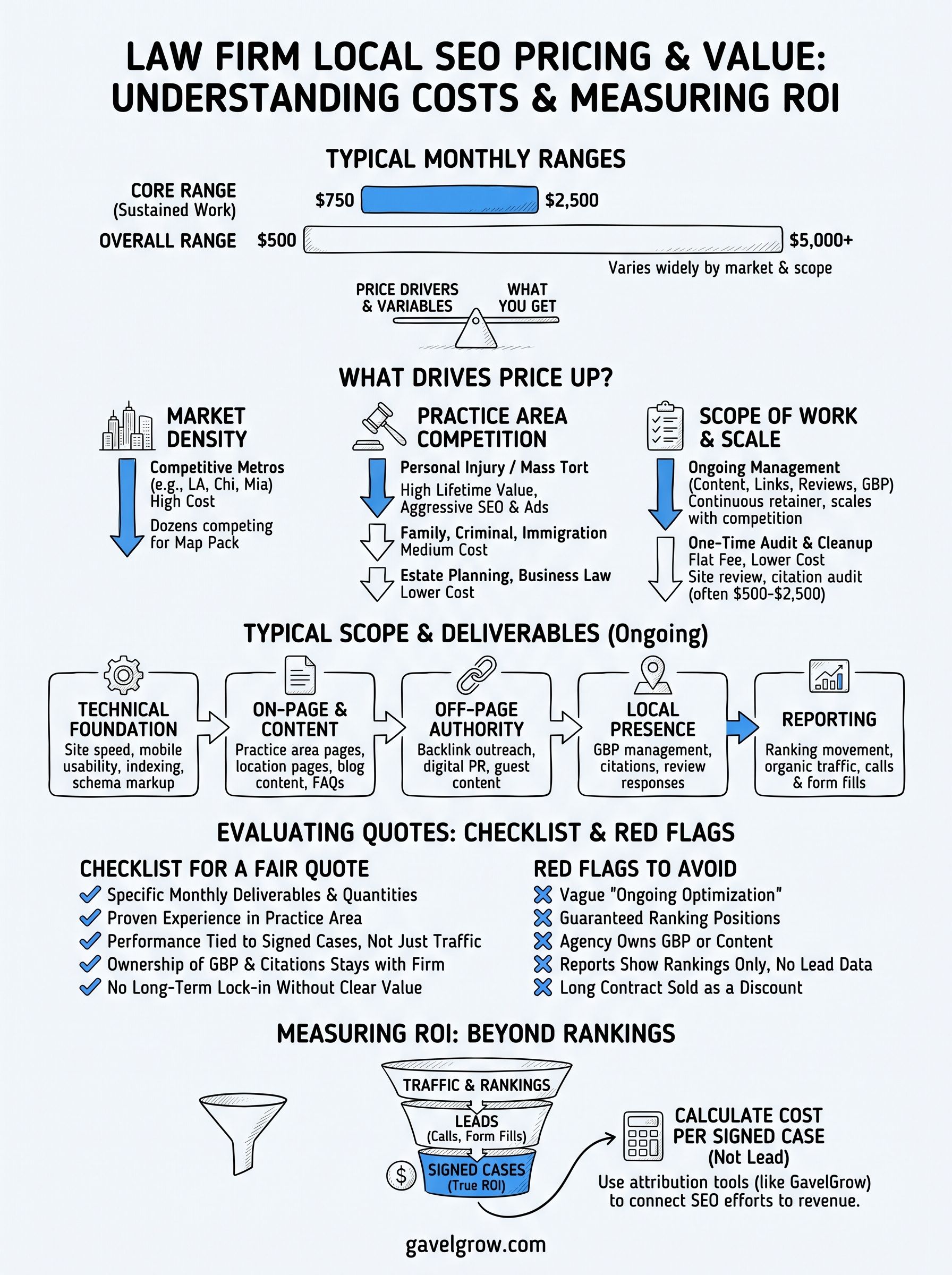
Local SEO services pricing typically runs from $500 to $5,000 or more a month, and the number that fits your firm depends on your market size, competition, and whether you want ongoing management or a one-time audit. Most solo and small firms land in the $750 to $2,500 range for sustained Google Business Profile work, citation cleanup, and content, while firms in dense metro markets with heavy personal injury or mass tort competition often pay more.
If you're comparing quotes right now, the real question isn't just the sticker price. It's what's actually included, how results get measured, and whether the agency understands legal marketing well enough to avoid generic templates that ignore how long a case actually takes to close. This article breaks down the cost ranges by scope, what drives price up or down, and the red flags that signal an agency is charging for busywork instead of signed cases.
We'll also cover how to judge ROI beyond rankings, since a firm that ranks well but can't turn calls into retainers is still losing money, and how attribution tools like GavelGrow's platform help you see which local SEO efforts actually produce signed cases, not just traffic.
Why local SEO pricing varies so much for law firms
Ask five agencies for a local SEO quote and you'll get five different numbers, sometimes for what looks like the same scope of work. That's not agencies padding invoices at random. It's because local SEO pricing responds to real variables: your market size, your practice area's competitiveness, how much technical cleanup your site needs, and whether you're buying a one-time project or ongoing management. A solo estate planning attorney in a mid-size suburb and a mass tort firm competing nationally are not buying the same product, even if both call it "local SEO."
Market density is usually the biggest driver. Competitive metro markets like Los Angeles, Chicago, or Miami have dozens of firms competing for the same map-pack rankings, which means agencies need more link-building, more content, and more review-generation work to move the needle. A firm in a mid-size market with fewer competitors can often see meaningful ranking improvement with a lighter monthly scope. Agencies price accordingly, and that's a legitimate reason for the spread you'll see between quotes, not a sign that someone's overcharging.
The number on a local SEO quote means nothing until you know exactly what work it buys and how competitive your specific market and practice area actually are.
Practice area competition changes the math
Personal injury and mass tort are the most expensive practice areas to rank for in almost every market, because the client lifetime value is high enough that firms pour money into SEO and paid ads simultaneously. Family law, criminal defense, and immigration tend to sit in the middle. Estate planning and business law are usually the least competitive, which shows up directly in what agencies charge to rank you locally. If you're comparing your quote to a friend's quote at a different firm, check whether you're even in the same competitive tier before assuming one of you is getting a bad deal.
Scope of work is the other half of the equation
A one-time technical SEO audit for law firm websites and citation cleanup might run a flat fee in the low four figures. Ongoing monthly management, which includes content production, Google Business Profile optimization, link-building, and review management, is priced as a retainer because it's continuous work, not a deliverable you check off once. Here's roughly how the major scope categories break down:
Notice that ongoing management is where most of the price variation lives, because it's the category that scales with market competitiveness and how aggressively you want to grow.
In-house tools versus agency-run programs
How you're structured internally also affects what you should expect to pay. Firms that already have marketing staff and just need better tooling, like call tracking, intake forms, and reporting that ties leads back to signed cases, often do better buying a legal marketing platform directly rather than paying an agency markup on top of tools the agency itself doesn't build. GavelGrow's self-serve marketing software exists for exactly this reason: firms running their own SEO and paid campaigns still need attribution and intake infrastructure, and buying that separately from three vendors gets expensive fast. Firms that want the strategy and execution handled for them are better served by a managed marketing engagement run by a legal-only team, where the SEO work, the reporting, and the platform are one subscription instead of a patchwork of tools that don't talk to each other.
Understanding these variables before you start collecting quotes puts you in a much stronger position to tell whether a price is fair for your specific situation, or whether you're being quoted for a competitive market and mass tort-level effort when your firm actually needs neither.
How to evaluate a local SEO pricing quote for your firm
Getting a number from an agency is the easy part. Knowing whether that number is fair takes a checklist, not a gut feeling. Before you sign anything, get the agency to answer specific questions in writing, not vague reassurances about "driving traffic" or "boosting visibility." A firm evaluating local seo services pricing should treat every quote as a scope document first and a price second, the same discipline that applies when shortlisting local SEO services near you.
Start by asking what deliverables you get each month, not just what activities happen. "We'll optimize your Google Business Profile" tells you nothing. "We'll publish four GBP posts, respond to every review within 48 hours, and add three new citations" tells you what you're paying for. Ask for a sample report from an existing client, with names redacted, so you can see whether their reporting shows rankings only or ties back to calls and leads.
A quote is only useful once you know exactly what deliverables it buys each month, not just the dollar figure at the top.
Questions to ask before you sign
Run every quote through the same set of questions. If an agency can't answer these clearly, that's information too.
- What specific deliverables happen monthly, and how many of each?
- Do you have experience with my specific practice area, and can you show results?
- How do you measure success, rankings, calls, or signed cases?
- What happens to my Google Business Profile and citations if I cancel?
- Is content written specifically for my firm, or repurposed across clients?
- What's the contract length, and is there a cancellation fee?
Compare scope, not just the sticker price
Once you have answers, line quotes up side by side. Two agencies quoting $1,500 a month can represent completely different amounts of actual work, so compare law firm marketing agencies head to head, because the cheaper number sometimes hides a thinner scope rather than a better deal. Pay attention to whether content production is included or billed separately, since a content strategy built to rank is often the line item agencies quietly reduce to hit a lower headline price. Also check ownership: your Google Business Profile, website, and citations should stay in your firm's name and accounts, never locked inside an agency's login credentials.
Ownership matters more than most firms realize until they try to switch agencies. Firms that lose access to their own GBP listing or citation logins after a bad breakup end up paying twice, once for the original work and again to rebuild what should have been theirs the whole time. This is the same principle behind why GavelGrow keeps ad accounts in the firm's own name rather than the agency's, on both the self-serve platform and managed engagements: whatever you're paying for should belong to your firm, not to whoever you're paying.
Finally, ask what happens after the initial contract term. Some agencies quote an attractive introductory rate that jumps significantly at renewal, so get the full pricing structure in writing before you commit, not just the number in the first email.
What drives local SEO costs in competitive practice areas
Market size explains part of the price gap between quotes, but practice area competitiveness explains the rest, and it explains more of it than most firm owners expect. Two firms in the same city can pay wildly different amounts for local SEO simply because one practices personal injury and the other handles wills and trusts. Understanding what actually drives cost inside a competitive practice area helps you spot when a quote is priced fairly and when it's priced for a fight you're not actually in.
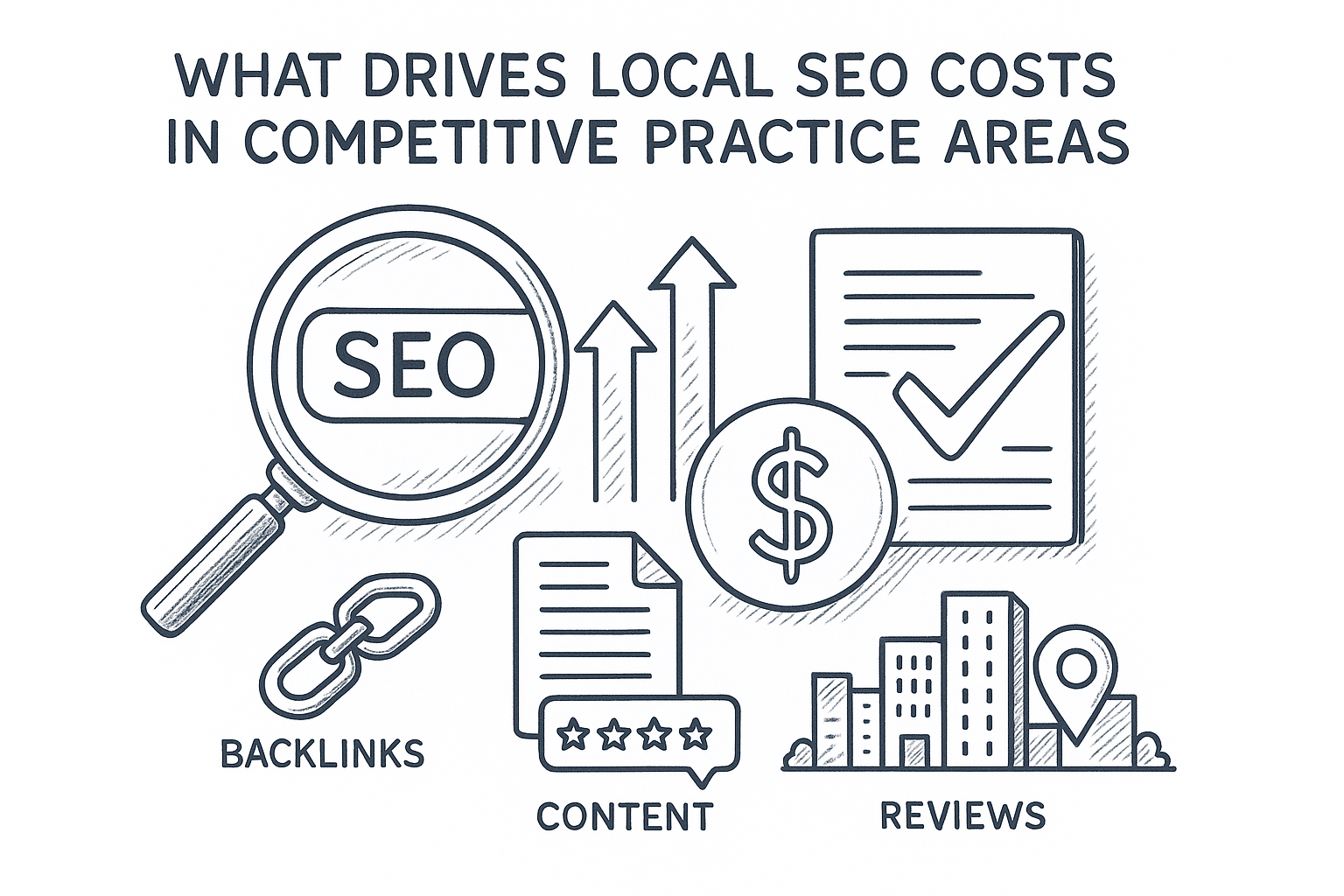
Backlink competition is the single biggest cost driver in crowded practice areas. Ranking a personal injury or mass tort site in a major metro often requires sustained, high-quality link acquisition for personal injury law firm SEO, and quality links take real time and relationships to earn. Agencies charge more in these practice areas because the work genuinely takes more hours, not because they've decided personal injury firms can afford it. Family law and criminal defense sit in a middle tier where link building matters but the arms race is less extreme.
The higher the practice area's competition, the more of your monthly fee goes toward link building and content depth, not toward the basics every firm needs regardless of niche.
Content depth and volume scale with competition
Competing practice areas also require more content, and not just more blog posts. Ranking a competitive personal injury page usually means comprehensive location and case-type pages, FAQ content addressing every angle a searcher might type, and regular publishing to keep pace with competitors doing the same. Content production at that volume costs more to produce well, and agencies that quote low for a competitive practice area are usually cutting corners here first, since content is easy to under-deliver without a client noticing right away.
Review volume and multi-location complexity add up fast
Review velocity is another factor searchers rarely think about until they see the numbers. Ranking in a competitive local map pack usually means outpacing competitors' review counts, not just collecting a handful of five-star reviews once. Firms should always ask every client for a review, resolve any complaints directly with the client rather than trying to filter who gets asked, and respond professionally to every public review, since Google's own review policies prohibit incentivizing or gatekeeping reviews. Multi-location firms multiply this cost further, since each office needs its own Google Business Profile optimization, which is what a Google Business Profile management service actually covers, plus its own local citations and often its own localized content, which is why a firm with five offices in a competitive practice area should expect a materially higher quote than a single-location firm in the same city.
When you're comparing local seo services pricing across quotes, ask specifically how each agency scales its work for your practice area's competitiveness. A generic answer here is a warning sign that the quote wasn't built for your firm at all.
What's included in a typical law firm SEO package
Once you understand what drives cost, the next question is what you're actually buying each month. A typical SEO package for a law firm bundles several distinct workstreams, and knowing what belongs in each one helps you spot when a quote is missing pieces or padding others. Most legitimate packages fall into four buckets: technical foundation, on-page and content, off-page authority, and local presence management. Skipping any one of these usually shows up as a stalled ranking within a few months, even if the other three are done well.
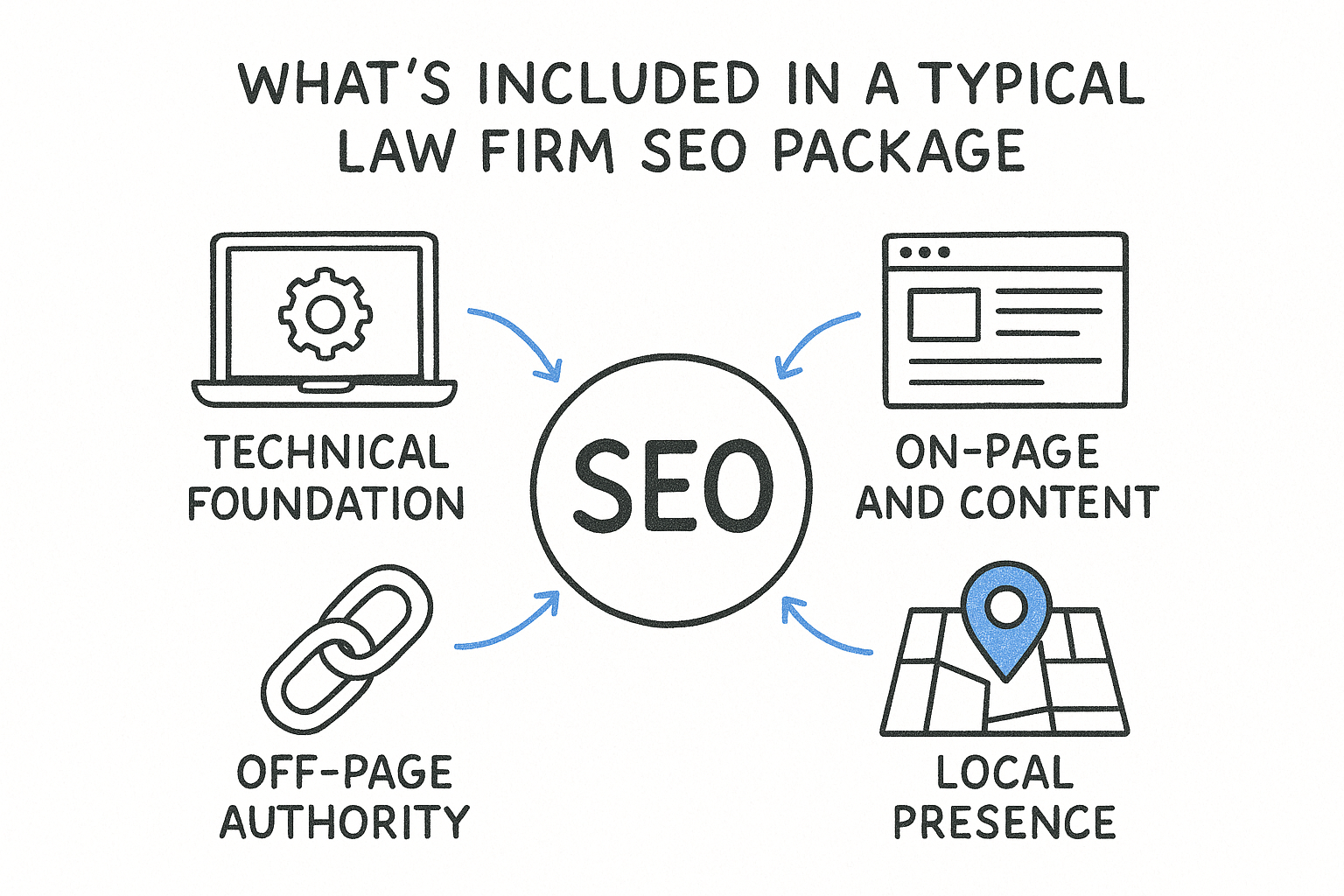
A package that only touches one of these four buckets isn't a local SEO program, it's a partial fix dressed up as one.
The four core components
Here's how the standard components map to what you should expect in a monthly report:
Reporting is part of the package, not an add-on
Reporting deserves its own line item, even though agencies rarely price it separately. A firm paying for local seo services pricing in the $1,000 to $2,500 range should get a monthly report showing ranking movement, organic traffic, and, ideally, which pages generated calls or form fills. Anything less than that leaves you guessing whether the spend is working. Google's own guidance on how Search ranks results makes clear that content quality and site experience both factor into visibility, so a package that only touches keywords and ignores site experience is incomplete by Google's own standard.
Where attribution tools fill the gap agencies leave open
Separately from the SEO work itself, most agencies stop reporting once a call comes in. They can tell you a page ranked and generated a phone call, but not whether that call became a signed case. That gap is exactly why firms pair SEO spend with a platform that tracks the full path from click to retainer. GavelGrow's marketing dashboard connects call tracking, intake, and case management for attribution from the first organic click to the signed retainer, so you can see which SEO pages actually produce signed cases, not just leads that never went anywhere. Without that layer, you're left trusting an agency's word that rankings translate to revenue, which is a hard position to negotiate future budget from.
Typical local SEO price ranges for law firms
Numbers help you sanity-check a quote once you understand what drives them, so here's what firms actually pay in practice. These ranges assume ongoing monthly management, not a one-time audit, and they shift based on the market and practice-area factors covered above. Local SEO services pricing clusters into a few predictable bands once you sort firms by size and competitiveness.
A quote that falls outside these ranges isn't automatically wrong, but it should come with a clear explanation of why your firm's situation is different.
Price bands by firm size and market
Use this table as a starting reference point when you're collecting quotes, not as a hard rule. Your specific market and practice area can push you toward either end.
Quotes below the low end of your band usually mean a thinner scope, often less content or slower link acquisition, rather than a genuinely better price. Quotes above the high end aren't automatically a rip-off, but they should come with a scope that visibly justifies the number, not just a claim of "premium service."
Why the top of the range keeps climbing
Ranges keep expanding at the top because competitive metro markets and high-value practice areas never stop requiring more work to hold position, let alone gain it. A mass tort firm competing nationally isn't just paying for SEO, it's paying to outpace dozens of other firms doing the exact same thing simultaneously, which pushes monthly retainers well past what a single-location family law practice would ever need to spend.
Self-serve firms sometimes assume a bigger budget always means a bigger agency team, but that's not always true. Many firms in the upper ranges are actually paying for volume of output, more pages, more links, more review responses, not necessarily more strategic thinking. If your firm already has marketing staff and just needs the infrastructure to track what's working, a platform like GavelGrow's Optimize plan at $599 a month can handle attribution and intake without adding agency markup on top of your SEO spend. Whichever band your firm falls into, treat the number as a starting point for negotiation, not a fixed price you have to accept as-is.
How to avoid overpaying for local SEO services
Overpaying rarely happens because a firm gets tricked by one bad number. It happens gradually, through contract terms nobody read closely, tools that duplicate what you already own, and vague deliverables that never get questioned month after month. Once you know what to look for, avoiding these traps takes discipline, not luck.
Beware long-term contracts sold as a discount. Agencies often offer a lower monthly rate in exchange for a 12-month lock-in, but that discount only pays off if the work stays good the whole time. If you're locked in and results stall in month four, you have no leverage until the contract ends. Ask for month-to-month terms first, and treat any agency that refuses as a signal they're not confident their own work will hold up to scrutiny.
Locking in a discount for a year only makes sense if you're also locking in the right to walk away when the work stops delivering.
Red flags that mean you're paying for busywork
Certain patterns show up again and again in overpriced local SEO contracts, and they overlap closely with the expensive mistakes firms make when hiring a legal marketing firm. Watch for these specifically:
- Reports that show ranking movement but never mention calls, form fills, or signed cases
- Vague monthly deliverables like "ongoing optimization" with no specific count of posts, links, or citations
- Content that reads like it was written for any small business, not a law firm in your practice area
- Guarantees of a specific ranking position, which no legitimate agency can promise and which some state bars flag as a compliance issue
- Ownership of your Google Business Profile or citations sitting under the agency's login instead of yours
Any one of these on its own might have an explanation. Two or more together usually means you're funding activity, not results, which is exactly how agency retainers get spent without producing cases.
Stop paying twice for the same infrastructure
Duplicate spend is the quietest way firms overpay. A firm might pay an agency for SEO, a separate vendor for call tracking, another tool for intake forms, and a fourth subscription just to stitch the reporting together. Each piece looks reasonable alone, but the combined bill often exceeds what a single connected platform would cost, and none of those tools talk to each other well enough to show which SEO page actually produced a signed case. Consolidating that stack is exactly what GavelGrow's platform is built to do, whether you're running SEO in-house on the self-serve tiers or letting the managed team handle the whole program under one subscription.
Before renewing any local SEO contract, add up everything you're currently paying across agencies and tools, then ask whether a consolidated option would cost less while giving you clearer attribution. Firms that do this audit once a year rarely find their current setup is the cheapest path to the same result.
How to measure ROI on your local SEO spend
Rankings feel like progress, but they're not revenue. A firm can climb to the top of the map pack for its main practice-area keyword and still lose money on SEO if none of that visibility turns into signed retainers, which is the real test of how local SEO works for law firms. Measuring ROI means connecting three data points that most agencies never link together: traffic, leads, and cases, which is the foundation of calculating and improving law firm marketing returns. If your monthly report stops at the first two, you're only seeing half the picture, and half the picture is exactly what lets an underperforming program keep getting renewed.
Rankings tell you where you show up. Only signed cases tell you whether showing up was worth the money.
Track cost per signed case, not cost per lead
Cost per lead is the metric most agencies default to because it's easy to report and always looks favorable. Cost per signed case, or cost per acquisition, is harder to calculate but it's the number that actually tells you whether your local SEO spend is working. To get there, you need to know which SEO pages generated the lead, whether that lead ever picked up the phone or filled out a form, and whether it eventually signed. Most standalone SEO tools stop at page views. A few practical steps close the gap:
- Tag every SEO landing page so leads from organic search are distinguishable from paid or referral leads
- Route all calls from organic listings through dedicated tracking numbers, not your main office line
- Match every lead to its eventual case outcome, signed or not, inside one system
- Divide total monthly SEO spend by signed cases, not by raw lead count, to get your real cost per case, or let a free CPA calculator for law firms do the math
GavelGrow's marketing dashboard does this matching automatically, tying organic calls and form fills through to signed retainers, so you're comparing SEO spend against actual revenue instead of a proxy metric that flatters the agency.
Build a feedback loop between SEO and case management
Once cost per signed case is visible, use it to redirect the SEO budget itself. If your family law content pages are producing signed cases at a lower cost than your personal injury pages, that's useful information for next quarter's content plan, not just a report to file away. Attribution data like this only has value if someone actually acts on it every month, so it helps to understand how marketing attribution works for law firms. Firms that review this number quarterly, alongside their agency or in-house team, tend to reallocate budget toward what's actually converting rather than what merely ranks well. Without that loop, you're paying for SEO twice: once for the work, and again in the opportunity cost of not knowing which part of it deserves more investment.
Setting your local SEO budget with confidence
Budgeting for local SEO isn't about finding the lowest quote or the most impressive-sounding scope. It's about matching your spend to your market size, your practice area's competitiveness, and a clear way to measure whether the work is producing signed cases, not just rankings. Local SEO services pricing will always vary across firms, and that's fine, as long as you know exactly what a given number buys you before you sign anything.
Use the price bands, the questions, and the red flags in this guide every time you collect a new quote. A fair price for a competitive personal injury market looks nothing like a fair price for a solo estate planning practice, and neither one is right or wrong on its own. What matters is whether you can trace spend to results.
If you want help pressure-testing a quote against your own numbers, see what GavelGrow's managed local SEO program for law firms includes and book a free strategy call.