PPC For Law Firms: Costs, Setup, and Case ROI Tracking
Categories: Legal Marketing Strategies
 Abram Ninoyan
Founder & Senior Performance Marketer
Credentials: Google Partner, Google Ads Search Certified, Google Ads Display Certified, Google Ads Measurement Certified, Google Analytics (IQ) Certified, HubSpot Inbound Certified, HubSpot Social Media Marketing Certified, Conversion Optimization Certified
Expertise: Google Ads, Meta Ads, Conversion Rate Optimization, GA4 & Google Tag Manager, Lead Generation, Marketing Funnel Optimization, PPC Management
LinkedIn Profile
PPC for law firms is paid search advertising, primarily Google Ads and Local Services Ads, where your firm bids on keywords potential clients type when they need a lawyer, and you pay only when someon...
Key Takeaways
- PPC For Law Firms: Costs, Setup, and Case ROI Tracking
- Why PPC works for law firms when done right
- How PPC for law firms works in Google Ads and LSAs
- How much PPC costs for law firms in 2026
PPC For Law Firms: Costs, Setup, and Case ROI Tracking
PPC for law firms is paid search advertising, primarily Google Ads and Local Services Ads, where your firm bids on keywords potential clients type when they need a lawyer, and you pay only when someone clicks. Done right, it's the fastest channel to generate signed cases. Done wrong, it's a $5,000-to-$50,000 monthly drain with nothing but vanity metrics to show for it.
The difference between those two outcomes almost never comes down to budget. It comes down to structure: which campaigns you build, how you track what happens after the click, and whether you're measuring cost per signed retainer instead of cost per lead. WordStream's 2025 industry benchmark data pegs the average cost per click in legal at $8.94, among the highest of any vertical, which means every wasted click hits harder here than in almost any other category. Yet most firms still can't connect a Google Ads click to a signed case in their pipeline, leaving real ROI invisible.
This guide breaks down what PPC actually costs across practice areas, how to structure campaigns that survive first contact with real competition, and how to track return all the way to the retainer. We built GavelGrow's platform around this exact problem, full-funnel attribution from ad click to signed case, because after working with over 500 law firms since 2015, we kept seeing the same gap: firms spending aggressively on ads with no reliable way to know what was working.
Key Takeaways:
- Legal CPCs average $8.94, making wasted clicks extremely expensive.
- Cost per lead matters less than cost per signed retainer.
- Campaign structure and match types determine most of your budget efficiency.
- Attribution from click to signed case is non-negotiable for real ROI tracking.
- Speed-to-lead under five minutes dramatically increases conversion rates.
Why PPC works for law firms when done right
The legal industry has one structural advantage that makes PPC exceptionally powerful: most people searching for a lawyer need one right now. Unlike e-commerce buyers who browse for weeks, someone typing "personal injury lawyer near me" after a car accident is in active crisis mode. That urgency collapses the consideration phase and pushes conversion timelines from months to hours, provided your firm responds quickly and your intake process is built to capture that momentum.
High-intent searches mean less persuasion, more action
When someone searches for a specific legal service, they've already decided they need help. Your ad doesn't have to create demand. It just has to show up, earn a click, and survive the intake call. This is fundamentally different from display advertising or social media, where you interrupt someone mid-scroll and spend a significant portion of your budget convincing them they have a problem worth solving.
Google's own research on search behavior shows that legal queries spike within hours of triggering events: accidents, arrests, divorce filings, and employment terminations. These are people at a decision point, and PPC for law firms places your firm directly in front of them at that exact moment. No other paid channel replicates that timing with the same precision or intent matching.
The searcher reaching your ad has already done the hard work of recognizing they need legal help. Your only job is to be visible, credible, and reachable when they click.
Why legal PPC competition rewards process over budget
Legal is one of the most competitive PPC verticals in existence. Personal injury keywords in major metros regularly hit $100+ per click, which stops many firms from starting. But that competition also acts as a market filter. Firms bidding at those levels are serious about conversion, which means the firms winning those clicks have refined their intake, follow-up, and case qualification processes over time.
If your firm builds a clean account structure and tracks results at the signed-retainer level rather than the lead level, you compete on efficiency rather than raw spend. A firm converting at 18% from lead to signed case on a $120 CPC outperforms a competitor converting at 6% on an $80 CPC by a significant margin. The math rewards disciplined process over budget size, which gives smaller and mid-sized firms real room to compete against larger operations.
The measurability advantage over every other legal marketing channel
Billboard placements, TV spots, and bar association directories produce calls and form fills that are nearly impossible to tie back to a specific ad spend. PPC gives you full traceability from click to conversion, which means you can calculate a real cost per signed case rather than estimating based on general lead volume.
When your campaign connects to a full-funnel attribution system, every click carries a source tag through your intake form, your CRM, and eventually your signed-retainer record. That closed loop is what separates a PPC budget you can defend to your partners from one you justify on faith alone. GavelGrow's platform ties each campaign directly to signed case outcomes, so you stop optimizing for cheap leads and start tracking the cases that actually close and generate revenue.
How PPC for law firms works in Google Ads and LSAs
PPC for law firms operates across two distinct Google products that serve different stages of the search experience: traditional Google Search Ads and Local Services Ads (LSAs). Understanding how each one works helps you allocate your budget to the right place and avoid paying for placements that don't match your intake process.
How Google Search Ads run on a live auction
Every time someone types a legal query into Google, an automated auction runs in milliseconds to determine which ads appear and in what order. Your firm's ad rank depends on your bid, your Quality Score (which Google calculates from expected click-through rate, ad relevance, and landing page experience), and the auction's competition at that moment. A higher Quality Score lets you win placements at lower bids than competitors who ignore it.
Match types control which searches trigger your ads, and this is where most firms leak budget. Broad match can show your ad for loosely related searches that will never convert. Phrase match and exact match give you tighter control. A personal injury firm bidding on broad-match "lawyer" in Chicago will burn through budget on searches for contract lawyers, immigration lawyers, and every other practice type in the metro. Start with phrase and exact match, then expand intentionally based on actual search term data.
How Local Services Ads differ from traditional PPC
LSAs appear above standard Google Ads in the search results and run on a pay-per-lead model rather than pay-per-click. Google verifies your firm through background checks and license validation before showing your ad, and the Google Screened badge signals trust to searchers instantly. You pay only when a potential client calls or messages through the ad, not every time someone sees it.
LSAs reward fast response times: Google's algorithm factors in your answer rate, so firms that respond quickly receive better placement without bidding higher.
LSAs work best for firms with strong review volume because Google surfaces ratings directly in the ad unit. Running both LSAs and Search Ads together captures more of the results page and gives you data to compare cost per qualified lead across both formats.
How much PPC costs for law firms in 2026
PPC for law firms carries some of the highest average CPCs in any industry, and 2026 costs reflect years of intensifying competition on Google Search. WordStream's 2025 benchmark data puts the average legal CPC at $8.94, but that number masks wide variation across practice areas, geography, and match types. What you actually spend per click in a competitive metro can run five to fifteen times that average, depending on how you structure your account.
What you'll pay per click by practice area
Practice area determines your baseline CPC more than almost any other single factor. Personal injury and mass tort keywords sit at the expensive end because signed cases generate contingency fees worth $15,000 to $300,000 or more, which justifies aggressive bidding. Family law and criminal defense run lower because fee structures are more predictable and competition thins considerably outside major metros.
Geography multiplies every number in that table. A criminal defense keyword costing $18 in a mid-sized market can exceed $60 in Los Angeles, New York, or Chicago.
What drives your total costs beyond the click
Your actual monthly spend depends on far more than the CPC alone. Budget pacing, Quality Score, and match type discipline collectively determine how far each dollar stretches across your campaign. A poorly structured account running broad match keywords will spend two to three times as much as a tight account to generate the same number of qualified leads, because it burns clicks on searches that will never convert to consultations.
LSA costs operate on a different model entirely since you pay per verified lead rather than per click. Google's Local Services Ads resource center notes that lead prices vary by service category, but legal firms typically pay $25 to $100 per LSA lead depending on practice area and market. That predictability makes LSAs a useful starting point if your click-to-intake conversion rate is still being refined.
How to set up a law firm PPC campaign step by step
Setting up PPC for law firms correctly from the start prevents the most common and costly mistakes: bloated match types, untracked conversions, and landing pages that bleed clicks without generating calls. Follow these steps in sequence rather than jumping ahead to launch.
Define your budget and practice area focus first
Before you open Google Ads, decide which single practice area you want to test first and set a realistic monthly budget that can generate statistically meaningful data. A personal injury firm spending $3,000 per month in a competitive market will collect enough clicks to identify what works within 30 to 60 days. Spreading that same budget across family law, criminal defense, and PI simultaneously produces thin data in every category and clean conclusions in none.
Starting with one focused campaign lets you refine your cost per signed case before scaling spend across additional practice areas.
Build a tightly structured account before writing ads
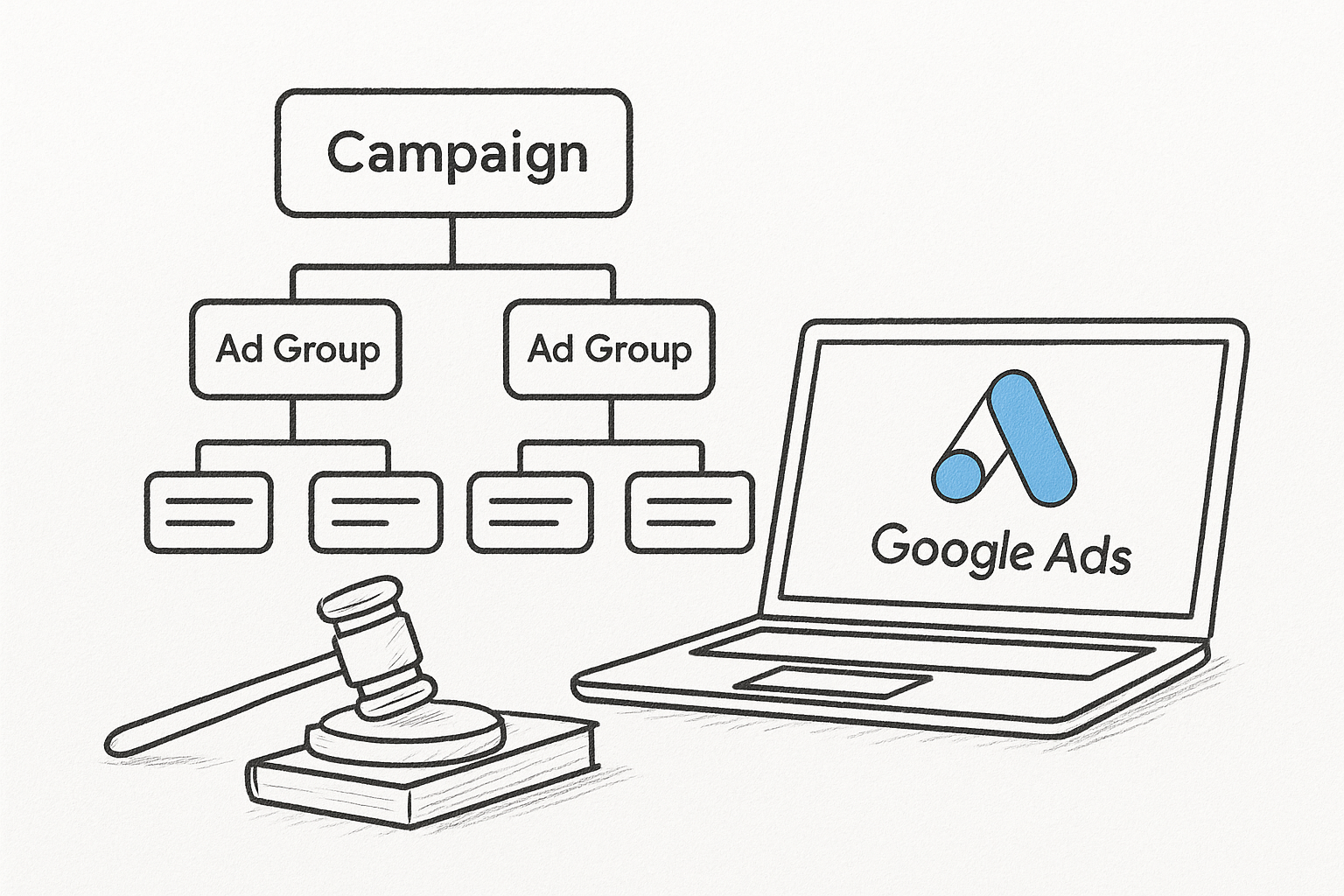
Account structure determines your budget efficiency more than ad copy or bid strategy. Organize campaigns by practice area, then break each campaign into ad groups by specific service (for example, one ad group for "car accident lawyer" keywords and a separate group for "slip and fall lawyer" keywords). Each ad group should contain three to five closely related keywords using phrase or exact match, never broad match until you have real search term data showing you which queries convert.
Use negative keywords from day one. Add terms like "free," "pro bono," "paralegal," "law school," and the names of practice areas your firm does not handle. A clean negative keyword list alone can reduce wasted spend by 20% to 30% in the first month.
Create a dedicated landing page for each campaign
Generic homepages convert poorly because they ask visitors to figure out where to go next. Build a separate landing page for each practice area you advertise, with a single clear call to action, a mobile-optimized intake form, and social proof such as Google reviews or case results. Page load speed matters directly to Quality Score, so run your landing page through Google PageSpeed Insights and fix any issues before your first ad goes live.
Connect conversion tracking before your campaign launches
Tracking setup is not optional. Install your Google Ads conversion tag, configure call tracking numbers tied to each campaign, and verify that form submissions fire a confirmation event before you spend your first dollar. Without this foundation, you cannot identify which keywords, ads, or match types generate actual consultations versus clicks that bounce immediately.
How to optimize for signed cases, not cheap leads
Most law firms running PPC for law firms campaigns optimize for the wrong metric. A low cost per lead feels like progress, but a $30 lead that never picks up the phone costs more than a $150 lead that signs a retainer the same day. Your entire optimization strategy shifts when you build your campaign around signed cases rather than raw lead volume, because the signals that drive cheap leads and the signals that drive signed retainers are not the same.
Why cost per lead misleads your optimization decisions
Cost per lead rewards quantity over quality, which pushes your campaigns toward broad keywords and permissive match types that generate high click volume at low CPCs. These keywords often attract people in the early research phase who are not ready to hire, people shopping multiple firms with no urgency, or queries that are adjacent to your practice area but not actually your ideal client. Pausing these keywords looks like a loss on a cost-per-lead dashboard even when eliminating them improves your signed case rate significantly.
Optimizing for cheap leads trains your campaign to find the wrong people more efficiently.
Track three numbers alongside cost per lead: consultation-to-signed rate, contact-to-consultation rate, and cost per signed retainer. These metrics tell you whether your targeting is reaching people who actually hire, or just people who click.
How to connect your ads directly to signed retainers
Attribution is the technical foundation of case-level optimization. Every campaign, ad group, and keyword should pass a source parameter through your intake form and into your case management system. When a lead signs, that retainer record needs to carry the originating campaign ID so you can pull a true cost per signed case by keyword and campaign.
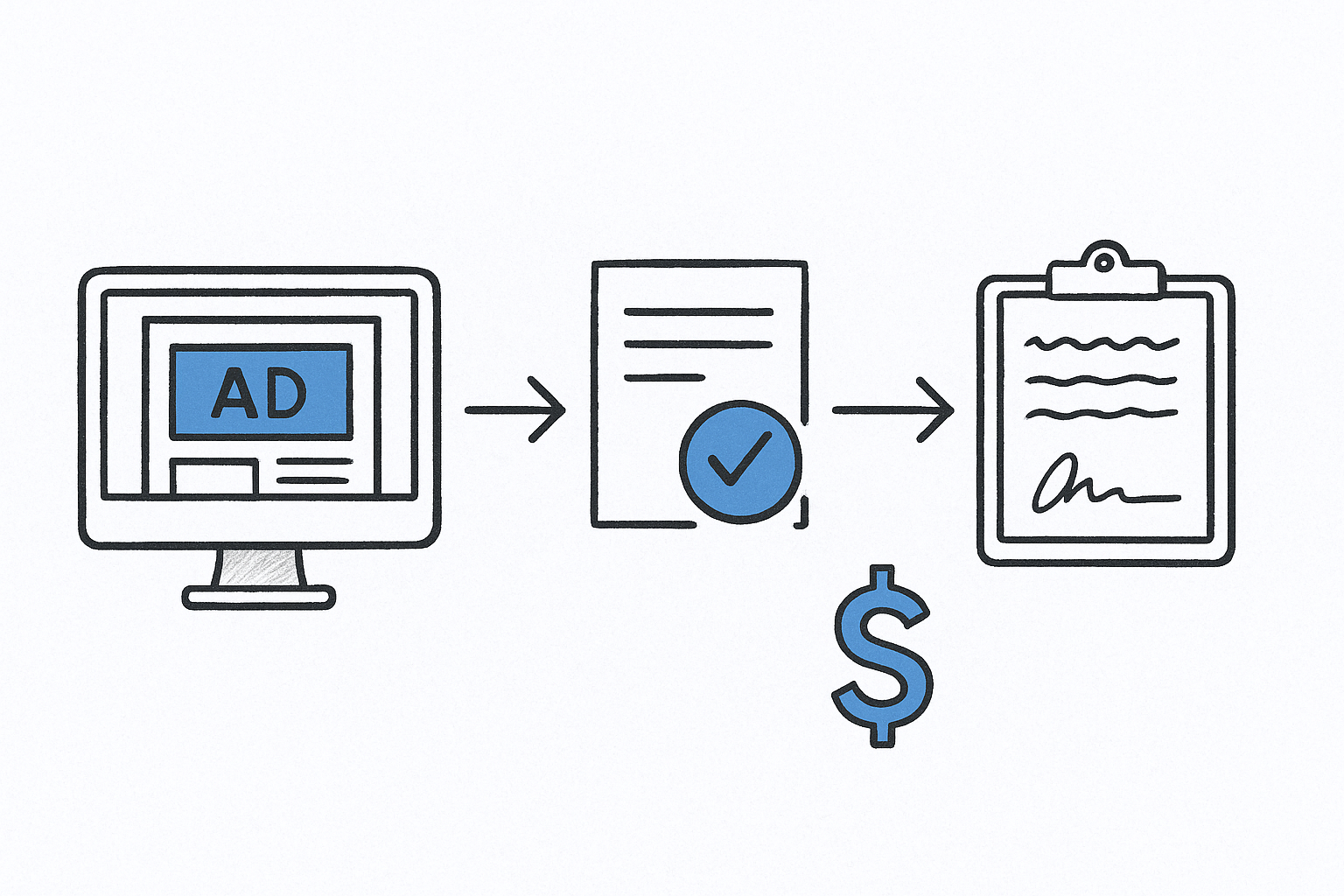
GavelGrow's platform automates this attribution chain, linking each signed retainer back to its originating ad click without manual tagging in spreadsheets. You get campaign-level cost-per-signed-case data in the same dashboard where you manage your pipeline, so optimization decisions stay grounded in revenue rather than lead counts.
Speed-to-lead as a direct case driver
Contact speed is one of the highest-leverage variables you can control after a click converts to a form fill or call. Research cited by Google confirms that response time directly impacts whether a prospect engages or moves to the next firm on the results page. Automated intake sequences that fire within 60 seconds of submission keep your firm top of mind while the prospect is still actively deciding, which lifts your conversion rate without changing a single bid or keyword.
Frequently Asked Questions
This section answers the most common questions managing partners and marketing directors ask when evaluating PPC for law firms for the first time or troubleshooting an underperforming account.
How much should a law firm budget for PPC per month?
Your starting budget depends on practice area and market size. Personal injury firms in competitive metros should plan for at least $5,000 to $10,000 monthly to generate enough data to optimize effectively. Estate planning or immigration firms in smaller markets can start meaningfully at $1,500 to $3,000. The real test is whether your budget generates 30 or more clicks per month, giving you enough signal to identify what converts.
What is a realistic cost per signed case from PPC?
Cost per signed case varies significantly by practice area. GavelGrow's modelled benchmarks put personal injury firms between $800 and $2,500 per signed retainer through Google Ads when attribution is tracked correctly. Criminal defense and family law firms fall in a modelled range of $300 to $900 per signed case. These figures only surface when your campaign tracks outcomes at the retainer level, not just the lead level.
How long does it take for law firm PPC campaigns to produce results?
Your first month generates mostly data, not signed cases. A properly structured Google Ads campaign needs 60 to 90 days before it exits the learning phase and delivers consistent lead volume. Budget, Quality Score, and conversion tracking setup all affect how quickly your campaign stabilizes, so avoid scaling spend before the learning phase completes.
Should your firm run Google Ads or Local Services Ads first?
LSAs are the lower-risk entry point because you pay per verified lead rather than per click, and the Google Screened badge builds immediate credibility with searchers. Once your intake process handles LSA volume reliably, adding Google Search Ads captures higher-intent keywords and gives you more control over targeting, bids, and landing page experience.
How do you track whether PPC leads actually sign retainers?
Full-funnel attribution connects your Google Ads click to your intake form, your CRM record, and your signed retainer. Without that chain, your firm optimizes on lead counts rather than revenue. GavelGrow's platform tracks every lead from originating campaign through signed case, so you can pull campaign-level cost-per-signed-case data instead of guessing which keywords generate real revenue.

Next Steps
PPC for law firms works when you build it on measurable outcomes from day one. The firms that see consistent returns are not necessarily spending the most. They track every click through to a signed retainer, they respond to leads within minutes, and they cut keywords that generate calls but never close. Those habits compound over time into a campaign that pays for itself and scales predictably.
Start by auditing what your current campaigns actually measure. If you cannot pull a cost per signed retainer by keyword right now, your attribution gap is costing you money every month. From there, tighten your match types, build practice-area landing pages, and connect your intake process to your ad account.
If you want a clear picture of where your marketing stands before investing more in paid search, run your firm through the free law firm marketing scorecard and find the gaps worth fixing first.
Frequently Asked Questions
How much should a law firm budget for PPC per month?
Your starting budget depends on practice area and market size. Personal injury firms in competitive metros should plan for at least $5,000 to $10,000 monthly to generate enough data to optimize effectively. Estate planning or immigration firms in smaller markets can start meaningfully at $1,500 to $3,000. The real test is whether your budget generates 30 or more clicks per month, giving you enough signal to identify what converts.
What is a realistic cost per signed case from PPC?
Cost per signed case varies significantly by practice area. GavelGrow's modelled benchmarks put personal injury firms between $800 and $2,500 per signed retainer through Google Ads when attribution is tracked correctly. Criminal defense and family law firms fall in a modelled range of $300 to $900 per signed case. These figures only surface when your campaign tracks outcomes at the retainer level, not just the lead level.
How long does it take for law firm PPC campaigns to produce results?
Your first month generates mostly data, not signed cases. A properly structured Google Ads campaign needs 60 to 90 days before it exits the learning phase and delivers consistent lead volume. Budget, Quality Score, and conversion tracking setup all affect how quickly your campaign stabilizes, so avoid scaling spend before the learning phase completes.
Should your firm run Google Ads or Local Services Ads first?
LSAs are the lower-risk entry point because you pay per verified lead rather than per click, and the Google Screened badge builds immediate credibility with searchers. Once your intake process handles LSA volume reliably, adding Google Search Ads captures higher-intent keywords and gives you more control over targeting, bids, and landing page experience.
How do you track whether PPC leads actually sign retainers?
Full-funnel attribution connects your Google Ads click to your intake form, your CRM record, and your signed retainer. Without that chain, your firm optimizes on lead counts rather than revenue. GavelGrow's platform tracks every lead from originating campaign through signed case, so you can pull campaign-level cost-per-signed-case data instead of guessing which keywords generate real revenue.