Average Cost Per Signed Case: Benchmarks For Law Firms
Categories: Legal Marketing Strategies
 Abram Ninoyan
Founder & Senior Performance Marketer
Credentials: Google Partner, Google Ads Search Certified, Google Ads Display Certified, Google Ads Measurement Certified, Google Analytics (IQ) Certified, HubSpot Inbound Certified, HubSpot Social Media Marketing Certified, Conversion Optimization Certified
Expertise: Google Ads, Meta Ads, Conversion Rate Optimization, GA4 & Google Tag Manager, Lead Generation, Marketing Funnel Optimization, PPC Management
LinkedIn Profile
The average cost per signed case for U.S. law firms ranges from roughly $800 to $12,000+, depending on practice area, market size, and how well your intake process converts leads into retained clients...
Key Takeaways
- Average Cost Per Signed Case: Benchmarks For Law Firms
- What does average cost per signed case mean?
- What benchmarks should law firms expect in 2026?
- How do you calculate cost per signed case?
Average Cost Per Signed Case: Benchmarks For Law Firms
The average cost per signed case for U.S. law firms ranges from roughly $800 to $12,000+, depending on practice area, market size, and how well your intake process converts leads into retained clients.
Most firms track cost per lead. Fewer track cost per consultation. Almost none measure what actually matters: the dollar amount spent to put a signed retainer on the desk. That gap between a raw lead and a paying client is where firms hemorrhage budget without realizing it. A personal injury firm spending $15,000 per month on Google Ads might generate 60 leads but sign only 6 cases, and without full-funnel attribution, the managing partner has no idea whether that $2,500 cost per signed case is competitive or catastrophic for their market.
That's exactly why we built GavelGrow's platform around case-centric measurement rather than vanity metrics. Our benchmark database draws from over 500 U.S. law firms, tracking real cost-per-signed-case figures across practice areas, campaign types, and market sizes. Every number in this article reflects that dataset alongside published industry sources, not guesswork. Whether you run your own campaigns or work with a managed-services partner, these benchmarks give you a concrete standard to measure against.
This article breaks down average cost per signed case by practice area (with a deep focus on personal injury and motor vehicle accidents), explains the variables that push that number up or down, and shows you how to calculate and improve yours. If you've been making budget decisions based on CPL alone, the real numbers will change how you allocate every dollar.
What does average cost per signed case mean?
Cost per signed case (sometimes called cost per acquisition or CPA) is the total marketing spend required to produce one signed retainer. You calculate it by dividing your total marketing investment for a given period by the number of cases you signed in that same window. If you spent $30,000 in May and signed 12 cases, your cost per signed case was $2,500. That single number tells you more about your marketing efficiency than any click-through rate or lead volume report ever will.
The Difference Between a Lead, a Consultation, and a Signed Case
Most analytics platforms stop at the lead. A lead is someone who filled out a form or called your office. A consultation is the scheduled meeting or call where your intake team or attorney evaluates the case. A signed case is the only outcome that generates revenue. Each step in this funnel carries a conversion rate, and those rates compound: if you convert 40% of leads to consultations and 50% of consultations to signed cases, you need five leads to produce one signed case.
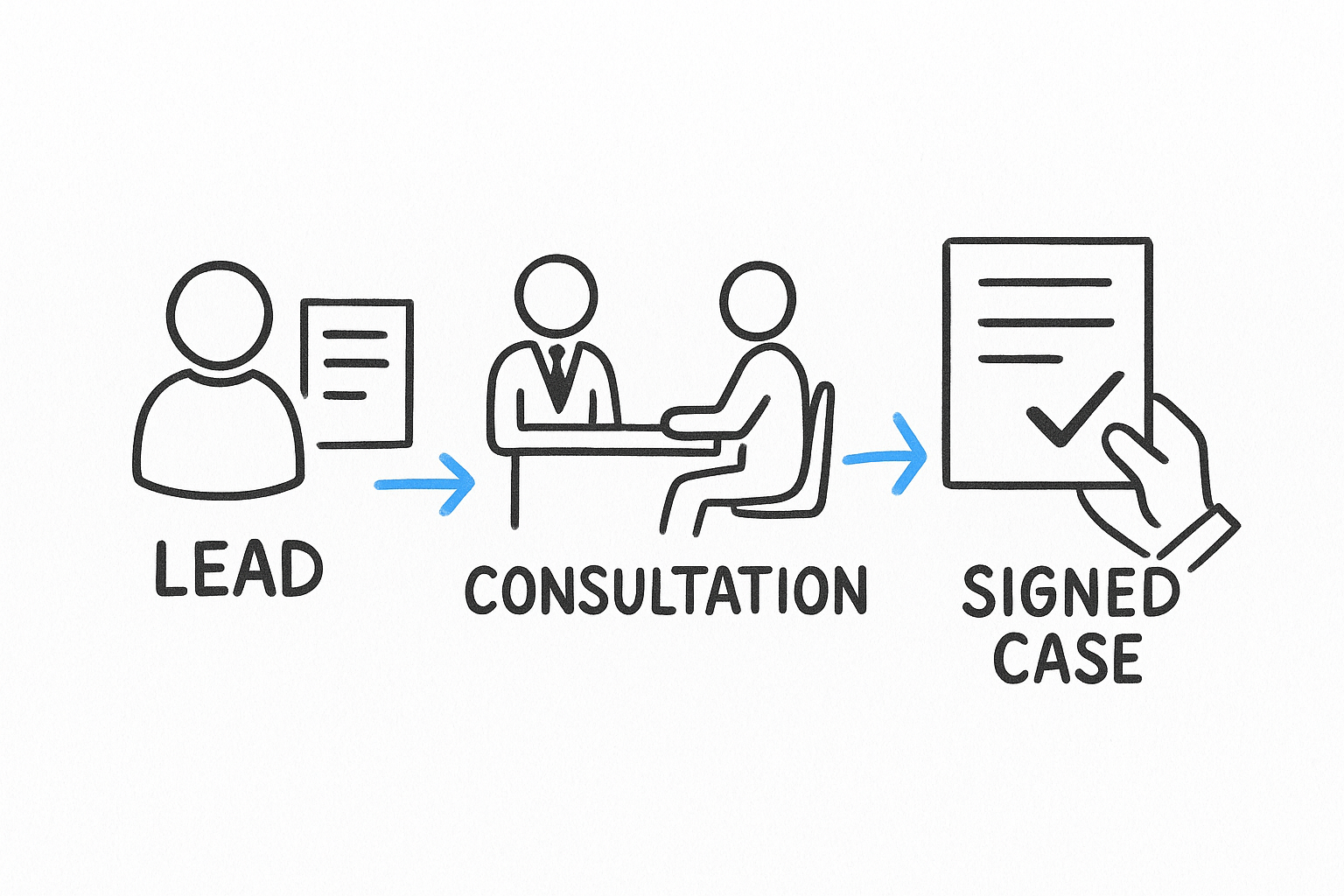
Understanding this conversion chain is essential because the average cost per signed case is not just a reflection of how much you spend on ads. It reflects the performance of your entire intake system, from the first ad impression to the moment a client signs the retainer agreement.
A firm with a $300 cost per lead but a 5% lead-to-signed-case rate pays $6,000 per signed case. A competitor spending $500 per lead but converting at 20% pays $2,500.
Why Cost Per Lead Is the Wrong Number to Optimize
CPL is a useful proxy, but optimizing for it in isolation creates a dangerous incentive: you drive down lead cost by broadening targeting, which floods your intake team with low-quality inquiries that never sign. Your CPL drops, your cost per signed case rises, and your managing partner wonders why revenue hasn't moved despite more leads than ever.
This is the core reason firms with sophisticated marketing operations shift their reporting to case-level attribution. When your campaign data feeds all the way through to signed retainers, you can see exactly which ad groups, keywords, and landing pages produce revenue, not just form fills. Google's own guidance on conversion tracking reinforces this point: measuring the outcome closest to revenue produces the most actionable optimization signals.
How Cost Per Signed Case Connects to Your Entire Marketing Budget
Your total marketing budget funds multiple channels: paid search, local service ads, SEO, social, and referral programs. Each channel produces leads at different costs and converts those leads to signed cases at different rates. A personal injury firm running Google Search ads might pay $400 per lead but convert at 18%, while the same firm's social campaigns generate $150 leads that convert at 4%.
Blending those two channels produces a blended cost per signed case that obscures which channel actually drives profitable growth. When you break out the metric channel by channel, the data often reveals that cutting the low-CPL social spend and doubling down on paid search would reduce overall cost per signed case by 30% or more. That level of clarity is only possible when you track the number all the way to the signed retainer.
What benchmarks should law firms expect in 2026?
The average cost per signed case varies widely, but most U.S. law firms fall into a predictable range once you account for practice area and market size. GavelGrow's benchmark database, built from performance data across 500+ U.S. law firms, shows that firms optimizing for signed cases rather than raw leads consistently outperform those chasing CPL targets alone.
Personal Injury and Motor Vehicle Accident Benchmarks
Personal injury and motor vehicle accident cases carry some of the highest advertising costs in legal because the potential settlement value attracts heavy competition on every major ad platform. In 2026, Google Search CPCs for terms like "car accident attorney" in competitive markets such as Los Angeles, Houston, or Miami regularly reach $80 to $150 per click, which pushes cost per signed case well above the national average.
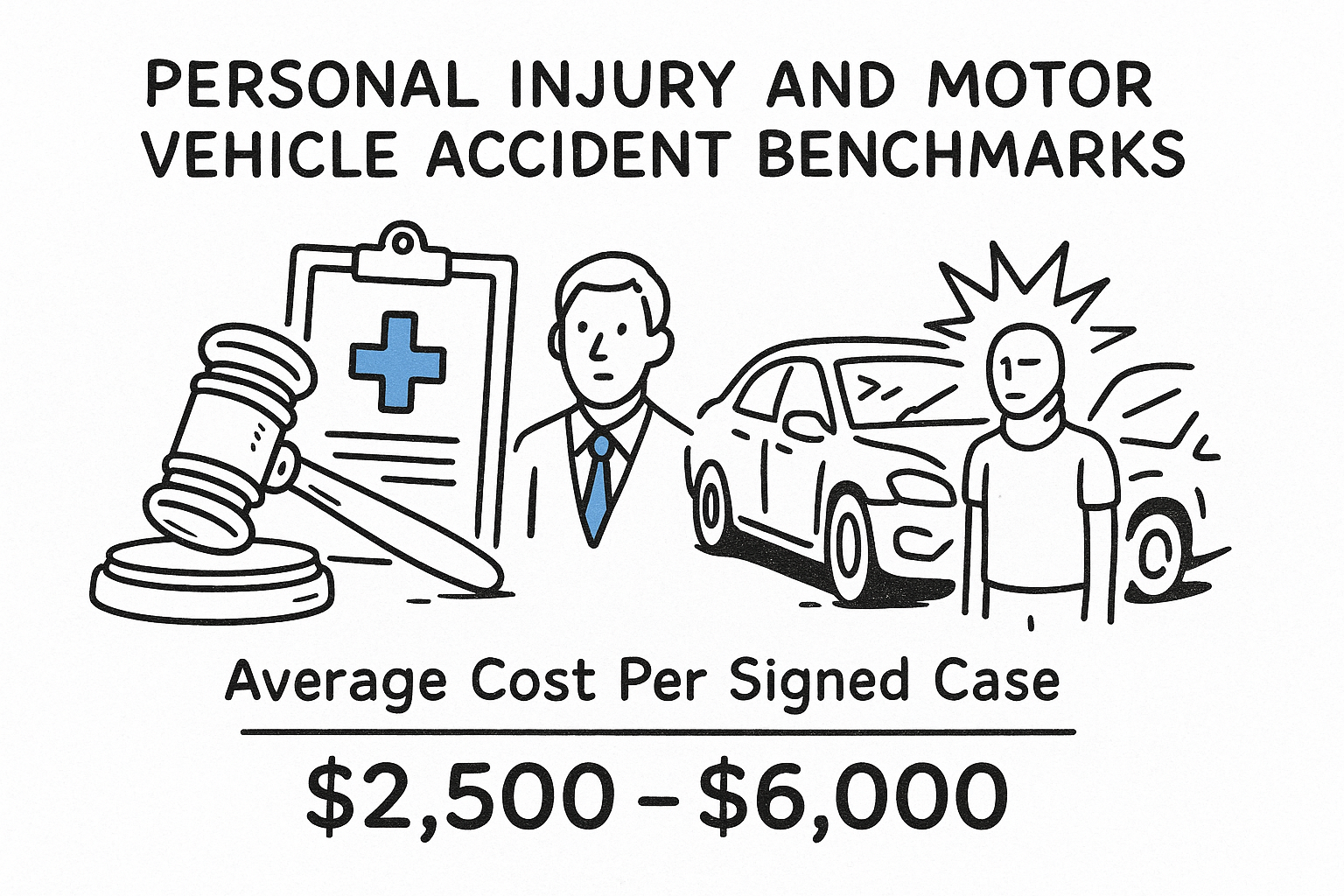
For personal injury firms in large metros, a cost per signed case between $2,500 and $6,000 is competitive. Anything above $8,000 signals a conversion problem, not a traffic problem.
Based on GavelGrow data, motor vehicle accident cases in mid-size markets (cities with populations between 250,000 and 1 million) average $1,800 to $4,000 per signed case when intake processes convert at industry-standard rates of 15% to 22% from lead to retained client.
How Practice Area Shifts the Number
Not every practice area competes on the same playing field. Family law and criminal defense firms typically see lower cost-per-signed-case figures because case values are smaller, competition is less aggressive, and intake cycles are shorter. Estate planning and business law firms often operate with the lowest acquisition costs because a significant portion of new clients arrive through referral networks rather than paid search.
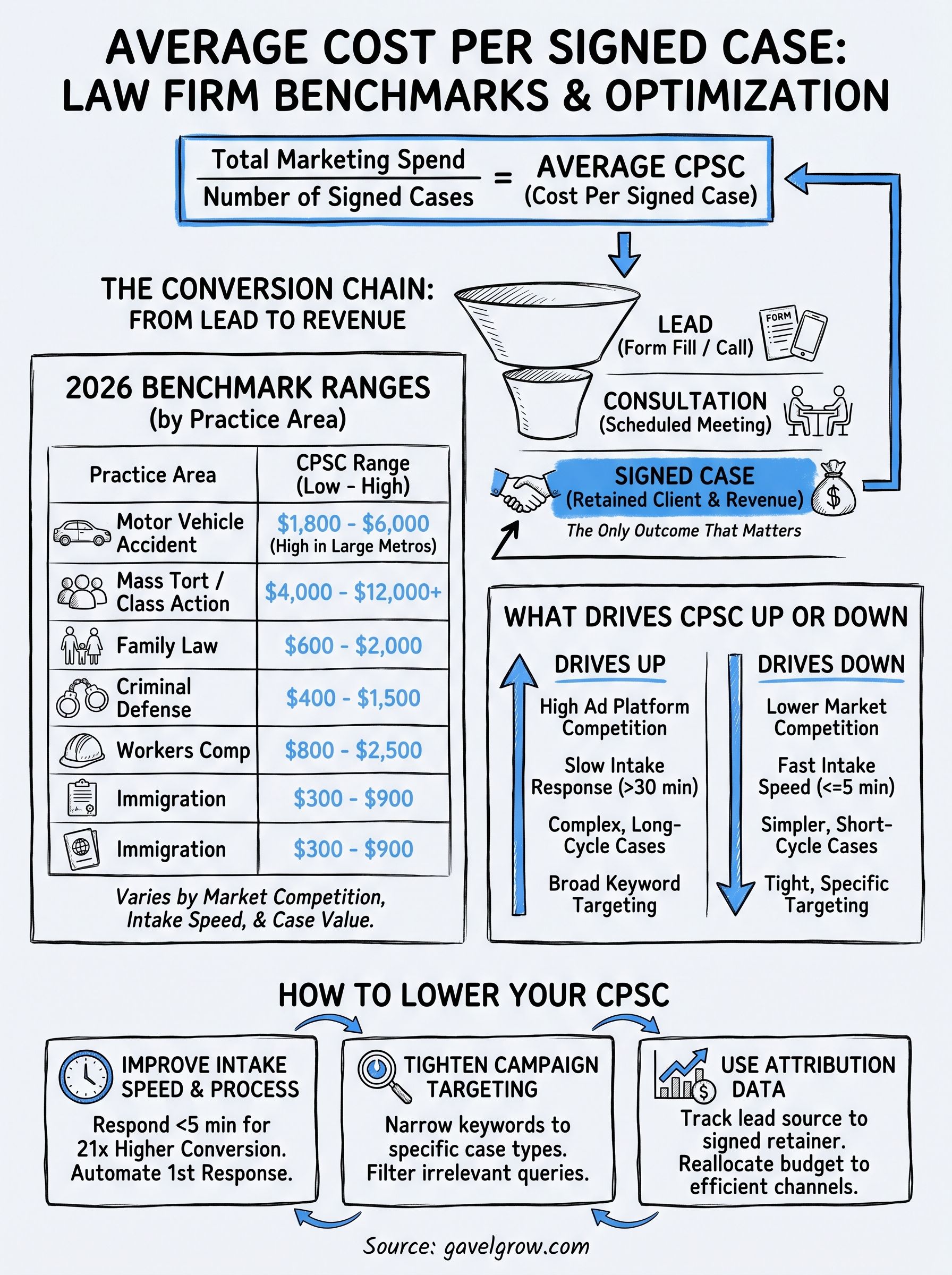
The table below reflects 2026 GavelGrow benchmark ranges by practice area for firms spending a minimum of $3,000 per month on paid acquisition:
Your firm's actual number will land somewhere in these ranges depending on market competitiveness, intake conversion rate, and average case value, which is why benchmarks are a starting point for diagnosis, not a fixed target.
How do you calculate cost per signed case?
Calculating cost per signed case requires one simple formula, but pulling the right inputs is where most firms go wrong. The math itself takes seconds; building the data infrastructure to feed that math accurately takes deliberate setup.
The Core Formula
Divide your total marketing spend for a defined period by the number of cases your firm signed during that same period. That's your average cost per signed case.
Cost Per Signed Case = Total Marketing Spend / Number of Signed Cases
If your firm spent $18,000 across all channels in April and signed 9 cases, your cost per signed case was $2,000. Include every dollar that contributed to client acquisition: paid search, local service ads, SEO agency fees, social media ads, and any platform or software costs tied directly to lead generation. Leaving out SEO retainer fees or call tracking costs understates your true acquisition cost and inflates how efficient your campaigns look.
How to Pull the Right Numbers
Your total spend figure should be straightforward to compile from your ad platform invoices and agency billing statements. The harder number to track accurately is signed cases, because most firms operate with at least two or three disconnected systems: an ad platform, a CRM, and a case management tool that rarely talk to each other. When those systems don't share data, you end up attributing signed cases to the wrong time period or the wrong channel entirely.
Tracking signed cases correctly means logging the retainer date and the originating lead source in the same system. When a client who clicked a Google Search ad in March signs in April, that signed case should attribute back to March's paid search spend. Without this linkage, your monthly figures fluctuate based on when clients sign rather than when the marketing that acquired them ran. GavelGrow's platform connects originating lead source to signed retainer automatically, so your campaign-level cost per signed case reflects real attribution rather than estimates. You can also break the calculation down by channel, by practice area, or by intake staff member to identify exactly where your acquisition funnel gains or loses efficiency.
What drives cost per signed case up or down?
Your average cost per signed case doesn't move in a vacuum. It responds to a set of identifiable variables that you can measure, monitor, and in most cases directly influence. Understanding which levers pull the number in each direction gives you a clear diagnosis when your acquisition cost spikes or dips unexpectedly.
Market Competition and Ad Costs
Ad platform competition is the most immediate factor pushing cost per signed case upward. Google Search operates as an auction, and every time a competitor enters your market or increases their budget, your cost per click rises without any change on your end. In high-density legal markets like Los Angeles or Chicago, personal injury terms regularly exceed $100 per click, which compresses margin on every lead your campaigns generate. If your conversion rate stays flat while CPCs climb, your cost per signed case rises in direct proportion.
Firms in smaller markets often achieve lower cost per signed case not because they run better campaigns, but because they face fewer bidders on the same keywords.
Intake Speed and Conversion Rate
Your lead-to-signed-case conversion rate has an outsized effect on acquisition cost because it determines how many leads you need to buy before one signs a retainer. A firm converting 20% of leads to signed cases pays less per case than a firm converting 8%, even if both firms pay identical CPLs. Speed plays a direct role here. Research cited in Clio's 2024 Legal Trends Report found that firms responding to leads within five minutes convert at dramatically higher rates than those responding after 30 minutes. Every hour your leads sit uncontacted, your effective conversion rate drops and your cost per signed case climbs.
Case Type and Geographic Market
Simpler cases with shorter decision cycles, such as immigration matters or uncontested divorces, tend to produce lower cost-per-signed-case figures because prospects make faster decisions and fewer competitors bid on those keywords aggressively. Complex cases like mass torts or medical malpractice involve longer evaluation periods, higher referral fees, and more competitive ad auctions, all of which push acquisition costs toward the higher end of the benchmark ranges. Your geographic market compounds this: a workers comp attorney in rural Ohio operates in a fundamentally different cost environment than one in Houston.
How do you lower cost per signed case?
Lowering your average cost per signed case requires working two levers simultaneously: reducing what you pay to acquire leads and increasing the percentage of those leads that become signed clients. Most firms focus exclusively on the first lever while ignoring the second, which means they chase lower CPLs without ever addressing the conversion gaps that inflate their true acquisition cost.
Improve Your Intake Speed and Conversion Process
Your intake process is the highest-leverage place to reduce cost per signed case because it multiplies the value of every lead you already paid for. When a prospect submits a form at 9:47 PM, a response at 9:48 PM converts at a measurably higher rate than a response at 9:15 AM the next morning. Automating your first response, whether an SMS confirmation, an email, or a callback sequence, keeps prospects engaged before they contact a competitor.
Firms that respond to leads within five minutes are up to 21 times more likely to qualify than firms that wait more than 30 minutes, according to research on lead response behavior.
Pair fast response with a structured qualification script so your intake staff captures the case details needed to move a prospect directly to a signed retainer rather than scheduling redundant callbacks. Each unnecessary step in that process adds time, and time kills conversions in legal intake.
Tighten Your Campaign Targeting
Broad match keywords and wide geographic targeting generate high lead volume at low CPL, but they consistently produce the worst lead-to-signed-case conversion rates. Narrowing your targeting to the specific case types your firm actually wants, combined with negative keyword lists that filter out irrelevant queries, reduces wasted spend and raises the average quality of each lead entering your pipeline.
Reviewing your search term reports weekly inside Google Ads surfaces the exact queries triggering your ads, many of which will have nothing to do with your practice area. Cutting those terms reduces spend without reducing signed cases, which directly improves your acquisition cost.
Use Attribution Data to Reallocate Budget
Cutting budget without attribution data is guesswork. When you track originating lead source through to signed retainer, you can identify which campaigns, ad groups, and keywords produce signed cases at the lowest cost and shift budget toward those channels. GavelGrow's platform connects every lead to its campaign source and logs the retainer date, so you can compare channel-level cost per signed case and make allocation decisions based on actual revenue performance rather than CPL estimates.
Frequently Asked Questions
The questions below address what managing partners and marketing directors ask most often when they start tracking cost per signed case for the first time.
What is a good average cost per signed case for a personal injury firm?
In most mid-size U.S. markets, a personal injury firm with a healthy intake process should target an average cost per signed case between $1,800 and $4,000. In competitive metros like Los Angeles or Houston, figures between $4,000 and $6,000 are still considered competitive given the higher average settlement values. Anything above $8,000 typically points to a conversion problem in intake, not a traffic problem in your ad campaigns.
How does intake speed affect my cost per signed case?
Your response time after a lead submits a form directly compresses or inflates your acquisition cost. Clio's 2024 Legal Trends Report found that 42% of firms fail to return calls within three days, which devastates conversion rates. When your intake team contacts leads within five minutes, your lead-to-signed-case rate rises sharply, meaning you need fewer leads to hit your case goals, which lowers your acquisition cost automatically.
Faster response does not just improve conversion rates; it reduces how much you spend to acquire every signed case.
Should I include SEO costs in my cost per signed case calculation?
Yes. Any spend that contributes to client acquisition belongs in your calculation, including your SEO retainer, content production costs, and any platform fees tied to lead generation. Leaving those out makes your cost per signed case look artificially low and causes you to misallocate budget between paid and organic channels. A blended calculation gives you a more accurate picture of your firm's true marketing efficiency.
What is the difference between cost per signed case and cost per lead?
Cost per lead measures what you paid to generate a form fill or phone call. Cost per signed case measures what you paid to produce a retained client. The gap between the two reflects your intake conversion rate, and that gap is where most firms lose budget without realizing it.
How often should I review my cost per signed case?
Review it monthly at minimum, broken out by channel and campaign. Monthly reviews let you catch rising acquisition costs before they compound over a full quarter. Firms using GavelGrow's platform can pull campaign-level cost per signed case on demand rather than waiting for a monthly report.
Next Steps
Your average cost per signed case is the single most honest number in your marketing operation. It strips away vanity metrics and tells you exactly what you're paying to grow your firm. The benchmarks in this article give you a concrete standard to measure against, but the real work starts when you pull your own data and compare it against firms in your practice area and market size.
Start by building the calculation for your last 90 days using total spend divided by signed retainers, broken out by channel. If your current tools don't connect lead source to signed case, that attribution gap is costing you money on every campaign you run. GavelGrow's platform tracks the full funnel from first ad click through signed retainer, so you see exactly which campaigns produce cases at the lowest cost. Book a free 45-minute strategy call to see how your numbers compare against 500+ peer firms.
Frequently Asked Questions
What is a good average cost per signed case for a personal injury firm?
In most mid-size U.S. markets, a personal injury firm with a healthy intake process should target an average cost per signed case between $1,800 and $4,000. In competitive metros like Los Angeles or Houston, figures between $4,000 and $6,000 are still considered competitive given the higher average settlement values. Anything above $8,000 typically points to a conversion problem in intake , not a traffic problem in your ad campaigns.
How does intake speed affect my cost per signed case?
Your response time after a lead submits a form directly compresses or inflates your acquisition cost. Clio's 2024 Legal Trends Report found that 42% of firms fail to return calls within three days, which devastates conversion rates. When your intake team contacts leads within five minutes, your lead-to-signed-case rate rises sharply , meaning you need fewer leads to hit your case goals, which lowers your acquisition cost automatically. Faster response does not just improve conversion rates; it reduces how much you spend to acquire every signed case.
Should I include SEO costs in my cost per signed case calculation?
Yes. Any spend that contributes to client acquisition belongs in your calculation , including your SEO retainer, content production costs, and any platform fees tied to lead generation. Leaving those out makes your cost per signed case look artificially low and causes you to misallocate budget between paid and organic channels. A blended calculation gives you a more accurate picture of your firm's true marketing efficiency.
What is the difference between cost per signed case and cost per lead?
Cost per lead measures what you paid to generate a form fill or phone call. Cost per signed case measures what you paid to produce a retained client. The gap between the two reflects your intake conversion rate , and that gap is where most firms lose budget without realizing it.
How often should I review my cost per signed case?
Review it monthly at minimum , broken out by channel and campaign. Monthly reviews let you catch rising acquisition costs before they compound over a full quarter. Firms using GavelGrow's platform can pull campaign-level cost per signed case on demand rather than waiting for a monthly report.