Criminal Defense Marketing: How To Get More Signed Cases
Categories: Legal Marketing Strategies
 Abram Ninoyan
Founder & Senior Performance Marketer
Credentials: Google Partner, Google Ads Search Certified, Google Ads Display Certified, Google Ads Measurement Certified, Google Analytics (IQ) Certified, HubSpot Inbound Certified, HubSpot Social Media Marketing Certified, Conversion Optimization Certified
Expertise: Google Ads, Meta Ads, Conversion Rate Optimization, GA4 & Google Tag Manager, Lead Generation, Marketing Funnel Optimization, PPC Management
LinkedIn Profile
Most criminal defense marketing fails because firms optimize for lead volume instead of signed retainers, and the difference between the two is where your budget either compounds or disappears. Crimin...
Key Takeaways
- Criminal Defense Marketing: How To Get More Signed Cases
- What a signed-case marketing plan includes
- Step 1. Pick the case types and territory you want
- Step 2. Build a website that converts stressed callers
Criminal Defense Marketing: How To Get More Signed Cases
Most criminal defense marketing fails because firms optimize for lead volume instead of signed retainers, and the difference between the two is where your budget either compounds or disappears.
Criminal defense sits in a unique position among practice areas. Prospects are searching at 2 a.m. after an arrest, comparing firms on their phone from a holding area lobby, and making a hiring decision within hours, not weeks. That means your intake speed and ad targeting matter more here than in almost any other legal vertical. Clio's 2024 Legal Trends Report secret-shopper study found that nearly half of firms (48%) were unreachable by phone. In criminal defense, waiting even 30 minutes can send a desperate prospect straight to the next firm on Google.
This guide breaks down the strategies that actually move the needle, from Google Ads structure and local SEO to intake automation and conversion tracking, built specifically around the realities of defending criminal cases. Every tactic ties back to one metric: signed cases, not vanity clicks. At GavelGrow, we've helped over 500 U.S. law firms close the gap between marketing spend and revenue, and criminal defense firms consistently rank among the fastest to see results when the fundamentals are in place.
Whether you're a solo practitioner spending $3K/month on ads or a multi-attorney firm investing $50K+, you'll walk away with a clear, actionable system for turning urgent searches into retained clients, and the benchmarks to know if your numbers are actually competitive.
What a signed-case marketing plan includes
A signed-case marketing plan treats every dollar you spend as an investment with a measurable return, not a cost you hope pays off. Most firms bolt together a website, a Google Ads account, and a phone number and call it a system. That patchwork fails because no single layer connects to the next, so you can't tell which campaign signed the most DUI clients last quarter or why your intake conversion rate dropped in March.
A complete criminal defense marketing plan doesn't end when a lead submits a form. It ends when a retainer is signed and the originating source is recorded.
Effective criminal defense marketing runs on five connected layers, and each one feeds the next. If any layer is missing or disconnected, the whole system leaks revenue. The table below maps each layer to its primary job and its measurable output.
The five layers of a signed-case marketing plan
Understanding what each layer does before you build it saves you from the common mistake of skipping infrastructure and going straight to ad spend. Each layer has one job and one number that tells you whether it's working.
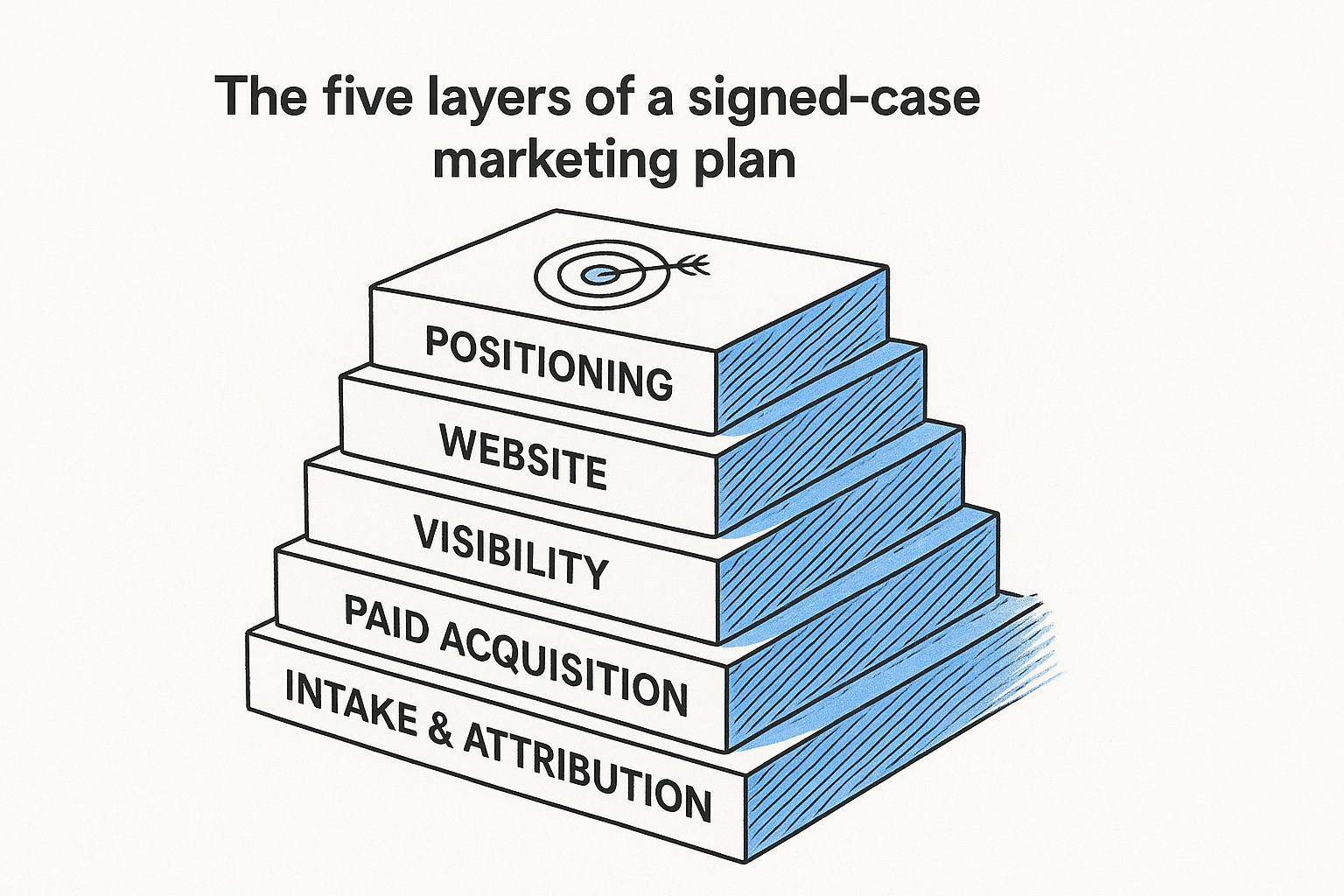
Each row is a responsibility. If you assign it to nobody, the outcome defaults to random.
Why attribution is the missing layer in most plans
Most criminal defense firms measure clicks and calls but never connect those numbers back to actual signed retainers. An attorney might spend $8,000 on Google Ads in a month, receive 60 calls, and have no idea how many became paying clients or which campaign drove them.
Full-funnel attribution fixes that by tagging every lead at the moment of capture with the campaign, keyword, and ad group that generated it, then following that lead through intake and into a signed retainer. GavelGrow's platform does this natively for every plan, firing GA4, Meta Pixel, and GTM events at conversion so your ad accounts reflect real case value, not raw lead count.
What makes criminal defense different from other practice areas
Criminal cases move faster than any other legal matter. A DUI arrest on a Friday night produces a search and a hiring decision before Monday morning in most instances. That urgency compresses the timeline between first touch and retained client to hours, not days.
Your plan needs to reflect that speed. Every layer, from your ad copy to your intake response time, must be optimized for a buyer who is stressed, mobile, and comparing three firms at once. A plan designed for a calm, desktop-browsing prospect will lose criminal defense cases at every step.
Step 1. Pick the case types and territory you want
Before you spend a single dollar on ads or SEO, you need to define exactly which cases you want and where you want to serve clients. Vague targeting produces vague results. A criminal defense firm that markets to "anyone arrested in the state" will get outcompeted by a firm that targets "DUI arrests in Dallas County" every time, because specificity drives relevance, and relevance drives conversion.
Choose your case mix first
Your practice area mix directly controls your cost-per-signed-case. DUI cases are high-volume and carry shorter sales cycles. Federal defense cases are lower-volume but command higher retainers. Drug charges, assault, and domestic violence each carry different search behavior and different ad costs. Decide which two or three case types you want to dominate before you build any campaigns.
A simple way to prioritize: rank your current signed cases from the past 12 months by revenue per case and intake-to-retainer conversion rate. The case types that score highest on both metrics are where your marketing budget should go first.
Picking the wrong case types to market isn't just a missed opportunity. It pulls budget toward leads your intake team can't convert at a rate that justifies the spend.
Define your geographic radius
Your geographic targeting radius determines both your ad costs and your competition set. A solo practitioner in Phoenix who targets the entire state will burn budget on clicks from Tucson and Flagstaff that rarely convert. Set your radius around the courthouse or county you practice in most, and expand only once your cost-per-signed-case stabilizes in that core market.
Map your last 24 signed cases by zip code before you set any geographic parameters in Google Ads. That data shows you where your clients actually come from, and it should anchor every targeting decision in your criminal defense marketing plan going forward.
Step 2. Build a website that converts stressed callers
Your website is your highest-leverage asset in criminal defense marketing, and it needs to do one job above everything else: get a stressed, mobile visitor to contact you before they click the back button. Research from Google's own mobile usability data shows that 53% of mobile users abandon a site that takes longer than three seconds to load. Criminal defense prospects are not casually browsing. They are in crisis, and your site either captures that urgency or loses the case to a competitor whose page loaded faster.
The single biggest conversion killer for criminal defense websites is asking too many questions before building enough trust to get the phone call.
The five elements every converting criminal defense page needs
Your practice area pages and homepage each carry specific conversion responsibilities. Stripping any of these elements out reduces your intake rate measurably. Build each page around this structure before you touch color palettes or stock photos.
How to structure your intake form for high conversion
Your intake form should collect three fields only at the initial step: name, phone number, and case type. Every additional field you add can lower mobile completion rates.
Use a multi-step format where the first step asks only for the case type, then the second step asks for contact details. This approach uses commitment momentum: once a visitor selects "DUI" from a dropdown, they are far more likely to complete step two than if they faced all fields at once.
Step 3. Win local visibility with SEO and reviews
Local SEO is the lowest cost-per-signed-case channel available to most criminal defense firms, and it compounds over time unlike paid ads that stop producing the moment you cut the budget. Your goal in this step is to dominate two placements: the Google Local Pack (the map results that appear above organic listings for searches like "DUI lawyer near me") and the top three organic results for your target case-type keywords.
For criminal defense marketing, appearing in the Local Pack on mobile produces roughly 3x the click-through rate of position 1 in standard organic results, according to BrightLocal's 2024 Local Search Consumer Survey.
Optimize your Google Business Profile for criminal defense searches
Your Google Business Profile is the single highest-leverage local SEO asset you control, and most firms leave it half-finished. Log into your profile and complete every field: primary category ("Criminal Justice Attorney"), service areas by county or city, individual services listed by case type ("DUI Defense," "Drug Charge Defense," "Federal Criminal Defense"), and a 750-character description that uses your target keywords in the first two sentences.
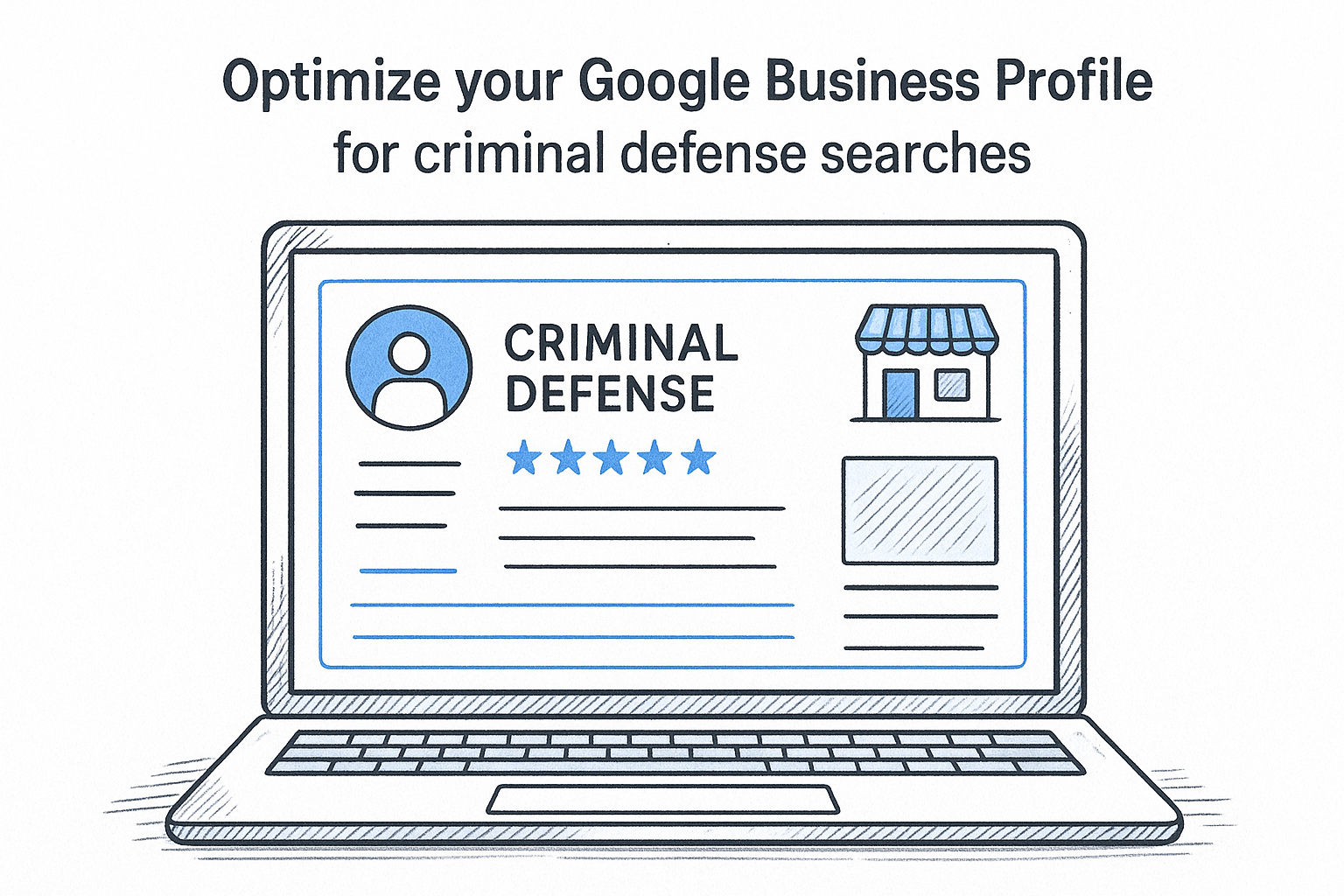
Upload at least 10 photos including your office exterior, consultation room, and headshots. Profiles with 10 or more photos receive 35% more click-throughs than profiles with fewer than 3, according to Google's own Business Profile help documentation. Post a short update every two weeks to signal activity to Google's local ranking algorithm.
Build review volume with a repeatable ask system
Reviews drive both Local Pack rankings and conversion rate once a prospect lands on your profile. The firms that consistently rank in the top three positions in competitive markets average 80+ reviews with a 4.8 or higher rating, based on manual audits of top-ranked criminal defense profiles in markets like Chicago, Houston, and Atlanta.
Send every closed client a direct review request link within 24 hours of case resolution. Use this short message template via SMS:
"[First name], thank you for trusting us with your case. If you're willing to share your experience, here's a direct link to leave us a Google review: [link]. It takes less than 2 minutes and helps other people in tough situations find us."
Track your monthly review count and average rating as a standing metric alongside your cost-per-signed-case so you catch any dip before it affects rankings.
Step 4. Run Compliant Google Ads and Local Services Ads
Paid search is the fastest way to put your criminal defense firm in front of someone who was arrested two hours ago and is actively comparing attorneys. Google Ads and Local Services Ads (LSAs) operate on different mechanics, and running both simultaneously gives you coverage at the top of the search results page that organic SEO alone cannot match in the short term.
Set up Local Services Ads first
LSAs display above everything else in Google search results, including standard paid ads, and they carry Google's "Google Screened" badge for legal professionals. That badge reduces skepticism faster than any headline you could write, because Google has already verified your license and background. To qualify, you submit your bar license, malpractice insurance, and pass a background check through Google's verification portal.
Firms with active LSA profiles in competitive markets like Los Angeles and Miami report cost-per-lead figures between $80 and $200 for DUI cases, compared to $150 to $400 for the same leads through standard Google Ads.
Set your LSA budget by case type, not by a flat weekly cap. DUI and drug charges convert faster, so allocate more budget to those categories and mark unqualified calls as disputed within the LSA dashboard to recover credits on leads that don't match your case criteria.
Structure your Google Ads campaigns for compliance and conversion
State bar advertising rules govern what you can claim in your ad copy. Avoid superlatives like "best" or "top-rated" unless you can substantiate the claim with a verifiable third-party source, and never promise specific outcomes. Use this compliant ad headline framework as your starting template:
Run separate ad groups for each case type (DUI, drug charges, assault) so your keywords, headlines, and landing pages all match the specific search query. A DUI prospect who clicks a generic "criminal defense lawyer" ad and lands on a generic homepage converts at a fraction of the rate compared to one who sees DUI-specific copy and lands on a DUI-specific page.
Step 5. Respond Fast and Track to Signed Retainer
Speed determines whether your criminal defense marketing investment actually converts into revenue. The Lead Response Management Study found that leads called within five minutes were 100 times more likely to be reached than those called at 30 minutes. In criminal defense, that window is even tighter. A person arrested on a Thursday night who submits a form at midnight and hears nothing until Friday afternoon has already called three other firms.
Your intake response time is a competitive differentiator in criminal defense, and it costs nothing to fix compared to increasing your ad budget.
How to Set Up a 5-Minute Response System
Your response system needs to fire automatically within 60 seconds of a lead submitting a form, without relying on a staff member to be at their desk. Use SMS as the first touchpoint because criminal defense prospects are almost always on their phone when they search. Send a short, personal message that confirms receipt and sets a callback expectation.
Here is a compliant SMS template you can use as your starting point:
"Hi [First Name], this is [Firm Name]. We received your message about your [case type] and an attorney will call you within the next 15 minutes. If it's urgent, call us directly at [phone number]."
Set a follow-up email to fire simultaneously with your firm's consultation offer and a direct calendar link. GavelGrow's intake automation sends both sequences within minutes of form submission and logs the TCPA consent timestamp automatically, so your compliance record updates without any manual steps.
Track Every Lead to a Signed Retainer
Most firms stop tracking at the cost-per-lead level, which tells you almost nothing about which campaigns are actually profitable. Connect every lead back to its originating campaign, ad group, and keyword, then update that record when the intake team marks it as a signed retainer.
Run a weekly pipeline review that covers three numbers: leads generated by source, leads contacted within five minutes, and leads converted to signed retainers. This review exposes where cases are leaking, whether that is slow response, unqualified leads from a specific campaign, or intake team capacity limits that need addressing before you increase ad spend.
Next Steps
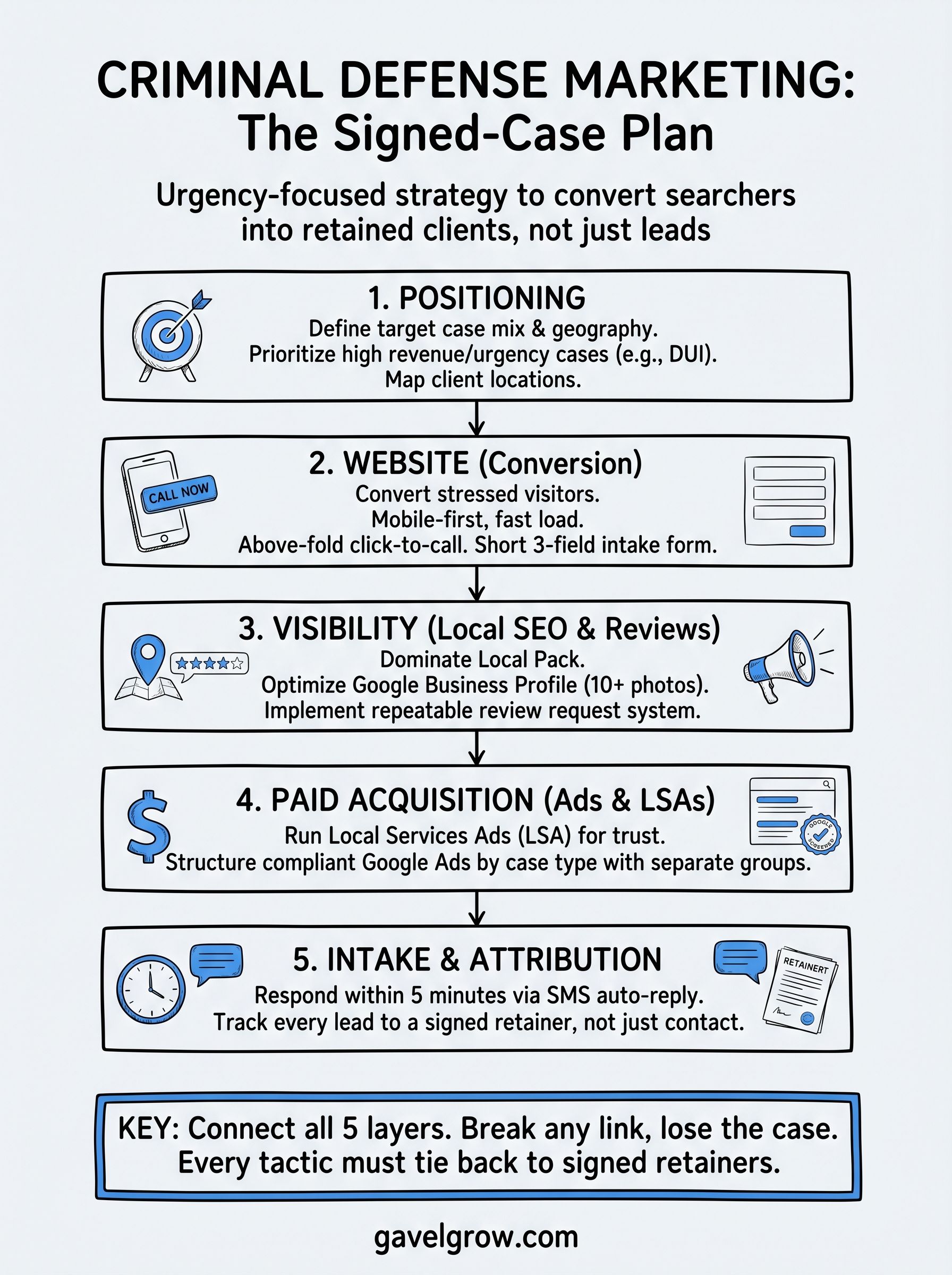
Criminal defense marketing works when every layer connects: your targeting feeds your website, your website feeds your intake system, and your intake system feeds your attribution data. Break any link in that chain and you lose cases you already paid to attract. The five steps in this guide give you a complete system, but the order matters. Start with your case mix and territory before you touch ad spend, and set up intake automation before you scale campaigns.
If you want to know exactly where your current system is leaking revenue, run your firm through GavelGrow's free law firm marketing scorecard to get a clear picture of what to fix first. Prefer to talk through your specific situation with someone who works exclusively with law firms? Book a free 45-minute strategy call at gavelgrow.com/book and we will show you where the fastest wins are.
Frequently Asked Questions
How much should a criminal defense firm spend on Google Ads?
Your Google Ads budget depends on your target case types and market. In competitive metro areas like Chicago or Houston, DUI campaigns typically require $5,000 to $15,000 per month to generate enough volume for reliable cost-per-signed-case data. Start with a smaller test budget for 60 days to establish your baseline cost-per-lead by case type, then scale the campaigns where your intake team converts the highest percentage of leads into signed retainers.
How long does criminal defense SEO take to produce results?
Most criminal defense firms see measurable ranking movement within 90 to 120 days of consistent SEO work, including on-page optimization, Google Business Profile updates, and review volume growth. Reaching the top three positions in a competitive market typically takes 6 to 12 months. The BrightLocal 2024 Local Search Consumer Survey found that 87% of consumers read online reviews before choosing a local service provider, which means your review velocity directly impacts how quickly your rankings translate into actual phone calls.
What is a good cost-per-signed-case for criminal defense marketing?
A competitive benchmark for DUI cases in mid-sized markets runs between $400 and $900 per signed retainer, based on GavelGrow's 2026 Law Firm Marketing Benchmarks Report. Federal defense cases carry a higher cost-per-signed-case but offset it with larger retainers. Track this number by campaign, not just by channel total, so you can cut underperforming ad groups before they pull your overall average down.
Should a criminal defense firm use Local Services Ads or Google Ads?
Run both simultaneously if your budget allows. Local Services Ads appear above standard Google Ads in search results and carry the Google Screened badge, which reduces trust friction for someone comparing attorneys from a phone. Standard Google Ads give you more control over keyword targeting, landing page destinations, and bidding strategy. Firms using both in markets like Atlanta and Phoenix report a 20 to 30% reduction in blended cost-per-lead compared to running either channel alone.
How fast does a criminal defense firm need to respond to a new lead?
Contact every new lead within five minutes of form submission. The Lead Response Management Study found that leads called within five minutes were 100 times more likely to be reached than those called at 30 minutes. In criminal defense, that urgency intensifies because many leads come in after hours following an arrest. Set up automated SMS to fire within 60 seconds and have a staff member or answering service follow up immediately during business hours.
What intake form fields should a criminal defense website include?
Limit your initial intake form to three fields: name, phone number, and case type. Every additional field you add reduces mobile completion rate by roughly 5 to 10%, based on conversion rate optimization benchmarks across legal landing pages. Use a multi-step form where the first screen asks only for the case type selection. Once a visitor picks "DUI" or "Drug Charges," commitment momentum carries them through to the contact details screen at a significantly higher rate than a single-page form with all fields visible at once.
What makes criminal defense marketing different from other practice area marketing?
The compressed decision timeline separates criminal defense from almost every other practice area. A prospect hiring an estate planning attorney may compare firms for two to four weeks. A prospect arrested on a Friday night makes a hiring decision before Monday in most cases. Your ads, website, and intake system must all be built for someone who is stressed, on a mobile device, and comparing three firms at once. Generic legal marketing templates designed for deliberate buyers fail at every stage when applied to criminal defense.
Frequently Asked Questions
How much should a criminal defense firm spend on Google Ads?
Your Google Ads budget depends on your target case types and market. In competitive metro areas like Chicago or Houston, DUI campaigns typically require $5,000 to $15,000 per month to generate enough volume for reliable cost-per-signed-case data. Start with a smaller test budget for 60 days to establish your baseline cost-per-lead by case type, then scale the campaigns where your intake team converts the highest percentage of leads into signed retainers.
How long does criminal defense SEO take to produce results?
Most criminal defense firms see measurable ranking movement within 90 to 120 days of consistent SEO work, including on-page optimization, Google Business Profile updates, and review volume growth. Reaching the top three positions in a competitive market typically takes 6 to 12 months. The BrightLocal 2024 Local Search Consumer Survey found that 87% of consumers read online reviews before choosing a local service provider, which means your review velocity directly impacts how quickly your rankings translate into actual phone calls.
What is a good cost-per-signed-case for criminal defense marketing?
A competitive benchmark for DUI cases in mid-sized markets runs between $400 and $900 per signed retainer , based on GavelGrow's 2026 Law Firm Marketing Benchmarks Report . Federal defense cases carry a higher cost-per-signed-case but offset it with larger retainers. Track this number by campaign, not just by channel total, so you can cut underperforming ad groups before they pull your overall average down.
Should a criminal defense firm use Local Services Ads or Google Ads?
Run both simultaneously if your budget allows. Local Services Ads appear above standard Google Ads in search results and carry the Google Screened badge, which reduces trust friction for someone comparing attorneys from a phone. Standard Google Ads give you more control over keyword targeting, landing page destinations, and bidding strategy. Firms using both in markets like Atlanta and Phoenix report a 20 to 30% reduction in blended cost-per-lead compared to running either channel alone.
How fast does a criminal defense firm need to respond to a new lead?
Contact every new lead within five minutes of form submission . The Lead Response Management Study found that leads called within five minutes were 100 times more likely to be reached than those called at 30 minutes. In criminal defense, that urgency intensifies because many leads come in after hours following an arrest. Set up automated SMS to fire within 60 seconds and have a staff member or answering service follow up immediately during business hours.
What intake form fields should a criminal defense website include?
Limit your initial intake form to three fields : name, phone number, and case type. Every additional field you add reduces mobile completion rate by roughly 5 to 10%, based on conversion rate optimization benchmarks across legal landing pages. Use a multi-step form where the first screen asks only for the case type selection. Once a visitor picks "DUI" or "Drug Charges," commitment momentum carries them through to the contact details screen at a significantly higher rate than a single-page form with all fields visible at once.