How to Build a Personal Injury Law Firm Intake Process
Categories: Legal Marketing Strategies
 Abram Ninoyan
Founder & Senior Performance Marketer
Credentials: Google Partner, Google Ads Search Certified, Google Ads Display Certified, Google Ads Measurement Certified, Google Analytics (IQ) Certified, HubSpot Inbound Certified, HubSpot Social Media Marketing Certified, Conversion Optimization Certified
Expertise: Google Ads, Meta Ads, Conversion Rate Optimization, GA4 & Google Tag Manager, Lead Generation, Marketing Funnel Optimization, PPC Management
LinkedIn Profile
The strongest personal injury law firm intake process has four parts. Capture every inquiry in one pipeline, pre-screen each lead with the same short script, collect a standard set of facts, and give...
Key Takeaways
- Why does your intake process decide which cases you sign?
- Step 1. Capture every lead in one place
- Step 2. Pre-screen and triage in the first call
- Step 3. Collect the right case information
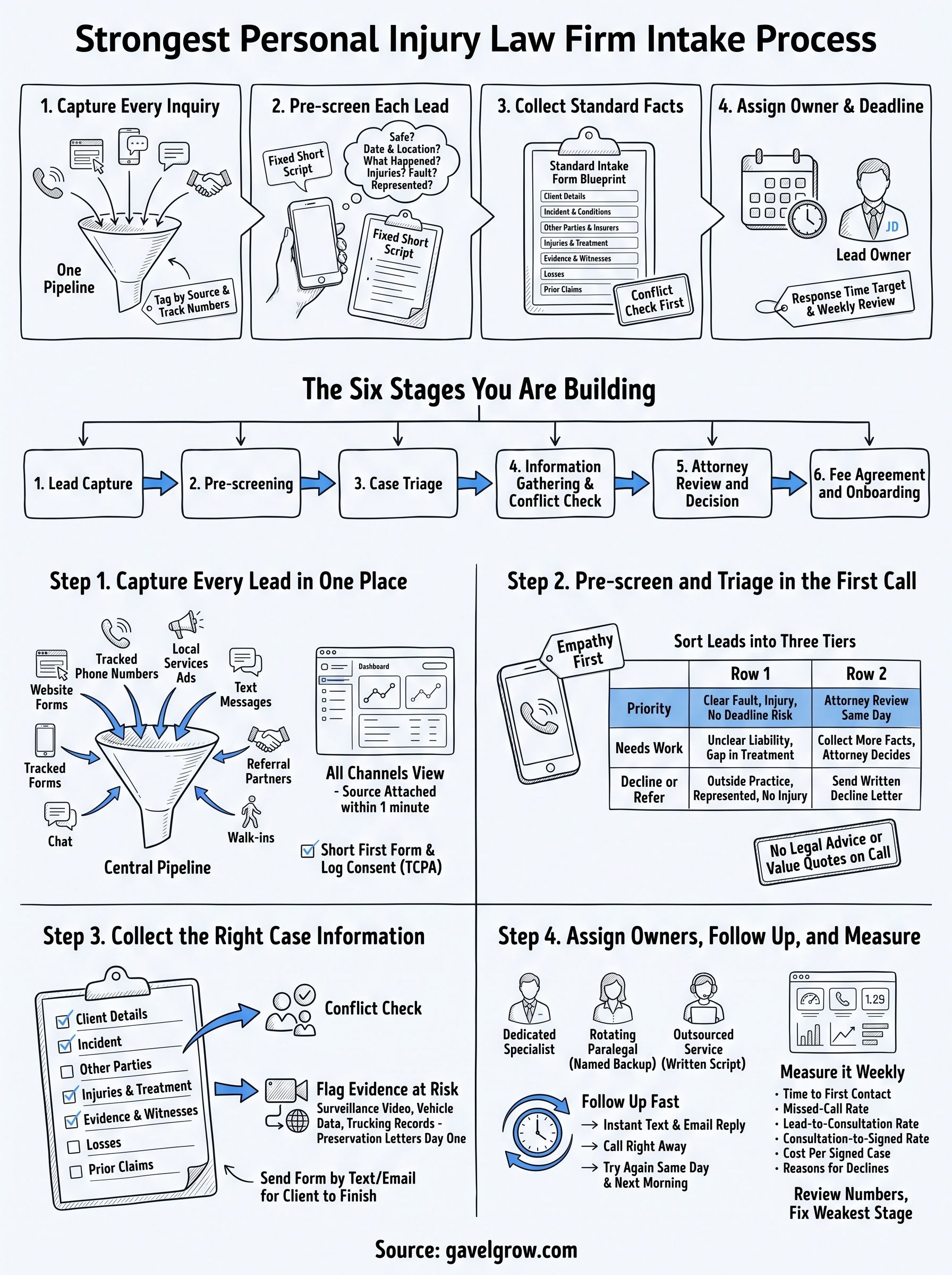
The strongest personal injury law firm intake process has four parts. Capture every inquiry in one pipeline, pre-screen each lead with the same short script, collect a standard set of facts, and give every lead an owner and a response deadline. Write those four parts down, assign people to them, and review the numbers every week.
Most firms already have intake, just not on purpose. A receptionist takes calls, a paralegal checks the web form between other tasks, and an attorney sorts promising cases from a shared inbox. An injured person who calls at 7 p.m. and reaches voicemail will call the next firm on the list. Meanwhile your team burns hours on cases with a missed deadline or no clear liability.
GavelGrow has worked only with law firms since 2015, and intake is where a lead you already paid for either becomes a client or disappears. This guide walks you through four steps. You get a screening script, a triage table, and an intake form blueprint that you can copy into your own system.
Why does your intake process decide which cases you sign?
Your intake process decides which cases you sign because every lead passes through it before an attorney sees the file. A slow or inconsistent personal injury law firm intake process loses good cases to faster firms. A process with no screening buries your attorneys in cases you cannot take. Both problems waste marketing money you already spent.
The stages you are building
Every intake process has the same six stages, whatever the size of the firm:
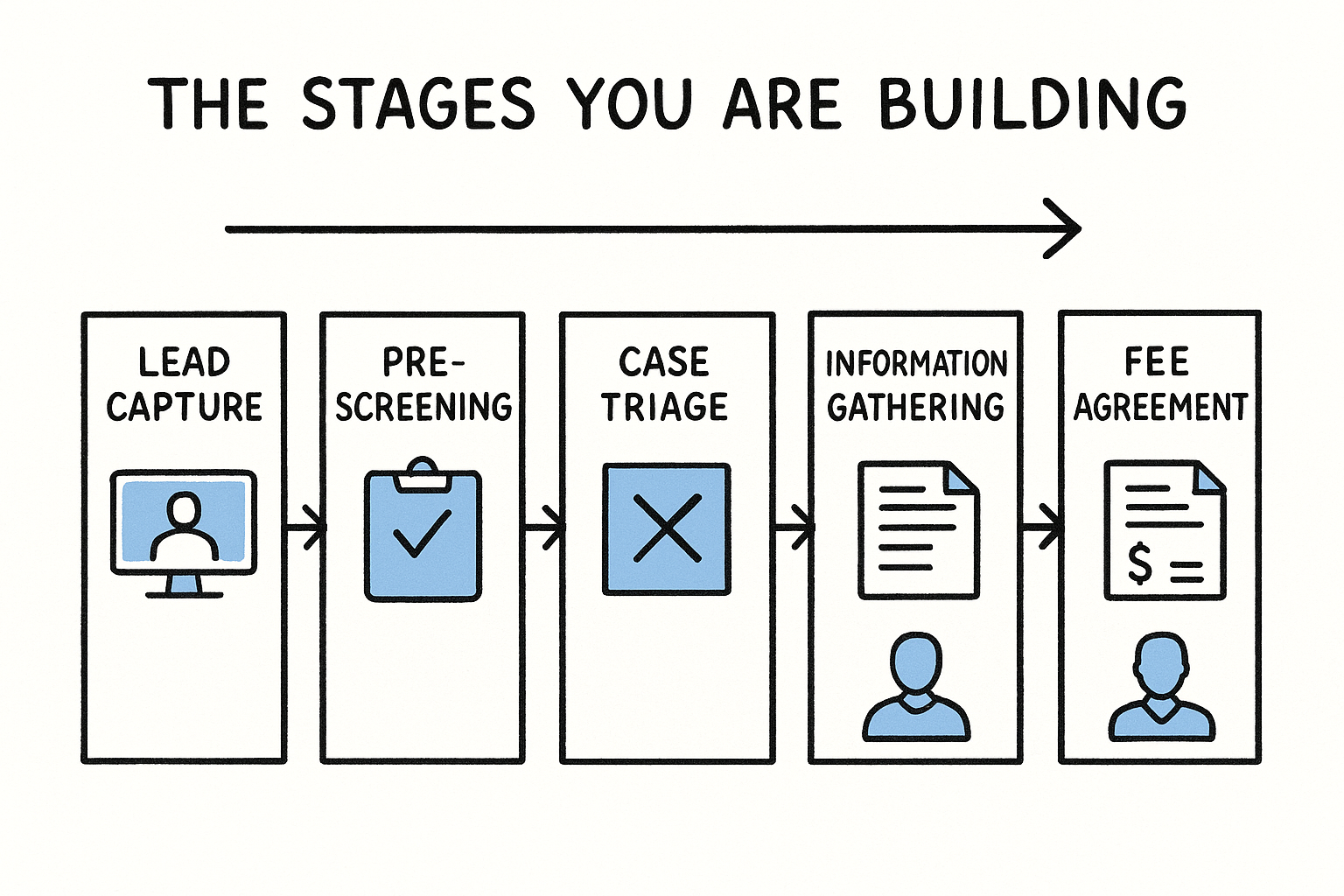
- Lead capture
- Pre-screening
- Case triage
- Information gathering and conflict check
- Attorney review and decision
- Fee agreement and onboarding
The four steps below cover all six. What changes from firm to firm is who does each stage and how fast.
What to settle before you start
Decide five things before you build anything. Write down your case criteria: injury types, minimum severity, liability standards, and the counties or states you cover. Pick one system of record where every lead and note lives. Name an owner for intake, a backup, and a response-time target. Finally, confirm your state's rules on advertising, solicitation, and supervising nonlawyer staff.
Attorneys set the criteria, and staff apply them. Intake staff speak for your firm from the first sentence, so they need a written standard, not instincts. Check your own state bar's rules before you finalize scripts and follow-up messages, because they differ by state.
Intake is the point where a paid lead becomes a client or a wasted click.
Step 1. Capture every lead in one place
Capture means one pipeline that receives every call, form, text, chat, and referral, tagged by source. If leads land in three inboxes and a voicemail box, you cannot respond quickly or measure anything.
Connect every channel to one pipeline
List every way a person can reach you: website forms, tracked phone numbers, Local Services Ads calls, text messages, chat, referral partners, and walk-ins. Give each marketing source its own tracking number so you know which campaign produced the call. Many injured people only phone, so a dashboard that counts web forms alone misses them.
GavelGrow's platform keeps built-in call tracking, call recordings, and a lead pipeline in one view, and adds missed-call texts once carriers approve your firm's texting registration, usually two to three weeks. Whatever system you use, the test is simple. A lead from any channel should appear in the same place within a minute, with its source attached.
Keep the first form short
Your first-touch form should ask for the minimum: name, mobile number, email, one line about what happened, and the incident date. Long forms get abandoned, and the gap is wider on phones than on desktops. Save the detailed questions for later.
Add a separate, unchecked consent box for calls and texts, and keep a record of every consent, because marketing texts sent with an autodialer need the person's prior express written consent under the TCPA. GavelGrow's hosted intake forms are mobile-first, can run as a short two-step form, and log text-message consent with the exact wording the person saw. Here is consent language you can adapt, which your own counsel should review:
Sample consent language: "By checking this box, I agree that [Firm Name] may contact me by phone, text message, and email about my inquiry. Message and data rates may apply. Reply STOP to opt out at any time. Consent is not required to receive legal services."
If a lead cannot reach you through its preferred channel, it will reach someone else.
Step 2. Pre-screen and triage in the first call
Pre-screening means asking the same short list of questions in the first conversation, so you know within minutes whether a lead deserves an attorney's time. Triage then sorts the leads that pass into priority tiers. Together they keep your personal injury law firm intake process fast without making it careless.
Use a fixed pre-screen script
An intake script gives every caller the same experience and makes sure nobody skips the question that matters. Lead with empathy, then move through the facts. Your disqualifiers are simple: the person is already represented, the deadline has passed or is close, liability is unclear, there is no injury or treatment, or the matter falls outside your practice. Deadlines vary by state, and claims against government bodies often carry much shorter notice periods, so flag any date concern for an attorney immediately.
Staff should never quote a case value, promise an outcome, or give legal advice on the call. Use a script like this:
- "I'm sorry this happened. Are you safe, and are you getting medical care?"
- "What date did it happen, and where?"
- "Who else was involved? Please give me the names of any other driver, business, or property owner."
- "Have you spoken with another attorney or signed anything with one?"
- "Briefly, what happened?"
- "What injuries do you have, and who has treated you?"
- "Do you know who was at fault? Was a police or incident report made?"
- "Have you given a statement to any insurance company?"
- "What is the best number and time to reach you? May we text you?"
Run the conflict check on the names from question 3 before the caller gives the detailed account. What a prospective client tells you is protected even if you decline the case, so the check comes first.
Sort leads into three tiers
Tiering decides how fast each lead moves. Use these tiers as a starting point and adjust them to your criteria.
- Priority: clear fault, documented injury and treatment, deadline not at risk, not represented. An attorney reviews the same day and the consultation gets scheduled.
- Needs work: unclear liability, a gap in treatment, or a modest injury. Collect more facts, and an attorney decides within your set window.
- Decline or refer: outside your practice, already represented, deadline passed, or no injury. Send a written decline and refer out when appropriate.

Treat red flags as prompts for questions, not automatic rejections. A shifting account, undisclosed prior claims, or pressure for fast cash deserves a closer look. A prior injury does not disqualify a case by itself.
Decline in writing
Send every declined lead a short non-engagement letter. State that you are not representing them, that deadlines may apply, and that they should speak with another attorney promptly. A written decline protects your firm and leaves the person with a better impression than silence does.
Good triage is a fast, kind no for the wrong cases and a faster yes for the right ones.
Step 3. Collect the right case information
Collect information in two passes. The pre-screen captures the basics, and a full intake form follows for leads in the first two tiers. This keeps your personal injury law firm intake process from overwhelming people who are in pain and short on patience.
Build the standard intake form
Use one form structure for every case, with sections that change by case type. A car crash needs vehicle and insurer details. A slip and fall needs premises and incident report details. Here are the core sections.
- Client details: name, contact, preferred channel, and employer, so you can reach the client and verify identity.
- Incident: date, time, location, conditions, and vehicles or premises, to establish liability facts and deadlines.
- Other parties: names, insurers, and policy and claim numbers, to identify coverage and run conflicts.
- Injuries and treatment: symptoms, providers, ER visit, and prior conditions, to assess damages and gather records.
- Evidence and witnesses: witness contacts, photos, video, and report number, to secure proof before it disappears.
- Losses: missed work, property damage, and out-of-pocket costs, to support the damages picture.
- Prior claims: earlier injuries, claims, or attorneys, to avoid surprises in review.
Send the form by text or email before the consultation, so clients can finish it at home. Pre-fill what you already know from the first call.
Do conflicts first and document everything
Run a conflict check on the client and every adverse party before you collect detailed facts. Prospective clients' information is protected even when you decline the case, as ABA Model Rule 1.18 reflects, so take it seriously.
Keep time-stamped notes in one system, and separate what the client said from what staff inferred. If you record calls, check your state's consent rules first, because some states require every party to agree. Store the recording with restricted access.
Flag evidence at risk
Some evidence disappears on a schedule. Surveillance video gets overwritten, vehicle data can be lost after repairs, and trucking and maintenance records may be purged under routine policies. Add a line to your intake form that asks what evidence exists and who holds it. Then an attorney can decide on day one whether to send preservation letters.
A complete file on day one saves weeks of re-contacting a client who is already exhausted.
Step 4. Assign owners, follow up, and measure
The last step turns your documents into a working team. Someone owns each lead, follow-up is quick and persistent, and the firm tracks results weekly.
Decide who runs intake
You have three common options: a dedicated intake specialist, rotating paralegals, or an outsourced intake service. A dedicated specialist gives the most consistency and removes the "I thought you had it" problem. Rotating staff works for small firms if one person is on point each day with a named backup. Outsourced teams can cover evenings and weekends, but they need your script and your criteria in writing.
Whatever you choose, plan for after-hours calls. Many injured people reach out at night, so a missed-call text and a morning callback beats a silent voicemail box. Supervise intake staff as you would any nonlawyer assistant.
Follow up fast, then keep following up
The Lead Response Management Study found that leads contacted within five minutes were 21 times more likely to qualify than leads first reached at 30 minutes. It measures the odds of qualifying a lead, not signed cases. The direction is still clear: speed gives you the first conversation.
Send an instant text and email reply, call right away, and try again later the same day and the next morning. GavelGrow's intake automation sends email follow-up sequences within minutes of capture, and text sequences once carriers approve your firm's texting registration. When a lead is ready, send the fee agreement for e-signature. Contingency fee agreements must be in writing, so explain the percentage, case costs, and timeline plainly. Be honest that duration depends on injuries, treatment, and the insurer, and never promise a result.
Measure it weekly
Track a short list of intake numbers and review them every week:
- Time to first contact
- Missed-call rate
- Lead-to-consultation rate
- Consultation-to-signed rate
- Cost per signed case
- Reasons for declines
These numbers show where leads leak. If missed calls are high, fix coverage. If consultations rarely sign, review your scripts and fee conversation. The CPA calculator helps you turn spend and signed cases into cost per signed case. If your forms and call handling need work, GavelGrow's conversion rate optimization service covers both.
What you do not measure at intake, you will keep losing without knowing it.
Frequently asked questions about personal injury intake
Should a personal injury firm run a conflict check before hearing the facts?
Yes. Comment [4] to ABA Model Rule 1.18 advises lawyers to limit the initial interview to the information reasonably needed to decide whether to take the matter, because hearing too much can disqualify the firm from representing someone else in the same dispute. Collect the names of the other driver, business, or property owner first, run the check right away, and take the detailed account only after it clears. Request medical records and documents after that point too.
How fast should a personal injury firm respond to a new lead?
Within minutes, at any hour. The Lead Response Management Study found that leads contacted within five minutes were 21 times more likely to qualify than those first reached at 30 minutes. Separately, a 2011 Harvard Business Review study found that firms that tried to contact a lead within an hour were nearly seven times as likely to qualify it as firms that tried even an hour later. Both measure qualification, not signed cases, so track your own time to first contact next to your signed-case rate.
Does a contingency fee agreement have to be in writing?
Yes. ABA Model Rule 1.5(c), which most states follow in some form, requires a contingent fee agreement in a writing signed by the client. It must state how the fee is calculated, including the percentage at settlement, trial, or appeal, which expenses are deducted, and whether they come out before or after the fee. The federal E-SIGN Act of 2000 gives electronic signatures legal effect, so e-signature works as long as your state's version of the rule is met.
Can intake staff text a prospective personal injury client?
Often, yes, with the right consent. Under the FCC's TCPA rules (47 CFR 64.1200(a)(2)), marketing texts sent with an autodialer need the recipient's prior express written consent, so keep an unchecked consent box on your forms and a dated record of the exact wording each person agreed to. Business texting from local numbers also requires A2P 10DLC registration with the carriers, and every message should honor STOP replies. Check your state's rules on attorney solicitation before you script any outreach.
Can a firm record personal injury intake calls?
Yes, with the right disclosure. Federal law (18 U.S.C. 2511(2)(d)) allows recording when one party to the call consents, but several states require every party's consent. California Penal Code section 632, for example, applies that rule to confidential communications. The safe practice is to announce at the start of every call that it may be recorded, store recordings with restricted access, and treat them as confidential prospective-client information. Have counsel confirm the rules for each state you take calls from.
Put your intake process in writing
A good intake process is simple and written down. Capture every lead in one pipeline, screen with a fixed script, sort leads into tiers, collect facts with a standard form, and give every lead an owner and a clock. Then review the numbers weekly and fix the weakest stage first.
You do not need to build everything at once. Start with the pre-screen script and the response-time rule, since those two changes usually matter most. Add the full form, tiering, and reporting as your team gets comfortable.
If you want a second opinion on where your own leads are leaking, schedule a free strategy call with GavelGrow. We will walk through your current intake, your response times, and how your leads move from first contact to signed retainer.
Frequently Asked Questions
Should a personal injury firm run a conflict check before hearing the facts?
Yes. Comment [4] to ABA Model Rule 1.18 advises lawyers to limit the initial interview to the information reasonably needed to decide whether to take the matter, because hearing too much can disqualify the firm from representing someone else in the same dispute. Collect the names of the other driver, business, or property owner first, run the check right away, and take the detailed account only after it clears. Request medical records and documents after that point too.
How fast should a personal injury firm respond to a new lead?
Within minutes, at any hour. The Lead Response Management Study found that leads contacted within five minutes were 21 times more likely to qualify than those first reached at 30 minutes. Separately, a 2011 Harvard Business Review study found that firms that tried to contact a lead within an hour were nearly seven times as likely to qualify it as firms that tried even an hour later. Both measure qualification, not signed cases, so track your own time to first contact next to your signed-case rate.
Does a contingency fee agreement have to be in writing?
Yes. ABA Model Rule 1.5(c), which most states follow in some form, requires a contingent fee agreement in a writing signed by the client. It must state how the fee is calculated, including the percentage at settlement, trial, or appeal, which expenses are deducted, and whether they come out before or after the fee. The federal E-SIGN Act of 2000 gives electronic signatures legal effect, so e-signature works as long as your state's version of the rule is met.
Can intake staff text a prospective personal injury client?
Often, yes, with the right consent. Under the FCC's TCPA rules (47 CFR 64.1200(a)(2)), marketing texts sent with an autodialer need the recipient's prior express written consent, so keep an unchecked consent box on your forms and a dated record of the exact wording each person agreed to. Business texting from local numbers also requires A2P 10DLC registration with the carriers, and every message should honor STOP replies. Check your state's rules on attorney solicitation before you script any outreach.
Can a firm record personal injury intake calls?
Yes, with the right disclosure. Federal law (18 U.S.C. 2511(2)(d)) allows recording when one party to the call consents, but several states require every party's consent. California Penal Code section 632, for example, applies that rule to confidential communications. The safe practice is to announce at the start of every call that it may be recorded, store recordings with restricted access, and treat them as confidential prospective-client information. Have counsel confirm the rules for each state you take calls from.