SEO for Estate Planning Lawyers: What It Is and What Works
Categories: Legal Marketing Strategies
 Abram Ninoyan
Founder & Senior Performance Marketer
Credentials: Google Partner, Google Ads Search Certified, Google Ads Display Certified, Google Ads Measurement Certified, Google Analytics (IQ) Certified, HubSpot Inbound Certified, HubSpot Social Media Marketing Certified, Conversion Optimization Certified
Expertise: Google Ads, Meta Ads, Conversion Rate Optimization, GA4 & Google Tag Manager, Lead Generation, Marketing Funnel Optimization, PPC Management
LinkedIn Profile
SEO for estate planning lawyers is the work of making your firm's website, Google Business Profile, and reputation easy for Google to find and easy for a family to trust when they search for a will, a...
Key Takeaways
- SEO for Estate Planning Lawyers: What It Is and What Works
- Why does SEO matter for estate planning lawyers?
- How do you build a local SEO foundation?
- What should your estate planning pages include?
SEO for Estate Planning Lawyers: What It Is and What Works
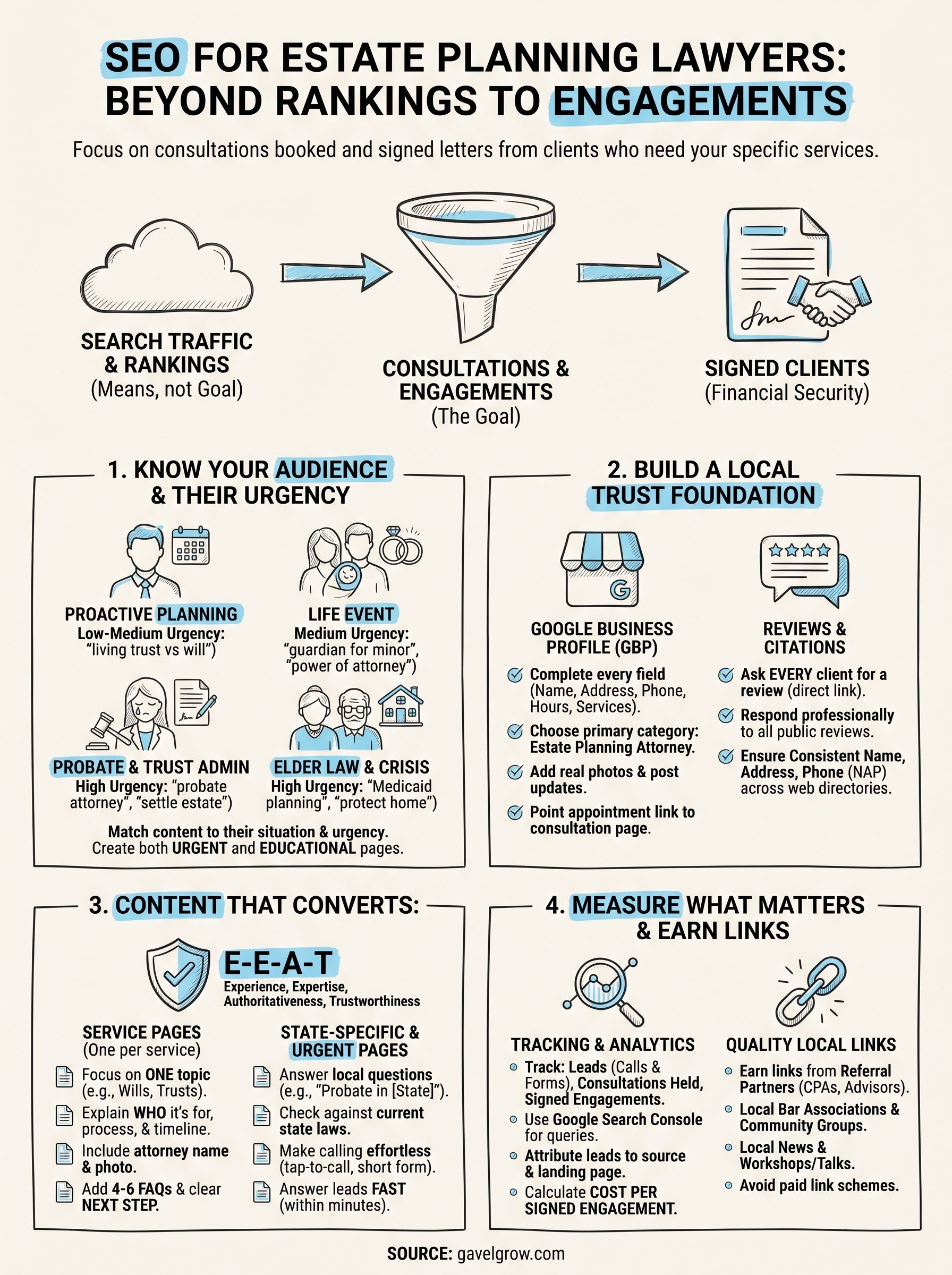
SEO for estate planning lawyers is the work of making your firm's website, Google Business Profile, and reputation easy for Google to find and easy for a family to trust when they search for a will, a trust, or probate help. The goal is not traffic. It is consultations booked and engagement letters signed by people who need what you actually sell.
Estate planning suits organic search because the work is local, the client researches before calling, and the decision rests on trust. This article explains why search matters for your practice, how to build the local foundation, what your pages need, how to earn links and measure results, and how to decide between doing it yourself and hiring help.
GavelGrow has marketed only for law firms since 2015, so this guide measures SEO the way a managing partner does: by signed engagements, not rankings. Advertising rules differ by state, so check your state bar's rules before you publish anything described here.
Why does SEO matter for estate planning lawyers?
SEO matters because families compare a few firms in one sitting, and the firms in the local map results and top organic listings get the first call. Even a prospect who hears your name from a CPA or a friend will search for you before dialing, so your search presence shapes every lead, referred or not.
How estate planning clients actually search
Estate planning demand is not one audience. It splits into four groups with different urgency, and each types different words into Google. Matching your site to these groups is the core of estate planning SEO, because a page that tries to serve all four serves none of them well.
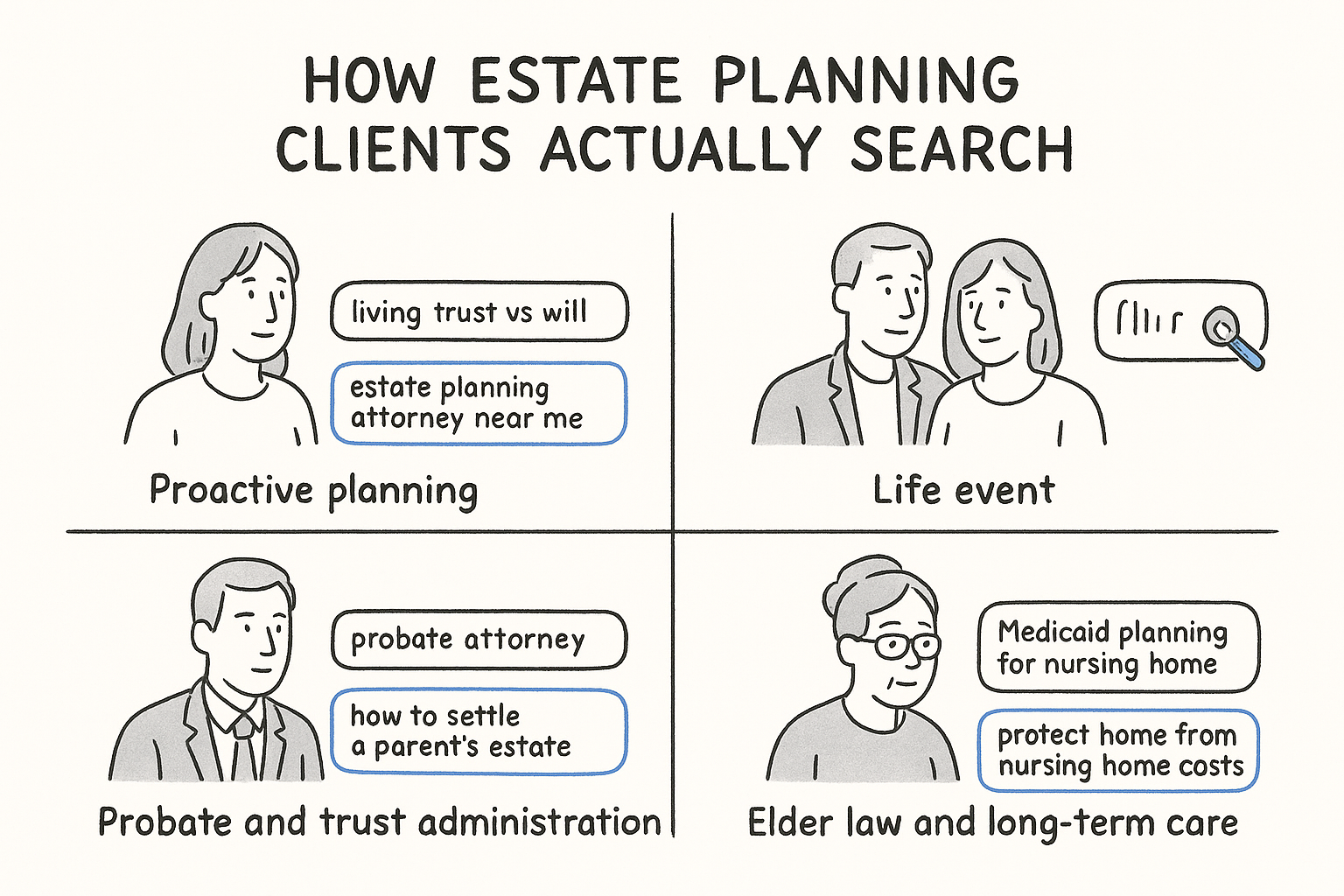
The two reactive groups tend to hire quickly because a deadline or a health event is driving them. The planning groups read for longer and often book after two or three pages. Build urgent pages that make calling effortless and educational pages that keep a researching family on your site.
Why trust carries so much weight in this niche
Google holds content on topics that affect people's financial security to a higher standard. Its guidance on helpful, people-first content says its systems give more weight to strong experience, expertise, authoritativeness, and trustworthiness on those topics, and it asks readers to be able to see who wrote a page and why. Advice about wills, trusts, and probate plainly fits.
A family handing over details about assets, children, and health also wants proof before calling. They look for a named attorney, a real office, and explanations in plain language. A site of anonymous, generic copy loses to one with a photo, a bar admission, and a clear explanation of how your process works.
What SEO will and will not do for your firm
Some firms report that SEO brings in people who want free advice or the cheapest document. That is usually a targeting problem. Pages built around "free will template" attract template shoppers, while pages built around "revocable living trust attorney" and "probate attorney" attract people ready to hire. Choose the searches you want before you write a word.
SEO also compounds slowly and guarantees nothing. No honest provider can promise a ranking or a number of clients. What you can control is whether each page matches a real client situation and offers one clear next step.
Estate planning SEO works when each page matches one client situation and one next step.
How do you build a local SEO foundation?
Start with a complete Google Business Profile, consistent firm details across the web, and a steady flow of genuine reviews. Local map results lean heavily on these signals, and they cost far less than content production.
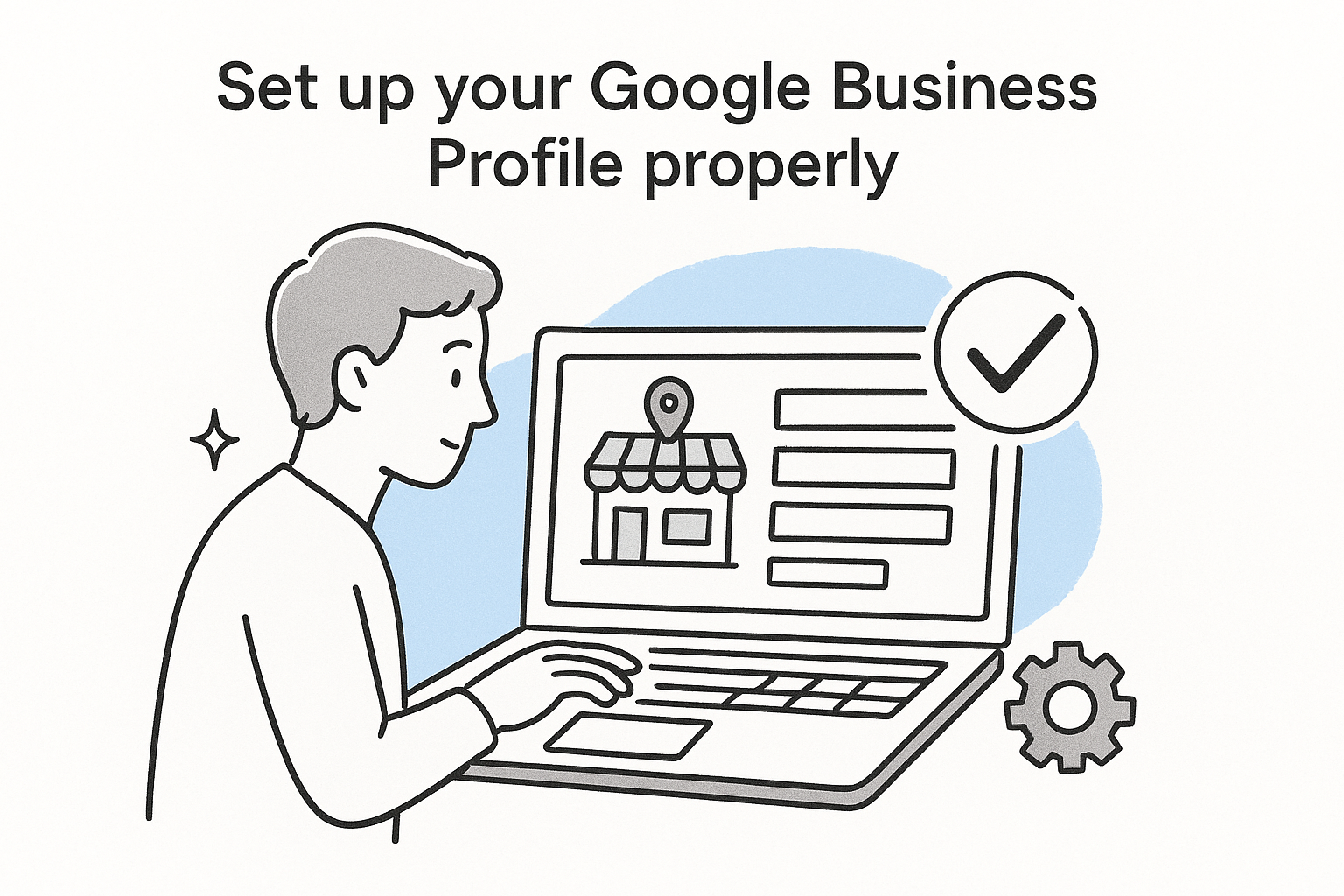
Set up your Google Business Profile properly
Your profile is the first thing many prospects see, often before your website. Treat it as a landing page and complete every field:
- Primary category: choose the one that matches your core work, such as estate planning attorney, and add secondary categories only for services you actually offer.
- Business name: use your real firm name exactly as it appears on your signage and letterhead. Adding keywords to the name violates Google's guidelines and risks suspension.
- Address, hours, and phone: keep them identical to your website. If you meet clients only by appointment, follow Google's rules for that setup.
- Services and description: list wills, trusts, powers of attorney, probate, and any other service you handle, in plain language.
- Photos and posts: add real photos of the office and attorneys, and post occasionally about seminars or new guides.
- Appointment link: point it to a consultation page, not a generic home page.
Earn reviews the way Google allows
Reviews decide many close calls, and estate planning clients are often at their happiest right after they sign. Ask every client, not a selected few, and send the request with a direct link to your profile. Resolve complaints with the client directly, and respond professionally to every public review.
Three practices put your profile at risk, so avoid them. Do not route unhappy clients to a private feedback form before they can post publicly. Do not ask only clients you expect to be satisfied. Do not offer gifts or discounts for reviews. Google's review policies prohibit all three.
Responding has a confidentiality catch. Never confirm that a reviewer was your client or mention any detail of the matter. A short reply such as "We take every concern seriously, and we would welcome a call from you" protects you. Check your state bar's guidance on responding to reviews.
Keep your firm details consistent across the web
Citations are listings of your firm's name, address, and phone number on other sites. Google compares them to confirm you exist where you say you do, so mismatches create doubt. An old suite number or a former phone line on a directory can undercut your profile.
Audit the major legal directories, your state and local bar listings, your chamber of commerce, and any site from a prior address. Choose one format for the firm name and use it everywhere. Then fix or remove stale listings.
A complete profile, honest reviews, and identical firm details everywhere are the cheapest local SEO gains you will find.
What should your estate planning pages include?
Build one page for each service and each client situation, written or reviewed by an attorney, answering the questions a prospect has before calling. Thin pages that name a service and ask for a call rarely compete.
Build one page for each service
A single "Practice areas" page cannot rank for six different searches. Give each core service its own page, such as wills, revocable living trusts, powers of attorney and health care directives, probate, trust administration, special needs planning, and elder law planning. Each page should cover:
- Who the service is for and what problem it solves
- The steps of your process, from first meeting to signing
- A realistic timeline
- How you charge, whether flat fee or hourly, if you are comfortable stating it
- What the client should bring to the first meeting
- State-specific rules that affect the outcome
- Four to six frequently asked questions
- The attorney's name, photo, and a clear next step
Explaining your fee structure tends to filter out price shoppers and reassures serious ones, which speaks to the lead-quality complaint many firms have. Keep each page focused on one primary topic.
Write state-specific and comparison content
Estate law is state law, so the strongest informational content is local. Articles like how probate works in your state, what happens when someone dies without a will, what a trustee must do, and when a trust is worth the cost speak to searches that national sites cannot answer well. Check every legal statement against current law before you publish, and review it on a schedule, since statutes and thresholds change.
Create city or county pages only for places you actually serve, and give each unique content, such as the local probate court's process. Pages that swap a city name into identical text are thin and can drag down your site. A single well-built county page is worth more than twenty copies.
Make every page easy to act on
A page that ranks but does not convert wastes the work. Put a tap-to-call number and a short form where a mobile visitor can reach them without scrolling, because forms tend to perform worse on phones than on desktops. Ask for a name, a phone number, and a one-line description of the need. Add a way to book a consultation directly.
Then answer fast. The Lead Response Management Study found that leads contacted within five minutes are far more likely to be qualified than those first reached at thirty minutes. That measures the odds of qualifying a lead, not signed cases, but the direction is clear: speed of response is part of SEO. A missed call from a grieving family may not ring twice.
Each page needs one primary topic, an attorney's name on it, and a next step the visitor can take in seconds.
Earning links and measuring what SEO delivers
Authority comes from links from sources that know you locally, and results should be judged by consultations and signed engagements, not by rankings or traffic.
Earn links that Google and clients both respect
Links from real, relevant sites signal that others vouch for you. For an estate planning firm, the natural sources are relationships you already have:
- Referral partners: CPAs, financial advisors, and insurance professionals who may mention your guides on their own sites.
- Local and state bar associations: committee pages, speaker listings, and member directories.
- Workshops and talks: event pages from libraries, senior centers, and community groups you present to.
- Local news: comment on a change in state estate law, and give reporters a quote.
Skip paid link packages and automated outreach. Google's spam policies treat link schemes as violations, and a penalty is far costlier than slow growth. A handful of local links from people who know your work beats hundreds from unrelated sites.
Track consultations and signed engagements
Rankings are a means, not the result. Track four numbers each month: leads (calls and forms), consultations held, signed engagements, and the source and landing page behind each. Google Search Console, which is free, shows the queries and pages that earn clicks. Your profile's performance data shows calls and direction requests. Add call tracking numbers to your website so phone leads are attributed, since many estate planning prospects never fill out a form. GavelGrow's platform includes built-in call tracking and carries attribution from the first click through to the signed retainer.
Here is a hypothetical example to show the math. These are illustrative figures, not benchmarks.
Now suppose 18 of those 30 leads were phone calls and you only tracked form fills. You would see 12 leads and a cost of $250 per lead, and you would misjudge what worked. Compare cost per signed engagement with the fees that engagement earns, and judge the program over several quarters, not several weeks.
If you cannot connect a ranking to a signed engagement, you are measuring the wrong thing.
Should you hire an SEO agency or handle it in-house?
Keep the work that needs an attorney's voice and judgment, and hire for the sustained technical, content, and link work, especially if no one at the firm owns marketing. Most firms end up with a split.
What you can do yourself for free
The core tools cost nothing. Google Business Profile and Google Search Console are free, and so are review requests and attorney-written service pages. What you spend is time, and attorney time is expensive. A realistic in-house routine is to fill out your profile, request reviews after every signing, and write or approve one strong page a month.
Where firms stall is consistency and technical work: site speed, indexing problems, schema markup, link outreach, and keeping dozens of pages current. That is where outside help pays for itself.
How to evaluate an SEO agency
Judge an SEO company on how it works, not on its pitch. Ask these questions:
- Does it work only with law firms, and does it understand state bar advertising rules?
- Will it work for competing firms in your market, or does it offer exclusivity?
- Who owns the website, profile, and analytics accounts if you leave?
- Is the contract month-to-month, or does it lock you in?
- Who writes the content, and does an attorney review it before it goes live?
- Will it report calls, consultations, and signed engagements, or only rankings and traffic?
Walk away from anyone who guarantees rankings, buys links, or builds near-duplicate city pages. Read their Google reviews and ask for references from a firm with a similar practice area. You can check ours too: GavelGrow has a 4.9 rating on Google.
GavelGrow's managed services include organic and local SEO run by a legal-only team. Engagements are scoped on a strategy call, and GavelGrow does not run marketing for two direct competitors in the same market.
Hire for the work you cannot do consistently, and keep ownership of your accounts and your attorney voice.
Frequently asked questions
These are the questions managing partners ask most often once the basics are clear.
How long does SEO take to bring in estate planning clients?
Plan on several months of steady work before judging results. Profile changes and new service pages can show movement sooner than competitive organic rankings, while links and content compound slowly. Review leading indicators monthly: Search Console impressions and clicks, profile calls, and consultations booked. A fair checkpoint is the end of the second or third quarter, when you can compare signed engagements against spend and decide whether to expand, adjust, or stop.
Can you do SEO for an estate planning firm for free?
Yes, the core tools cost nothing. Google Business Profile and Google Search Console are both free, and requesting reviews and writing attorney-authored pages costs only your time. Paid costs appear when you add link building, technical fixes, content production, or call tracking numbers. Many firms run the profile and reviews themselves and outsource the rest, which keeps the attorney's voice where it matters.
Does AI search change SEO for estate planning lawyers?
Google has said that the same foundational SEO practices apply to its AI features in Search, so there is no separate trick to learn. What helps is the same work you already need: clear answers stated in the first two sentences of a page, a named attorney, consistent firm details, and genuine reviews. Pages that answer a question directly are also easier for any system to quote accurately.
Do state bar rules affect SEO content?
Yes. Advertising rules are set state by state and reach things SEO pages commonly include: testimonials and reviews, claims of specialization or expertise, and anything that implies an outcome. Some states restrict terms like "specialist" or "expert" unless a recognized certification supports them. Never promise results or call your firm the best or top in your area, and check your own state bar's rules before publishing.
How much should an estate planning firm spend on SEO?
Work backward from the value of a signed engagement. Decide what a new client is worth in fees, what share of that you can afford to spend to acquire them, and how many signings you want each month. GavelGrow's free cost-per-acquisition calculator runs that math. Agency fees vary with scope, so get the scope in writing before you compare quotes.
A defensible SEO budget starts from cost per signed engagement, not from a rankings goal.
Your next step
Estate planning SEO comes down to a few moves done well: a complete profile with honest reviews, one focused page for each service and client situation, links from people who know your work, and tracking that follows a lead all the way to a signed engagement. Start with the profile and the review process this week, because they cost the least and pay back first.
If you would rather have a legal-only team build and run it, look at GavelGrow's SEO service for law firms. Whichever route you choose, hold the work to the same test: did it bring in people who signed?
Frequently Asked Questions
How long does SEO take to bring in estate planning clients?
Plan on several months of steady work before judging results. Profile changes and new service pages can show movement sooner than competitive organic rankings, while links and content compound slowly. Review leading indicators monthly: Search Console impressions and clicks, profile calls, and consultations booked. A fair checkpoint is the end of the second or third quarter, when you can compare signed engagements against spend and decide whether to expand, adjust, or stop.
Can you do SEO for an estate planning firm for free?
Yes, the core tools cost nothing. Google Business Profile and Google Search Console are both free, and requesting reviews and writing attorney-authored pages costs only your time. Paid costs appear when you add link building, technical fixes, content production, or call tracking numbers. Many firms run the profile and reviews themselves and outsource the rest, which keeps the attorney's voice where it matters.
Does AI search change SEO for estate planning lawyers?
Google has said that the same foundational SEO practices apply to its AI features in Search , so there is no separate trick to learn. What helps is the same work you already need: clear answers stated in the first two sentences of a page, a named attorney, consistent firm details, and genuine reviews. Pages that answer a question directly are also easier for any system to quote accurately.
Do state bar rules affect SEO content?
Yes. Advertising rules are set state by state and reach things SEO pages commonly include: testimonials and reviews , claims of specialization or expertise, and anything that implies an outcome. Some states restrict terms like "specialist" or "expert" unless a recognized certification supports them. Never promise results or call your firm the best or top in your area, and check your own state bar's rules before publishing.
How much should an estate planning firm spend on SEO?
Work backward from the value of a signed engagement. Decide what a new client is worth in fees, what share of that you can afford to spend to acquire them, and how many signings you want each month. GavelGrow's free cost-per-acquisition calculator runs that math. Agency fees vary with scope, so get the scope in writing before you compare quotes. A defensible SEO budget starts from cost per signed engagement, not from a rankings goal.