SEO for Mass Tort Lawyers: 5 Ways to Reach Claimants Early
Categories: Legal Marketing Strategies
 Abram Ninoyan
Founder & Senior Performance Marketer
Credentials: Google Partner, Google Ads Search Certified, Google Ads Display Certified, Google Ads Measurement Certified, Google Analytics (IQ) Certified, HubSpot Inbound Certified, HubSpot Social Media Marketing Certified, Conversion Optimization Certified
Expertise: Google Ads, Meta Ads, Conversion Rate Optimization, GA4 & Google Tag Manager, Lead Generation, Marketing Funnel Optimization, PPC Management
LinkedIn Profile
SEO for mass tort lawyers means ranking your firm's pages for the searches claimants make before they look for an attorney: symptoms, product names, recalls, and "can I sue" questions. It wo...
Key Takeaways
- SEO for Mass Tort Lawyers: 5 Ways to Reach Claimants Early
- How does SEO work for a mass tort practice?
- 1. Map keywords to claimant awareness stages
- 2. Publish medically accurate pillar pages
SEO for Mass Tort Lawyers: 5 Ways to Reach Claimants Early
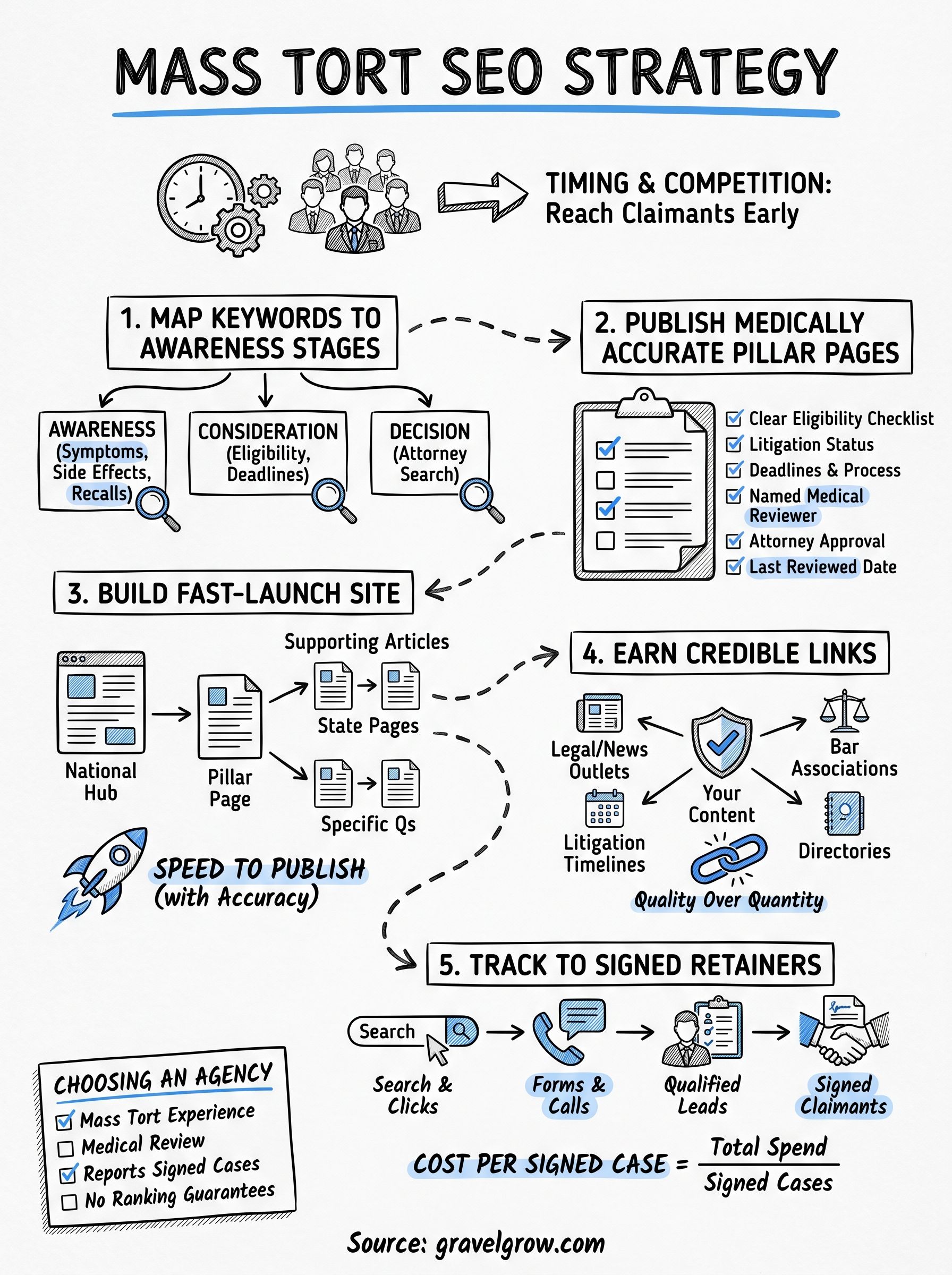
SEO for mass tort lawyers means ranking your firm's pages for the searches claimants make before they look for an attorney: symptoms, product names, recalls, and "can I sue" questions. It works when you map keywords to each stage of claimant awareness, publish medically accurate pillar pages, keep the site fast and crawlable, earn credible links, and track results to signed retainers. Firms launching on a new tort should start with the keyword map and content. Firms that already get traffic but cannot say which pages sign cases should start with tracking.
The problem is timing and competition. Most people with a valid claim do not know it yet. They notice a symptom, hear about a recall, and search Google. The firm that explains what is happening, accurately and early, is the one they remember when they are ready to call. Meanwhile every firm filing the same tort chases the same national keywords, and rankings take months to move.
This guide explains how mass tort SEO works, walks through five strategies in the order we would tackle them, and then shows you how to decide whether to hire an agency. GavelGrow has marketed only for law firms since 2015, so the advice leans on how legal marketing actually gets measured: signed cases, not clicks. Check your state bar's advertising rules before you publish any claimant-facing page.
How does SEO work for a mass tort practice?
SEO for a mass tort practice puts educational, accurate content in front of claimants when they first research a symptom or a product, then guides them to your intake form or phone number. The difference from local personal injury SEO is the audience, the geography, and the clock.
How mass tort search behavior differs from local injury work
A car accident client searches "car accident lawyer near me" right after a crash. A mass tort claimant searches for symptoms or side effects months or years after exposure, often with no idea a lawsuit exists. That makes your first touchpoint an explainer, not a sales page.
In mass tort SEO, the first page a claimant reads should explain, not sell.
What a realistic timeline looks like
Plan on three to six months before new pages move for competitive terms, and about a year before you judge return. Long-tail symptom and eligibility searches usually move first, and attorney searches move last. Be wary of any provider who promises page-one rankings in 30 days.
Torts also follow a lifecycle of rising awareness. Content published before awareness peaks has more time to earn links and rankings than content published during the rush. You cannot control when a tort heats up, so the strategies below also cover how to launch fast.
1. Map keywords to claimant awareness stages
Keyword research for mass torts starts with symptoms and product names, not with "mass tort lawyer." Build one keyword map per tort with three tiers, one for each stage of claimant awareness.
How to build the map
Each tier needs its own page type, because a person asking about side effects wants something different from a person ready to retain counsel. The examples below show the shape of each query, with a placeholder where the product name goes.
Find the terms with Google Trends for breakout queries, Search Console for queries you already appear for, and a keyword tool for volume and difficulty. Read how claimants describe symptoms in forums and in Google's "People also ask" boxes. Their words beat clinical vocabulary for awareness-stage pages, while the medical terms belong in the body text.
Where firms go wrong
The most common mistake is chasing only decision-stage keywords. They carry the highest intent and the fiercest competition, and a new page rarely breaks in. You also lose every claimant who is still asking what is wrong.
The second mistake is cramming all three stages onto one page. A page that tries to explain symptoms, qualify claimants, and sell your firm usually does none of it well. Give each stage its own page and link them together.
Win the awareness search and you are already in the room when the attorney search happens.
2. Publish medically accurate pillar pages
Each active tort needs one pillar page covering eligibility, case status, deadlines, and the litigation process, supported by narrower articles that answer specific questions.
What the pillar page covers
Write the page so a claimant can decide in a few minutes whether to call. A clear eligibility checklist does more than paragraphs of legal explanation, and a last reviewed date tells readers the status is current. Only change that date when the content actually changed.
- What the product or exposure is and which injuries are alleged
- Who may qualify, as a short checklist
- Where the litigation stands, in plain English
- How filing deadlines work and why they vary by state
- What happens after a claimant contacts your firm
- A prominent phone number and intake form
How to keep it accurate and trustworthy
Mass tort content is health and legal information, the kind Google holds to a higher standard. Its guidance on helpful, people-first content asks who wrote the page, how, and why. Answer all three on the page. Use an attorney byline with a real bio, add a named medical reviewer for explainers, and cite primary sources such as FDA notices, CDC pages, and court dockets.
Never promise outcomes or compensation amounts, and never present a general explanation as advice for one person's situation. State bar advertising rules differ by state, so have an attorney in your firm approve every claim.
A page with no named author and no named medical reviewer asks readers to trust a stranger.
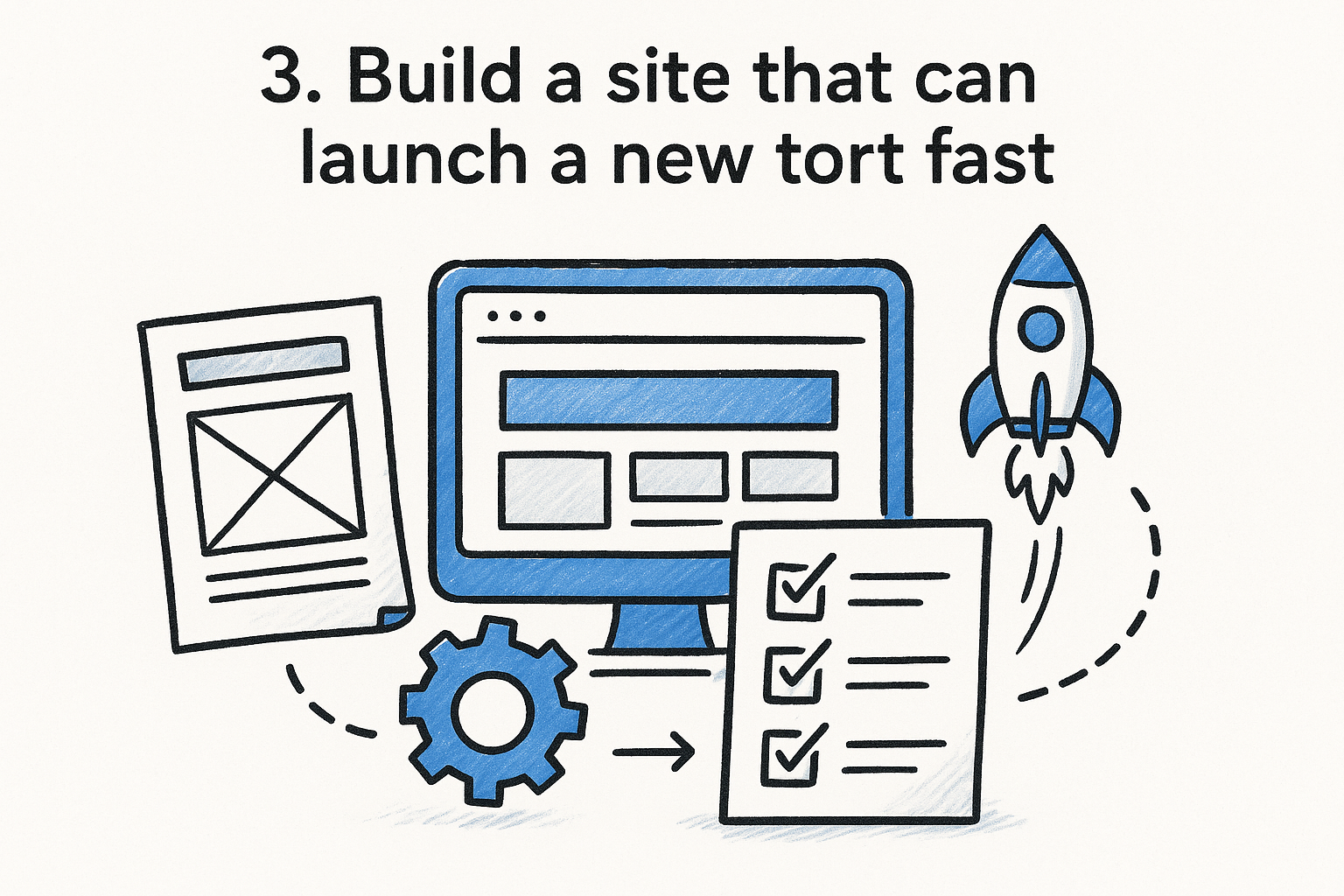
3. Build a site that can launch a new tort fast
Your site needs clean architecture and a repeatable process, so you can publish a complete, reviewed tort section within days of a recall or a litigation milestone.
The technical basics at scale
A growing tort library multiplies small technical SEO problems. Check these before you add pages:
- Fast mobile pages. Test with PageSpeed Insights and fix what it flags. Many claimants search from a phone.
- Crawlable structure. Link from a tort hub to the pillar page to each supporting article, and keep an XML sitemap current.
- One unique page per tort. Do not reuse text across tort pages with the product name swapped.
- Content before disclaimers. Keep long legal boilerplate from pushing the answer down the page.
- Accurate structured data. Mark up your organization and articles, with authors, only where the markup matches what is on the page.
National pages, state pages, and launch templates
Build the national pillar page first. Add state pages only where you can add something real, such as how deadlines differ in that state or where your attorneys are licensed. Near-identical pages with only the state name changed are thin content, and mass-produced pages can fall under Google's spam policies.
Then write a launch template: the outline, the intake form, the internal links, and the reviewer already assigned. When news breaks, your team fills in facts instead of designing a page. Speed to publish helps only if the page is also correct, so keep the medical and attorney review inside the template.
Speed to publish matters only if the page is accurate, so build the review step into the template.
4. Earn links from credible legal and news sources
Authority comes from credible sites linking to your pages because your content is useful. In a market where every firm targets the same terms, links are often what separates page one from page three.
Link sources that work
Focus on sources your claimants and journalists actually read, and pursue them through the work you already do:
- Bylined commentary from your attorneys in legal and trade publications on litigation developments
- Expert comment for journalists covering a tort in national or local news
- Bar association and legal organization listings and speaking pages
- Reputable legal directories with consistent firm information
- A maintained, plain-English litigation timeline that other sites want to cite
- Nonprofit and community partnerships, checked first against your state bar's rules
The last resource works because it is the kind of page people cite. It also earns links over time instead of needing outreach every month.
What to avoid
Skip bought links, link networks, and bulk guest posts. Google treats link schemes as spam, and a penalty on a site carrying your tort pages costs far more than the links ever returned. Be just as careful with any provider who runs a web of lead-generation domains and promises to point them at you.
Judge a link by its relevance and readership, not by a count in a monthly report.
One link from a publication lawyers and journalists read beats fifty from sites nobody reads.
5. Track organic results to signed claimants
Track organic search like every other channel: from the first visit to the signed retainer, by tort and by landing page.
What to measure
Rankings and impressions show whether content is gaining ground. They do not show whether it signs claimants. Measure each step of the path:
- Impressions and clicks by tort in Search Console
- Form fills and phone calls by landing page
- Qualification rate: the share of leads who meet the case criteria
- Signed claimants per tort
- Cost per signed case
Many claimants phone instead of filling in a form, so give organic traffic its own call tracking number. GavelGrow's marketing platform includes built-in call tracking, intake forms, and case-level attribution. It starts at $199/month on Track or $599/month on Optimize, with a 7-day free trial and no credit card.
Speed also matters after the lead arrives. The Lead Response Management Study found that leads contacted within five minutes were far more likely to be qualified than leads first reached at thirty minutes. That measures odds of qualifying a lead, not signed cases, but it is a good reason to automate your first reply.
A worked example of cost per signed case
The figures below are hypothetical, to show the math. Say a firm spends $9,000 a month on SEO, or $27,000 over a quarter, covering content, links, tools, and review.
Run your own numbers in GavelGrow's cost-per-acquisition calculator. Because rankings take months, judge organic search on rolling quarters. Early months will show cost with little signed output, and that pattern is normal.
Rankings and traffic are inputs; signed claimants and cost per signed case are the result.
How do you choose an SEO agency for mass tort work?
Choose an agency that can show mass tort experience, uses medical review, reports on signed cases, and refuses to promise rankings. If a provider cannot meet all four, keep looking or build the work in-house.
Questions to ask before you sign
Put these to every provider you consider, and expect specific answers:
- Which torts have you worked on, and how do you handle medical review?
- Who writes the content, and who checks it before it goes live?
- Do you report on signed cases, or only on rankings and traffic?
- Do you work for other firms in my tort or my market?
- How do you handle state bar advertising rules?
- Who owns the website, accounts, and content if we leave?
- What is the contract term, and how do we cancel?
Red flags include guaranteed rankings, bulk-produced pages, link buying, and reports that stop at traffic. An agency that reports only on rankings is reporting on its own work, not on your cases.
An agency that reports only on rankings is reporting on its own work, not on your cases.
In-house, general agency, or legal-only team
GavelGrow's done-for-you SEO is legal-only. On managed engagements it does not run marketing for two direct competitors in the same market, and each firm gets a named contact instead of a ticket queue. Agency plans are month-to-month, and pricing is scoped on a free 45-minute strategy call. Ask us the same seven questions you ask everyone else.
Where to start with mass tort SEO
Mass tort SEO rewards firms that reach claimants while they are still asking what is wrong. Build the keyword map for the tort you are litigating, publish an accurate pillar page with a named reviewer, keep the site ready to launch the next tort, earn links that matter, and measure everything down to cost per signed case.
If you want a legal-only team to build and run this, see how GavelGrow's done-for-you SEO service for law firms works.