Signed Case Attribution: From Ad Click To Signed Retainer
Categories: Legal Marketing Strategies
Founder & Senior Performance Marketer
Credentials: Google Partner, Google Ads Search Certified, Google Ads Display Certified, Google Ads Measurement Certified, Google Analytics (IQ) Certified, HubSpot Inbound Certified, HubSpot Social Media Marketing Certified, Conversion Optimization Certified
Expertise: Google Ads, Meta Ads, Conversion Rate Optimization, GA4 & Google Tag Manager, Lead Generation, Marketing Funnel Optimization, PPC Management
LinkedIn Profile
Signed case attribution is the practice of tracing every signed retainer agreement back to the exact ad click, keyword, or campaign that started the relationship, giving law firms a true cost-per-sign...
Key Takeaways
- Signed Case Attribution: From Ad Click To Signed Retainer
- Key Takeaways
- What is signed case attribution for law firms?
- Why Signed Case Attribution Beats Lead Attribution
Signed Case Attribution: From Ad Click To Signed Retainer
Signed case attribution is the practice of tracing every signed retainer agreement back to the exact ad click, keyword, or campaign that started the relationship, giving law firms a true cost-per-signed-case instead of a misleading cost-per-lead. If your firm spends $20K a month on Google Ads but can't tell which campaigns actually produce retained clients, you're making budget decisions with incomplete data.
Most law firms track clicks, maybe form fills, and stop there. The gap between "lead captured" and "retainer signed" can stretch weeks or months, and that's where attribution falls apart. In practice areas like personal injury, that stretch tends to run longest. Generic analytics tools weren't built for that timeline. Legal-specific platforms like GavelGrow bridge that gap by connecting ad spend data to intake pipelines and case outcomes, so every dollar is accountable through the full funnel.
This article breaks down how signed case attribution works, why standard marketing metrics fail law firms, and what your firm needs to measure the only metric that matters: revenue generated per marketing dollar spent.
Key Takeaways
Before diving into the mechanics, here are the most important points your firm needs to know about signed case attribution and why it changes how you allocate your marketing budget.
- Signed case attribution tracks every retainer back to the specific ad, keyword, or campaign that generated the client.
- Cost-per-lead is a vanity metric for law firms; cost-per-signed-case is the number that drives real budget decisions.
- Attribution breaks down when intake data and ad platforms stay disconnected, which is the default for most firms.
- A full-funnel setup requires tracking numbers, intake forms, a CRM, and ad platform sync working together.
- Firms that close the attribution gap can cut wasted ad spend and reinvest in the campaigns that actually produce retained clients.
Without a direct line from ad click to signed retainer, your marketing decisions are based on guesswork, not evidence.
Why This Matters More for Legal Than Any Other Industry
Legal has the longest and most complex sales cycle of any service category. A personal injury client may submit a form in January and sign a retainer in March. Standard digital marketing tools report conversions at the click or form-fill stage, which means your Google Ads dashboard might show a campaign as a winner while the cases it generates never actually close. That gap is unique to legal, and it's why off-the-shelf attribution solutions consistently fail law firms.
Your firm needs a system that holds attribution data open across weeks or months, then closes the loop when a retainer is signed. Platforms built for legal intake, like GavelGrow, carry the originating campaign data all the way through the pipeline so the final cost-per-signed-case is always calculable, not estimated.
What is signed case attribution for law firms?
Signed case attribution is the process of connecting each signed retainer agreement to the specific marketing source that generated the client, whether that's a Google Ads campaign, an organic search click, a Local Services Ad, or a referral. For law firms, it replaces guesswork with a clear record: this campaign produced this client, at this cost.
How It Differs From Standard Marketing Attribution
Most marketing attribution models stop at the lead event, meaning the form fill or the phone call. That works fine for e-commerce, where a purchase closes the loop in minutes. Legal is different. Your intake team qualifies leads, schedules consultations, sends retainer agreements, and follows up across weeks or months before a case is signed.
Signed case attribution keeps the originating campaign data attached to a lead through every stage of your intake pipeline, closing the loop only when a retainer is actually signed.
Your firm needs attribution logic that matches your actual sales cycle, not a 30-day conversion window built for an online retailer. That means your call tracking data, intake forms, CRM status updates, and ad platform reporting all need to share the same source-of-truth record for each lead.
Why Signed Case Attribution Beats Lead Attribution
Lead attribution tells you how many people submitted a form or called your number. Signed case attribution tells you how much revenue each campaign actually generated. Those are fundamentally different measurements, and confusing one for the other is how firms waste significant ad spend on campaigns that look productive but never close.
A campaign with a low cost-per-lead but a high disqualification rate can cost far more per signed case than a campaign with fewer, better-qualified leads.
The Problem With Cost-Per-Lead as Your North Star
Cost-per-lead rewards volume, not quality. A personal injury campaign generating 50 leads at $100 each looks better on a dashboard than one generating 10 leads at $300 each. But if the first campaign produces zero signed retainers and the second produces eight, you have been optimizing for the wrong number the entire time. Lead attribution hides that difference completely.

What Revenue-Based Attribution Actually Shows You
When your revenue-based reporting connects ad spend directly to signed retainers, patterns that were previously invisible become clear. You can see which practice area campaigns close at higher rates, which traffic sources attract unqualified leads, and exactly where your intake process loses cases that could have been won with faster follow-up.
How does signed case attribution work end to end?
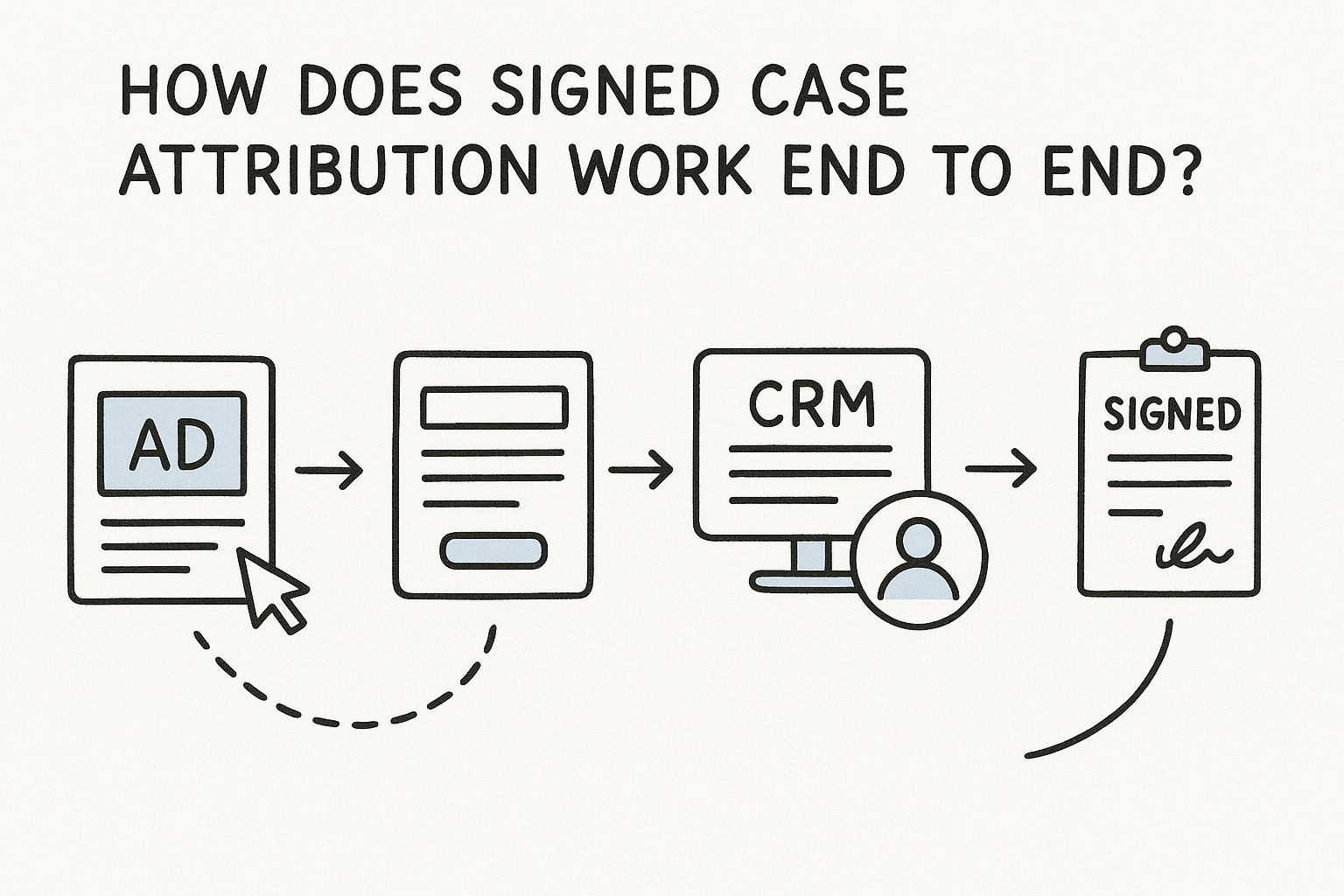
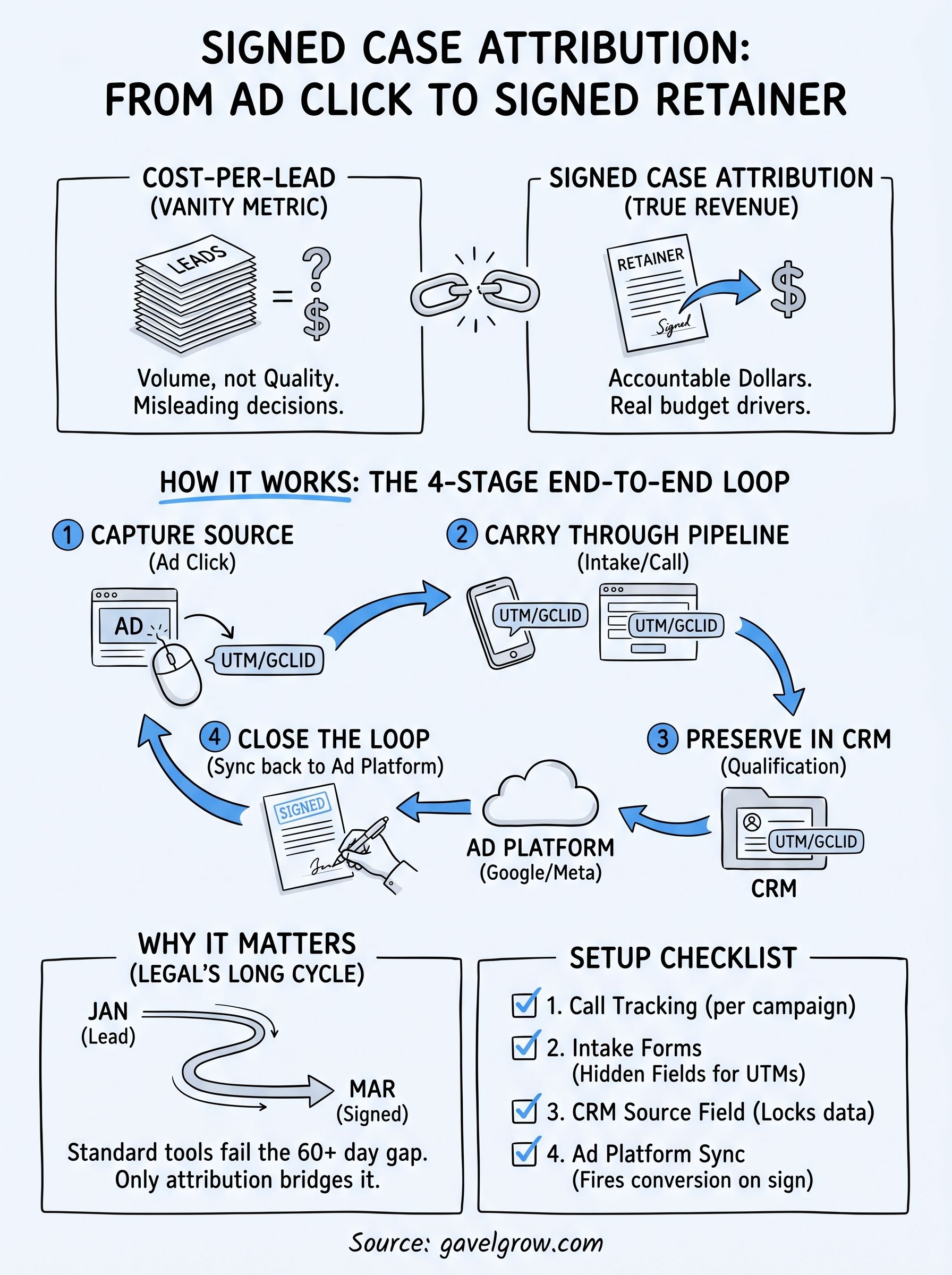
Signed case attribution runs through four connected stages: a tracking identifier attaches to the visitor at the ad click, rides along through your intake form or phone call, syncs to your CRM as the lead moves through qualification, and finally closes the loop when your team marks a retainer as signed.
Stage 1: Capturing the Source at the Click
When a prospect clicks your Google Ad, a UTM parameter or Google Click ID (GCLID) records exactly which campaign, ad group, and keyword drove that visit. Your intake form or call tracking number captures that data at the moment of first contact, so the source is locked before the lead ever reaches your team.
Stage 2: Carrying Attribution Through the Pipeline
As the lead moves from intake to consultation to retainer, your CRM preserves the originating source data at every stage. When a case is signed, that campaign identifier triggers the final conversion event back to Google Ads or Meta, reporting an actual signed retainer rather than a form fill.
The entire system collapses if any single handoff drops the tracking data, which is why a unified platform matters far more than patched-together tools.
How to set up signed case attribution in your firm
Setting up signed case attribution requires four connected components working together: call tracking numbers, intake forms that capture UTM parameters, a CRM that preserves source data, and a sync back to your ad platforms when a retainer is signed. Most firms already have some of these pieces; the gap is usually that they don't pass data to each other.
Connect Your Tracking Infrastructure First
Assign dedicated call tracking numbers to each campaign so every inbound call carries a campaign identifier from the start. Your intake forms need to auto-populate UTM parameters or GCLIDs in hidden fields at the moment a prospect submits their information.
Skipping the hidden field setup on your intake forms is the single most common reason attribution breaks down before it starts.
Here's what each component must capture:
- Call tracking numbers: one per campaign, recording source at every inbound call
- Intake form hidden fields: auto-populate UTM or GCLID on submission
- CRM source field: lock campaign data to the lead record on creation
Close the Loop When a Retainer Is Signed
Once a lead signs a retainer, your CRM needs to fire a conversion event back to Google Ads and Meta. GavelGrow handles this automatically by syncing campaign-level signed-case data the moment your team updates a case status, so your ad accounts reflect actual retained clients rather than raw form fills.
Next Steps
Signed case attribution closes the gap between your ad spend and your actual revenue, but only if every piece of your tracking stack talks to each other. Most firms reading this already have some of the components in place. The missing piece is usually a unified platform that carries campaign data from the first click through the signed retainer without dropping the source identifier along the way.
Start by auditing your current setup. Check whether your intake forms capture UTM parameters in hidden fields, confirm that your call tracking numbers are assigned per campaign, and verify that your CRM preserves the originating source when a lead is created. If any of those three checks fail, your attribution data has gaps right now.
If you want a clear read on where your firm's marketing measurement stands today, run through the free law firm marketing scorecard to identify exactly where your funnel needs work.
Frequently Asked Questions
What is signed case attribution?
Signed case attribution is the practice of tracing every signed retainer back to the exact ad click, keyword, or campaign that started the relationship, giving a firm a true cost-per-signed-case instead of a misleading cost-per-lead. It replaces guesswork with a clear record of which campaign produced which client at what cost. Unlike standard attribution, it keeps the originating source attached to a lead through the entire intake pipeline until a retainer is actually signed.
Why is cost-per-lead a poor metric for law firms?
Cost-per-lead rewards volume, not quality, so it hides which campaigns actually produce revenue. A campaign generating many cheap leads can look better on a dashboard than one generating fewer, better-qualified leads, even if the cheaper campaign signs zero retainers and the other signs several. Because a low cost-per-lead can pair with a high disqualification rate, optimizing for it can quietly push budget toward campaigns that look productive but never close cases.
Why does signed case attribution matter more for law firms than other industries?
Legal has one of the longest and most complex sales cycles of any service category, often stretching weeks or months from first contact to a signed retainer. Standard marketing tools report conversions at the click or form-fill stage and use short conversion windows built for e-commerce, so a campaign can look like a winner while the cases it generates never close. That timing gap is why off-the-shelf attribution consistently fails law firms.
How does signed case attribution work end to end?
It runs through four connected stages. A tracking identifier such as a UTM parameter or Google Click ID attaches to the visitor at the ad click, then rides along through your intake form or call tracking number at first contact. Your CRM preserves that source as the lead moves through qualification, and the loop closes when your team marks a retainer as signed, firing a conversion event back to the ad platform. If any handoff drops the data, the system breaks.
What does a law firm need to set up signed case attribution?
You need four components working together: dedicated call tracking numbers assigned per campaign, intake forms that auto-populate UTM parameters or GCLIDs in hidden fields, a CRM that locks the campaign source to each lead record, and a sync that fires a conversion event back to Google Ads or Meta when a retainer is signed. Most firms already have some pieces; the common failure is that they don't pass data to each other, especially the hidden form fields.
Frequently Asked Questions
What is signed case attribution?
Signed case attribution is the practice of tracing every signed retainer back to the exact ad click, keyword, or campaign that started the relationship, giving a firm a true cost-per-signed-case instead of a misleading cost-per-lead. It replaces guesswork with a clear record of which campaign produced which client at what cost. Unlike standard attribution, it keeps the originating source attached to a lead through the entire intake pipeline until a retainer is actually signed.
Why is cost-per-lead a poor metric for law firms?
Cost-per-lead rewards volume, not quality, so it hides which campaigns actually produce revenue. A campaign generating many cheap leads can look better on a dashboard than one generating fewer, better-qualified leads, even if the cheaper campaign signs zero retainers and the other signs several. Because a low cost-per-lead can pair with a high disqualification rate, optimizing for it can quietly push budget toward campaigns that look productive but never close cases.
Why does signed case attribution matter more for law firms than other industries?
Legal has one of the longest and most complex sales cycles of any service category, often stretching weeks or months from first contact to a signed retainer. Standard marketing tools report conversions at the click or form-fill stage and use short conversion windows built for e-commerce, so a campaign can look like a winner while the cases it generates never close. That timing gap is why off-the-shelf attribution consistently fails law firms.
How does signed case attribution work end to end?
It runs through four connected stages. A tracking identifier such as a UTM parameter or Google Click ID attaches to the visitor at the ad click, then rides along through your intake form or call tracking number at first contact. Your CRM preserves that source as the lead moves through qualification, and the loop closes when your team marks a retainer as signed, firing a conversion event back to the ad platform. If any handoff drops the data, the system breaks.
What does a law firm need to set up signed case attribution?
You need four components working together: dedicated call tracking numbers assigned per campaign, intake forms that auto-populate UTM parameters or GCLIDs in hidden fields, a CRM that locks the campaign source to each lead record, and a sync that fires a conversion event back to Google Ads or Meta when a retainer is signed. Most firms already have some pieces; the common failure is that they don't pass data to each other, especially the hidden form fields.