SEO for Employment Lawyers: 4 Strategies That Sign Cases
Categories: Legal Marketing Strategies
 Abram Ninoyan
Founder & Senior Performance Marketer
Credentials: Google Partner, Google Ads Search Certified, Google Ads Display Certified, Google Ads Measurement Certified, Google Analytics (IQ) Certified, HubSpot Inbound Certified, HubSpot Social Media Marketing Certified, Conversion Optimization Certified
Expertise: Google Ads, Meta Ads, Conversion Rate Optimization, GA4 & Google Tag Manager, Lead Generation, Marketing Funnel Optimization, PPC Management
LinkedIn Profile
SEO for employment lawyers works when your site answers the exact questions workers and employers type, appears in your state's local results, and ties every call to a signed case. Employee-side firms...
Key Takeaways
- SEO for Employment Lawyers: 4 Strategies That Sign Cases
- 1. Build separate pages for workers and employers
- 2. How does local SEO win employment clients?
- 3. Publish attorney-reviewed answers that AI tools can quote
SEO for Employment Lawyers: 4 Strategies That Sign Cases
SEO for employment lawyers works when your site answers the exact questions workers and employers type, appears in your state's local results, and ties every call to a signed case. Employee-side firms usually gain most from local rankings and intake tracking, while management-side firms gain most from content that speaks to HR leaders and business owners.
Most employment firm websites read like a list of practice areas. A fired worker searching late at night and an HR director searching for handbook help need different pages. Google now answers both questions in AI summaries before anyone clicks. Generic agency templates rarely account for that split.
This guide covers four strategies, then answers the questions about cost, timing, and AI search. GavelGrow has worked only with law firms since 2015, so the advice comes from legal marketing, not general small business SEO. Check your state bar's advertising rules before you publish anything that describes results or client feedback.
Key Takeaways
- Separate pages for workers and employers rank better than one generic page.
- Local SEO matters because employment law is state-specific and clients choose nearby.
- Direct, attorney-reviewed answers get quoted by Google and AI tools.
- Judge SEO by signed cases, not by rankings or traffic.
- Expect several months, not weeks, before organic search brings steady cases.
1. Build separate pages for workers and employers
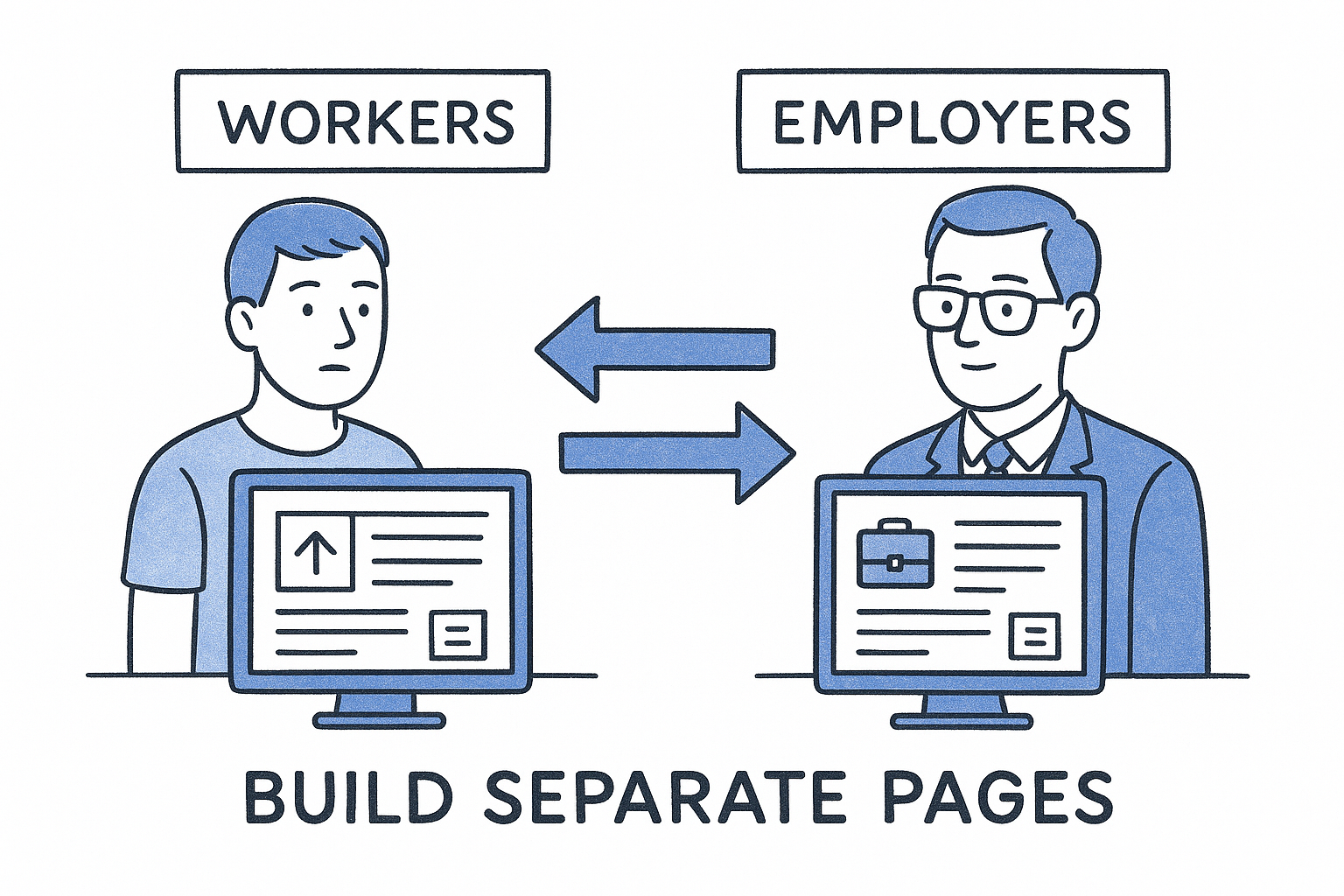
Give every matter type its own page and split employee-side from employer-side content, because a fired worker and an HR director run different searches. This is the foundation of SEO for employment lawyers, and it is where a single "Employment Law" page fails.
What to do
Start with the searches that come before a retainer. Workers type fears, such as being fired after a complaint or not being paid overtime. Employers type tasks, such as responding to an agency charge. Build one page per matter type and write each in the voice of its reader, then link related pages together.
- Employee-side: wrongful termination, discrimination, harassment and retaliation, wage and hour, severance review, leave rights.
- Employer-side: handbook and policy review, agency charge response, executive contracts and non-competes, wage and hour audits.
One page per matter type, written in the voice of the person searching.
Common mistakes
Most firms make three errors. They bundle every practice area onto one page, they copy the same text onto city pages with only the place name changed, and they repeat "employment lawyer" in headings until it reads badly. Each one dilutes relevance and gives Google no reason to rank you over a firm with a focused page.
How to measure it
Group your pages by audience in Google Search Console and watch impressions and clicks for each group. Then check which pages produce calls and form fills. Rankings alone mislead. A page that ranks but never generates a consultation request needs a clearer next step, not more keywords.
2. How does local SEO win employment clients?
Local SEO wins employment clients because the law is state-specific and people want an attorney nearby, so your Google Business Profile and location pages decide whether you appear in the map results. Local work is where SEO for employment lawyers is most concrete.
What to do
Choose the primary category that matches your core work, list your real services, and keep your firm name, address, and phone number identical everywhere. Add a location page only for an office or city where you genuinely practice. Include details a copied page cannot fake, such as the state labor agency you deal with and the attorneys who handle matters there.
Reviews need a clean process. Ask every client, resolve complaints with the client directly, and reply professionally to every public review. Do not screen out unhappy clients, and do not offer anything in exchange for a review, because Google's policies prohibit both. Check your state bar's rules on displaying client feedback on your own site.
Local rankings reward real offices, consistent details, and reviews from every client.
Common mistakes
Virtual office addresses and copied city pages are the usual culprits. A listing for an address where no attorney works can get the profile suspended, and near-identical location pages add nothing. Inconsistent details across directories also muddy your data. Fix one source of truth first, then update every listing to match.
How to measure it
Track calls, direction requests, and website clicks from your profile. Check rankings from the neighborhoods where your clients live, not just from your office. Put a separate tracking number on the profile so those calls show up as their own source.
3. Publish attorney-reviewed answers that AI tools can quote
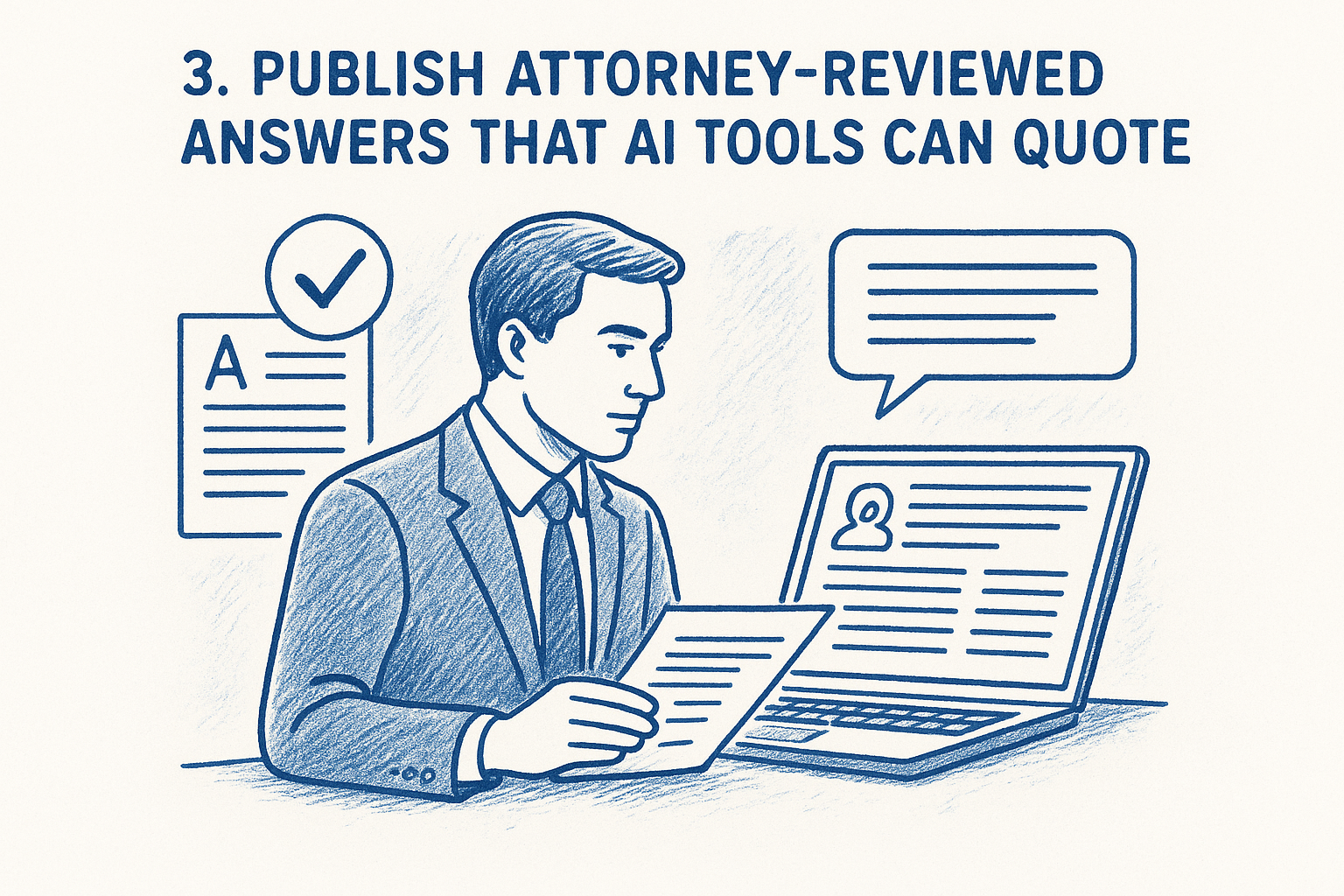
Publish direct answers written or reviewed by a named attorney, because Google and AI tools quote passages that answer the question in the first sentence. No one can guarantee a citation, but this approach helps SEO for employment lawyers in both classic results and AI summaries.
What to do
Lead each page or section with the answer, then explain the exceptions. Deadlines work well because people search them under stress. Add a byline with the attorney's bar admission, update the page when the law changes, and use Attorney or LegalService structured data so your firm details are machine-readable.
State law can differ, so name your jurisdiction and have an attorney confirm every figure before it goes live.
A direct first sentence is the passage that gets quoted.
Common mistakes
Do not promise outcomes, restate federal statutes without adding anything, or publish pages nobody at the firm has reviewed. Google's guidance on helpful, people-first content asks who created a page and why. An anonymous post under a firm name answers neither.
How to measure it
Once a month, search your target questions in Google and in AI tools and note whether your pages appear or are cited. Watch Search Console for question-style queries and for rising branded searches, which often follow content that builds trust.
4. How do you track signed cases from organic search?
Track every organic call and form from first visit to signed retainer, because traffic does not pay your bills. Without source tracking, SEO for employment lawyers looks like a cost you cannot defend to your partners.
What to do
Put a distinct tracking number on organic traffic, send every form into one intake pipeline that records the source, and update case status when a matter signs. GavelGrow's platform does this with built-in call tracking numbers and a dashboard that follows leads from click to signed retainer, including callers who never fill in a form.
Then respond fast. The Lead Response Management Study found that leads contacted within five minutes are far more likely to be qualified than leads first reached at thirty minutes. It measures the odds of qualifying a lead, not signed cases, but the lesson holds for intake.
If you cannot name the source of a signed case, you cannot judge your SEO.
Common mistakes
Firms count leads instead of signed cases, ignore phone-only inquiries, and let voicemail sit until morning. Each mistake hides which pages actually produce retainers. A missed-call text and a clear after-hours process cost little and recover leads you already paid to earn.
How to measure it
Divide your monthly SEO spend by the signed cases that came from organic search. Employment matters take time to close, so compare rolling quarters instead of single months. Add the cost per signed case from paid channels as a benchmark.
Frequently Asked Questions
How much does SEO for an employment law firm cost?
There is no single price. Cost follows your market's competition, how many practice and location pages you need, and how much content and link work the scope includes. Ask what you receive each month, not only what you pay. GavelGrow's done-for-you SEO is scoped on a strategy call, and on managed engagements we do not run marketing for two direct competitors in the same market. Our tracking platform plans, Track at $199/month and Optimize at $599/month, are on the pricing page.
Ask what you will receive each month, not only what you will pay.
How long does SEO take to bring in employment cases?
Expect several months before organic search produces steady consultation requests, and longer in competitive metros. Search Console often shows impressions rising before clicks do, so check it early to see whether Google is picking up your new pages. Be skeptical of any promise of page-one rankings within weeks, and ask which exact keywords the agency means.
Is SEO or Google Ads better for an employment law firm?
Most firms benefit from both, because they do different jobs. Google Ads bill per click and stop producing calls the day you pause them. Organic traffic carries no per-click charge, but it takes months to build and needs steady content and review work. If you need cases in the next few weeks, start with ads. If you want lower acquisition cost over years, invest in SEO alongside them.
Does SEO help my firm show up in AI search?
Yes, indirectly. Google's guidance says a page must be indexed and eligible to appear in Search with a snippet to be used in its AI features, so the basics of crawlable, well-structured pages still apply. Clear answers, named attorney authors, and consistent firm details give AI tools passages worth quoting. No tactic guarantees a citation, so treat AI visibility as a result of good SEO.
What should you ask an SEO agency before you hire it?
Ask who owns your Google Business Profile, Search Console, and analytics accounts. They should stay in your firm's name. Ask whether the agency works for competing employment firms in your market, what deliverables you get each month, and how it reports signed cases instead of rankings. Ask for the contract term too. A trustworthy agency explains its work plainly and does not guarantee results, which many state bars restrict.
Where to start with your firm
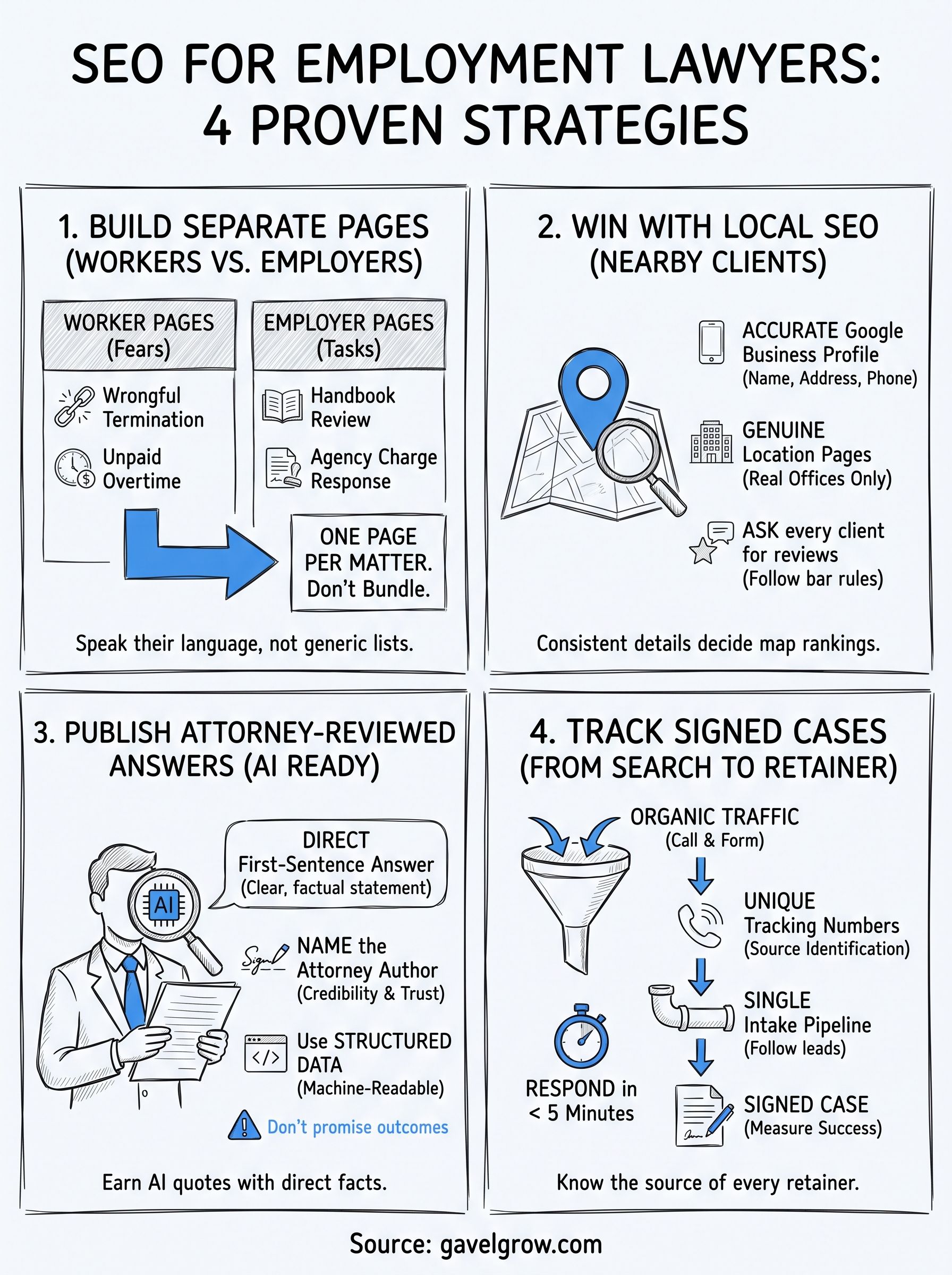
The four strategies work together. Separate pages match what workers and employers search, local signals put you in front of nearby clients, attorney-reviewed answers earn trust from Google and AI tools, and source tracking shows which work produces signed cases. Pick the weakest of the four and fix it first.
If you want a legal-only team to handle it, GavelGrow's done-for-you SEO service covers local SEO, Google Business Profile work, and practice-area pages for law firms. You can talk through your market and goals on a strategy call.
Frequently Asked Questions
How much does SEO for an employment law firm cost?
There is no single price. Cost follows your market's competition, how many practice and location pages you need, and how much content and link work the scope includes. Ask what you receive each month, not only what you pay. GavelGrow's done-for-you SEO is scoped on a strategy call, and on managed engagements we do not run marketing for two direct competitors in the same market. Our tracking platform plans, Track at $199/month and Optimize at $599/month, are on the pricing page . Ask what you will receive each month, not only what you will pay.
How long does SEO take to bring in employment cases?
Expect several months before organic search produces steady consultation requests, and longer in competitive metros. Search Console often shows impressions rising before clicks do, so check it early to see whether Google is picking up your new pages. Be skeptical of any promise of page-one rankings within weeks, and ask which exact keywords the agency means.
Is SEO or Google Ads better for an employment law firm?
Most firms benefit from both, because they do different jobs. Google Ads bill per click and stop producing calls the day you pause them. Organic traffic carries no per-click charge, but it takes months to build and needs steady content and review work. If you need cases in the next few weeks, start with ads. If you want lower acquisition cost over years, invest in SEO alongside them.
Does SEO help my firm show up in AI search?
Yes, indirectly. Google's guidance says a page must be indexed and eligible to appear in Search with a snippet to be used in its AI features, so the basics of crawlable, well-structured pages still apply. Clear answers, named attorney authors, and consistent firm details give AI tools passages worth quoting. No tactic guarantees a citation, so treat AI visibility as a result of good SEO.
What should you ask an SEO agency before you hire it?
Ask who owns your Google Business Profile, Search Console, and analytics accounts. They should stay in your firm's name. Ask whether the agency works for competing employment firms in your market, what deliverables you get each month, and how it reports signed cases instead of rankings. Ask for the contract term too. A trustworthy agency explains its work plainly and does not guarantee results, which many state bars restrict.