Law Firm Intake Explained: Process, Roles, Best Practices
Categories: Legal Marketing Strategies
 Abram Ninoyan
Founder & Senior Performance Marketer
Credentials: Google Partner, Google Ads Search Certified, Google Ads Display Certified, Google Ads Measurement Certified, Google Analytics (IQ) Certified, HubSpot Inbound Certified, HubSpot Social Media Marketing Certified, Conversion Optimization Certified
Expertise: Google Ads, Meta Ads, Conversion Rate Optimization, GA4 & Google Tag Manager, Lead Generation, Marketing Funnel Optimization, PPC Management
LinkedIn Profile
Law firm intake is the process of turning an inquiry (a call, form, text, or chat) into a qualified prospect and, when the matter fits, a signed retainer. It covers capturing the lead, screening it, r...
Key Takeaways
- Law Firm Intake Explained: Process, Roles, Best Practices
- Why does law firm intake matter for signed cases?
- How to build a law firm intake process step by step
- What does an intake specialist do at a law firm?
Law Firm Intake Explained: Process, Roles, Best Practices
Law firm intake is the process of turning an inquiry (a call, form, text, or chat) into a qualified prospect and, when the matter fits, a signed retainer. It covers capturing the lead, screening it, running conflict checks, and getting the engagement agreement signed. An intake specialist usually runs it.
Most firms do not have a lead problem. They have an intake problem. A prospect who calls at 7 p.m. and reaches voicemail often calls the next firm on the list. The Lead Response Management Study found that leads contacted within five minutes are far more likely to be qualified than those first reached at thirty minutes. That measures qualification, not signed cases, but the direction is clear. Speed and consistency decide who gets the case.
This guide walks through each step of the intake process, what an intake specialist actually does, and how to set up a process your team can repeat. It also covers when to hire in-house, when outsourced intake makes sense, and how to track results. If you are searching for intake jobs, the role breakdown will show you what firms expect. GavelGrow has worked only with law firms since 2015, so the examples come from legal practice.
Why does law firm intake matter for signed cases?
Every dollar you spend on ads, SEO, or referrals ends at the same place: a person reaching out. What happens next decides whether that spend becomes revenue. Law firm intake is the conversion point of your whole marketing program, and it is the step most firms measure least. A flawless campaign can still lose the case in the first three minutes of the client intake process.
Where leads leak before they become cases
Most losses from intake process mistakes are not dramatic. They are small, repeated gaps that nobody tracks. A prospect with a fresh injury or a pending court date is stressed and often contacting several firms, so the first firm that answers well usually gets the consultation. The leaks that show up most often are:
- Calls that go to voicemail after 5 p.m. or at lunch
- Web forms answered the next morning, or never
- Text messages sitting on one person's phone that nobody else can see
- Screening that changes with whoever picks up, so good cases get declined and poor ones eat attorney time
- Qualified leads that get no follow-up after the first unanswered attempt
Each of these is fixable, but only once you can see it. A missed call that never became a lead record is invisible in most reports, so the problem gets blamed on "ads not working" instead of on dropped calls.
How intake changes your cost per signed case
Consider an illustrative example, not a benchmark. A firm spends $10,000 in a month and gets 50 leads, so cost per lead is $200. The marketing side is identical in both columns below. Only intake differs.
Same traffic, same budget, half the cost per signed case. Doubling signed cases is a deliberately round number to make the math easy to follow. Your real rates will vary by practice area and case type.
Intake is where marketing spend either becomes a signed retainer or quietly disappears.
That is why cost per lead alone misleads you. A cheap lead source paired with slow, inconsistent intake can cost more per signed case than an expensive source your team handles well. Judge every channel by signed cases, and fix intake before you raise your ad budget.
Why you need to measure intake, not guess
Tracking intake ROI turns intake from a feeling into a number. For each campaign, you want to know how many calls were answered, how many became leads, how many were qualified, and how many signed. Phone-only leads deserve special attention, because many prospects never touch a form and vanish from web analytics entirely.
A platform like GavelGrow's call tracking and marketing dashboard ties each call and form to its campaign and follows it through to a signed retainer. You see cost per signed case, not just cost per lead. A weak intake step then shows up in your data instead of hiding inside your ad budget.
How to build a law firm intake process step by step
Every firm needs a written intake process, even a two-person firm. It should be a short sequence where each step has one owner and a time limit. Here is the order that works across practice areas, from personal injury to family law, and it forms the backbone of any legal intake process.
The six steps from first contact to signed retainer
- Capture: Route calls, forms, texts, and chats into one lead record.
- Respond: Send an instant text and email, then make a live attempt within minutes.
- Screen: Use a written checklist covering practice area, location, incident date, deadlines, and key facts.
- Check conflicts: Search the names of every party before you hear confidential details.
- Route: Book the consultation or hand the file to the right attorney.
- Sign and follow up: Send the engagement agreement for e-signature and follow up until it is signed or declined.
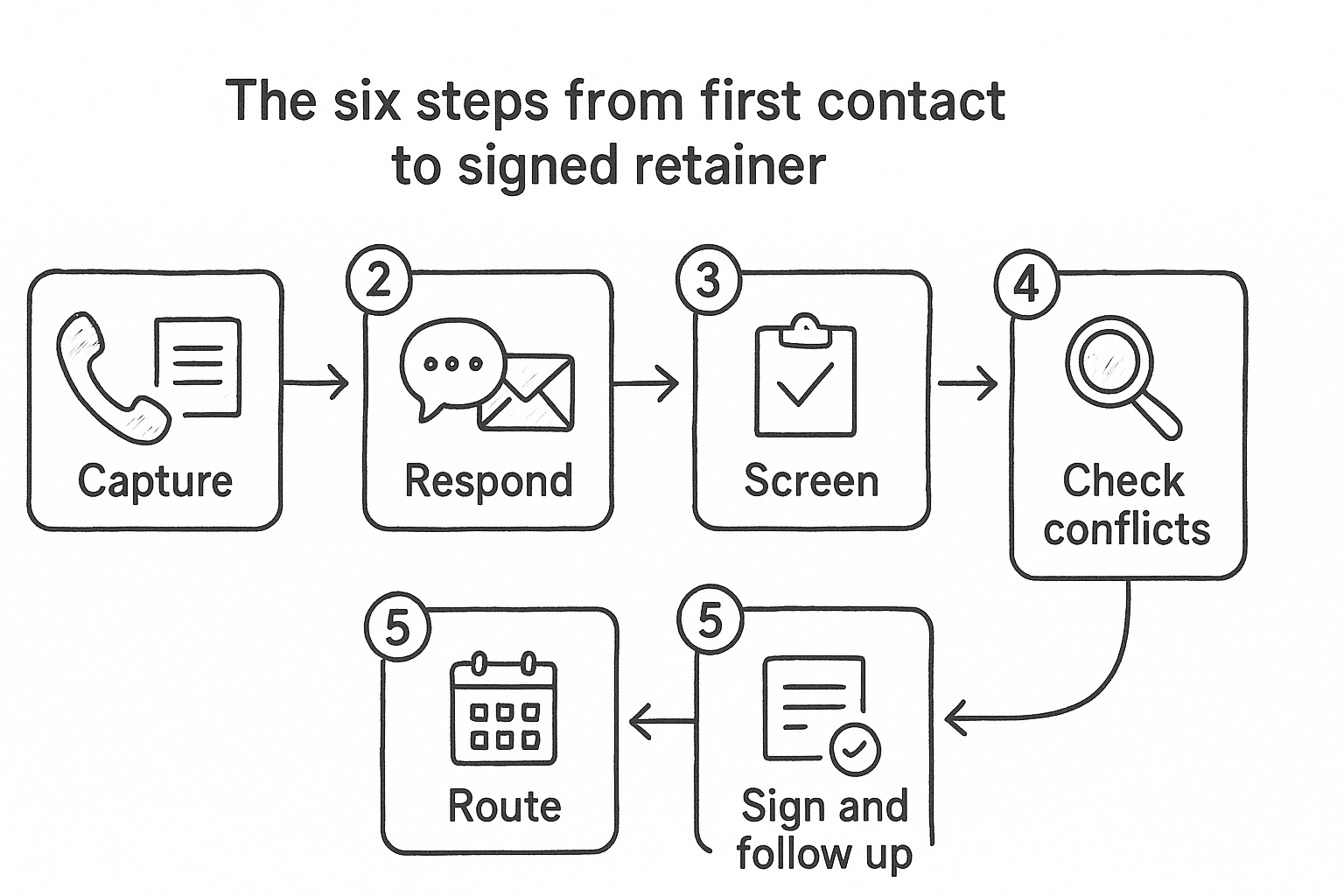
Order matters more than most firms expect. Conflict checks come before substantive advice, and screening comes before attorney time. If your form records consent at the source, you also have a clean, documented basis for texting prospects under TCPA rules.
A written process with one owner per step beats a talented team improvising.
Assign owners, deadlines, and after-hours coverage
Next, give every step a name and a clock. For example, the intake specialist owns steps one through three, a paralegal or operations manager runs the conflict check, and the attorney owns the consultation. Write the deadlines down. "Within five minutes" is a standard your team can miss, which means you can measure it and coach to it.
Then plan for nights and weekends, because prospects do not inquire only from 9 to 5. Decide whether after-hours calls go to a live answering service, an outsourced intake team, or an automated text-back with a firm morning callback. Pair that with a follow-up cadence, such as several attempts across a week, so one missed call does not end the lead. Check your state bar's advertising and solicitation rules before you script any outreach.
What does an intake specialist do at a law firm?
An intake specialist is the first person a prospect talks to, and often the only non-attorney who shapes whether they hire you. You will also see the title written as legal intake specialist, intake coordinator, or intake representative. Whatever the label, the job is to turn inquiries into qualified consultations while treating each caller with care.
Daily responsibilities
Most of the day goes to a handful of repeatable tasks. This is what belongs in a job description, and what anyone applying for intake jobs should expect to do.
- Answer calls, texts, web forms, and chats within your response standard
- Screen each inquiry against the written checklist and record the facts in one lead record
- Collect the names of all parties and pass them on for the conflict check
- Book consultations on attorney calendars
- Send engagement agreements and follow up on unsigned ones
- Tag every outcome (qualified, callback, unqualified, spam) so reports stay accurate
- Refer out matters the firm does not handle, politely and promptly
What an intake specialist must not do
Boundaries matter as much as tasks. A specialist gathers facts and explains next steps. They do not give legal advice, predict outcomes, or promise results. Whether to accept a case is an attorney decision, and your state bar's rules on non-lawyer staff and client communications apply, so check them before you write the role description.
An intake specialist collects facts and books the consultation, and the attorney decides whether to take the case.
Skills to hire for and how to judge performance
Empathy and calm come first, because callers are often hurt, frightened, or angry. Add accurate note-taking, comfort in a law firm CRM, and the habit of asking follow-up questions without sounding like an interrogation. Prior law firm experience helps, but many firms train new hires on the script. Spanish or other language skills can be decisive in practice areas like immigration.
Then measure the person with intake metrics, not just the volume. Track answer rate, time to first response, lead-to-consultation rate, and consultation-to-signed rate for each specialist. Listen to recorded calls every week, and coach on specifics. With built-in call recordings and outcome tagging, you can review real calls next to the result, so coaching rests on evidence instead of impressions.
What should a legal intake form and call script include?
A form and a script do the same job in two channels. Both collect the facts you need to screen a matter, and both should ask in the same order so every inquiry reaches your law firm intake record in the same shape.
What a legal intake form should capture
Keep the form short. Every extra field costs you completions, especially on phones. Ask only what you need to decide on a consultation and leave the detail for the attorney. A short, mobile-first form keeps the first step easy for a stressed prospect.
- Name, phone, email, and preferred contact method
- Practice area or type of problem
- Incident date and any upcoming deadline or court date
- State and county
- Names of all other parties, for the conflict check
- One free-text box: "Briefly, what happened?"
- How they found you
- Consent to calls and texts
Ask only what you need to decide on a consultation, and ask it the same way every time.
Consent needs care. Make the checkbox unchecked by default, say in plain words what the person agrees to, and keep a record of the time and wording. Have counsel review the language against TCPA consent requirements and your state's rules. GavelGrow's hosted intake forms store that consent in an append-only audit log. Leave out Social Security numbers and medical details, since no attorney-client relationship exists yet.
How to structure an intake call script
Intake call scripts work best as a flow, not a speech. Your specialist should sound natural while still covering every checklist item in the same order on every call.
- Greet the caller, name the firm, and take a callback number first in case the call drops.
- Ask an open question: "Tell me what happened."
- Work through the checklist: date, location, injuries or deadlines, other lawyers involved.
- Get every party's name, then run the conflict check before hearing more detail.
- Explain the next step and book the consultation.
- Confirm by text and email.
Here is an opening you can adapt:
Thank you for calling [Firm Name], this is [Name]. I'm not an attorney
and can't give legal advice, but I can gather a few details and get you
to the right person. What's the best number to reach you if we get
disconnected?
Disclosure belongs in the script too. Tell callers the call may be recorded, because some states require every party's consent. Then review recordings weekly and rewrite any question that callers keep misunderstanding.
How to choose between in-house and outsourced intake
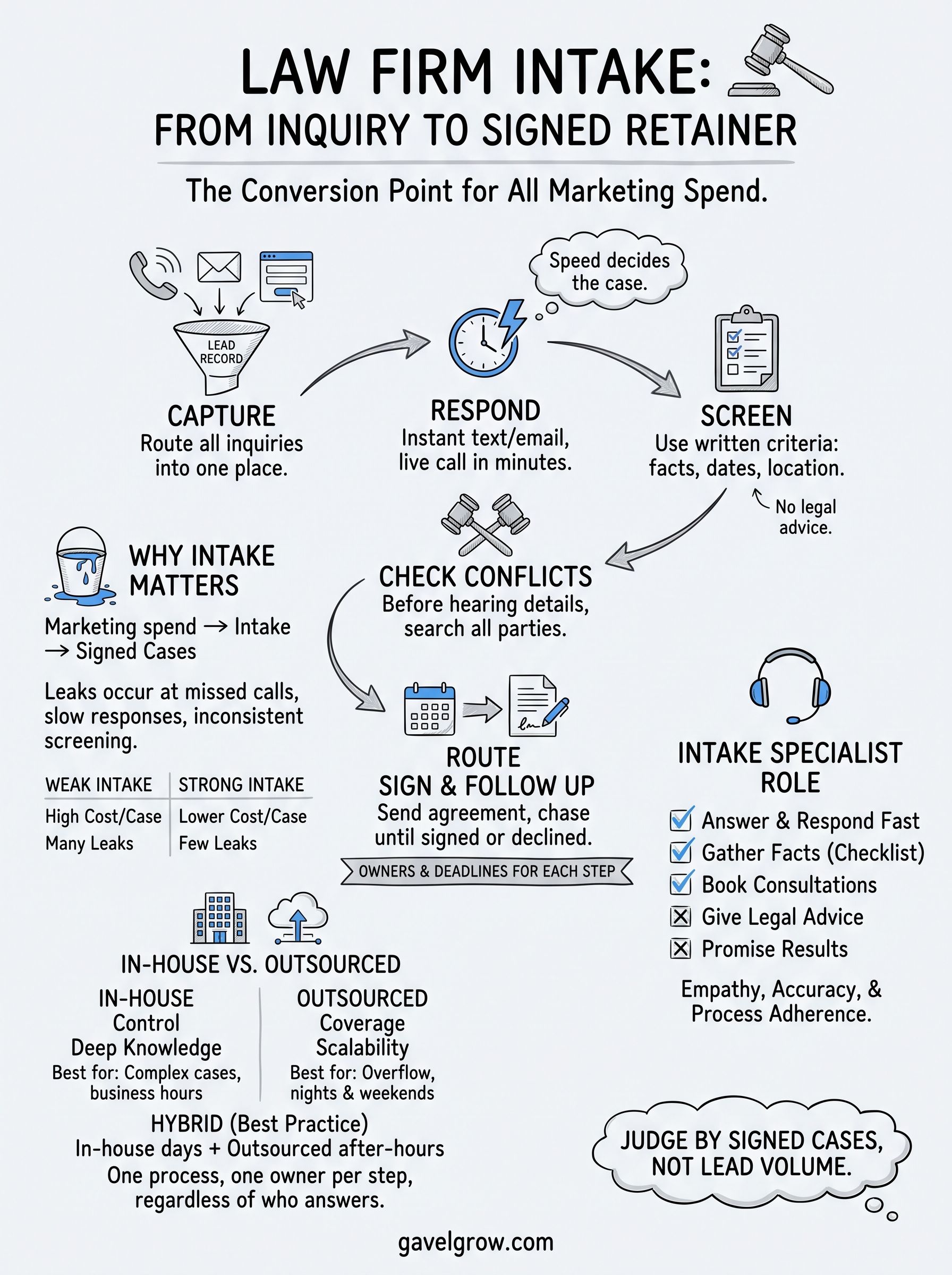
Your answer depends on three things: call volume, the hours you need covered, and how much control you want over screening. Neither model wins on its own. Good law firm intake comes down to having one owner for the process, whether that person sits in your office or at a vendor.
In-house vs. outsourced at a glance

Outsourced intake services solve a coverage problem quickly, but they cannot replace your judgment on which cases to take. If your matters are complex, such as mass torts or medical malpractice, in-house staff usually screen better because they absorb your attorneys' preferences.
Questions to ask before you outsource
Before you sign anything, press any vendor on how they will handle your prospects. Get every answer in writing, because their staff will speak to your future clients in your firm's name.
- Do they work only with law firms, and in your practice area?
- Will they follow your written screening checklist and script?
- How do they run conflict checks before hearing details?
- How do they handle call-recording disclosure and text consent?
- Can you hear recordings and see outcomes by call?
- Do leads land in your own system, and who owns that data?
- How do they stay within your state bar's rules on non-lawyer staff?
Outsource the hours you cannot cover, but keep ownership of your screening rules and your lead data.
A hybrid setup that works for many firms
Many firms keep daytime intake in-house and send after-hours calls and overflow to an outside team. This protects the evening prospect without paying a full-time salary for quiet hours. The rule is simple: everyone uses the same checklist, the same lead record, and the same response clock, no matter who answers.
If you would rather have campaigns and intake designed together, GavelGrow's legal marketing services include lead intake systemization, scoped on a strategy call.
Putting your intake process to work
Strong law firm intake is not complicated. It is a written sequence with one owner per step, a response clock your team can meet, and a form and script that ask the same questions every time. Whether you staff it in-house, outsource nights and weekends, or mix both, judge the process by signed cases, not by lead counts.
Start small this week. Write down your six steps, name an owner for each, and listen to five recorded calls. You will find the leaks quickly, and fixing them costs far less than buying more leads. If you want a second set of eyes on your setup, book a free 45-minute intake strategy call with GavelGrow and walk through your intake with a team that has worked only with law firms since 2015.