Local Services Ads vs Google Ads: Which Fits Your Law Firm?
Categories: Legal Marketing Strategies
 Abram Ninoyan
Founder & Senior Performance Marketer
Credentials: Google Partner, Google Ads Search Certified, Google Ads Display Certified, Google Ads Measurement Certified, Google Analytics (IQ) Certified, HubSpot Inbound Certified, HubSpot Social Media Marketing Certified, Conversion Optimization Certified
Expertise: Google Ads, Meta Ads, Conversion Rate Optimization, GA4 & Google Tag Manager, Lead Generation, Marketing Funnel Optimization, PPC Management
LinkedIn Profile
Local Services Ads vs Google Ads comes down to payment, control, and trust. Local Services Ads (LSAs) charge you per lead, usually appear at the top of the results page, and let Google decide which...
Key Takeaways
- Why does the choice between LSAs and Google Ads matter?
- How do costs differ between the two?
- How to choose between Local Services Ads and Google Ads
- How to set up and measure both for signed cases
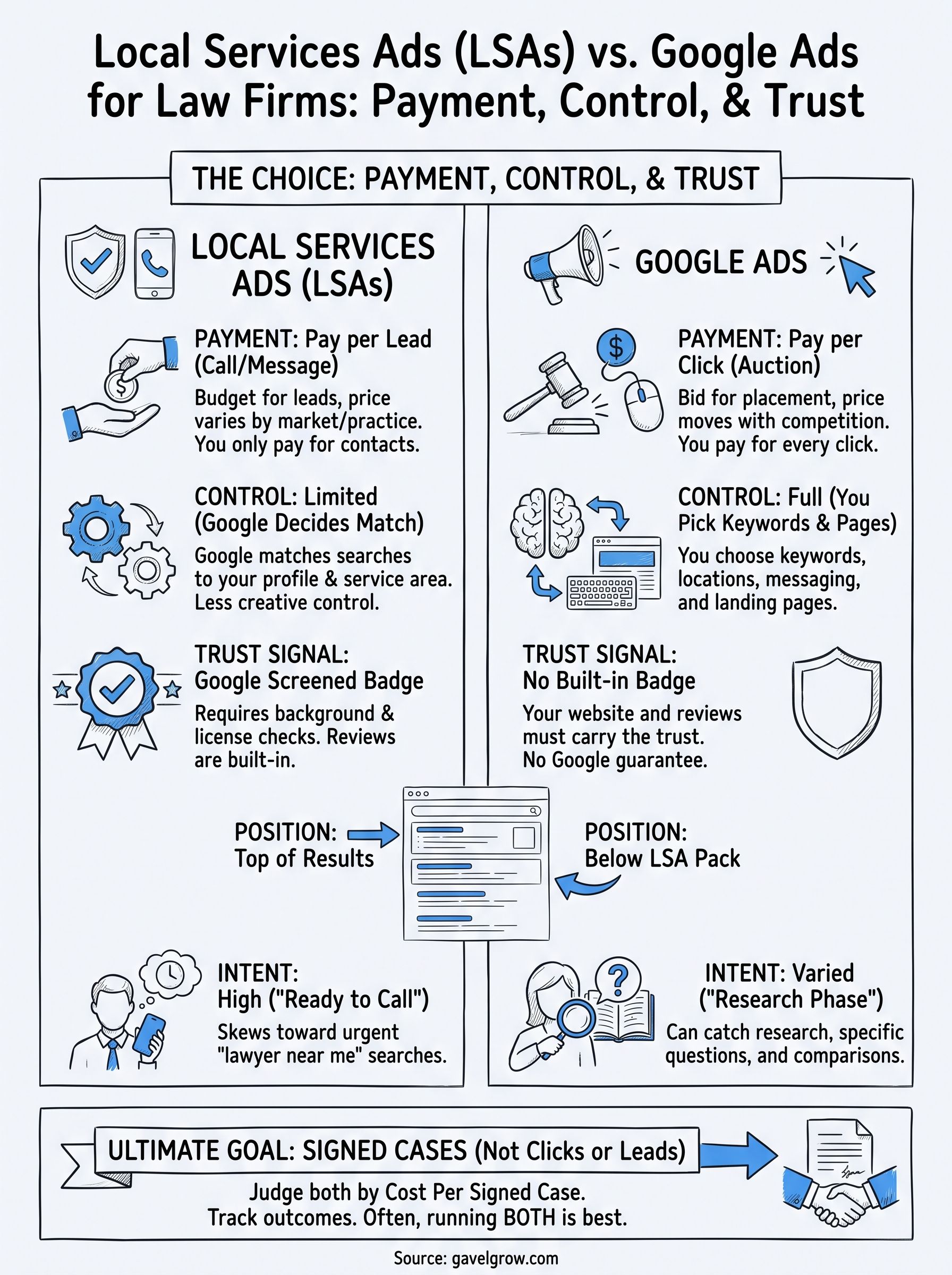
Local Services Ads vs Google Ads comes down to payment, control, and trust. Local Services Ads (LSAs) charge you per lead, usually appear at the top of the results page, and let Google decide which searches to match. Google Ads charges per click, usually shows below the LSA pack, and lets you choose every keyword, message, and landing page. For a law firm, the better option is the one that signs more cases per dollar, and often that means running both.
In plain terms, an LSA is a listing with your firm name, reviews, service area, and a Google Screened badge, built to earn a phone call or message. A standard Google Ads campaign is a text ad that sends the searcher to your website, where your intake form or phone number has to finish the job. Some people search for this as Google Ads vs Google Local Services, but both are paid placements on Google. They simply work differently.
GavelGrow has served law firms exclusively since 2015, and we build both channels for them. This guide covers why the choice matters, how the costs compare, how to decide, and how to set up and measure each channel so you judge them by signed cases instead of clicks.
Why does the choice between LSAs and Google Ads matter?
The choice matters because the two products bill, rank, and report differently. The same budget can produce very different calls and very different signed cases. In the Local Services Ads vs Google Ads decision, neither side wins by default. Your practice area, your market, and how fast your intake answers decide it.
How each ad type works
Google runs LSAs as a separate product with its own dashboard, verification, and billing. Google describes them as pay-per-lead listings for verified local businesses. Standard Google Ads is the auction platform most firms already know. Here is how they compare on the points that affect a law firm.
- Billing: LSAs charge per lead (a call or message). Google Ads charges per click.
- Position: LSAs usually show at the top of the results. Google Ads show below the LSA pack, above or below the organic results.
- Targeting: Google matches searches to your LSA practice areas and service area. With Google Ads, you pick keywords, locations, audiences, and schedules.
- Trust signal: LSAs show the Google Screened badge and reviews in the listing. Google Ads has none built in, so your site and reviews carry it.
- Creative control: LSAs are limited to your profile. Google Ads gives you full control of ad copy and landing pages.
- Setup: LSAs require identity and bar license checks, insurance where applicable, and background checks for some users. Google Ads needs an account, campaigns, and conversion tracking.
- Availability: LSAs cover eligible practice areas and markets only. Google Ads is open to any law firm Google's policies allow.
That comparison hides one practical difference. LSA traffic skews toward "lawyer near me" searches from people ready to call. Google Ads can also catch the research phase, such as someone typing a question about a specific legal problem. That is a different intent, and it needs a landing page that explains your services before it asks for the call.
What changes for a law firm
LSAs for lawyers depend on verification. Before the Google Screened badge appears, Google checks identity and each lawyer's bar license, asks for professional liability insurance where applicable, and runs background checks for some users. After that, placement depends on factors such as proximity, review score, and responsiveness. Google says missed calls may hurt your responsiveness, so a firm that lets calls go to voicemail can lose ground in the pack.
Google Ads has no such gate, so you can advertise any practice area in any location Google allows. LSAs are different. Availability varies by practice area and market, so check eligibility first during the LSA sign-up. Your state bar's advertising rules also apply to both channels. Never promise results in ad copy, and avoid superlatives such as "best" or "top."
LSAs reward the firm Google trusts and answers fastest, while Google Ads rewards the firm that targets and measures best.
How do costs differ between the two?
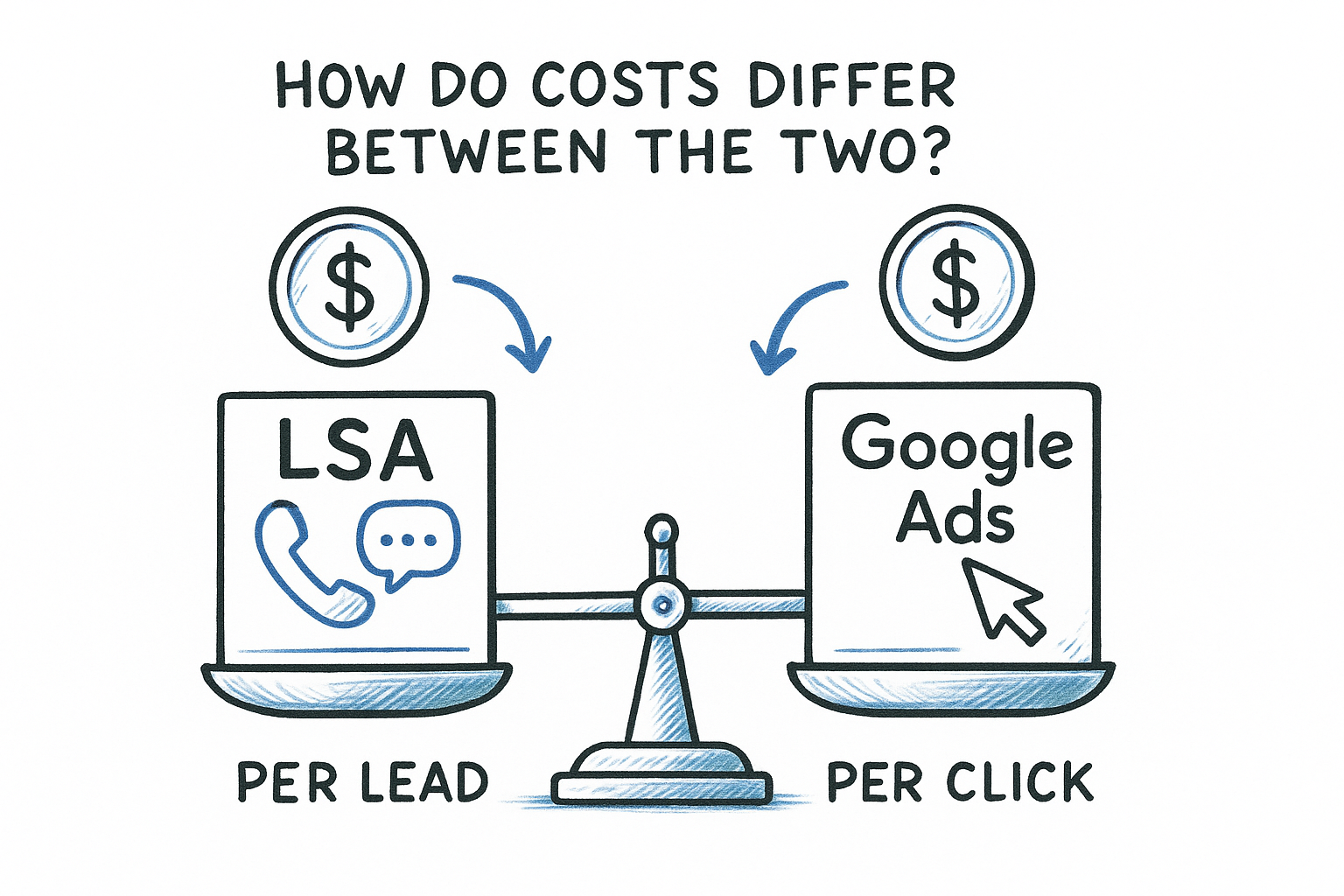
LSAs charge per lead and Google Ads charges per click, but neither number tells you what a signed case costs. A lead price and a click price do not compare cleanly. Convert both to cost per signed case before you judge either channel.
How billing works
With LSAs, you pay when a prospect calls or messages you through the listing, and you set a budget around the number of leads you want. Google sets the price per lead by practice area and market. Google says it does not charge for leads it determines to be invalid or low quality, and it may credit a charged lead later if it turns out to be invalid, so check your billing for credits.
With Google Ads, you pay for each click and bid in an auction. Your price moves with competition, ad and landing page quality, and your bidding strategy. Legal terms are competitive, but the real figure depends on your practice area and city, so trust your own account data over any published average. Here is what each model charges for:
- LSAs: a valid call or message, whether or not it becomes a case.
- Google Ads: a click, whether or not the visitor calls, fills out your form, or leaves.
- Both: nothing about whether the person is a fit, signs, or pays.
Why cost per lead misleads
A lower cost per lead can still produce a higher cost per signed case. The figures below are hypothetical and only show the method. They are not benchmarks.
- Channel A: $6,000 spend, 30 leads at $200 each, 6 signed cases, so $1,000 per signed case.
- Channel B: $6,000 spend, 60 leads at $100 each, 4 signed cases, so $1,500 per signed case.
Channel B looks twice as cheap per lead and costs 50% more per signed case. The reverse can happen too. The point is that lead quality decides the winner, and you only see it when you track outcomes. Plug your own spend and results into the cost-per-acquisition calculator to see where each channel lands.
Lead definitions differ as well. An LSA lead is a call or message of any quality, including wrong-fit callers. A Google Ads lead is whatever you define as a conversion, so a sloppy definition flatters the numbers.
A cheaper lead is not a cheaper case, so divide spend by signed retainers.
How to choose between Local Services Ads and Google Ads
Choose LSAs when phone calls from nearby searchers drive your intake and you can answer fast. Choose Google Ads when you need control over practice areas, geographies, and keywords. If you are weighing Google Local Services vs Google Ads for a single-location firm, start with the channel that matches how your clients first reach you.
When Local Services Ads fit
LSAs work best when most of your clients start with a phone call and your location is the main reason they pick you. Check these conditions:
- Your practice areas and market are eligible for LSAs.
- Most new clients call instead of filling out a form.
- Someone answers during your posted hours, and missed calls get a text back fast.
- You have a steady flow of public reviews, because review score affects ranking.
- You serve a defined local area, not a whole state or the nation.
When Google Ads fits
Google Ads fits when you need to decide which searches deserve your money. You can target one case type and exclude the rest, add negative keywords to block job seekers and free-advice searches, and send each campaign to a matching landing page. It also suits firms with several offices, statewide reach, or nationwide mass tort campaigns, since LSAs stay tied to local service areas.
Google Ads also gives you something LSAs cannot. You can test landing pages and intake forms, change bids by location or device, and feed signed cases back into bidding. If your firm wants to optimize beyond the lead, that control matters.
When to run both
Run both when your budget allows. The two can show on the same results page, so you capture the "near me" caller and the person researching a specific legal problem. Keep them separate in your reporting, with their own tracking numbers, and compare cost per signed case over several months before you shift money. GavelGrow runs Local Services Ads and Google Ads for law firms and reports them side by side.
Run LSAs for the call, Google Ads for the research, and judge both by signed cases.
How to set up and measure both for signed cases
Set up each channel so every lead can be traced to a signed retainer. Setup is quick compared with the measurement discipline that follows. Most firms lose money not on launch but on the missing tracking and slow follow-up after it.
Set up Local Services Ads
- Confirm that your practice areas and service area are eligible in the LSA sign-up.
- Submit your business details and each lawyer's bar license, add proof of insurance where Google requires it, and complete any background checks Google asks for.
- Fill in your profile with practice areas, hours, service area, and bio.
- Set a lead budget and connect a phone number your intake team actually answers.
- Ask every client for a review, resolve complaints directly with the client, and respond professionally to every public review. Do not filter who you ask, route unhappy clients to private forms, or offer incentives, because Google's review policies prohibit all three.
- Review leads weekly, check which ones Google credited, and tag each outcome.
Launch Google Ads
- Build campaigns by practice area instead of one catch-all.
- Pick keywords with clear case intent and add negative keywords from day one.
- Send each campaign to a matching, mobile-friendly landing page with a short form and a click-to-call button.
- Track calls and form submissions as conversions.
- Read the search terms report weekly and prune what wastes spend.
Measure to signed cases
Use per-campaign tracking numbers and record each lead's outcome: qualified, callback, unqualified, or spam. Then match leads to cases so you can see which channel produced retainers. GavelGrow's platform includes built-in call tracking and a dashboard that shows cost per signed case by campaign. See the features page for the details.
Smart Conversions sends signed cases back to Google Ads as offline conversions, so bidding learns which clicks become retainers. It does not change LSA bidding, because LSAs cannot accept that signal. Speed matters in both channels. The Lead Response Management Study found that leads contacted within five minutes were 21 times more likely to qualify than those first reached at 30 minutes. That measures qualification, not signed cases.
You cannot optimize what you cannot trace, so connect every lead to a signed case.
Frequently asked questions
Are Local Services Ads better than Google Ads for law firms?
Neither is better across the board. LSAs suit firms whose intake runs on calls from nearby searchers, because you pay per lead and the Google Screened badge builds trust. Google Ads suits firms that need control over keywords, practice areas, and landing pages. Compare them on cost per signed case, not cost per lead. In LocaliQ's 2026 search advertising benchmarks, the average legal cost per lead was $131.63, yet that number says nothing about how many of those leads sign. Start with the channel that matches how clients first contact you, then track outcomes for a few months.
Are Local Services Ads still available to law firms?
Yes. Google still offers Local Services Ads to lawyers in the US, with the Google Screened badge and pay-per-lead billing. Google lists separate lawyer categories, such as Family lawyer services and Estate lawyer services, and availability depends on your practice area and market, so check eligibility during sign-up. Each lawyer needs a bar license check, and Google asks for professional liability insurance where applicable. If your category is not offered in your area, Google Ads and local SEO can capture similar intent.
Is there anything better than Google Ads for a law firm?
Nothing replaces it outright, but several channels complement it. LSAs capture near-me calls, and local SEO with a complete Google Business Profile builds visibility over time. Google says local results are mainly based on relevance, distance, and popularity. Paid social on Meta reaches people before they search, though Meta removed detailed targeting options tied to health conditions in January 2022, so injury-specific targeting is limited. Allocate budget by cost per signed case in each channel, and check your state bar's advertising rules before adding any of them.
Are Google Ads still worth it for law firms?
They are worth it when you can trace spend to signed retainers. Google Ads is still where a person types a specific legal need and you can bid on it, but clicks alone prove nothing. Track calls and forms, record which leads signed, and send signed cases back to Google Ads as offline conversions. Google keeps the click ID for only 90 days, so upload each signed case within that window. GavelGrow's Optimize plan, at $599 per month, includes that sending, and the 7-day free trial needs no card and shows what is ready to send.
Can you run Local Services Ads and Google Ads at the same time?
Yes. They are separate products with separate budgets, so you can run both, and one results page may show your firm in each. Give each channel its own call tracking number so you can see which one produced every signed case. Google Ads now records calls from ads by default when both numbers are in the US or Canada, so tell callers about recording where your state requires it. Answer speed matters in both. The Lead Response Management Study found that leads contacted within five minutes were 21 times more likely to qualify than those first reached at 30 minutes.
Choose the channel that signs cases
LSAs charge per lead, carry a Google Screened badge, and give you less control. Google Ads charges per click, gives you full control, and asks more of your tracking. Neither wins on price alone. The winner is the one with the lower cost per signed case in your practice area and market, and you only learn that by tracking every lead to its outcome.
If you want help deciding, or want us to build and run either channel, book a free 45-minute strategy call on LSAs and Google Ads. We will look at your practice areas, market, and intake process, and tell you which mix fits your firm.
Frequently Asked Questions
Are Local Services Ads better than Google Ads for law firms?
Neither is better across the board. LSAs suit firms whose intake runs on calls from nearby searchers, because you pay per lead and the Google Screened badge builds trust. Google Ads suits firms that need control over keywords, practice areas, and landing pages. Compare them on cost per signed case, not cost per lead. In LocaliQ's 2026 search advertising benchmarks, the average legal cost per lead was $131.63, yet that number says nothing about how many of those leads sign. Start with the channel that matches how clients first contact you, then track outcomes for a few months.
Are Local Services Ads still available to law firms?
Yes. Google still offers Local Services Ads to lawyers in the US, with the Google Screened badge and pay-per-lead billing. Google lists separate lawyer categories, such as Family lawyer services and Estate lawyer services, and availability depends on your practice area and market, so check eligibility during sign-up. Each lawyer needs a bar license check, and Google asks for professional liability insurance where applicable. If your category is not offered in your area, Google Ads and local SEO can capture similar intent.
Is there anything better than Google Ads for a law firm?
Nothing replaces it outright, but several channels complement it. LSAs capture near-me calls, and local SEO with a complete Google Business Profile builds visibility over time. Google says local results are mainly based on relevance, distance, and popularity. Paid social on Meta reaches people before they search, though Meta removed detailed targeting options tied to health conditions in January 2022, so injury-specific targeting is limited. Allocate budget by cost per signed case in each channel, and check your state bar's advertising rules before adding any of them.
Are Google Ads still worth it for law firms?
They are worth it when you can trace spend to signed retainers. Google Ads is still where a person types a specific legal need and you can bid on it, but clicks alone prove nothing. Track calls and forms, record which leads signed, and send signed cases back to Google Ads as offline conversions. Google keeps the click ID for only 90 days, so upload each signed case within that window. GavelGrow's Optimize plan, at $599 per month , includes that sending, and the 7-day free trial needs no card and shows what is ready to send.
Can you run Local Services Ads and Google Ads at the same time?
Yes. They are separate products with separate budgets, so you can run both, and one results page may show your firm in each. Give each channel its own call tracking number so you can see which one produced every signed case. Google Ads now records calls from ads by default when both numbers are in the US or Canada, so tell callers about recording where your state requires it. Answer speed matters in both. The Lead Response Management Study found that leads contacted within five minutes were 21 times more likely to qualify than those first reached at 30 minutes.