Personal Injury Leads: Costs, Companies, And DIY Strategies
Categories: Legal Marketing Strategies
 Abram Ninoyan
Founder & Senior Performance Marketer
Credentials: Google Partner, Google Ads Search Certified, Google Ads Display Certified, Google Ads Measurement Certified, Google Analytics (IQ) Certified, HubSpot Inbound Certified, HubSpot Social Media Marketing Certified, Conversion Optimization Certified
Expertise: Google Ads, Meta Ads, Conversion Rate Optimization, GA4 & Google Tag Manager, Lead Generation, Marketing Funnel Optimization, PPC Management
LinkedIn Profile
Personal injury leads cost anywhere from $50 to $500+ each depending on whether you buy them from a lead generation company, generate them through paid ads, or build an organic pipeline, and the real...
Key Takeaways
- Personal Injury Leads: Costs, Companies, And DIY Strategies
- What counts as a personal injury lead?
- How much do personal injury leads cost in 2026?
- Which lead companies are worth testing first?
Personal Injury Leads: Costs, Companies, And DIY Strategies
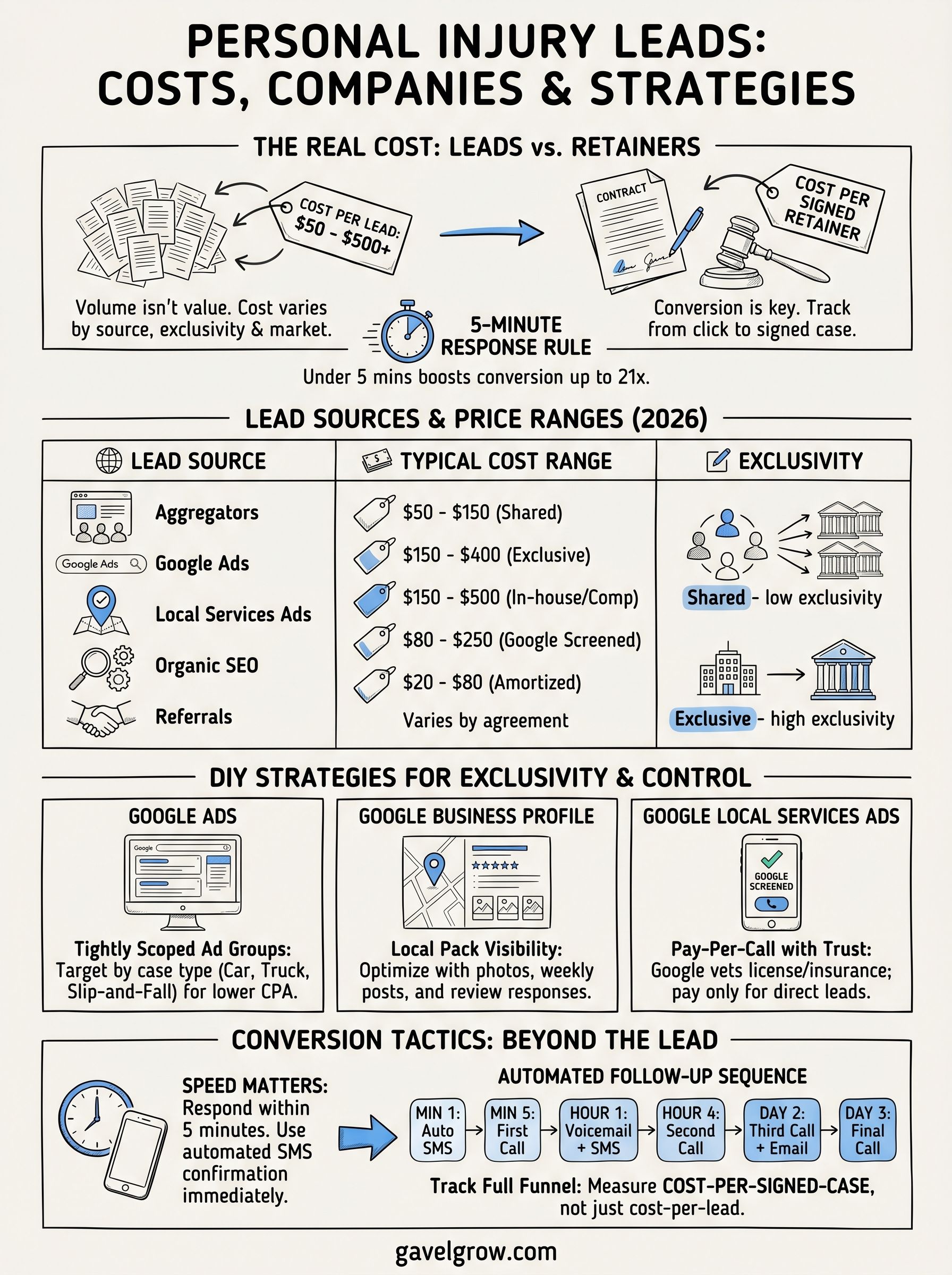
Personal injury leads cost anywhere from $50 to $500+ each depending on whether you buy them from a lead generation company, generate them through paid ads, or build an organic pipeline, and the real cost isn't the lead itself, but whether it converts into a signed retainer.
That distinction matters more than most firms realize. A $75 shared lead that never picks up the phone is infinitely more expensive than a $250 exclusive lead that signs within a week. Yet firms pour thousands into lead sources every month without tracking past the initial form fill. According to Clio's 2024 Legal Trends Report, 42% of firms don't return intake calls within three days, which means even good leads die on the vine. The firms winning in personal injury aren't just buying more leads; they're building systems that convert them faster.
This guide breaks down what personal injury leads actually cost across every major channel, compares the top lead generation companies selling them, and walks through DIY strategies your firm can run in-house. We built GavelGrow specifically to help PI firms track every lead from first ad click through signed case, so we'll also show you where most firms leak money and how to plug those gaps with proper attribution and intake automation.
Key Takeaways
- Shared PI leads run $50–$150; exclusive leads cost $150–$500+ depending on market.
- Lead gen companies vary wildly, vet exclusivity, return policies, and geographic targeting.
- DIY strategies (Google Ads, SEO, LSAs) typically deliver lower cost-per-signed-case long term.
- Speed-to-lead under 5 minutes increases conversion rates by up to 21×.
- Full-funnel tracking from click to retainer separates profitable firms from the rest.
What counts as a personal injury lead?
A personal injury lead is any prospective client who has expressed interest in pursuing a PI claim and provided enough contact information for your firm to follow up. That definition sounds simple, but it skips the part that actually matters: not all leads carry equal value, and treating every form fill as a genuine opportunity is one of the fastest ways to exhaust your marketing budget without growing your caseload.
The three signals that define lead quality
Before you evaluate any lead source, build a working definition of what a qualified lead looks like at your specific firm. Three signals separate a real opportunity from a dead record:
- Case fit: Does the person have a plausible claim that matches your accepted case types? A rear-end collision victim with documented injuries and an identifiable at-fault driver is a qualified PI lead. Someone disputing a neighbor dispute or a self-inflicted injury is not.
- Contactability: Can your intake team actually reach the person within minutes of submission? A lead with a disconnected number or a mistyped email has zero conversion value regardless of how compelling the incident description sounds.
- Exclusivity: Was this lead sold only to your firm, or did it go to three other firms in your market at the same time? Shared leads force a speed race against competitors you may never see.
A lead that checks all three boxes is worth more than ten that check only one.
Why contact information alone is not enough
Most lead generation companies define a "lead" as any submission containing a name, phone number, and a brief incident description. That threshold is intentionally low because it maximizes their billable volume, not your signed cases. Your firm needs a stricter internal definition that screens for incident date, injury severity, existing attorney relationships, and case type before any lead enters your intake workflow.
Clio's 2024 Legal Trends Report found that 37% of potential clients contact more than one law firm before signing a retainer. That stat means your qualification criteria and response speed are active competitive variables from the moment a lead lands. A submission from someone who already retained counsel, whose incident date falls outside your statute of limitations window, or whose "injury" was a minor scrape with no medical contact is not a personal injury lead worth pursuing. It is a dead record that costs intake labor with no upside.
How your lead source shapes what you receive
The channel that generated the lead tells you a great deal about the conversion potential before you make a single call. Organic search leads from people who typed "car accident attorney near me" convert at higher rates because the person self-selected with genuine purchase intent. Paid search leads from Google Ads sit one tier below: still intent-driven, but competitive bidding attracts some speculative submissions alongside real claimants.
Purchased leads from third-party aggregators occupy a different category entirely. These are people who completed a form on a generic legal matching site, often without fully understanding their information would be sold to multiple firms. Conversion rates on purchased leads typically run 2-5%, compared to 10-20% for leads generated directly through your own website, based on GavelGrow's modelled benchmarks.
What a qualified PI lead checklist looks like
Apply these criteria to every new lead source you test and to your intake qualification flow. Reviewing each submission against this checklist takes under two minutes but immediately separates actionable intake work from wasted effort.
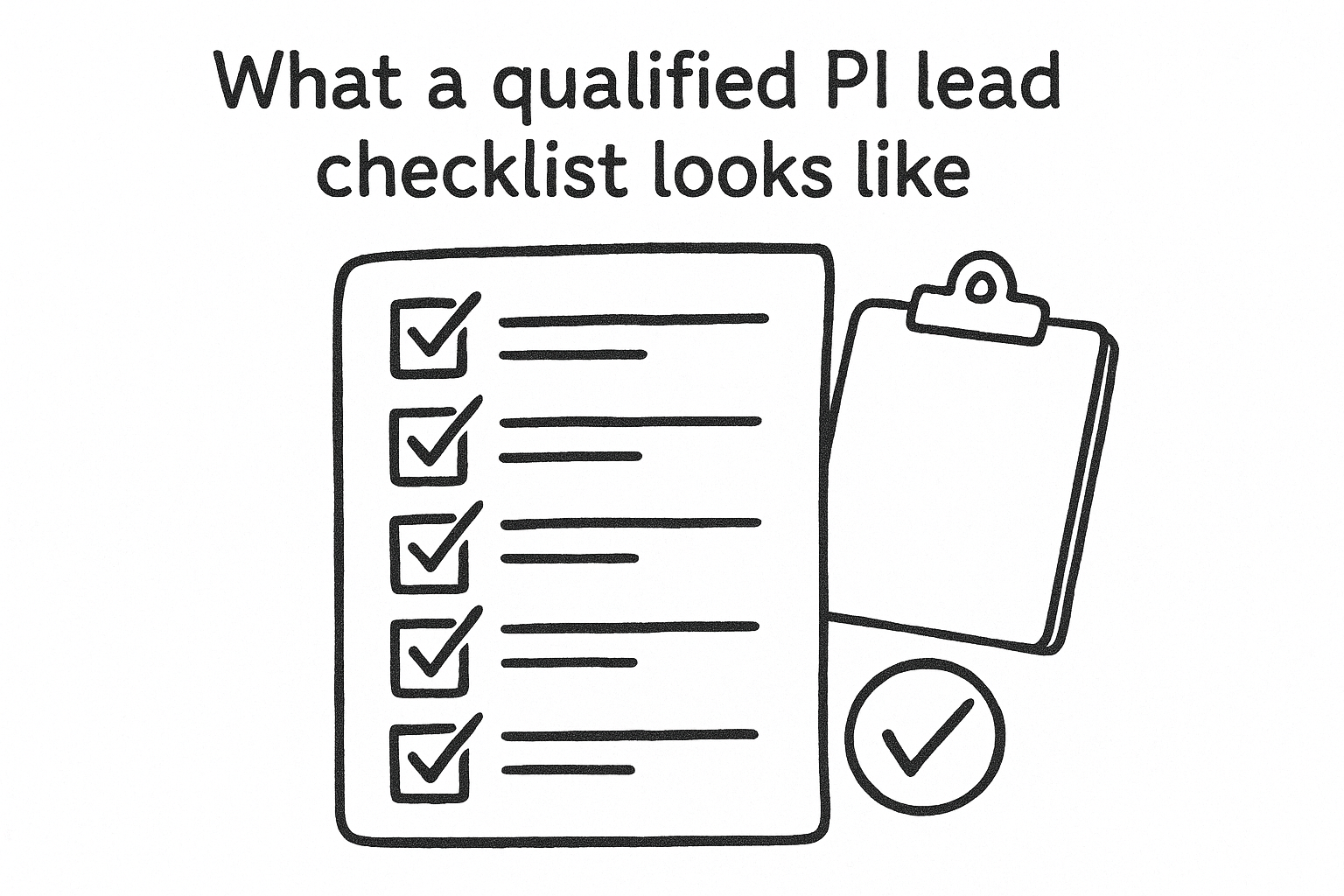
Firms that skip this filter routinely discover they are paying for high lead volume that would never convert under any intake protocol, no matter how fast their team responds.
How much do personal injury leads cost in 2026?
Personal injury leads in 2026 range from $50 for a shared aggregator submission to well over $500 for a verified, exclusive lead in a high-competition market like Los Angeles or Miami. The price you pay tells you almost nothing about the conversion value you receive, so understanding what drives pricing differences helps you allocate budget toward channels that actually produce signed retainers.
What determines the price of a PI lead?
Three factors move the price more than any other: exclusivity, market density, and case type. A shared lead that gets resold to four competing firms costs a fraction of an exclusive one, but you will burn intake hours racing those competitors for the same prospect. Market density pushes prices up in metro areas where bid competition is highest. Case type also matters: trucking accident and medical malpractice leads routinely command premium prices because the average case value justifies higher acquisition costs.
The real question is never "what did the lead cost?" but "what did it cost per signed retainer?"
Price ranges by lead source in 2026
Different channels produce personal injury leads at very different price points. Use this table as a starting reference when you plan channel tests:
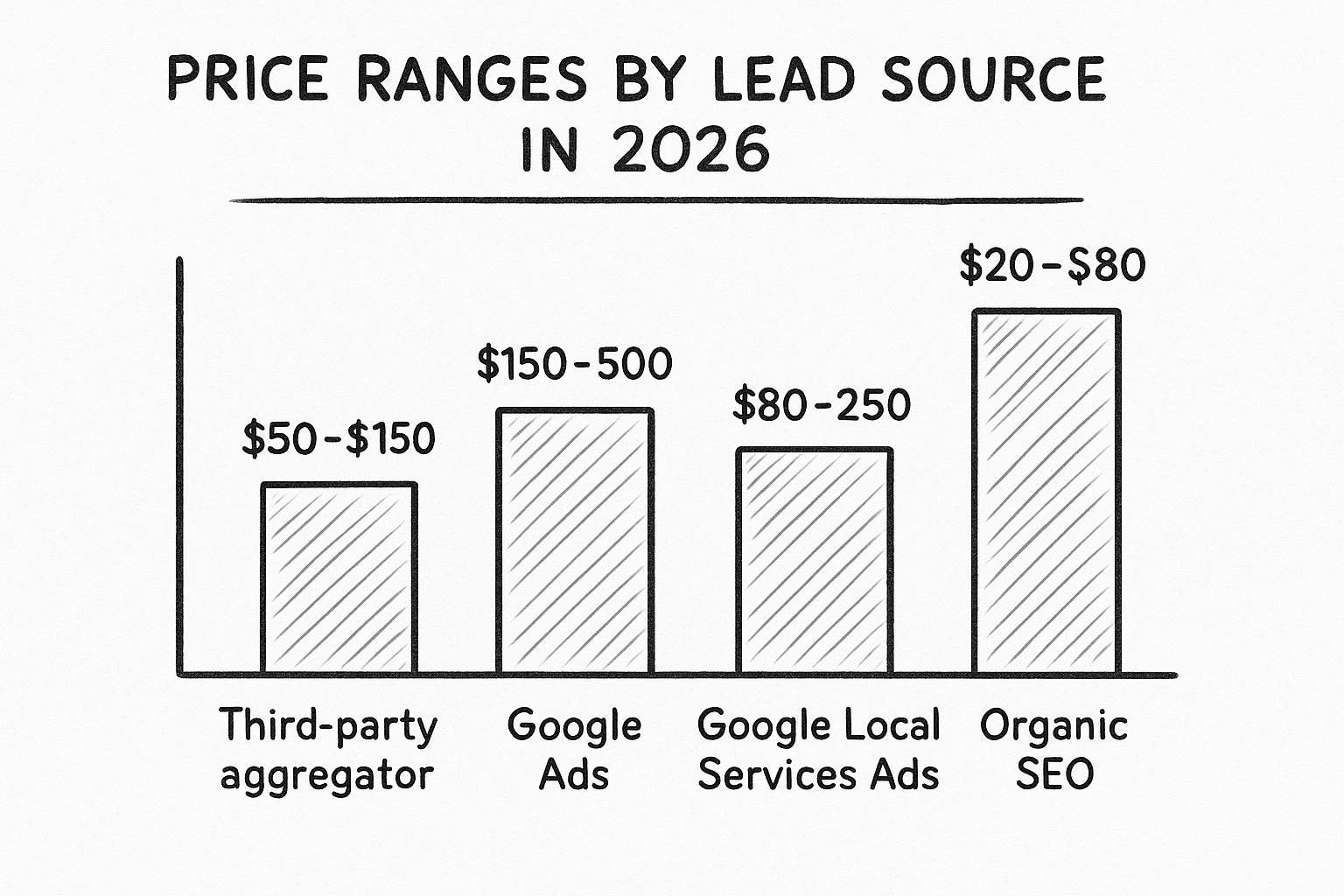
These ranges reflect 2026 market conditions and can shift significantly by practice subtype. A slip-and-fall lead in a mid-size market may sit at the low end of the Google Ads range, while a commercial vehicle accident lead in a major metro can blow through $500 easily.
Why cost-per-lead is the wrong primary metric
Your intake speed and qualification process determine whether any lead price is worth paying. GavelGrow's call tracking and intake automation for law firms captures the full timeline from submission to first contact, so you can identify exactly where conversion breaks down and calculate your true cost-per-signed-case instead of stopping at cost-per-lead. Firms that switch to this measurement routinely discover that their cheapest leads by volume are their most expensive by signed case.
Which lead companies are worth testing first?
Not every lead vendor operates the same way, and spending $5,000 with the wrong one before you understand its model costs you more than money. It costs intake capacity and the opportunity to test a better channel. The vendors below represent three distinct categories worth understanding before you commit budget to any single source.
Mass-market aggregators
Mass-market aggregators like FindLaw Lawyer Marketing and LegalMatch build large consumer-facing sites that rank for broad legal queries, then sell the resulting submissions to member firms. They generate high volume, but that volume comes with a critical trade-off: most submissions are shared with multiple competing firms in your area, sometimes as many as four or five. Your intake team has to move faster than every competitor receiving the same record.
If your firm cannot make first contact within five minutes of submission, shared aggregator leads will consistently underperform regardless of the vendor's brand reputation.
These platforms typically charge on a subscription or pay-per-lead model, with monthly retainers ranging from a few hundred dollars to several thousand depending on practice area and market. Run a 30-day test with a strict first-contact timer and calculate your cost-per-contact before you renew.
Pay-per-call networks
Pay-per-call vendors like Martindale-Avvo and similar networks charge you only when a live person calls a tracked number, which filters out non-contactable submissions by design. Because the prospect is already on the line, your intake team skips the callback race entirely. This model typically costs more per interaction, but contactability is built into the product rather than something you have to chase.
Evaluate pay-per-call vendors using three criteria: minimum call duration thresholds (anything under 60 seconds rarely qualifies as a real prospect), geographic targeting precision, and return or credit policies for obvious mismatches like wrong practice area or out-of-state callers.
Legal-specific marketplaces
Platforms like Avvo and Nolo let prospective clients browse attorney profiles and submit direct inquiries. These submissions arrive with stronger intent than a generic form fill because the person actively searched for a lawyer, reviewed profiles, and chose to contact your firm specifically. That self-selection process means conversion rates typically run higher than broad aggregator leads.
The trade-off is lower volume. Legal marketplace leads work well as a supplemental source alongside your own paid search campaigns rather than as a primary personal injury leads pipeline. Pair any marketplace investment with call tracking and intake automation for law firms so every inbound inquiry gets logged, timed, and attributed accurately before it disappears into an untracked inbox.
How do you vet vendors and stay compliant?
Picking a personal injury leads vendor without vetting them first is the fastest way to burn budget on contacts that will never sign. Before you hand over a credit card number, run every prospective vendor through a structured review that covers their lead sourcing methods, exclusivity guarantees, and return policies. Most vendors will agree to answer these questions in writing before you commit.
What to ask every vendor before you sign
Send these questions via email so you have documented answers before any contract is in place. Verbal promises from sales calls are difficult to enforce when a vendor disputes a credit request three months later.
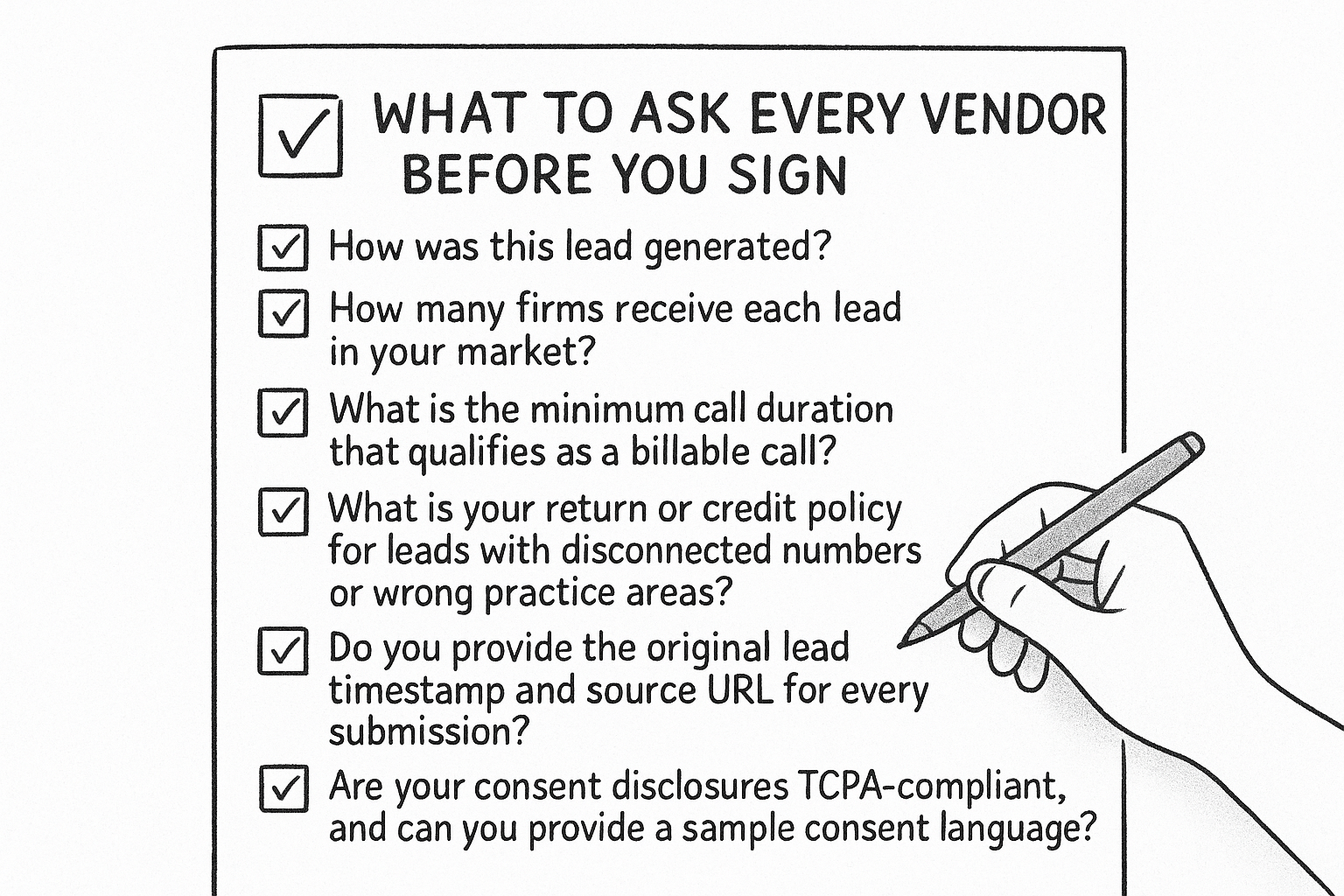
Vendor vetting checklist:
- How was this lead generated? (Organic search, paid ad, partner site, co-registration)
- How many firms receive each lead in your market?
- What is the minimum call duration that qualifies as a billable call?
- What is your return or credit policy for leads with disconnected numbers or wrong practice areas?
- Do you provide the original lead timestamp and source URL for every submission?
- Are your consent disclosures TCPA-compliant, and can you provide a sample consent language?
- Do you offer market exclusivity so competitors cannot buy the same leads?
A vendor who hesitates on any of these questions is telling you something important about how their business operates.
How FTC rules apply to your lead buying
The Federal Trade Commission's guidance on lead generation and advertising disclosures (last updated October 2022) requires that consumer consent be clearly obtained before a company sells contact information to third parties. When you buy leads, you inherit liability risk if the originating consent language was defective. If a prospective client received a call they claim was unsolicited, your firm can face TCPA complaints even if you purchased the lead in good faith.
Require every vendor to provide the exact consent language shown to the consumer at the point of submission, and keep those records on file for at least four years.
Request a sample consent disclosure before you run your first campaign with any new vendor. The consent text must clearly state that the consumer agrees to be contacted by a law firm, name the firm or the category of business, and explain how the consumer can opt out. Vague language like "you may be contacted by our partners" does not satisfy TCPA requirements and puts your firm at risk. Your intake platform should also log every opt-out request automatically so your team never calls a contact who has withdrawn consent, regardless of how the original lead arrived.
How do you generate personal injury leads yourself?
Generating your own personal injury leads through owned and paid channels costs more upfront in time and setup, but it delivers two advantages third-party vendors never can: full exclusivity on every submission and complete attribution data from click to signed case. Firms that build direct acquisition channels typically reach a lower cost-per-signed-case within 6 to 12 months compared to sustained vendor purchasing.
Run Google Ads with tightly scoped ad groups
Google Search campaigns remain the highest-intent paid channel for PI acquisition because the person is actively searching for representation at the exact moment your ad appears. The mistake most firms make is running broad match keywords against a single ad group, which burns budget on irrelevant queries and drives up cost-per-click unnecessarily.
Build your campaigns with tightly segmented ad groups organized by case type: one group for car accident queries, one for truck accident, one for slip-and-fall, and so on. Use exact and phrase match only during your first 30 days to control spend while you gather conversion data. A starting daily budget of $100 to $200 per case type in a mid-size market gives you enough volume to identify which ad groups produce signed cases within two billing cycles.
Once you have 30 days of conversion data, shift budget toward ad groups with the lowest cost-per-signed-case rather than the lowest cost-per-click.
Optimize your Google Business Profile for local PI searches
Your Google Business Profile is the single highest-return, zero-media-cost asset you control for local search visibility. Firms with complete profiles, 50 or more reviews, and weekly posts consistently outrank competitors in the Local Pack for "personal injury lawyer [city]" queries, which carry strong hire-intent from searchers.
Specific actions to take this week:
- Set your primary category to "Personal Injury Attorney"
- Add injury subtypes (auto accident, slip and fall, wrongful death) as secondary categories
- Upload 10 or more photos showing your office, team, and any published settlements
- Post a case result or client FAQ update at least once per week
- Respond to every review within 48 hours, including negative ones
Claim Google Local Services Ads
Google Local Services Ads place your firm above standard paid search results and charge you only when a verified lead calls or messages directly through the ad. Because Google vets your license and insurance before approval, the Google Screened badge on your listing increases trust and conversion rates compared to standard text ads. Set up your LSA profile through Google's Local Services platform and connect your tracking numbers before your first call arrives so attribution is captured from day one.
How do you turn leads into signed retainers?
Generating personal injury leads is only half the equation. The conversion gap opens the moment a lead submits and your intake team fails to respond fast enough, or follows up without a structured sequence. Most firms lose cases not because they lacked qualified prospects, but because their intake process treated every lead like a low-urgency task.
Respond within five minutes every time
Speed is the single most controllable variable in your conversion rate. Research cited across multiple industry reports, including Clio's 2024 Legal Trends Report, consistently shows that prospects contacted within five minutes convert at dramatically higher rates than those reached after 30 minutes. That window closes fast in PI because the injured person is also browsing three other firm websites simultaneously.
If your intake team cannot guarantee a five-minute first-contact standard during business hours, set up automated SMS replies that fire within 60 seconds of every submission so the prospect knows your firm received their inquiry.
Set your automated SMS to confirm receipt, set an expectation, and include a direct callback number. Here is a working template your firm can deploy today:
Hi [First Name], this is [Firm Name]. We received your message about your injury case
and will call you within the next few minutes. If you're available now, call us directly
at [Phone Number]. We're here to help.
Carrier-validated phone numbers and a logged consent audit trail protect your firm from TCPA risk every time that automated message fires. GavelGrow's call tracking and intake automation for law firms handles both automatically, so your team never sends an outbound message to an unverified or opted-out contact.
Build a follow-up sequence that runs automatically
Most prospective clients do not answer the first call. Your intake protocol should include at least five follow-up touchpoints across three days before a lead moves to a "no contact" status. A basic sequence that converts well in PI looks like this:
- Minute 1: Automated SMS confirmation (template above)
- Minute 5: First live call attempt from intake staff
- Hour 1: Voicemail + second SMS if no answer
- Hour 4: Second call attempt
- Day 2, morning: Third call + brief email summary of your firm's PI process
- Day 3, afternoon: Final call attempt before status change
Track what closes, not just what contacts
Your firm needs cost-per-signed-case data, not just cost-per-lead figures, to know which personal injury leads sources actually pay off. Log every case status change against the originating lead source so your attribution reflects reality. Review GavelGrow's GavelGrow pricing for solo to multi-office firms to see which plan tier includes full-funnel attribution reporting for your caseload size.
Frequently Asked Questions and Next Steps
Building a reliable pipeline of personal injury leads requires answers to the questions that come up every time a managing partner reviews a marketing budget. Here are the ones firms ask most often.
How many leads should you buy per month?
Start with 20 to 30 leads per source per month so you accumulate enough data to calculate a statistically valid cost-per-signed-case within 60 days.
Should you pay per lead or per call?
Pay-per-call reduces non-contactable waste because the prospect is already on the line when you pay.
What intake speed should you target?
Contact every lead within five minutes. Clio's 2024 Legal Trends Report links sub-five-minute response to conversion rates up to 21 times higher than 30-minute delays.
What should you track first?
Track cost-per-signed-case, not cost-per-lead. One metric tells you what growth costs; the other just tells you what volume costs.
Ready to measure your full funnel from first click to signed retainer? Book a free 45-minute PI marketing strategy call and get a channel-by-channel plan built for your firm.
Frequently Asked Questions
How many leads should you buy per month?
Start with 20 to 30 leads per source per month so you accumulate enough data to calculate a statistically valid cost-per-signed-case within 60 days.
Should you pay per lead or per call?
Pay-per-call reduces non-contactable waste because the prospect is already on the line when you pay.
What intake speed should you target?
Contact every lead within five minutes. Clio's 2024 Legal Trends Report links sub-five-minute response to conversion rates up to 21 times higher than 30-minute delays.
What should you track first?
Track cost-per-signed-case, not cost-per-lead. One metric tells you what growth costs; the other just tells you what volume costs. Ready to measure your full funnel from first click to signed retainer? Book a free 45-minute PI marketing strategy call and get a channel-by-channel plan built for your firm.