TCPA Compliance For Law Firms: Marketing Checklist
Categories: Legal Marketing Strategies
 Abram Ninoyan
Founder & Senior Performance Marketer
Credentials: Google Partner, Google Ads Search Certified, Google Ads Display Certified, Google Ads Measurement Certified, Google Analytics (IQ) Certified, HubSpot Inbound Certified, HubSpot Social Media Marketing Certified, Conversion Optimization Certified
Expertise: Google Ads, Meta Ads, Conversion Rate Optimization, GA4 & Google Tag Manager, Lead Generation, Marketing Funnel Optimization, PPC Management
LinkedIn Profile
A single unsolicited text message can cost your firm $500 to $1,500 in TCPA penalties, and the FCC's one-to-one consent rule, which took effect January 27, 2025, made the compliance bar significantly...
Key Takeaways
- TCPA Compliance For Law Firms: 2026 Marketing Checklist
- What TCPA compliance means for law firm marketing in 2026
- Step 1. Map every call and text your firm sends
- Step 2. Fix consent for the FCC one-to-one rule
TCPA Compliance For Law Firms: 2026 Marketing Checklist
A single unsolicited text message can cost your firm $500 to $1,500 in TCPA penalties, and the FCC's one-to-one consent rule, which took effect January 27, 2025, made the compliance bar significantly higher for every firm running paid lead generation. If your intake process doesn't meet current TCPA compliance for law firms standards, you're exposed every time a prospect fills out a form or answers a call.
The irony isn't lost on anyone: personal injury and mass tort firms routinely file TCPA class actions against corporations, yet many of those same firms run marketing campaigns that violate the very statute they litigate. The FCC's updated rules eliminated lead generators' ability to sell a single consent across multiple buyers, meaning every firm now needs its own documented, prior express written consent before making a marketing call or sending a text. Generic intake forms and third-party lead vendors that haven't adapted are liability magnets.
This checklist breaks down exactly what your firm needs to do, from consent language and call recording disclosures to SMS opt-out handling and recordkeeping, to stay compliant through 2026 and beyond. Every requirement maps to practical steps you can implement this week, whether you handle marketing in-house or through an agency. GavelGrow built these safeguards directly into the platform: append-only consent audit logs, CTIA-compliant opt-out keyword handling, carrier-level phone validation, and two-party-consent call recording controls ship standard on every plan, because bolting compliance on after the fact doesn't work.
What TCPA compliance means for law firm marketing in 2026
The Telephone Consumer Protection Act restricts how firms contact consumers via phone, text, and auto-dialed calls. The FCC's one-to-one consent rule, effective January 27, 2025, ended the practice of shared consent across lead buyers. Now each firm must obtain separate written consent before sending any marketing text or making any auto-dialed or prerecorded call.
What changed with the FCC's one-to-one rule
Your firm can no longer rely on consent collected by a third-party lead vendor and shared across multiple buyers. Under the updated rule, consent must identify your firm by name and must be obtained on a form that specifically names your firm. Lead aggregators who sold a single consumer opt-in to multiple law firms are violating the TCPA on your behalf if you act on those leads without separate documented consent.
If you bought leads from any aggregator before January 27, 2025, and you're still texting those contacts, your firm carries real liability right now.
What prior express written consent actually requires
TCPA compliance for law firms depends on four documented elements the FCC enforces: the consumer's electronic signature, a clear statement of who will contact them by name, the communication methods covered (calls, texts, or both), and a disclosure that consent is not required to receive legal services. Missing any single element makes the consent legally defective.
- Consumer's electronic signature or checkbox confirming agreement
- Your firm's name stated explicitly in the consent language
- Specific methods of contact covered (calls, texts, auto-dialer, prerecorded voice)
- Statement that consent is not a condition of receiving services
Step 1. Map every call and text your firm sends
You can't fix what you haven't documented. Before you update consent language or adjust your intake flow, pull a complete inventory of every outbound communication channel your firm uses to contact prospects. This includes auto-dialed calls, prerecorded voicemails, SMS sequences, and any third-party lead vendor campaigns running in your firm's name.
If a vendor sends texts on your behalf and you haven't reviewed their consent process, your firm shares the liability.
Build a communication channel inventory
Start by listing every touchpoint in a simple table. For each channel, record the technology used, the consent collection method, and who actually owns the consent record.
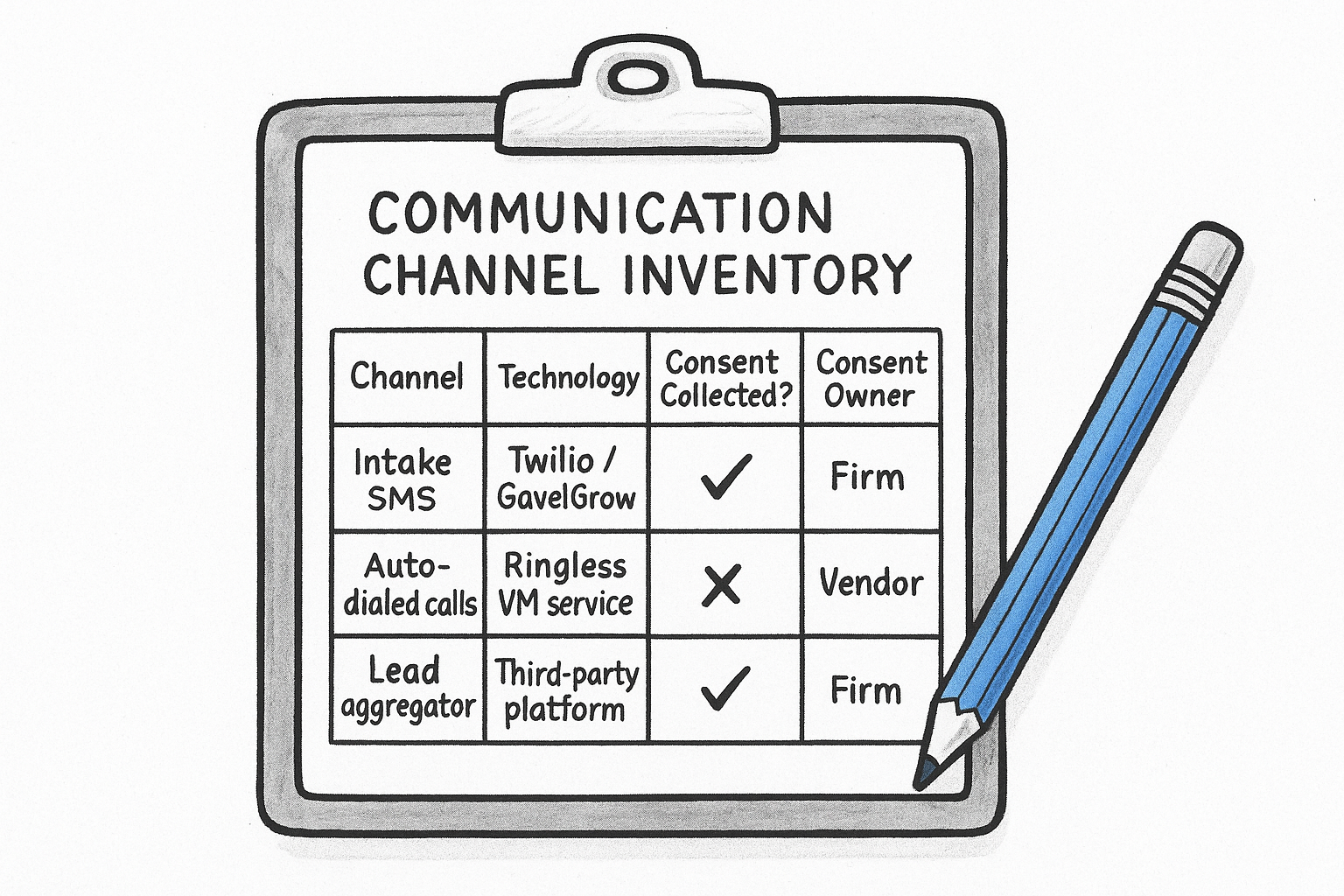
TCPA compliance for law firms requires documenting every touchpoint before you attempt to close any gaps.
Step 2. Fix consent for the FCC one-to-one rule
Once you have your channel inventory, update every intake form that collects consent for outbound marketing. The FCC's January 2025 rule requires your firm's name to appear explicitly in the consent language, and that language must cover each communication method you plan to use.
Generic "I agree to be contacted" checkboxes no longer satisfy TCPA compliance for law firms under the one-to-one rule.
Use this consent language template
Replace your current checkbox text with the following language, filling in your firm's name and adjusting the contact methods listed:
"By checking this box, I provide my prior express written consent for [Firm Name] to contact me using auto-dialed calls, prerecorded messages, and/or SMS text messages at the number I provided. I understand that consent is not required to receive legal services."
This template satisfies the three required elements: your firm named explicitly, the communication methods specified, and the condition-of-service disclaimer. Store a timestamped record of every submission alongside the IP address and form version used.
Step 3. Lock down DNC, opt-outs, timing, and vendors
Consent is only one piece of TCPA compliance for law firms. You also need active controls on Do Not Call registry scrubbing, opt-out processing, call timing windows, and vendor accountability before you send another message or make another call.
A firm that processes opt-outs within 30 days is still violating the TCPA. The FCC requires honoring opt-out requests within 10 business days of receipt.
Scrub lists and process opt-outs immediately
Scrub every contact list against the National DNC Registry before each outbound campaign. For SMS campaigns, configure your platform to process STOP keyword requests automatically at the moment they arrive. GavelGrow handles CTIA opt-out keywords in real time, but if you use a separate SMS tool, test its opt-out latency before the next campaign goes out.
Enforce call timing and vendor contracts
Federal rules prohibit outbound calls or texts before 8 a.m. or after 9 p.m. in the recipient's local time zone. Require every third-party vendor contacting prospects on your behalf to provide written confirmation of their DNC scrubbing cadence, opt-out handling process, and consent documentation practices.
Step 4. Prove compliance with audit logs in GavelGrow
Documented consent is only useful if you can produce it on demand. When a plaintiff's attorney or the FCC requests proof that a specific consumer opted in, you need a timestamped, tamper-proof record tied to that exact submission. GavelGrow's append-only consent audit log captures the IP address, form version, timestamp, and consent language shown at the moment each lead submitted their information.
If you can't prove when consent was collected and what language the consumer saw, the consent is effectively worthless in a TCPA dispute.
What the GavelGrow audit log captures
Every intake form submission records six data points automatically, and your firm accesses all of them directly from the lead pipeline without needing a developer or a third-party data export. TCPA compliance for law firms requires records that survive platform changes, and the append-only structure ensures no record can be edited or deleted after the fact.
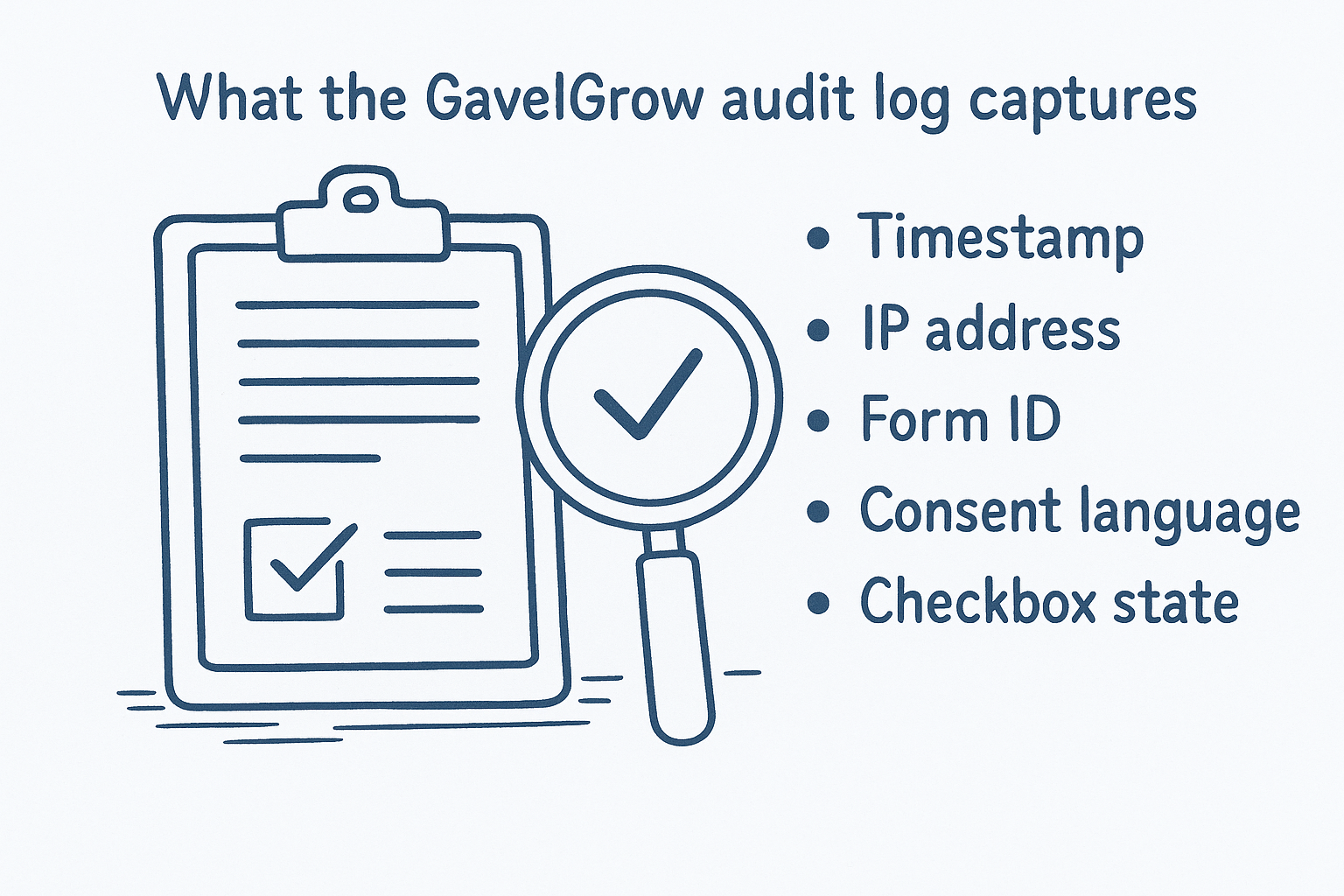
- Submission timestamp
- IP address
- Form ID and version number
- Consent language displayed at submission
- Carrier-level phone validation status
- TCPA-compliant checkbox state
Frequently Asked Questions
The questions below cover the most common concerns managing partners raise about TCPA compliance for law firms when updating their intake forms, SMS campaigns, and vendor contracts.
What does the FCC's one-to-one consent rule require?
Your firm must obtain separate written consent that names your firm explicitly before sending any marketing text or auto-dialed call. The rule took effect January 27, 2025, and applies to every firm buying or generating leads.
How much can a TCPA violation cost your firm?
Each violation carries a $500 statutory penalty, rising to $1,500 for willful violations. Class actions multiply that figure across every unsolicited contact your firm sent.
Plaintiffs' attorneys actively recruit TCPA plaintiffs from personal injury and mass-tort markets because law firms are high-value defendants.
What opt-out keywords must my SMS platform handle?
CTIA guidelines require your platform to recognize STOP, QUIT, CANCEL, UNSUBSCRIBE, and END. Every keyword must trigger immediate opt-out processing, not batch processing at end of day.
How long should my firm retain consent records?
Retain timestamped consent records for at least four years, which aligns with the TCPA's federal statute of limitations under 28 U.S.C. § 1658.
Does prior express written consent expire?
Your consent records carry no fixed expiration, but the FCC expects your firm to honor revocations immediately and re-obtain fresh documented consent after any substantial gap in communication.
Where to go from here
TCPA compliance for law firms isn't a one-time fix. The FCC updated its rules in January 2025, and enforcement actions have followed. Every firm that runs paid lead generation, buys aggregated leads, or sends post-intake SMS sequences carries real exposure until consent language, audit records, and opt-out workflows match the current standard.
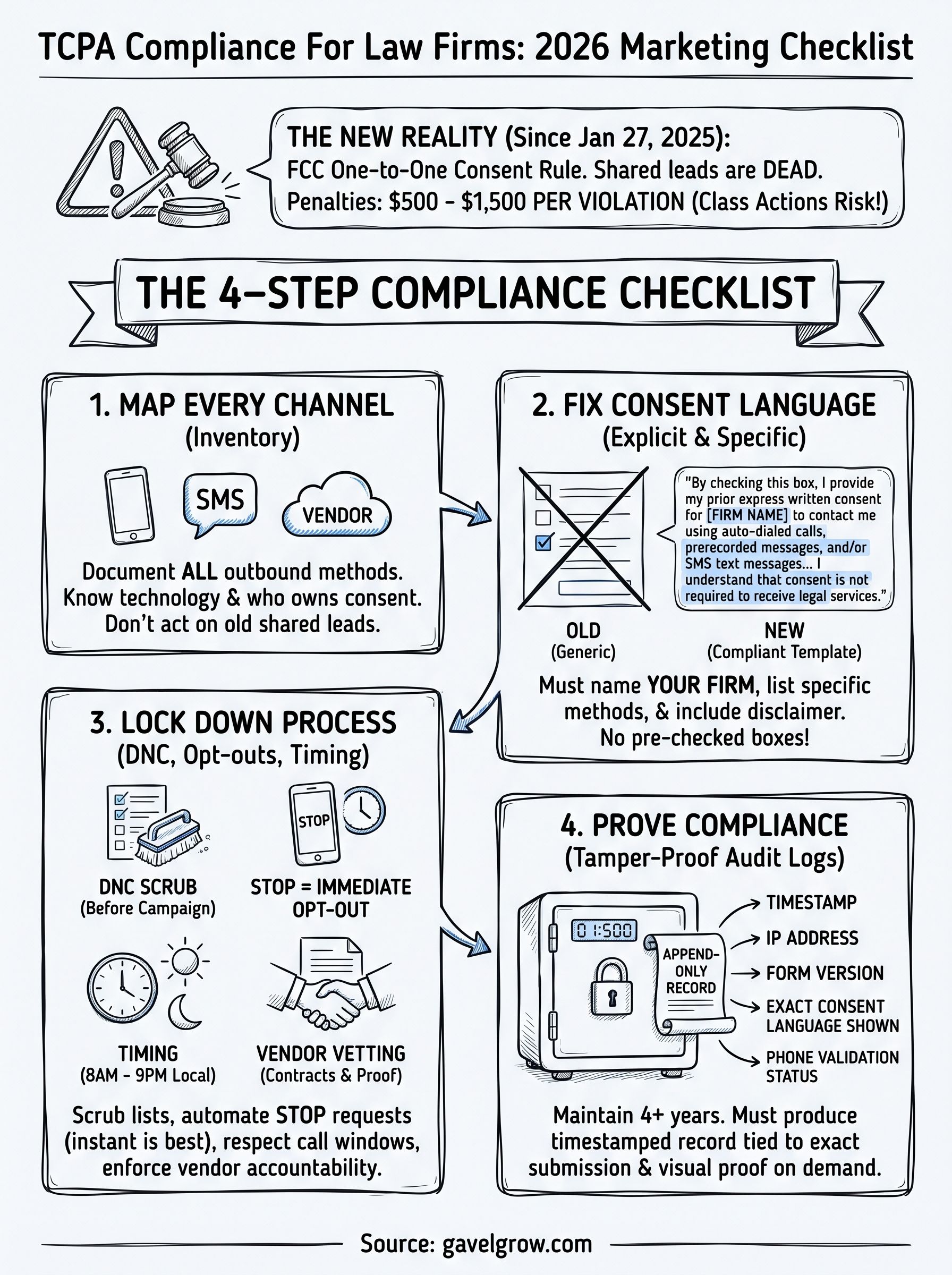
Work through the four steps in this checklist in order: map your channels, fix your consent language, lock down opt-outs and vendor contracts, then confirm your platform captures tamper-proof audit logs. If you complete each step, you'll have a defensible compliance posture backed by documentation.
GavelGrow builds all of these safeguards into the platform by default, so your intake process stays compliant without additional tools or manual record-keeping. Start your 7-day free trial of GavelGrow's legal marketing platform today, or book a free 45-minute strategy call to review your current intake setup with a specialist.
Frequently Asked Questions
What does the FCC's one-to-one consent rule require?
Your firm must obtain separate written consent that names your firm explicitly before sending any marketing text or auto-dialed call. The rule took effect January 27, 2025 , and applies to every firm buying or generating leads.
How much can a TCPA violation cost your firm?
Each violation carries a $500 statutory penalty , rising to $1,500 for willful violations. Class actions multiply that figure across every unsolicited contact your firm sent. Plaintiffs' attorneys actively recruit TCPA plaintiffs from personal injury and mass-tort markets because law firms are high-value defendants.
What opt-out keywords must my SMS platform handle?
CTIA guidelines require your platform to recognize STOP, QUIT, CANCEL, UNSUBSCRIBE, and END. Every keyword must trigger immediate opt-out processing , not batch processing at end of day.
How long should my firm retain consent records?
Retain timestamped consent records for at least four years, which aligns with the TCPA's federal statute of limitations under 28 U.S.C. § 1658.
Does prior express written consent expire?
Your consent records carry no fixed expiration, but the FCC expects your firm to honor revocations immediately and re-obtain fresh documented consent after any substantial gap in communication.