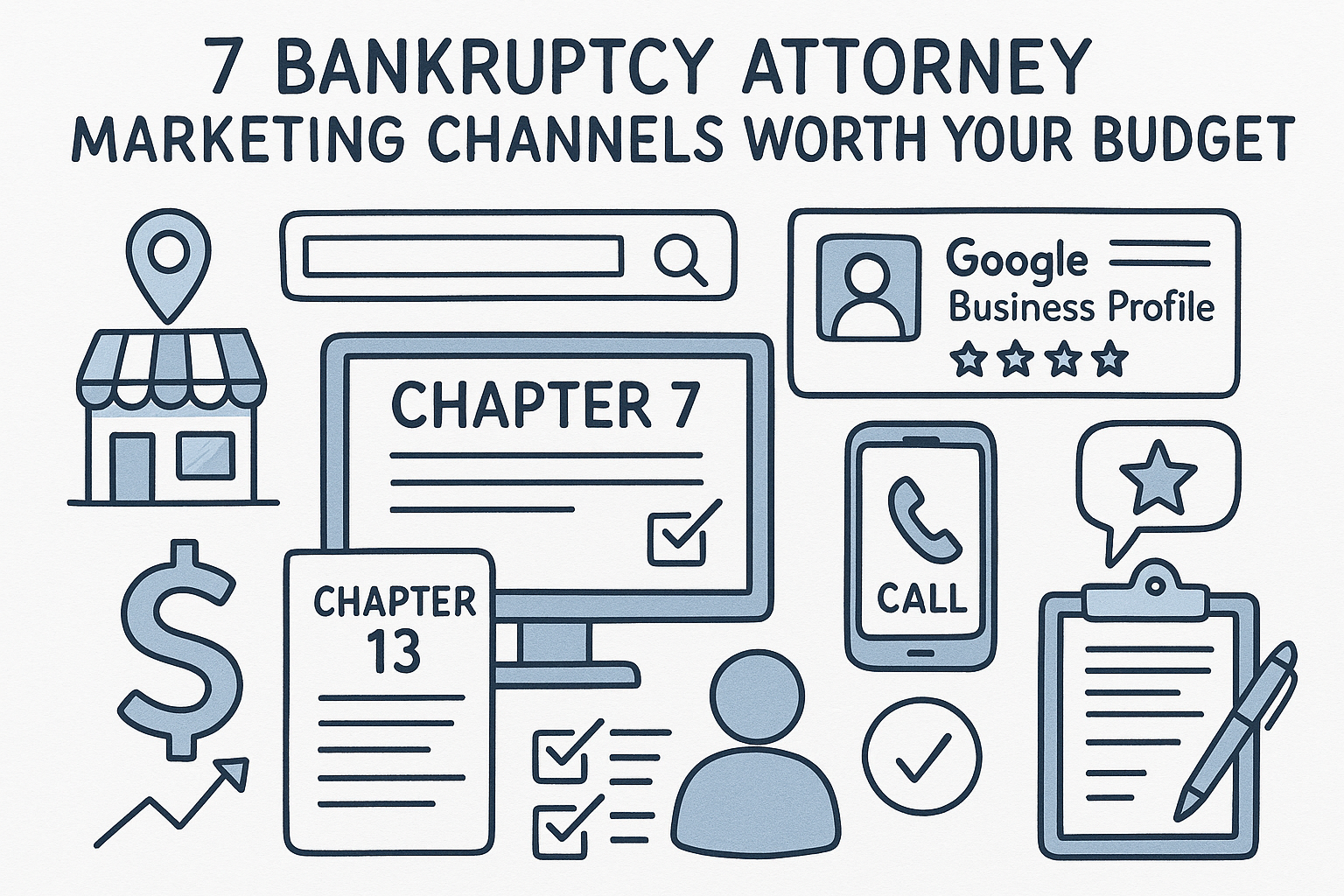
7 Bankruptcy Attorney Marketing Channels Worth Your Budget
Categories: Legal Marketing Strategies
 Abram Ninoyan
Founder & Senior Performance Marketer
Credentials: Google Partner, Google Ads Search Certified, Google Ads Display Certified, Google Ads Measurement Certified, Google Analytics (IQ) Certified, HubSpot Inbound Certified, HubSpot Social Media Marketing Certified, Conversion Optimization Certified
Expertise: Google Ads, Meta Ads, Conversion Rate Optimization, GA4 & Google Tag Manager, Lead Generation, Marketing Funnel Optimization, PPC Management
LinkedIn Profile
Good bankruptcy attorney marketing puts your firm in front of people at the moment they search, then answers them fast enough to win the consultation. Start with local SEO and a well-run Google Busine...
Key Takeaways
- 7 Bankruptcy Attorney Marketing Channels Worth Your Budget
- 1. Local SEO and your Google Business Profile
- 2. Chapter 7 and Chapter 13 landing pages
- 3. Are Local Services Ads worth it for bankruptcy?
7 Bankruptcy Attorney Marketing Channels Worth Your Budget
Good bankruptcy attorney marketing puts your firm in front of people at the moment they search, then answers them fast enough to win the consultation. Start with local SEO and a well-run Google Business Profile for durable lead flow. Add Local Services Ads or Google Ads when you need calls this month, and treat intake speed as the channel that decides whether the rest pays off. Solo practitioners usually do best with items 1, 3 and 5. Firms with a larger budget add items 2, 4 and 7. Item 6 suits any firm with a local reputation to build.
Bankruptcy is unlike most practice areas. Your prospect is facing a garnishment, a foreclosure date or constant collection calls, and they will phone several firms in one sitting. Visibility alone does not sign cases, and a federal disclosure rule shapes what your ads must say.
This article walks through seven channels. For each, you get how it works, who it fits and what to watch. A final section covers compliant advertising. GavelGrow has marketed only for law firms since 2015, so the advice leans on one question: does this channel produce signed retainers, or only clicks?
1. Local SEO and your Google Business Profile
How it works
Local SEO decides which firms appear in the map pack and organic listings when someone searches "bankruptcy attorney near me." Google weighs relevance, distance and prominence, and your Google Business Profile is the biggest lever you control. Build it first, then back it with a website that names the cities and counties you serve.
Your map listing is your storefront, and a bankruptcy prospect on a phone decides from it quickly.
Work through this checklist:
- Choose the most specific bankruptcy category available as your primary category.
- Keep your firm name, address and phone number identical on your site, profile and directories.
- Use an address where you actually meet clients, never a virtual office.
- List your services, hours and consultation options, and add real photos of your office.
Who it fits
Firms with a physical office and a defined service area get the most from this channel. It rewards patience, so expect months rather than weeks before rankings move. Once they do, the leads carry no per-click fee. A solo practitioner on a modest budget should start here.
What to watch
The usual mistakes are thin city pages that swap one place name into identical text, and a profile name stuffed with keywords, which risks suspension. Profile insights count calls and clicks, not signed cases, so you also need call tracking to learn which calls became clients. If you would rather hand this work off, GavelGrow's local SEO and Google Business Profile service is built for law firms only.
2. Chapter 7 and Chapter 13 landing pages
How it works
A landing page built around one question converts better than a page that tries to answer everything. Create separate pages for Chapter 7, Chapter 13, "Chapter 7 vs Chapter 13," wage garnishment and "how much does bankruptcy cost." A person facing a garnishment wants to know what happens next, not a history of the Bankruptcy Code.
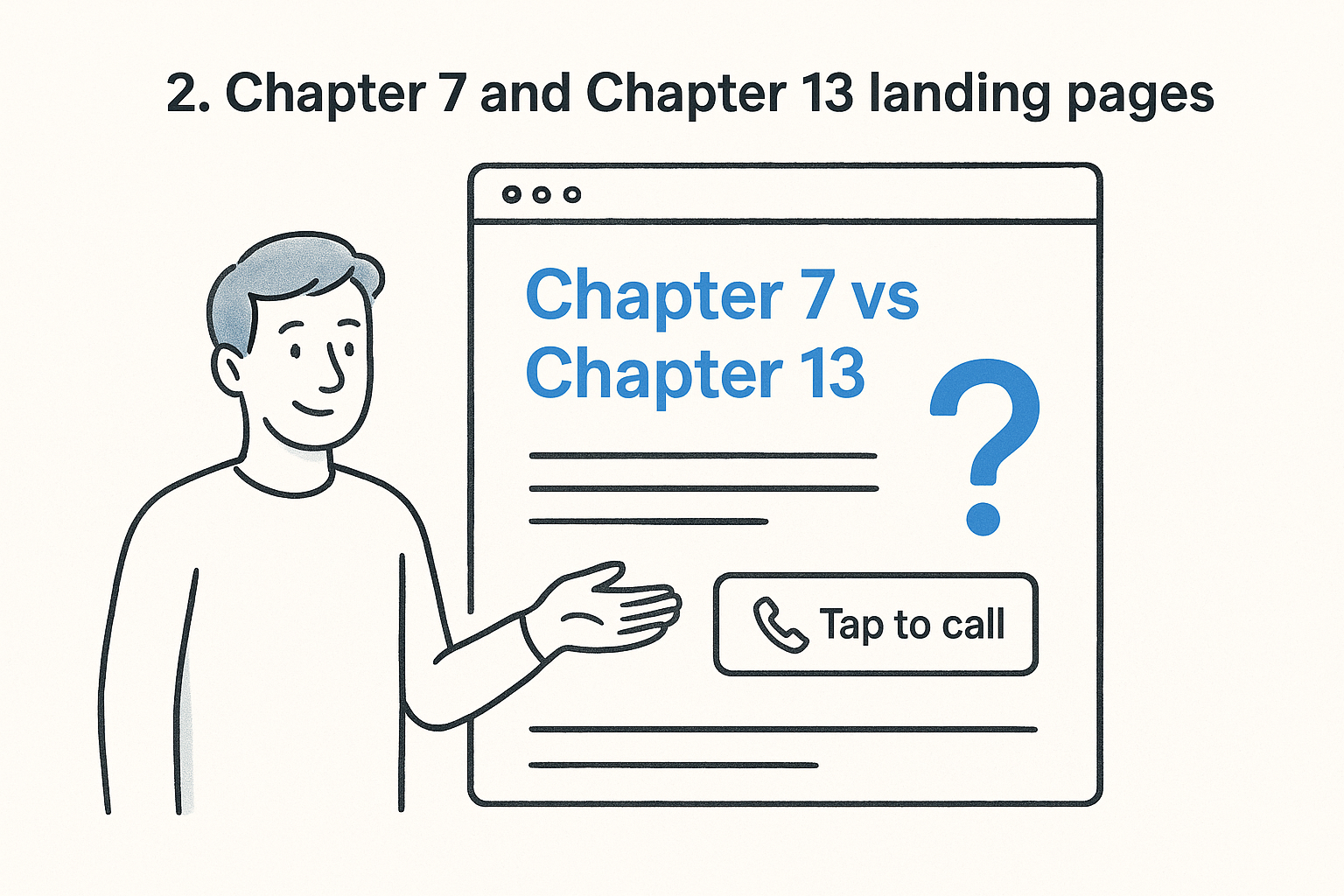
A bankruptcy page should answer one question and offer one next step.
Each page should include:
- A plain-language answer on the first screen
- The steps of the process, including what happens at the meeting of creditors
- Your fee structure, and what the court charges separately
- A tap-to-call number and a short form near the top
- Your debt relief agency statement, covered in the last section
Who it fits
Any firm whose site still has one generic "practice areas" page needs this. It matters most if you buy ads, because paid traffic sent to a specific page tends to waste less spend than traffic sent to a homepage.
What to watch
Do not promise outcomes. "We will eliminate your debt" invites bar complaints, and a page that explains discharge should also explain its limits. Test every page on a phone. Forms that feel long on a small screen lose people, and a slow page loses a worried visitor before the headline appears. Intake form and landing page work is the focus of GavelGrow's conversion optimization service.
3. Are Local Services Ads worth it for bankruptcy?
How it works
Local Services Ads are pay-per-lead ads that sit above standard search results with a Google Screened badge. You pay when a qualifying call or message arrives, not when someone clicks, and you can dispute leads that do not qualify. Placement draws on factors such as your reviews, how quickly you respond and how close you are to the searcher.
With Local Services Ads you rent attention by the lead, so every missed call is money lost.
Who it fits
Solo and small firms that want ringing phones without managing keywords tend to like this format. You must answer quickly, because missed calls cost you leads and weaken your responsiveness signals. Expect to complete Google's verification process, and check whether bankruptcy is offered in your market, since availability for legal services varies by location and practice type.
What to watch
Google controls the leads, so you control little. You do not pick keywords, and reporting stops at the lead. Local Services Ads also cannot accept offline conversion signals, so you cannot send signed cases back to improve bidding. Track each call through to a signed retainer yourself, or use a platform that does. GavelGrow's Local Services Ads service manages these campaigns for law firms.
4. How should you run Google Ads for bankruptcy?
How it works
Run search campaigns on high-intent phrases, with one ad group per chapter or problem and a landing page matched to each. Add negative keywords early to filter searches like "file bankruptcy myself" or "free bankruptcy forms," which bring browsers rather than clients. Unlike Local Services Ads, you choose keywords, geography and schedule, and you pay per click.
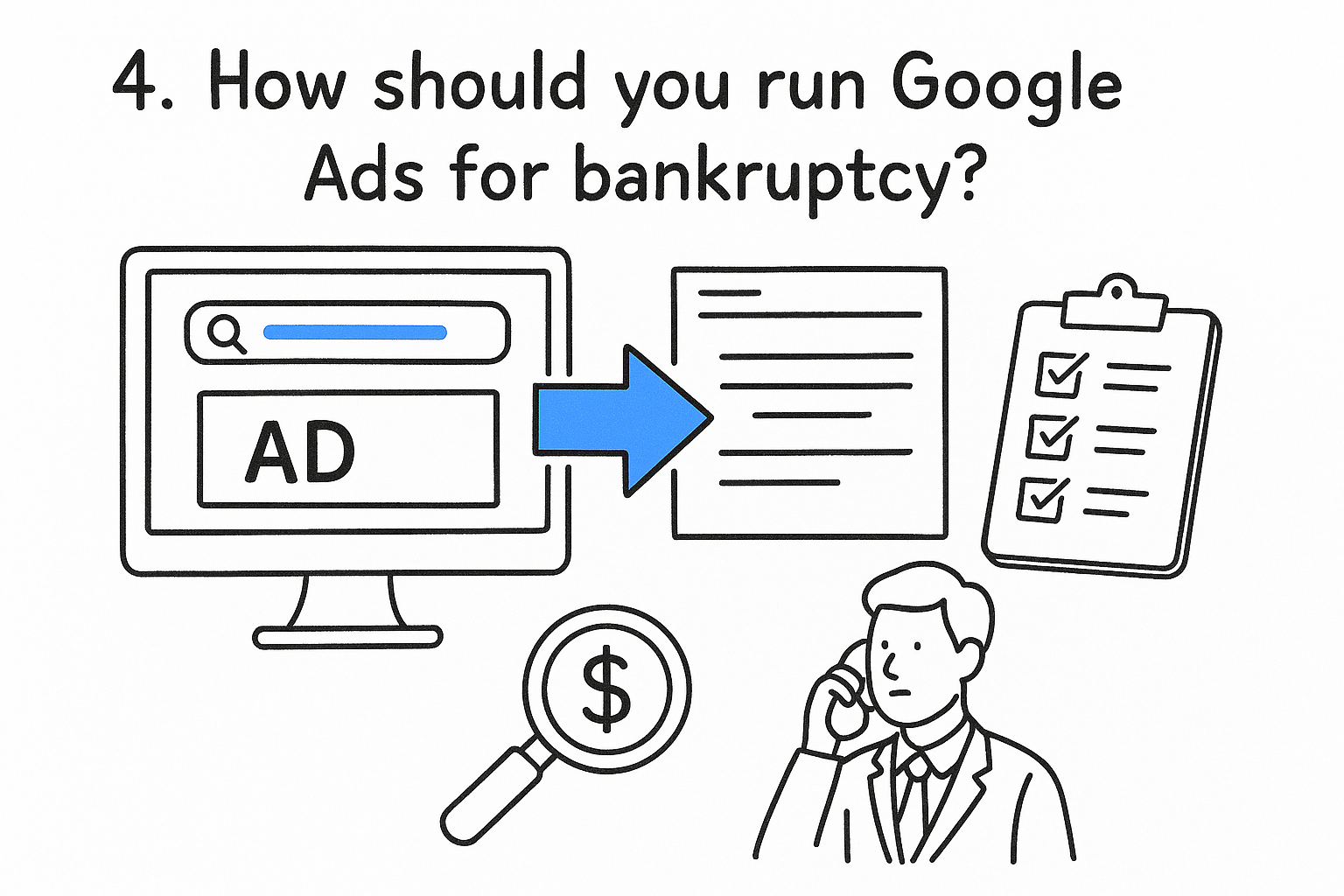
Count phone calls as conversions, not only form fills. Many bankruptcy prospects never type anything.
Who it fits
This suits firms with consistent intake capacity and a desire for control over spend by county or city. It also suits firms that want to test messaging quickly. If you cannot return calls the same day, fix intake first (item 7) before raising the budget.
What to watch
Cost per lead hides the real picture. The table below uses hypothetical numbers to show why.
Identical ad spend and identical lead cost can produce a cost per signed case that differs by 2x.
Be wary of vendors that resell the same lead to several firms. Run your own numbers with the cost per acquisition calculator, and see GavelGrow's managed Google Ads service if you want it run for you. On the Optimize plan, signed cases can be sent back to Google Ads as offline conversions.
5. How to earn reviews without risking your profile
How it works
Reviews affect both map rankings and the decision to call. Build a routine: ask every client at the same point in the case, send a Google review link that goes straight to your profile, and respond to every public review. Consistency matters more than volume, and a steady trickle looks natural.
Ask every client, never a filtered few, and answer every review in public.
Who it fits
Every firm benefits, and firms running Local Services Ads depend on it, since reviews feed those rankings. Bankruptcy clients are often private about their finances, so some will decline. That is fine. Do not push.
What to watch
Google's review policies prohibit gating, which means routing unhappy clients to a private form before they can review publicly. They also prohibit asking only satisfied clients and offering incentives for reviews. If a client complains, resolve it with them directly.
Public replies carry a confidentiality risk. Do not confirm that the reviewer was a client or mention case details, even when the review is positive. A safe template:
Thank you for taking the time to share your feedback. Because of our confidentiality obligations, we can't discuss any matter in a public reply. We welcome you to contact our office directly at [phone number].
Rules on testimonials vary by state, so check your state bar before quoting reviews in ads.
6. Referral partners who see debt trouble first
How it works
People in financial distress usually talk to someone before they talk to you. Build relationships with CPAs, financial advisors, mortgage brokers, real estate agents and credit counselors, plus family law, personal injury and collections defense lawyers who see debt problems but do not file bankruptcies. Individual filers must complete credit counseling before filing, so approved counseling agencies see prospects early. Offer a one-page explainer on Chapter 7 versus Chapter 13 that partners can share, or a short lunch-and-learn.
The best referral relationships begin with education, never with a request.
Who it fits
Firms with deep local roots and little ad budget get the most from referrals. Chamber of commerce and bar association events make good starting points, and the cost is mostly your time. Results arrive slowly but tend to bring clients who already trust you.
What to watch
Do not pay or give anything of value for referrals. ABA Model Rule 7.2 restricts it, and your state's version may be stricter, so check before you formalize any arrangement. Also record the source on every intake. Without it, referral work looks like it does nothing, and you will cut the channel that is quietly signing cases.
7. How fast should you answer a bankruptcy lead?
How it works
Every channel above ends in a call or a form, and the next few minutes decide the outcome. The Lead Response Management Study found that leads contacted within five minutes were far more likely to be qualified than leads first reached at thirty minutes. That measures the odds of qualifying a lead, not signed cases. The direction still matters, because bankruptcy prospects often phone several firms in a row.
A workable first-response routine:
- Answer live during business hours, and send after-hours calls to a service or a missed-call follow-up.
- Send an instant email auto-reply when a form arrives.
- Call or text within minutes, texting only with recorded consent.
- Run a short follow-up sequence for people who do not book.
- Tag every outcome as signed, not qualified or no answer.
Leads you already paid for are the cheapest ones to win, so answer them first.
Who it fits
Every firm, but above all firms already paying for leads. A faster response costs far less than another dollar of ad spend, and it lifts the return on every channel above.
What to watch
Texting requires TCPA consent captured at the source, with a record you can produce. Calls you record need a recording notice. The bigger trap is tool sprawl: separate forms, call tracking and CRM that do not share data leave you guessing which campaign signed which case. GavelGrow's platform combines call tracking numbers, consent-logged intake forms, follow-up sequences and click-to-signed-case attribution. Track is $199/month and Optimize is $599/month, both with a 7-day free trial and no credit card.
What do bankruptcy ads have to disclose?
The debt relief agency statement
Federal law requires debt relief agencies to include a clear and conspicuous disclosure in advertisements of bankruptcy assistance directed to the general public. The Supreme Court held in Milavetz, Gallop & Milavetz v. United States that attorneys providing bankruptcy assistance to consumer debtors fall under the rule. The statute is 11 U.S.C. § 528, and it calls for this statement or one substantially similar:
We are a debt relief agency. We help people file for bankruptcy relief under the Bankruptcy Code.
Put it on landing pages, video, direct mail and social posts. Short search ads and small social formats are the hard case, so confirm with ethics counsel how your jurisdiction expects you to handle them.
If a bankruptcy ad reaches the public, the disclosure goes with it.
State bar rules and claims to avoid
State bars add their own law firm advertising rules on top of federal law, so check yours before launching anything. As a baseline:
- Never guarantee a result, such as discharge of all debts.
- Avoid superlatives like "best" or "top" for your firm.
- Claim specialist status only where your state allows it and you qualify.
- Make "free consultation" offers only with terms you can honor.
- Follow your state's testimonial and review-quoting rules.
Where to start with your bankruptcy marketing
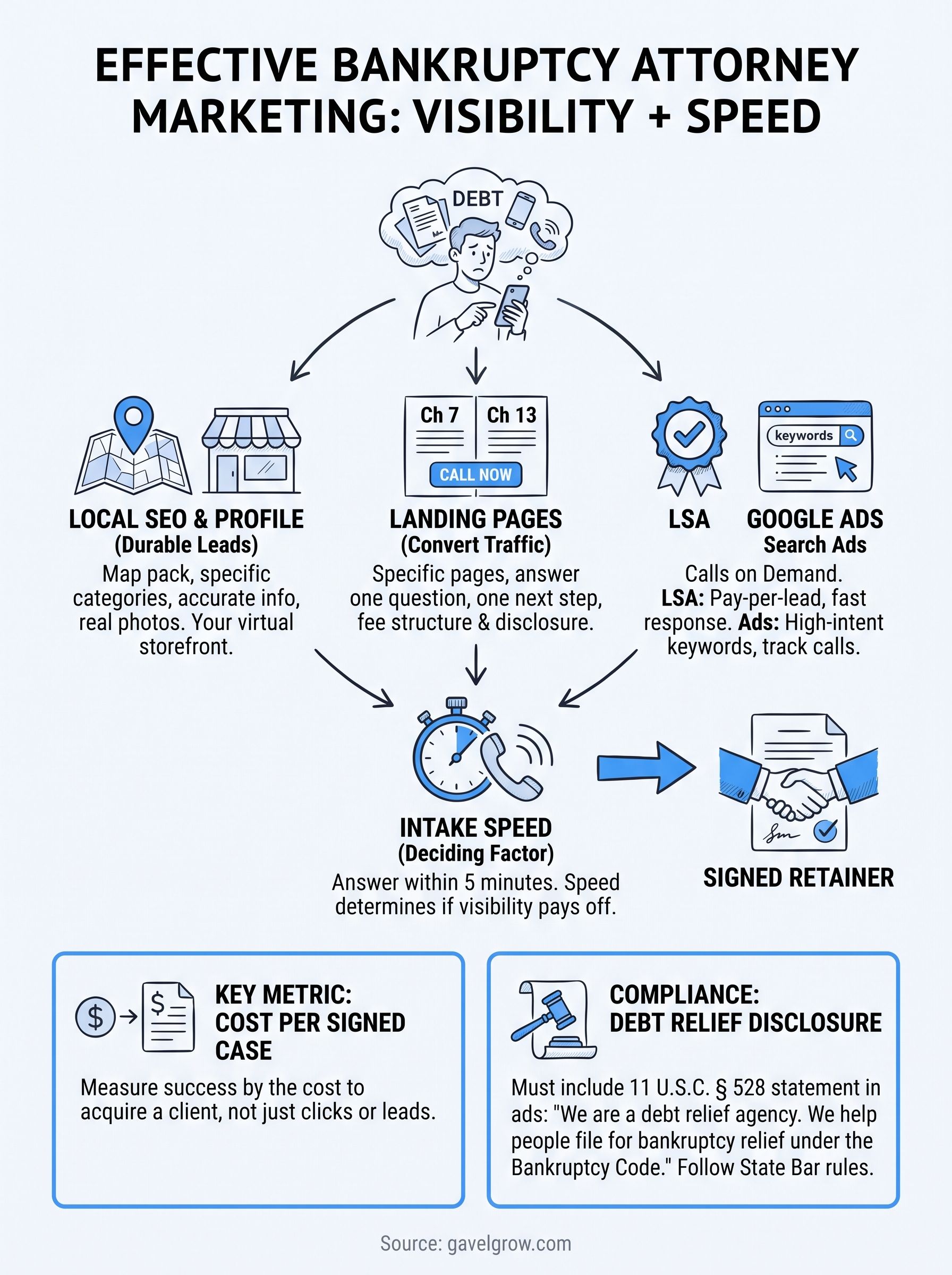
Bankruptcy attorney marketing works when you pair visibility with speed. Local SEO and a clean Google Business Profile bring steady demand. Chapter-specific pages convert it, Local Services Ads and Google Ads add calls on demand, and reviews and referral partners build trust. Intake speed decides how many of those calls become signed retainers. Measure everything by cost per signed case, and keep the debt relief statement and your state bar's rules in every ad.
Pick two channels, not seven. Most firms start with the profile and one paid channel, then add the rest as intake gets faster. If you want a second opinion on where your next dollar should go, book a free 45-minute bankruptcy marketing strategy call with GavelGrow's legal-only team.