Google Local Services Ads: What They Are and How They Work for Law Firms
Categories: Legal Marketing Strategies
 Abram Ninoyan
Founder & Senior Performance Marketer
Credentials: Google Partner, Google Ads Search Certified, Google Ads Display Certified, Google Ads Measurement Certified, Google Analytics (IQ) Certified, HubSpot Inbound Certified, HubSpot Social Media Marketing Certified, Conversion Optimization Certified
Expertise: Google Ads, Meta Ads, Conversion Rate Optimization, GA4 & Google Tag Manager, Lead Generation, Marketing Funnel Optimization, PPC Management
LinkedIn Profile
You've seen the "Google Screened" badge sitting above the regular search ads, and you're wondering if it's worth chasing for your firm. Google Local Services Ads (LSAs) are a pay-per-lead ad...
Key Takeaways
- Google Local Services Ads: What They Are and How They Work for Law Firms
- Why Google Local Services Ads matter for law firms
- How does Google Local Services Ads work?
- How to set up Google Local Services Ads for your firm
Google Local Services Ads: What They Are and How They Work for Law Firms
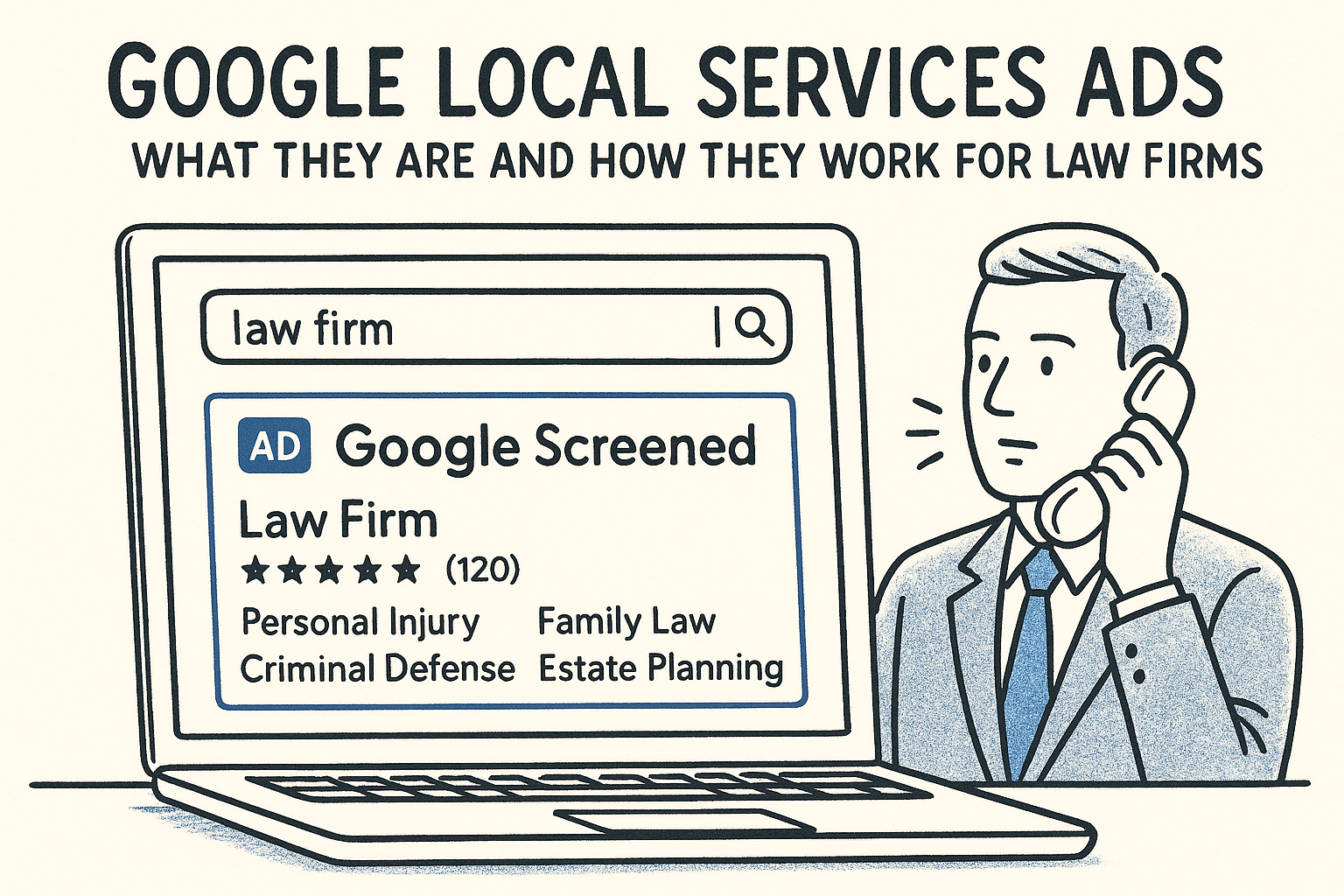
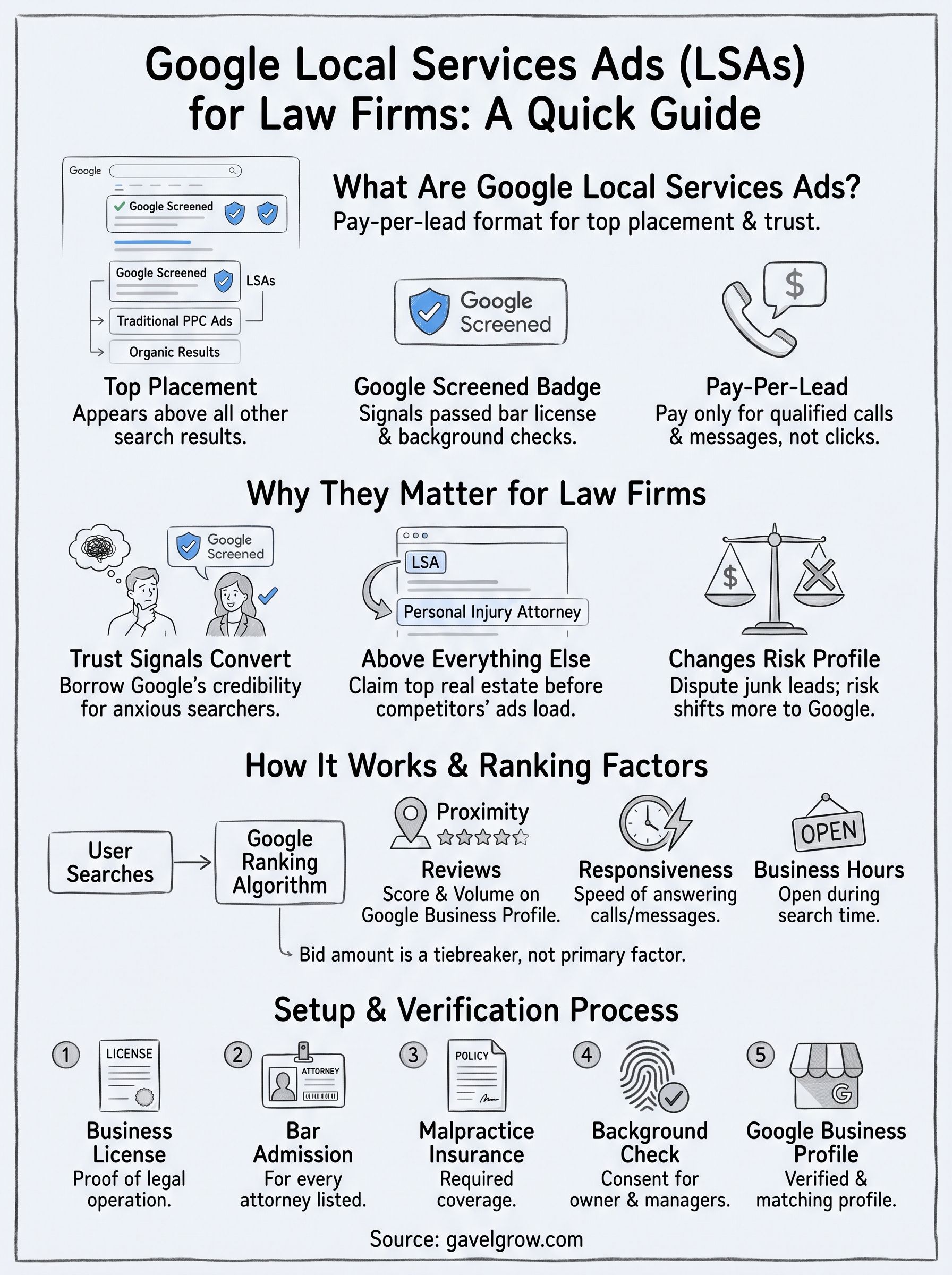
You've seen the "Google Screened" badge sitting above the regular search ads, and you're wondering if it's worth chasing for your firm. Google Local Services Ads (LSAs) are a pay-per-lead ad format that puts your firm at the very top of Google search results, above traditional PPC ads, with a badge signaling you've passed Google's background and license checks.
Here's the direct answer: Google local services ads work differently from standard Google Ads. Instead of paying per click, you pay per qualified lead, whether that's a phone call or a message from a potential client. Google verifies your bar license and business details before you can run ads, which is why the program carries extra weight with searchers who are already nervous about hiring the wrong attorney. Understanding how local services ads work matters before you commit budget, because the bidding, qualification, and dispute process differ substantially from the Google Ads campaigns most firms already run.
This article breaks down what these ads cost, how the verification process works for law firms specifically, which practice areas see the best return, and how to track leads once they start coming in through your intake process.
Why Google Local Services Ads matter for law firms
Legal services carry more emotional weight than most searches on Google. Someone searching for a personal injury attorney at 11 p.m. after a car accident isn't comparison shopping the way they would for a plumber. They're scared, in pain, and trying to figure out who they can trust. Google Local Services Ads speak directly to that anxiety because every listing carries a Google Screened or Google Guaranteed badge, a checkmark that tells the searcher Google has already verified your bar license, insurance, and business identity before you're allowed to show up.
Trust signals convert better than blue links
A badge next to your firm's name does something a standard text ad can't: it borrows Google's credibility. According to Google's own Local Services Ads support documentation, businesses must pass a background check and license verification specific to their profession before the badge appears (support.google.com, accessed 2026). For law firms, that means bar verification, not just a business license, which raises the bar for who can compete against you in the ad slot.
A verified badge next to your firm's name does the trust-building work a text ad never could.
Placement above everything else on the page
LSA listings sit above both traditional Google Ads and organic results, meaning your firm can occupy the very top of the search results page before a competitor's paid search or SEO ranking ever loads. This matters more in legal than almost any other vertical because personal injury and mass tort keywords are some of the most expensive in all of Google Ads, often running $100 or more per click depending on market. LSAs let you claim that top real estate through a different, sometimes cheaper, mechanism.
Pay-per-lead changes your risk profile
Unlike standard PPC, where you pay for every click regardless of intent, LSAs bill you only when someone calls or messages through the ad and Google counts it as a valid lead. You can dispute charges for leads that are spam, wrong practice area, or outside your service area, which shifts more of the financial risk onto Google rather than your firm. That said, disputing leads takes documentation, and firms that don't track call outcomes carefully tend to leave money on the table. This is exactly where call tracking software built for law firms and outcome tagging matter, since you need a clean record of which leads were junk to win a dispute.
Which practice areas benefit most
Not every practice area sees the same lift. Firms in high-intent, high-urgency categories tend to see the strongest results:
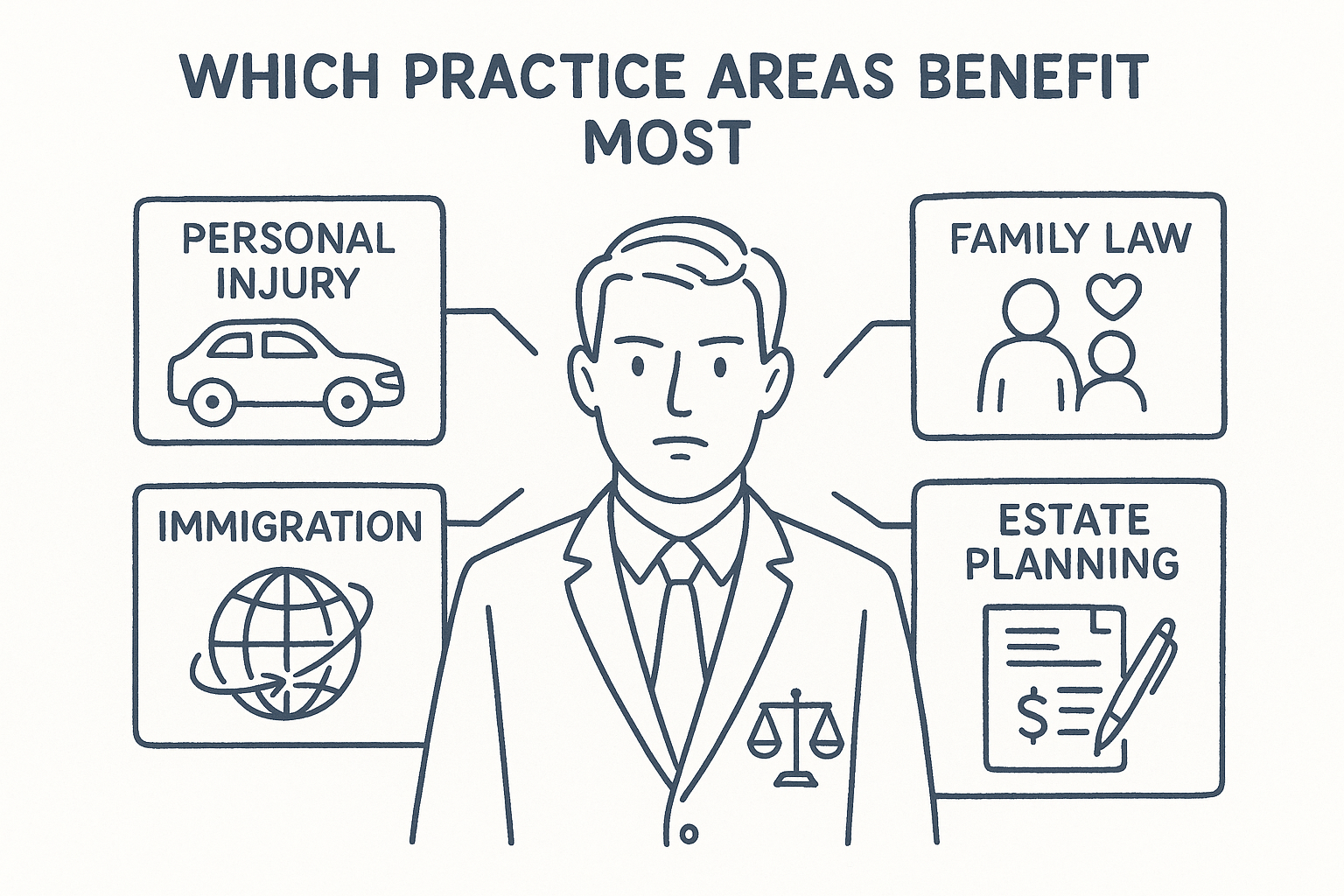
- Personal injury and car accident cases
- Family law and divorce
- Criminal defense and DUI/DWI
- Immigration
- Estate planning
Mass tort campaigns generally don't fit the LSA model well, since those cases rely on broader awareness campaigns rather than someone actively searching for a local attorney by name.
How does Google Local Services Ads work?
Google pulls listings for Local Services Ads from a completely separate system than standard search or display campaigns. Your firm builds a profile inside the Local Services app, sets a weekly budget, and picks the practice areas and service radius you want to target, and a step-by-step LSA setup walkthrough covers each of those screens in order. From there, Google's ranking algorithm decides which verified firms show up for a given search, and in what order, based on a mix of proximity, review volume, responsiveness, and how much you've set aside to bid.
What determines your ranking
Unlike traditional Google Ads, you're not bidding on keywords. Instead, Google weighs several signals every time a search happens:
- Proximity to the searcher's location
- Review score and volume on your Google Business Profile
- Responsiveness, meaning how quickly you answer calls and messages
- Business hours, since firms open when the search happens rank higher
- Bid amount, which acts more like a tiebreaker than a primary factor
Reviews and response speed move the needle more in Local Services Ads than raw ad spend ever will.
That ranking model is exactly why some solo practitioners with strong review histories consistently outrank firms spending three times as much on their weekly budget.
How leads get counted and billed
A lead counts once someone calls the number on your listing or sends a message and Google's system deems it a genuine inquiry from someone in your service area seeking your practice area. You're charged a set price per lead, which varies by market and specialty, only after that qualification happens, not for the impression or the click. If a lead turns out to be a wrong number, a solicitation, or outside your practice area, you can file a dispute through the Local Services dashboard within the allowed window, and Google credits your account if the dispute is approved. This billing structure is why firms running google ads for local services alongside standard paid search campaigns need separate tracking for each channel, since blending the two makes it impossible to know which one is actually producing signed cases.
How to set up Google Local Services Ads for your firm
Getting your firm live on Google Local Services Ads takes longer than launching a standard Google Ads campaign for a law firm because Google verifies every attorney and firm before approving the account. Budget two to four weeks for the background check to clear, especially if your state bar records take time to confirm. Skipping ahead or rushing the paperwork is the most common reason firms get stuck in review limbo.
The verification checklist
Google requires a specific set of documents before your badge goes live, and missing any one of them restarts the clock:
- Business license and proof of legal operating status in your state
- Bar admission number for every attorney listed on the account
- Malpractice insurance documentation, since Google treats legal services as a licensed profession category
- Background check consent for the business owner and any managing attorneys
- A claimed and verified Google Business Profile that matches the business name and address on your LSA application exactly
Mismatched business names between your Google Business Profile and your LSA application delay approval more than any other single mistake.
Setting your budget and service area
Once approved, you set a weekly budget rather than a daily one, and Google spends against it based on lead volume in your area. Start conservatively, somewhere around $500 to $1,000 a week for a single practice area in a mid-sized market, and adjust after you see two to three weeks of real lead data. Define your service radius carefully; a radius that's too wide pulls in leads outside a jurisdiction you can actually serve, and disputing those later eats time you don't get back.
Connecting the pieces after approval
Approval is the beginning, not the finish line. You still need a way to route every LSA call and message into an automated intake pipeline where your staff can respond fast, since Google's ranking algorithm rewards responsiveness. Firms running LSAs alongside GavelGrow's call tracking and intake automation get a single view of which leads actually converted into signed cases, instead of guessing from the LSA dashboard alone.
How much do Google Local Services Ads cost for lawyers?
Cost is the question every managing partner asks first, and the honest answer is: it depends heavily on your practice area and market. Google Local Services Ads charge per verified lead rather than per click, and that price fluctuates based on competition, location, and how many other verified firms are bidding in your practice area. A solo estate planning attorney in a small city pays a fraction of what a personal injury firm in a major metro pays for the same lead volume.
Typical cost per lead by practice area
Here's what firms typically see per qualified lead, and how those ranges compare to cost per lead benchmarks by practice area across every channel:
These ranges shift with local competition, so a firm in Los Angeles pays more than one in a smaller Midwest market for the identical practice area.
Why costs vary within the same market
Even within one city, two firms in the same practice area can pay different rates depending on their review score, response time, and how tightly they've defined their service radius. Google's Local Services Ads support documentation confirms that lead price is dynamic and recalculated for each auction, not a fixed rate you negotiate upfront (support.google.com, accessed 2026). Firms that answer calls within minutes and maintain strong reviews tend to see lower effective costs over time, since Google's ranking model favors responsiveness over raw spend.
Cost per lead only matters if you're also tracking what each signed case actually costs you, otherwise you're flying blind.
Budgeting realistically
Setting your weekly budget too low limits how many leads you can capture during peak search volume, while setting it too high without tracking outcomes risks paying for leads that never convert. Most firms starting fresh do best committing to at least four to six weeks of spend before judging performance, since Google's algorithm needs time to calibrate ranking based on your response patterns and review activity.
Are Google Local Services Ads worth it for law firms?
Yes, for most firms in high-intent practice areas, Google Local Services Ads earn back what you spend, but only if your intake process can keep up with the speed the format demands. Firms that answer calls fast, follow up within minutes, and maintain strong reviews consistently pull a lower cost per signed case than they get from standard PPC in the same practice area. Firms that let leads sit in a voicemail box for hours end up paying premium rates for calls nobody ever answers.
The math only works if someone picks up the phone, because a google verified local services ads badge doesn't convert a lead you never called back.
When LSAs pay off
LSAs tend to justify the spend when a few conditions line up at once:
- Your firm operates in personal injury, family law, criminal defense, immigration, or estate planning
- You have staff or an answering service that picks up calls within minutes, not hours
- You already track cost per signed case, not just cost per lead
- Your service area is narrow enough that leads actually fall inside your jurisdiction
When they fall short
Firms without a fast-response system waste money on LSAs faster than on any other channel, since the billing happens the moment Google counts the lead as valid, whether or not your firm ever engages it. Mass tort shops also see weaker returns, since the format rewards local, urgent searches rather than the broader awareness campaigns those cases require. Solo attorneys juggling intake themselves sometimes find the volume unmanageable during peak hours, which drags down their responsiveness score and, in turn, their ranking.
Managing partners who track outcomes through a platform like GavelGrow's marketing dashboard get a clear read on whether LSA leads actually turn into retainers, rather than relying on the raw lead count Google shows in its own dashboard.
Where local services ads fit in your firm's marketing mix
Local Services Ads work best as one piece of a larger acquisition strategy worth weighing against your other lead sources, not a replacement for SEO, standard PPC, or referral relationships. Google Local Services Ads capture the searchers who want to hire someone right now, while your organic presence and reputation management build the pipeline that keeps showing up months later. Firms that treat LSAs as their entire marketing plan usually hit a ceiling fast, since weekly budgets and service radius limits cap how much volume you can pull from the channel alone.
Getting the most out of local services ads by Google means pairing them with fast intake and clean attribution, so you know which leads actually became clients. If you're weighing LSAs against everything else competing for your marketing dollars, talk through your LSA budget with the GavelGrow team and get a straight answer on where your money belongs.
Frequently Asked Questions
How long does Local Services Ads approval take for a law firm?
Budget two to four weeks. Google verifies every attorney and firm before the Google Screened badge goes live, running a background check and confirming your license, bar admission, and malpractice insurance. Missing any required document restarts the clock, and a mismatch between your Google Business Profile name and your LSA application is the most common cause of delay, so have every document ready before you apply.
Can law firms dispute invalid Local Services Ads lead charges?
Yes, and you should. Because LSAs bill per lead, you can dispute charges for leads that are spam, wrong numbers, outside your service area, or for a practice area you do not handle, and Google credits valid disputes. Disputing invalid leads also helps Google refine your targeting over time. Route every lead into a tracking system so you can document why a charge should be credited if Google questions it.
Do you need a Google Business Profile to run Local Services Ads?
Yes. A claimed, verified Google Business Profile whose name and address exactly match your LSA application is part of the approval requirements, and your review score and volume on that profile directly influence your LSA ranking. Clean up the profile before you apply, since inconsistencies between it and your LSA account are a leading cause of approval delays.
Should a law firm run Local Services Ads and Google Search Ads at the same time?
Most competitive firms do. Local Services Ads sit above search ads and bill per lead, capturing bottom-of-funnel callers, while Search Ads bill per click and give you control over keywords and landing pages for broader terms. Running both lets you own more of the results page and compare cost per signed case across formats. The key is tracking each channel to signed cases, not just to leads.
What happens to Local Services Ads leads if no one answers the phone?
You often still get billed, and your ranking suffers. Google counts a valid lead the moment someone calls or messages, whether or not your firm engages it, and responsiveness is a direct ranking factor, so missed calls both waste money and push you down the listings. That is why LSAs punish slow intake harder than almost any channel: an unanswered LSA lead is a paid lead you threw away.
How do Local Services Ads leads get into a law firm's intake system?
By default, LSA calls and messages land in Google’s Local Services app, which is fine for a solo firm but breaks down at volume. To respond within the minutes the format rewards, most firms route every LSA call and message into an intake pipeline that fires an automated text or task instantly and tags the lead by source, so nothing sits unanswered and every LSA lead can be tracked through to a signed case.
Frequently Asked Questions
How long does Local Services Ads approval take for a law firm?
Budget two to four weeks. Google verifies every attorney and firm before the Google Screened badge goes live, running a background check and confirming your license, bar admission, and malpractice insurance. Missing any required document restarts the clock, and a mismatch between your Google Business Profile name and your LSA application is the most common cause of delay, so have every document ready before you apply.
Can law firms dispute invalid Local Services Ads lead charges?
Yes, and you should. Because LSAs bill per lead, you can dispute charges for leads that are spam, wrong numbers, outside your service area, or for a practice area you do not handle, and Google credits valid disputes. Disputing invalid leads also helps Google refine your targeting over time. Route every lead into a tracking system so you can document why a charge should be credited if Google questions it.
Do you need a Google Business Profile to run Local Services Ads?
Yes. A claimed, verified Google Business Profile whose name and address exactly match your LSA application is part of the approval requirements, and your review score and volume on that profile directly influence your LSA ranking. Clean up the profile before you apply, since inconsistencies between it and your LSA account are a leading cause of approval delays.
Should a law firm run Local Services Ads and Google Search Ads at the same time?
Most competitive firms do. Local Services Ads sit above search ads and bill per lead, capturing bottom-of-funnel callers, while Search Ads bill per click and give you control over keywords and landing pages for broader terms. Running both lets you own more of the results page and compare cost per signed case across formats. The key is tracking each channel to signed cases, not just to leads.
What happens to Local Services Ads leads if no one answers the phone?
You often still get billed, and your ranking suffers. Google counts a valid lead the moment someone calls or messages, whether or not your firm engages it, and responsiveness is a direct ranking factor, so missed calls both waste money and push you down the listings. That is why LSAs punish slow intake harder than almost any channel: an unanswered LSA lead is a paid lead you threw away.
How do Local Services Ads leads get into a law firm's intake system?
By default, LSA calls and messages land in Google’s Local Services app, which is fine for a solo firm but breaks down at volume. To respond within the minutes the format rewards, most firms route every LSA call and message into an intake pipeline that fires an automated text or task instantly and tags the lead by source, so nothing sits unanswered and every LSA lead can be tracked through to a signed case.