7 Lead Gen Strategies for Lawyers That Actually Sign Cases
Categories: Legal Marketing Strategies
 Abram Ninoyan
Founder & Senior Performance Marketer
Credentials: Google Partner, Google Ads Search Certified, Google Ads Display Certified, Google Ads Measurement Certified, Google Analytics (IQ) Certified, HubSpot Inbound Certified, HubSpot Social Media Marketing Certified, Conversion Optimization Certified
Expertise: Google Ads, Meta Ads, Conversion Rate Optimization, GA4 & Google Tag Manager, Lead Generation, Marketing Funnel Optimization, PPC Management
LinkedIn Profile
Most lead gen for lawyers advice stops at generating clicks and phone calls, then leaves you to figure out which ones actually turned into signed cases. If your firm is spending on Google Ads, Local S...
Key Takeaways
- 7 Lead Gen Strategies for Lawyers That Actually Sign Cases
- 1. GavelGrow for full-funnel lead attribution
- 2. Search engine optimization for law firm websites
- 3. Pay-per-click and Local Services Ads
7 Lead Gen Strategies for Lawyers That Actually Sign Cases
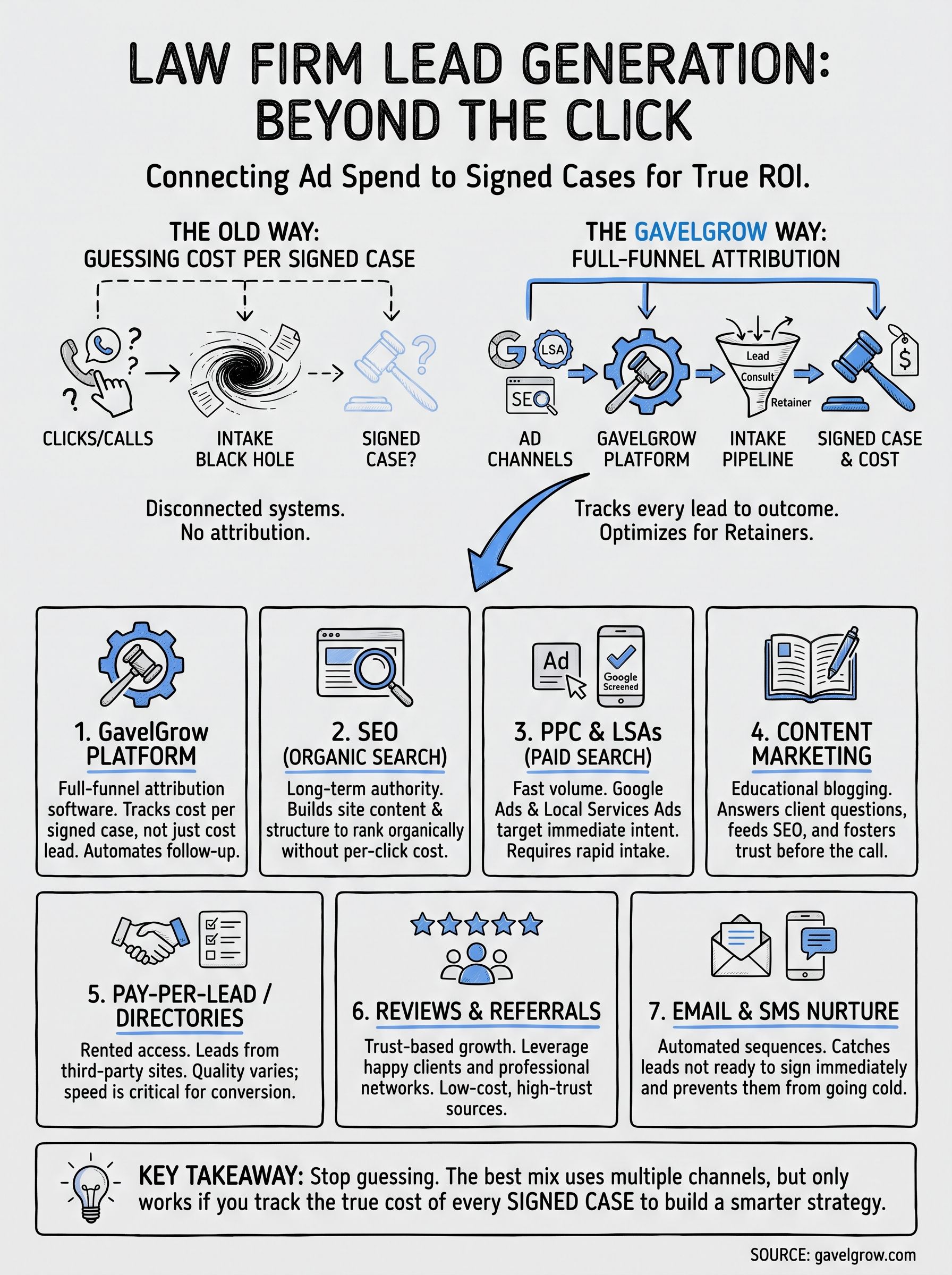
Most lead gen for lawyers advice stops at generating clicks and phone calls, then leaves you to figure out which ones actually turned into signed cases. If your firm is spending on Google Ads, Local Services Ads, or SEO and still can't say what a signed case cost you, the problem isn't your ad budget. It's that leads and case outcomes live in separate systems that never talk to each other.
The fix isn't more leads, it's better measurement and faster follow-up on the leads you already have. Firms that track cost per signed case instead of cost per lead, and build full-funnel attribution from first click to retainer, consistently outspend competitors who are still guessing.
This article breaks down seven strategies that have actually moved the needle for law firms, from speed-to-lead fixes to intake-form changes to how you should be reading call recordings. Some you can implement this week with no new tools. Others work best when call tracking and intake automation are built into your marketing stack from the start, which is where a platform like GavelGrow comes in.
1. GavelGrow for full-funnel lead attribution
GavelGrow is legal lead generation software built to answer one question: what did each signed case actually cost you, from the ad click all the way to the retainer? Most attorney lead generation services hand you a lead count and call it done. GavelGrow keeps going, tracking every lead through intake, case status, and outcome so you can see cost per signed case by campaign, not just cost per click.
How it works
Every lead gets tracked from its source, whether that's a Google Ads click, a Local Services Ads call, or an organic form fill, through tracking numbers, mobile-first intake forms, and a case pipeline in the self-serve platform that ties attribution to signed retainers. Missed calls trigger automatic SMS. Signed cases feed back into Google Ads and Local Services bidding through Smart Conversions, so your campaigns optimize toward outcomes that matter instead of raw lead volume.
A lead you can't trace to a signed case is a number, not a strategy.
Who it's best for
GavelGrow suits firms already spending real money on paid channels, whether they run that spend in-house or hand it to an agency, who are tired of guessing which campaigns actually produce clients. Personal injury and mass tort shops with high case values lean toward self-serve tiers for control over their own numbers. Firms that would rather hand campaigns to a legal-only team use the managed marketing option instead, with a named contact running paid social, SEO, and Google Ads under one subscription.
What they cost
Annual billing gets you two months free on either self-serve tier, and every plan starts with a 7-day free trial, no credit card required. Managed engagements carry a $500/day ad-spend minimum, which is your own media budget, not a fee to GavelGrow. Full details, including seat and SMS add-on pricing, are on the page listing every plan and what it includes.
2. Search engine optimization for law firm websites
Search engine optimization, or SEO, is the slow but durable channel: you build content and site authority so your firm ranks organically for the searches your future clients type into Google, without paying per click. For lead generation legal teams, it's the one channel where the traffic doesn't stop the day you pause spending.
How it works
SEO for a law firm combines on-page work (practice-area pages, city-specific landing pages, clean site structure), technical fundamentals (site speed, mobile usability, secure hosting), and off-page signals like backlinks and a fully optimized Google Business Profile. Local pack rankings matter as much as organic results for most firms, since a large share of legal searches carry local intent.
Rankings without intake tracking just tell you where you show up, not what you signed.
Who it's best for
SEO rewards firms playing a long game: family law, estate planning, and other practice areas where clients research before calling. It suits firms willing to invest 6 to 12 months before seeing meaningful ranking movement, and it compounds well alongside online lead generation for lawyers efforts like content and reviews.
What it costs
Agency SEO retainers for law firms commonly range from $1,500 to $5,000+ monthly depending on market competitiveness and city count, with no guaranteed timeline. GavelGrow's agency services include local and organic SEO alongside Google Business Profile optimization, so rankings and paid campaigns share one attribution system instead of two separate reports.
3. Pay-per-click and Local Services Ads
Pay-per-click advertising, mainly Google Ads and Google's Local Services Ads (LSAs), gets your firm in front of someone the moment they search "car accident lawyer near me" or "divorce attorney [city]." It's the fastest way to generate volume, and for lead generation companies for lawyers, it's usually the first channel they pitch because results show up in days, not months.

How it works
Google Ads runs on keyword bidding and lands you in the paid search results, while LSAs work on a pay-per-lead model with a Google Screened badge that builds instant trust. Both channels need dedicated tracking numbers and fast intake, since a missed call on a paid lead is money spent for nothing.
A paid click that never gets a callback is the most expensive lead you'll ever generate.
Who it's best for
Personal injury, DUI/DWI, and other high-value practice areas with urgent client need get the most out of paid search, since searchers convert quickly and case values justify aggressive bidding.
What it costs
Cost per click for competitive legal keywords often runs $50 to $150+, and LSA leads are billed per qualified contact rather than per click. Budgets below $3,000 to $5,000 monthly rarely generate enough data to optimize well. GavelGrow's Smart Conversions feed signed cases back into your bidding automatically, on the Optimize plan and above, so spend shifts toward campaigns producing retainers, not just clicks.
4. Content marketing and legal blogging
Content marketing means publishing articles, FAQs, and practice-area explainers that answer the questions your future clients already type into Google before they ever call a lawyer. It's one of the cheapest forms of lead generation for law firm growth, since a well-ranked blog post keeps bringing in traffic long after you've stopped writing it.
How it works
You publish content built around real client questions, things like "what happens after a car accident settlement" or "how long does a divorce take in [state]," and structure each post to funnel readers toward a consultation. Blogging feeds your SEO efforts directly, since fresh, specific content gives Google more pages to rank and gives your intake forms more entry points to capture a lead.
Content that never gets tracked past the click is a blog, not a lead source.
Who it's best for
Firms in family law, estate planning, immigration, and bankruptcy do especially well here, since clients in these areas research extensively before reaching out. It also suits firms with an attorney willing to contribute real expertise, since generic, unsigned content rarely outperforms competitors' pages.
What it costs
A freelance legal writer runs $150 to $500 per post, while a full content program with an in-house or agency writer can run $2,000 to $4,000+ monthly. GavelGrow's agency services include a content studio as part of managed engagements, so blog traffic gets tracked into the same pipeline as your paid leads.
5. Pay-per-lead services and legal directories
Pay-per-lead services and legal directories, think Avvo, Justia listings, FindLaw, or niche mass-tort lead brokers, sell you access to people who already searched or filled out a form on someone else's platform. You pay per contact whether or not the case ever signs, which makes this one of the riskier entries among lead generation companies for lawyers.
How it works
Directories build visibility through their own domain authority and profile pages, ranking for searches your firm might not reach alone, while pure lead-broker vendors route calls or form fills based on practice area and geography, then bill per lead regardless of quality. Exclusivity costs more; shared leads, sold to three or four firms at once, cost less and convert worse.
You're renting someone else's traffic, and your return depends entirely on how fast you follow up.
Who it's best for
New firms still building case volume, mass tort intake shops that need scale fast, and practice areas like immigration or criminal defense, where directory listings sit high in search results, get the most use out of this channel among online lead generation for lawyers options.
What it costs
Per-lead pricing commonly runs $30 to $300 depending on practice area and exclusivity, with mass tort leads often priced far higher. Flat directory placement fees typically fall between $100 and $1,000+ monthly. Since these leads arrive with no built-in attribution, routing them through GavelGrow's intake pipeline lets you tag the source and see, honestly, whether directory spend produces signed cases at a cost you can defend.
6. Reviews and referral programs
Google reviews and referral relationships are the lead sources your firm already has and probably under-uses. Both run on trust that's already been earned rather than trust you're buying through an ad, which makes them some of the cheapest lead generation services for lawyers available.

How it works
Every client who finishes a matter should get asked to leave a Google review, full stop. Don't filter who you ask or route unhappy clients to a private form first; Google's review policies prohibit gating reviews that way, and it can put your Google Business Profile at risk. Handle complaints directly with the client, then respond professionally to every public review, good or bad. Referral programs work alongside this: build relationships with other attorneys, past clients, and local professionals like financial advisors who see prospective clients before you do.
A five-star profile with fifty reviews closes more consultations than another ad campaign ever will.
Who it's best for
Family law, estate planning, and criminal defense firms benefit most, since clients in these areas lean heavily on reviews and word of mouth before calling. It's a strong complement to any attorney lead generation services strategy already running.
What it costs
Asking for reviews costs nothing but a follow-up email or text. Reputation management software or agency services for review monitoring and referral outreach typically run $200 to $800 monthly, and GavelGrow's agency services include review and referral program management as part of managed engagements.
7. Email and SMS lead nurture sequences
Nurture sequences catch the leads who aren't ready to sign today but will be in two weeks, a case that never gets a callback often dies quietly, and automated sequences stop that from happening. This is less a channel for finding new leads and more a system for not wasting the ones you already paid for, which makes it one of the highest-leverage forms of legal lead generation software a firm can run.
How it works
When a lead hits your intake form or misses a call, an automated SMS and email sequence fires within seconds, confirming receipt, answering the obvious first question, and prompting a reply. Sequences branch based on behavior: no response after 24 hours triggers a different message than a lead who already replied. Every sequence needs STOP and HELP opt-out handling built in, since TCPA consent rules apply the moment you send that first text.
The leads you already paid for are cheaper to save than new ones are to buy.
Who it's best for
High-volume practice areas like personal injury, mass torts, and immigration benefit most, since lead counts are high enough that a few extra saved conversations move revenue meaningfully. Solo firms without after-hours staff also lean on this heavily, since automation covers the gap nights and weekends.
What it costs
Standalone SMS/email nurture tools run $50 to $300 monthly. It's built into every GavelGrow plan, firing sequences within 60 seconds of lead capture starting at $199/month on the Track plan.
Choosing the right lead gen mix for your firm
No single channel on this list wins by itself. Personal injury firms usually need paid search and Local Services Ads for speed, plus a nurture sequence to catch every lead after hours. Family law and estate planning firms lean harder on SEO, content, and reviews, since their clients research for weeks before calling. Most firms end up running three or four of these at once, which is exactly when tracing each signed case back to the channel that produced it starts to matter more than any individual tactic.
The common thread across all seven strategies is the same: a lead only counts if you can trace it to a signed case, and you can only fix what's broken once you can see it. If you're still guessing at cost per signed case across channels, that's the gap to close first. Book a free 45-minute call and walk through your current numbers with someone who's done this for 500+ law firms.