Real Estate Attorney Marketing: What It Is and How It Works
Categories: Legal Marketing Strategies
 Abram Ninoyan
Founder & Senior Performance Marketer
Credentials: Google Partner, Google Ads Search Certified, Google Ads Display Certified, Google Ads Measurement Certified, Google Analytics (IQ) Certified, HubSpot Inbound Certified, HubSpot Social Media Marketing Certified, Conversion Optimization Certified
Expertise: Google Ads, Meta Ads, Conversion Rate Optimization, GA4 & Google Tag Manager, Lead Generation, Marketing Funnel Optimization, PPC Management
LinkedIn Profile
Real estate attorney marketing is everything you do to get found, trusted, and hired by the buyers, sellers, landlords, investors, and referral partners in your area. In plain terms, it is how you tur...
Key Takeaways
- Why does real estate attorney marketing matter?
- How do you market a real estate law practice?
- How do you know your marketing is working?
- Frequently Asked Questions
Real estate attorney marketing is everything you do to get found, trusted, and hired by the buyers, sellers, landlords, investors, and referral partners in your area. In plain terms, it is how you turn the legal work you offer into a steady flow of local clients who know why they should call you.
Marketing is broader than advertising. It covers what you offer, how you price it, where clients find you, and how you communicate your value. This guide shows why it matters for a closings and transactions practice, how to build a local plan step by step, and how to measure whether that plan is signing cases.
GavelGrow has marketed only for law firms since 2015, so the advice here comes from legal-only work. It focuses on ethics rules and cost per signed case instead of vanity clicks.
Key Takeaways
- Marketing is how local clients find, trust, and hire your practice.
- Referral partners and a strong Google Business Profile anchor local marketing.
- Measure cost per signed case, not clicks or raw lead counts.
- Check your state bar's advertising rules before you publish anything.
Why does real estate attorney marketing matter?
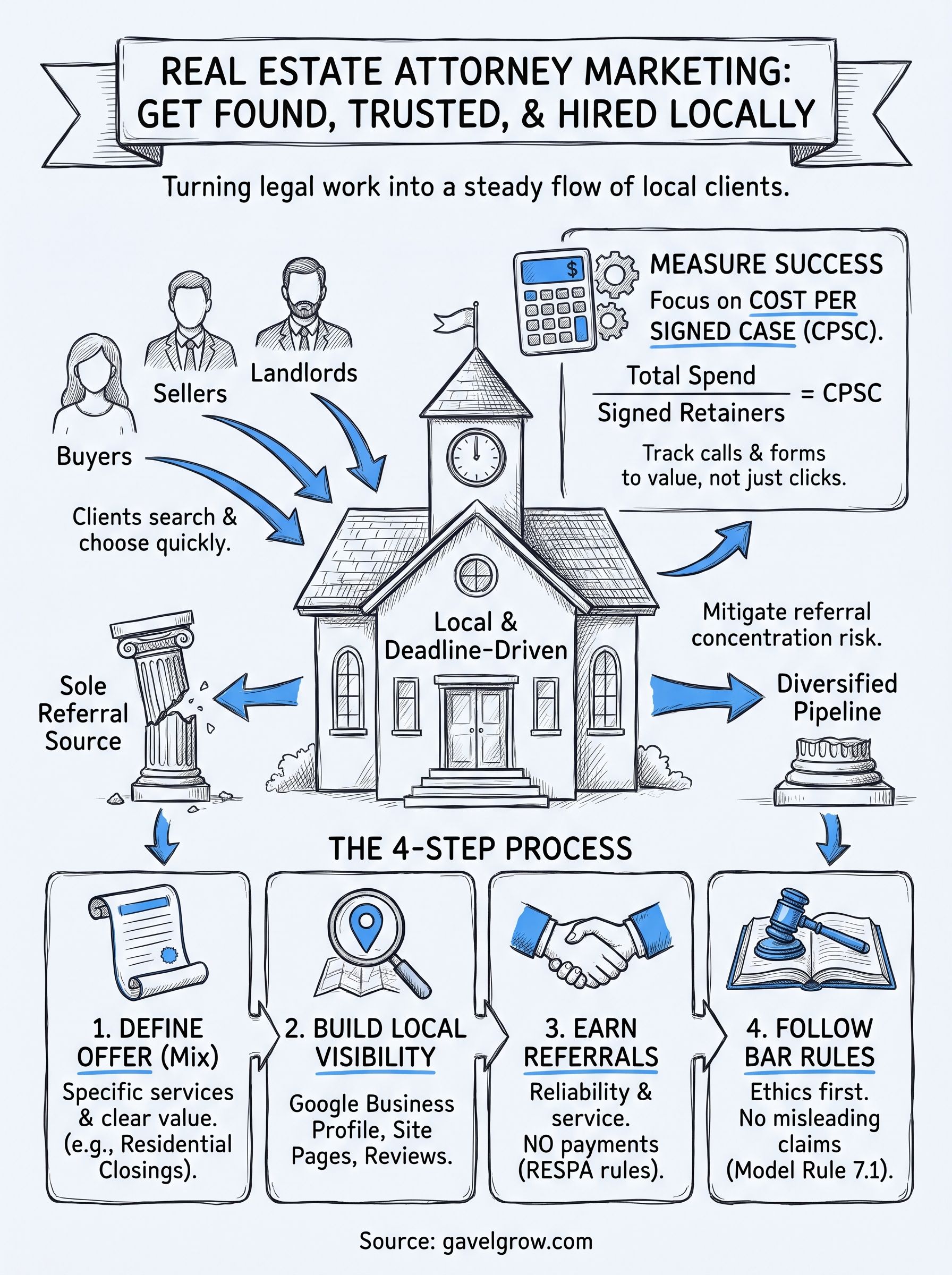
Marketing matters because real estate legal work is local and deadline-driven, so the attorney who is found and trusted first usually gets the call. Without a plan, your pipeline depends on whoever remembers your name that week.
Clients search locally and choose quickly
A buyer under contract has a closing date. A landlord with a lease dispute or an owner with a title problem has a deadline of their own. Each one searches for a local real estate attorney, compares a few websites and profiles, and calls whoever looks credible and responsive.

Your competitors appear in those same results. If your site and profile do not say plainly which matters you handle, the visitor moves on to one that does.
Referrals fill your calendar until the source moves
Agents, lenders, and title companies send a large share of transactional work, which creates referral concentration risk. If your busiest source changes firms or retires, volume can drop overnight.
Direct inquiries from search, past clients who buy or sell again, and investors with repeat needs give you a second and third source. Marketing is how you build them before you need them.
Referrals fill your calendar until the source moves on, so build a second channel before you need it.
How do you market a real estate law practice?
Market it by deciding which matters you want, making yourself easy to find locally, earning referrals ethically, and staying inside your state bar's rules. Work through these four steps in order.
Define your offer with the marketing mix
The American Marketing Association describes marketing as the activity, institutions, and processes for creating, communicating, delivering, and exchanging offerings that have value. Applied to your practice, that becomes four decisions.
- Product: the services you sell, such as residential closings, lease review and title issues.
- Price: how you charge and explain fees, such as a flat fee per closing or hourly for disputes.
- Place: where clients find you, such as Google search, your Business Profile and agent offices.
- Promotion: how you communicate value, such as your website, referral outreach and email to past clients.
Choose one or two matter types to lead with, such as residential closings or commercial leases. A visitor trusts a firm that sounds specific more than one that lists every service.
Build local visibility
Start with a complete Google Business Profile: accurate categories, service descriptions, hours, and a phone number you can track. Then give each core service its own page on your website, written for the local reader. GavelGrow's local SEO and Google Business Profile service covers this work for firms that would rather not run it.

Reviews matter here, and the rules are simple. Ask every client, resolve complaints directly with the client, and respond professionally to every public review. Never route unhappy clients to a private form, ask only happy ones, or offer incentives, because Google's review policies prohibit all three.
Earn referrals from agents, lenders, and title companies
Give referral partners a reason to remember you: fast replies, clear status updates, and a one-page closing checklist they can hand to their own clients. Reliability is your marketing here, and a short thank-you note after a smooth closing keeps you in mind.
Never pay for recommendations. Most state bars restrict paying anyone to recommend you, and federal RESPA rules limit referral payments among settlement service providers, so check before you offer anything of value.
Follow your state bar's advertising rules
Rules vary by state, so read your state bar's advertising rules before you publish anything. As a baseline, ABA Model Rule 7.1 prohibits false or misleading statements about a lawyer's services. In practice that means no promised outcomes and no "best" or "top" labels attached to your firm.
Pick a niche, be findable locally, earn referrals cleanly, and never publish a claim you cannot support.
How do you know your marketing is working?
Track cost per signed case: your total spend divided by the matters that actually sign. Clicks and form fills only show activity, while signed retainers show whether the money worked.
Track calls as well as forms
Many real estate clients pick up the phone, so a report that counts only forms undercounts you. Give each channel its own tracking number, record outcomes such as qualified, callback, or spam, and match each call to the lead it created. GavelGrow's platform puts call tracking, intake, and attribution in one dashboard, with self-serve plans from $199/month and a 7-day free trial with no credit card.
Speed matters too. The Lead Response Management Study found that leads contacted within five minutes are far more likely to be qualified than those first reached at thirty minutes. Decide who answers new inquiries and how fast.
A worked example
Suppose you spend $3,000 on Google Ads in a month. These figures are illustrative, not benchmarks.
- Ad spend: $3,000 for the month.
- Leads (calls plus forms): 40, so cost per lead is $3,000 divided by 40, or $75.
- Signed cases (retainers signed): 6, so cost per signed case is $3,000 divided by 6, or $500.
Compare the $500 to what a typical matter earns you after costs. If the matter pays well above that, the channel earns its place. If not, tighten your targeting or your intake before you add budget.
Judge every channel by what it costs to sign one case, not by what it costs to get one click.
Frequently Asked Questions
What does real estate attorney marketing include?
It includes inbound channels like your website, local search, Google Business Profile, and reviews, plus outbound efforts like referral outreach, email to past clients, and paid ads. Claiming a Google Business Profile is free, so it is usually the first step. Pick two or three channels you can run consistently rather than spreading thin across all of them.
How much should you spend on marketing?
Work backward from the cost per signed case you can afford. If you can pay $500 to sign one matter and want 10 new matters a month, plan for about $5,000 in spend, then adjust as real numbers come in. Ad platforms charge per click, so tracking which spend becomes signed cases matters more than the total.
Do you need a certification to market your practice?
No marketing certification is required to promote your practice. What you must follow are your state bar's advertising rules, and ABA Model Rule 7.1 is the common baseline against false or misleading statements about your services. Review your state's version and have a colleague check any claim about results before it goes live.
Should you hire a marketing company or run it in-house?
Hire help if you lack the time to manage campaigns weekly. Before you sign, confirm the ad accounts stay in your name, ask whether the agency works for direct competitors in your market, and ask about markup on ad spend. GavelGrow's managed service keeps ad accounts in your firm's name, charges no markup on ad spend, and does not run marketing for two direct competitors in the same market.
Ask who owns the ad accounts before you sign anything.
How long until marketing brings in clients?
Paid ads can send calls soon after Google approves your campaign, while organic rankings and reviews build over months. Review your cost per signed case after each full month. Give search work more time than ads before you judge it, and never promise a client or prospect a specific result.
Start with one channel and measure it
Real estate attorney marketing comes down to a few habits. Offer specific services, be easy to find locally, earn referrals without paying for them, and stay inside your state bar's rules. Then measure everything by what it costs to sign a case.
You do not need every channel at once. Pick one, track every call and form back to its source, and add the next channel when the numbers justify it. If you want help choosing channels and setting up tracking, book a free 45-minute strategy call with GavelGrow's legal-only team.
Frequently Asked Questions
What does real estate attorney marketing include?
It includes inbound channels like your website, local search, Google Business Profile, and reviews, plus outbound efforts like referral outreach, email to past clients, and paid ads. Claiming a Google Business Profile is free, so it is usually the first step. Pick two or three channels you can run consistently rather than spreading thin across all of them.
How much should you spend on marketing?
Work backward from the cost per signed case you can afford. If you can pay $500 to sign one matter and want 10 new matters a month, plan for about $5,000 in spend , then adjust as real numbers come in. Ad platforms charge per click, so tracking which spend becomes signed cases matters more than the total.
Do you need a certification to market your practice?
No marketing certification is required to promote your practice. What you must follow are your state bar's advertising rules , and ABA Model Rule 7.1 is the common baseline against false or misleading statements about your services. Review your state's version and have a colleague check any claim about results before it goes live.
Should you hire a marketing company or run it in-house?
Hire help if you lack the time to manage campaigns weekly. Before you sign, confirm the ad accounts stay in your name , ask whether the agency works for direct competitors in your market, and ask about markup on ad spend. GavelGrow's managed service keeps ad accounts in your firm's name, charges no markup on ad spend, and does not run marketing for two direct competitors in the same market. Ask who owns the ad accounts before you sign anything.
How long until marketing brings in clients?
Paid ads can send calls soon after Google approves your campaign, while organic rankings and reviews build over months . Review your cost per signed case after each full month. Give search work more time than ads before you judge it, and never promise a client or prospect a specific result.