Law Firm Intake Coordinator Hiring Guide: Pay and Screening
Categories: Legal Marketing Strategies
 Abram Ninoyan
Founder & Senior Performance Marketer
Credentials: Google Partner, Google Ads Search Certified, Google Ads Display Certified, Google Ads Measurement Certified, Google Analytics (IQ) Certified, HubSpot Inbound Certified, HubSpot Social Media Marketing Certified, Conversion Optimization Certified
Expertise: Google Ads, Meta Ads, Conversion Rate Optimization, GA4 & Google Tag Manager, Lead Generation, Marketing Funnel Optimization, PPC Management
LinkedIn Profile
To hire a law firm intake coordinator, build the job around the first phone call, set pay from current postings in your own metro area, recruit from legal, medical, and call-center backgrounds, and pi...
Key Takeaways
- Law Firm Intake Coordinator Hiring Guide: Pay and Screening
- What does a law firm intake coordinator do?
- Step 1. Define the role and set pay
- Step 2. Find candidates who fit
Law Firm Intake Coordinator Hiring Guide: Pay and Screening
To hire a law firm intake coordinator, build the job around the first phone call, set pay from current postings in your own metro area, recruit from legal, medical, and call-center backgrounds, and pick finalists with a live role-play call instead of a resume. This law firm intake coordinator hiring guide walks you through each step with a skills table, a job posting template, and a screening rubric.
The problem is that this hire is usually rushed. Calls are already going to voicemail, an attorney is answering the phone between meetings, and the first resume with "legal experience" gets an offer. Intake candidates look alike on paper, local pay is hard to pin down, and a coordinator who says the wrong thing to a caller can create an ethics problem as well as a lost case.
Below, you will define the role and set pay, find candidates, and then screen and onboard them. GavelGrow has marketed only for law firms since 2015, and our view is simple: ad spend only becomes revenue when someone handles the first call well. The person at that desk deserves a careful hiring process.
What does a law firm intake coordinator do?
A law firm intake coordinator is the first person a prospective client reaches. They answer calls, texts, and form submissions, collect the facts of the matter, decide whether it fits your firm, and book a consultation or route the file to an attorney.
Core duties and common titles
Most intake coordinators handle the same core workflow, whatever the posting calls them. Titles vary widely: intake specialist, legal intake specialist, new client coordinator, client access coordinator, and matter intake coordinator at larger firms. Search all of them when you recruit, and judge the duties list rather than the title.
- Answer inbound calls and respond to web forms and texts, ideally within minutes
- Ask screening questions about practice area, location, deadlines, and opposing parties
- Enter complete contact and case details in your CRM or case management system
- Collect conflict-check information before an attorney speaks with the caller
- Schedule consultations and follow up with leads who did not book
- At some firms, send engagement paperwork and chase signatures
Where the role stops
An intake coordinator does not give legal advice, predict outcomes, or quote fees outside an approved script. Under ABA Model Rule 5.3, lawyers with supervisory authority must make reasonable efforts to ensure that nonlawyer staff conduct is compatible with the lawyer's professional obligations. In practice, that means a written screening script, a clear handoff rule, and an attorney who reviews intake. Check your own state bar's version of the rule and its advertising rules before you finalize the script.
The coordinator gathers facts and books consultations, and attorneys give the advice.
Signs you need to hire now
You need a dedicated hire when calls go to voicemail during business hours, leads wait hours for a first reply, or attorneys and paralegals keep taking intake calls. Speed matters here. The Lead Response Management Study found that leads contacted within five minutes are far more likely to be qualified than those first reached at thirty minutes. If your volume is too low to justify a salary, fixing call handling and intake forms may solve part of the problem first, and GavelGrow's conversion optimization service covers exactly that.
Key takeaways
- The coordinator owns the first call, never the legal advice.
- Pay should come from your metro's current postings, not national averages.
- Phone presence and accuracy matter more than a paralegal certificate.
- A live role-play call predicts performance better than a resume.
Step 1. Define the role and set pay
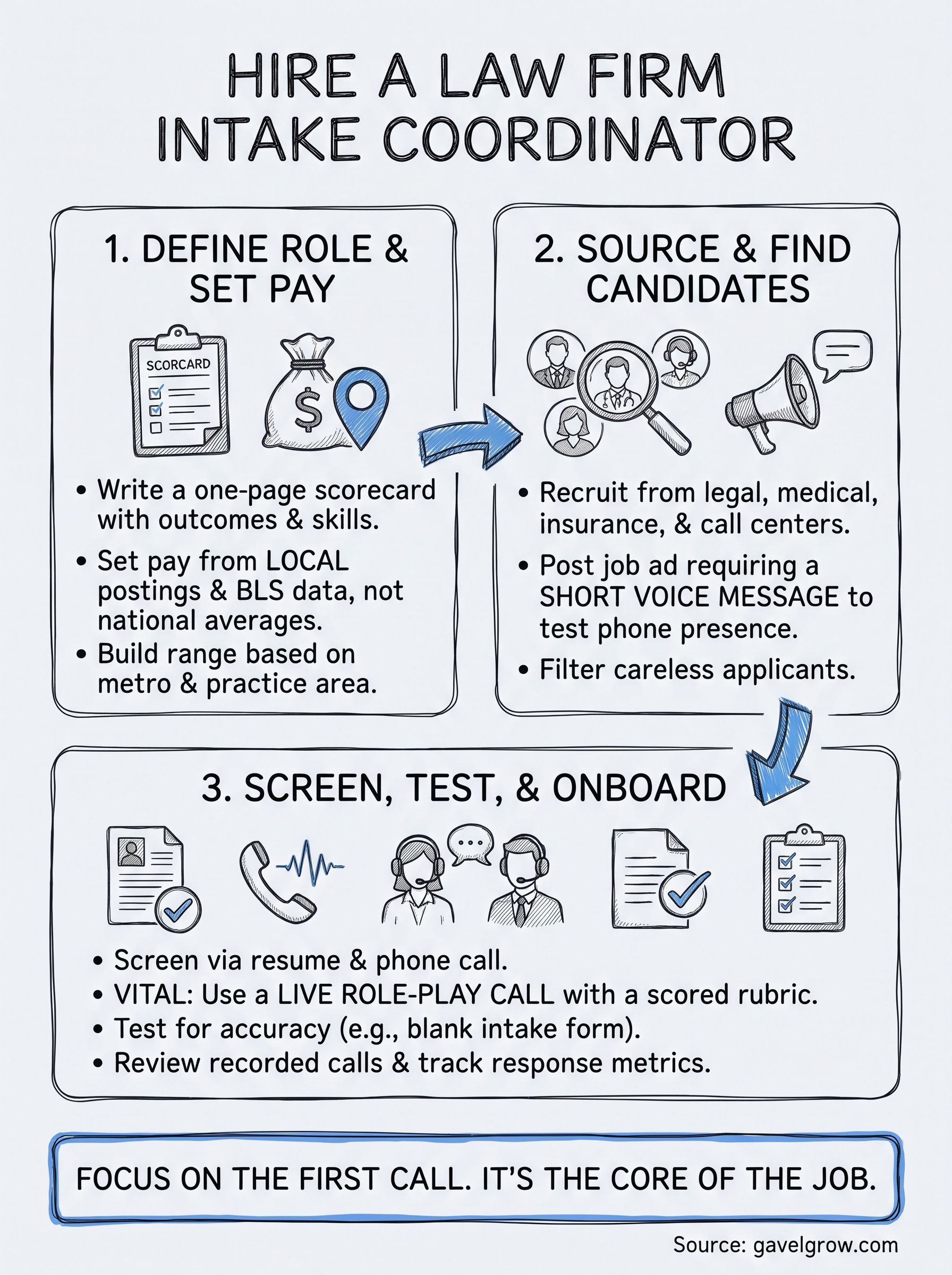
Write a one-page scorecard before you post anything. It names the outcomes of the job, the skills you will test, and the pay range, and every later step depends on it.

Choose the skills and experience to require
Separate what you must hire for from what you can train. Voice, accuracy, and composure are hard to teach quickly. Legal terminology and your software are easy to teach in a month.
My position: one to two years in a medical office, insurance claims, legal office, or call center beats a paralegal certificate. No degree is needed for this role.
Set pay for your area
Pay depends on your metro, your practice area, and your hours, so build the range locally. Pull 10 to 15 current postings within about 25 miles for intake specialist, legal receptionist, and legal assistant roles, and note the posted ranges. Then open the U.S. Bureau of Labor Statistics Occupational Employment and Wage Statistics tool and read the wages for receptionists and for legal secretaries and administrative assistants in your metro. Set your range near the middle of comparable roles, with a premium for bilingual skills, evening coverage, or a high-volume practice area.
A worked example shows the math. Say the postings you collect cluster between $20 and $24 an hour. At 2,080 paid hours a year, that is $41,600 to $49,920 in wages. Hire at $22 and wages are $45,760. Employer payroll taxes start at 7.65% for Social Security and Medicare, so a planning assumption of 25% for taxes, benefits, and paid leave puts the real cost near $57,200.
Treat the role as hourly and non-exempt unless your employment counsel says otherwise, so overtime applies past 40 hours a week. Several states require a pay range in job postings, so check yours before you publish. If you add a bonus, tie it to booked consultations and call quality, and check your state bar's rules before tying pay to signed cases.
Pay your metro's market rate, then compete on training, schedule, and respect.
Step 2. Find candidates who fit
Post where phone-skilled people already look, and recruit from adjacent industries as well as other law firms. Intake is a communication job first and a legal job second.
Where to source candidates
Use several channels at once, because each reaches a different pool.
- Legal staffing agencies can place a temp-to-hire candidate so you can test the fit. Ask about fees and conversion terms up front.
- Paralegal and legal studies programs at local colleges post jobs through career services.
- Local bar association and legal support association job boards reach people already working in legal offices.
- Employee referrals from your own staff tend to come with an honest account of the job.
- Medical front desks, insurance claims teams, and call centers produce people used to scripts, anxious callers, and documentation.
- General job boards bring volume, so expect to screen more applicants.
Post a job ad that screens
A good posting names the duties, the pay, and one small task that filters out careless applicants. Asking for a short voice message with the application tells you more about phone presence than any resume line. Copy and adapt this template.
Legal Intake Coordinator - [Firm Name], [City, State]
[Practice areas] firm seeking a full-time intake coordinator to be the first voice of our firm.
What you'll do
- Answer inbound calls, texts, and web inquiries with warmth and accuracy
- Screen prospective clients using our written intake script
- Enter complete records in [CRM] and schedule consultations
- Follow up with prospective clients who have not booked
What you bring
- 1+ years in a legal, medical, insurance, or call-center role
- Fast, accurate typing and clear note-taking
- Calm, empathetic phone presence and discretion with sensitive information
Pay and schedule
- $[X] to $[Y] per hour, [days and hours], [on-site or hybrid]
- [Benefits]
How to apply
Send your resume and a 60-second voice message answering this question:
"A caller is upset and does not know where to start. What do you say first?"
Applicants who skip the voice message or ramble past two minutes have already shown you something about how they will handle your phones.
Make every applicant do one small phone task, and you screen before you ever interview.
Step 3. Screen, test, and onboard
Screen in passes, from cheapest to most expensive for your time, and end with a live role-play call. Do not skip the call. It is the closest thing to the actual job.

Run the screening passes
- Resume and voice message (10 minutes). Look for relevant experience, steady employment, and typos in a role that depends on accuracy.
- Phone screen (15 minutes). Listen to how they sound, and ask about the hardest caller they have handled and what they did.
- Role-play call (20 minutes). You play a caller from your top practice area. Be anxious, give facts out of order, and ask once, "Do I have a case, and will I win?"
- Accuracy test (15 minutes). Play a three-minute recorded call or hand over a written call summary with a blank intake form, then check for missed or wrong fields.
- Attorney interview and references. Finalists meet an attorney. Ask two references how the person handled upset callers and confidential information.
Score the role-play call
Score every finalist on the same rubric so the decision does not rest on who you liked best.
Onboard and measure the first 90 days
In the first 30 days, review recorded calls together every week and tighten the script. Recording consent laws differ by state, so check yours and keep a recording notice at the start of every call.
Then track four numbers: time to first response, the share of inquiries that reach a live person, consultations booked per qualified lead, and consultation-to-signed rate. GavelGrow's platform records every tracked call, opens each one with a recording notice, credits it to its campaign, and shows last-activity aging for each lead in the pipeline. You can see which inquiries are waiting without asking your coordinator.
Test the first call you are hiring for, because that call is the job.
Frequently asked questions
How much does a legal intake specialist make?
It depends on your metro, firm size, practice area, and hours. Build your own figure from 10 to 15 local postings plus the BLS wage data for your metro, then convert it: at 2,080 paid hours a year, every $1 of hourly pay adds $2,080 in annual wages. Plan for payroll taxes and benefits on top, since employer Social Security and Medicare alone start at 7.65% of wages.
Do you need a law degree or paralegal certificate to hire for this role?
No. Neither is required, and many postings only prefer legal office experience. Look for phone presence, accurate data entry, and discretion, and train the legal vocabulary yourself. A coordinator from a medical or insurance office often learns your screening questions within a few weeks. What you cannot skip is attorney supervision of the work.
Can an intake coordinator give legal advice?
No. Giving legal advice is the practice of law, and ABA Model Rule 5.3 makes supervising lawyers responsible for reasonable efforts to keep nonlawyer conduct compatible with their obligations. Give your coordinator a script for the "Will I win?" question, such as explaining that an attorney will review the facts. Rehearse that line in the role-play, and check your state's version of the rule.
A coordinator who can say "an attorney will review that" is worth more than one who knows case law.
Should you hire in-house or outsource intake?
Hire in-house when your call volume is steady during business hours and you want control over tone and training. Consider outside intake support for after-hours coverage or overflow, since one employee cannot answer calls at lunch, on vacation, or at 9 p.m. Many firms combine a daytime hire with an overflow arrangement. Whichever you choose, hold both to the same script and the same response-time measures.
How many intake coordinators does your firm need?
Ask whether every inquiry can reach a person within minutes during your open hours, including when your coordinator is out sick. If not, you have a coverage gap, not necessarily a headcount problem. Check missed-call reporting for a few weeks and note the time of day each missed call came in. A cluster at lunch or after 5 p.m. points to a backup or after-hours solution before a second full-time hire.
Hire for the first call
The right intake coordinator is someone who sounds steady on the phone, records facts accurately, and knows where their role ends. Define the job around the first call, set pay from your own metro's postings, source from legal and adjacent industries, and decide with a role-play call and a scored rubric. Then measure response time and consultation rates so you know the hire is working.
If you want a second set of eyes on your intake process before you post the job, book a free 45-minute strategy call with GavelGrow and bring your current response times and booked-consultation numbers. We will go through where inquiries stall and what the role should own.
Frequently Asked Questions
How much does a legal intake specialist make?
It depends on your metro, firm size, practice area, and hours. Build your own figure from 10 to 15 local postings plus the BLS wage data for your metro, then convert it: at 2,080 paid hours a year, every $1 of hourly pay adds $2,080 in annual wages. Plan for payroll taxes and benefits on top, since employer Social Security and Medicare alone start at 7.65% of wages.
Do you need a law degree or paralegal certificate to hire for this role?
No. Neither is required, and many postings only prefer legal office experience. Look for phone presence, accurate data entry, and discretion , and train the legal vocabulary yourself. A coordinator from a medical or insurance office often learns your screening questions within a few weeks. What you cannot skip is attorney supervision of the work.
Can an intake coordinator give legal advice?
No. Giving legal advice is the practice of law, and ABA Model Rule 5.3 makes supervising lawyers responsible for reasonable efforts to keep nonlawyer conduct compatible with their obligations. Give your coordinator a script for the "Will I win?" question, such as explaining that an attorney will review the facts. Rehearse that line in the role-play, and check your state's version of the rule. A coordinator who can say "an attorney will review that" is worth more than one who knows case law.
Should you hire in-house or outsource intake?
Hire in-house when your call volume is steady during business hours and you want control over tone and training . Consider outside intake support for after-hours coverage or overflow, since one employee cannot answer calls at lunch, on vacation, or at 9 p.m. Many firms combine a daytime hire with an overflow arrangement . Whichever you choose, hold both to the same script and the same response-time measures.
How many intake coordinators does your firm need?
Ask whether every inquiry can reach a person within minutes during your open hours, including when your coordinator is out sick. If not, you have a coverage gap , not necessarily a headcount problem. Check missed-call reporting for a few weeks and note the time of day each missed call came in. A cluster at lunch or after 5 p.m. points to a backup or after-hours solution before a second full-time hire.