Workers Compensation Lawyer Marketing: How to Get Clients
Categories: Legal Marketing Strategies
 Abram Ninoyan
Founder & Senior Performance Marketer
Credentials: Google Partner, Google Ads Search Certified, Google Ads Display Certified, Google Ads Measurement Certified, Google Analytics (IQ) Certified, HubSpot Inbound Certified, HubSpot Social Media Marketing Certified, Conversion Optimization Certified
Expertise: Google Ads, Meta Ads, Conversion Rate Optimization, GA4 & Google Tag Manager, Lead Generation, Marketing Funnel Optimization, PPC Management
LinkedIn Profile
Workers compensation lawyer marketing works when you win local search, publish content that answers injured workers' questions, add paid search for speed, and track every lead to a signed retainer. If...
Key Takeaways
- Workers Compensation Lawyer Marketing: How to Get Clients
- Why does workers' comp marketing work differently?
- Step 1. Win local search and reviews
- Step 2. Publish content injured workers search for
Workers Compensation Lawyer Marketing: How to Get Clients
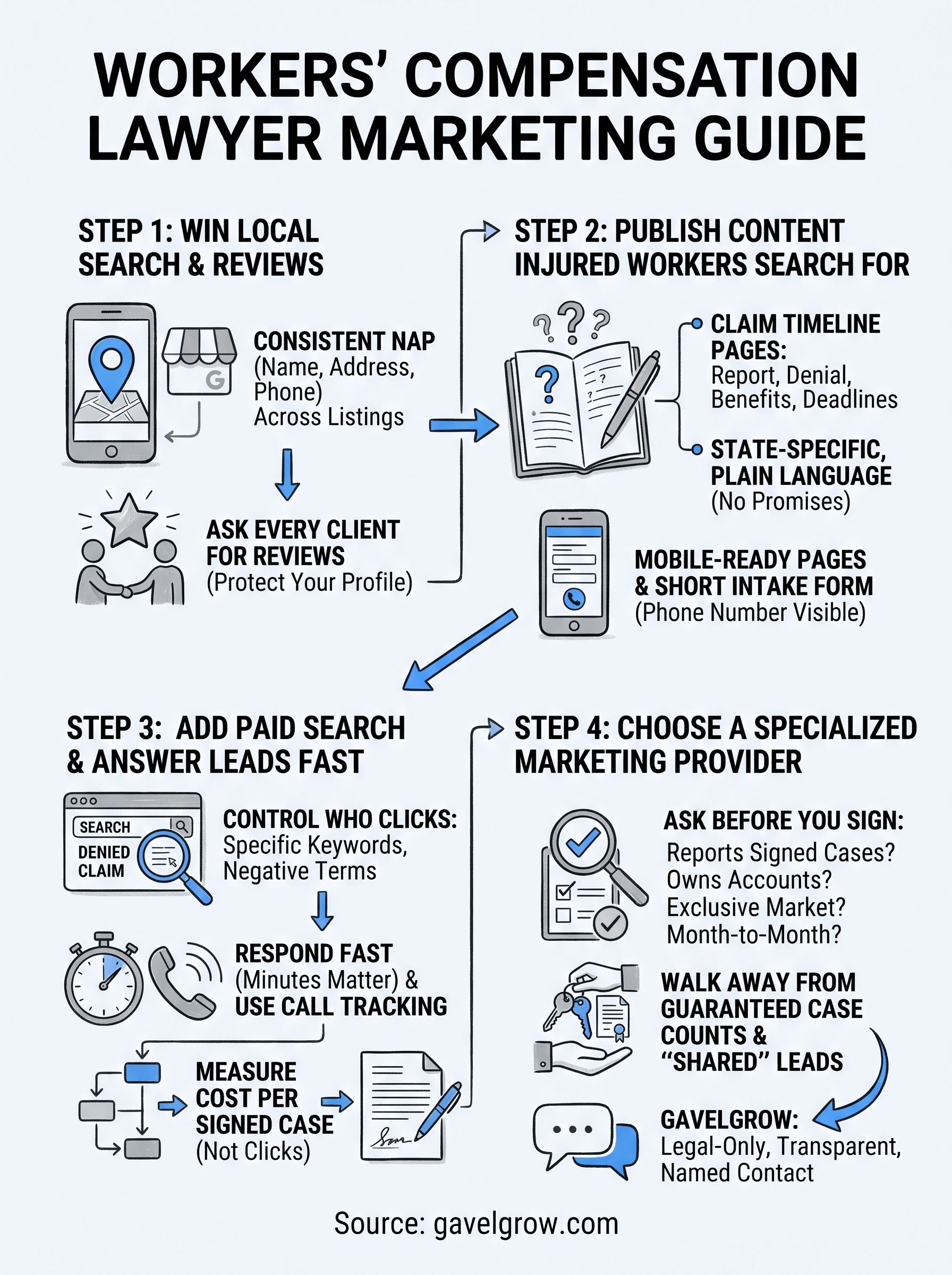
Workers compensation lawyer marketing works when you win local search, publish content that answers injured workers' questions, add paid search for speed, and track every lead to a signed retainer. If you hire help, choose a provider that knows workers' comp intake and reports on signed cases, not clicks.
The problem is that your client is hurt, often out of pay, and searching on a phone about a denial or a deadline. That person calls the first firm that answers. You also compete with personal injury firms and with lead vendors that sell one inquiry to several firms. Many agencies treat workers' comp like generic injury work, so they send you volume and call it progress.
This guide gives you four steps: local search, content, paid search with fast intake, and how to vet a specialized marketing provider. It starts with what makes this practice area different. GavelGrow has marketed only for law firms since 2015, and the advice below comes from that legal-only work.
Why does workers' comp marketing work differently?
Workers' comp marketing works differently because your clients search about a specific problem, not a general need, and your margin per case is limited. That changes your keywords, your intake speed and the math you use to judge spend.
Who you are trying to reach
Claimants search with a concrete problem: a denied claim, an insurer-picked doctor, a boss who hints at consequences. Their searches are specific and urgent, and most happen on a phone. Your pages and your phone line have to meet that urgency.
Fees in this practice area are set or capped by state law in many states. That means your margin per case is limited and wasteful spend hurts faster than in personal injury. Check your own state bar's advertising rules before you publish anything, and never promise or imply a result.
What to measure before you spend
Each channel plays a different role, so judge it by that role.
Judge all of them by cost per signed case, not cost per lead. Here is an illustrative example, not a benchmark. You spend $6,000 on ads and get 60 leads, so each lead costs $100. If 8 of those leads sign, your cost per signed case is $750, which is what you compare against the value of a case.
A cheap lead that never signs is more expensive than a pricey one that does.
Step 1. Win local search and reviews
Start with your Google Business Profile and consistent listings, because injured workers search for a lawyer near them and call from the map results. This step takes the longest to pay off, so begin it first.
Set up the profile and listings
Claim your Google Business Profile, choose the most specific category available, and list workers' comp and its related services. Keep your name, address and phone number identical on your website, on Google and in every legal directory. Add a call tracking number to the profile so you know how many calls it drives. Keep your real number as a secondary number on the listing.
If you want this built and maintained for you, GavelGrow's done-for-you SEO and local SEO service covers profile optimization and organic ranking for law firms.
Ask every client for a review
Reviews decide many calls. The rules are simple, and they protect your profile:
- Ask every client, not only the happy ones.
- Resolve complaints with the client directly, and never steer unhappy clients to a private form first.
- Never offer a gift or discount for a review.
- Reply professionally to every public review, without sharing case details.
Consistent asking beats clever tactics, and a profile with steady reviews outranks one with a burst of them.
Local search rewards firms that stay consistent for months, not firms that push for a week.
Step 2. Publish content injured workers search for
Write one page for each question a claimant asks, in plain language, for each state where you practice. Content for workers compensation lawyer marketing earns its keep by answering a question before the reader calls anyone.
Build pages around the claim timeline
Map topics to the stages of a claim. Each page should answer one question completely:
- How to report an injury and file a claim
- What to do after a claim is denied
- Whether your employer can fire you for filing
- Which benefits you may receive, such as medical care and wage replacement
- How filing deadlines work in your state
- Occupational illness and repetitive stress claims, such as carpal tunnel
Deadlines and benefits differ by state, so write state-specific pages and say plainly that the reader should confirm details with a lawyer. A page that explains a process and promises nothing earns more trust than one that boasts.
Make every page ready to convert
Each page needs a visible phone number and a short intake form that works on a phone. Ask for name, phone number, employer and injury date, then stop. A long form loses an injured person who is typing with one hand. Treat the form and the call line as part of the content, because that is where the reader becomes a lead.
Answer the claimant's question first, then make calling you the easy next step.
Step 3. Add paid search and answer leads fast
Google Ads gives you the quickest way to put your firm in front of claimants while your search work matures. It pays off only if you filter out junk clicks and answer the leads you get within minutes.
Control who clicks
Build campaigns around claim-specific searches, such as denied claims and injury-at-work questions, and limit targeting to the states where you are licensed. Add negative keywords for searches that signal the wrong person, such as insurance quotes for employers, jobs and forms. Review your search terms report every week and cut what wastes money. Send each campaign to its own page with its own tracking number.
Respond before the lead goes cold
The Lead Response Management Study found that leads contacted within five minutes are far more likely to be qualified than those first reached at thirty minutes. It measures the odds of qualifying a lead, not signed cases, but the lesson holds. Set up an instant auto-reply and a clear owner for every inbound call and form.
To see which campaign produced each signed case, including the leads that only phoned, you need call tracking and intake in one place. GavelGrow's self-serve platform does this with built-in call tracking and click-to-signed-case attribution.
Paid search buys you the click, but your intake process decides whether it becomes a case.
Step 4. How to choose a specialized marketing provider
Choose a provider that works only with law firms, reports on signed cases, and lets you keep control of your ad accounts. Ask the questions below before you sign anything.
Questions to ask before you sign
Walk away from guaranteed case counts. Also walk away from "exclusive" leads that are sold to several firms, and from any agency that will not show you what it does with your ad spend.
How GavelGrow fits these criteria
GavelGrow is built only for law firms, and it has served 500+ law firms since 2015. Ad accounts and tracking numbers are created in your firm's name, GavelGrow adds no markup to ad spend, and plans are month-to-month. Managed clients get a named contact, review every ad asset before it runs, and do not share a market with a direct competitor. Managed engagements are scoped on a strategy call, plus ad spend.
The right provider reports on signed cases and hands you the keys to your own accounts.
Where to start this month
Start with local search and a tighter intake process, then add content and paid search once you can see which leads sign. Workers compensation lawyer marketing rewards firms that measure cost per signed case and answer every claimant fast.
If you want a second opinion on where your firm stands, book a free strategy call with GavelGrow.