How to Improve Google Ads Quality Score: 7 Law Firm Fixes
Categories: Legal Marketing Strategies
 Abram Ninoyan
Founder & Senior Performance Marketer
Credentials: Google Partner, Google Ads Search Certified, Google Ads Display Certified, Google Ads Measurement Certified, Google Analytics (IQ) Certified, HubSpot Inbound Certified, HubSpot Social Media Marketing Certified, Conversion Optimization Certified
Expertise: Google Ads, Meta Ads, Conversion Rate Optimization, GA4 & Google Tag Manager, Lead Generation, Marketing Funnel Optimization, PPC Management
LinkedIn Profile
If you want to know how to improve Google Ads Quality Score, fix whichever of the three components shows "Below average" in your keyword table: expected CTR, ad relevance, or landing page ex...
Key Takeaways
- How to Improve Google Ads Quality Score: 7 Law Firm Fixes
- What is a good Quality Score and how is it measured?
- 1. Split campaigns into tight, intent-based ad groups
- 2. Write ad copy that mirrors the search
How to Improve Google Ads Quality Score: 7 Law Firm Fixes
If you want to know how to improve Google Ads Quality Score, fix whichever of the three components shows "Below average" in your keyword table: expected CTR, ad relevance, or landing page experience. For most law firms, tight ad groups and matching ad copy fix the first two, and a faster, more specific landing page fixes the third. On non-brand keywords, a score of 7 or higher is a sensible target.
Legal clicks are expensive, and a weak score can make them more so. Quality Score is only a diagnostic, but the signals behind it influence your ad rank. Ad rank decides whether your ad shows, where it shows, and what you pay. A messy account can end up paying more for the same position, and it often attracts searchers who were never going to hire you.
This guide explains how the score works, then gives seven fixes in the order most accounts should work through them. Each fix includes a law firm example. GavelGrow has marketed only for law firms since 2015, so the examples use legal keywords. Every ad copy suggestion assumes you check your own state bar's advertising rules first.
Key takeaways
- A good score is 7 or higher on non-brand keywords.
- Three components drive it: expected CTR, ad relevance, and landing page experience.
- Tight ad groups and mirrored ad copy fix most relevance problems.
- Negative keywords and assets lift CTR; fast, matched pages fix landing experience.
- Judge keywords by signed cases, not by the score alone.
What is a good Quality Score and how is it measured?
Quality Score is a 1 to 10 rating that Google gives each keyword in your account, and a 7 or higher on non-brand keywords is a realistic target. Google describes it as a diagnostic summary, not a direct input to the auction. The signals behind it still feed the real-time ad rank that sets your position and cost.
The three components behind the score
Google rates three components per keyword as Above average, Average, or Below average, compared with other advertisers on the same keyword. Google does not publish a formula, so any calculator that promises exact weightings is giving you an estimate. Treat the three ratings as your to-do list.
Fix the component rated below average, not the number itself.
What counts as a good score
Brand keywords, meaning your own firm name, should sit at or near 10 because no competitor can match that relevance. Non-brand legal terms such as "car accident lawyer" are crowded, so 6 or 7 is normal and 8 or higher is strong. A dash instead of a number means Google has too little data, usually because the keyword gets few searches.
How to see your score
You can add the score to your keyword table in a minute. Quality Score exists only at keyword level, so ad group and account figures need a roll-up that fix 7 shows.
- Open the Keywords page and choose Search keywords.
- Click Columns, then Modify columns.
- Under Quality Score, add Quality Score, Landing page exp., Ad relevance, and Exp. CTR.
- Add the historical versions if you want to see changes over time.
1. Split campaigns into tight, intent-based ad groups
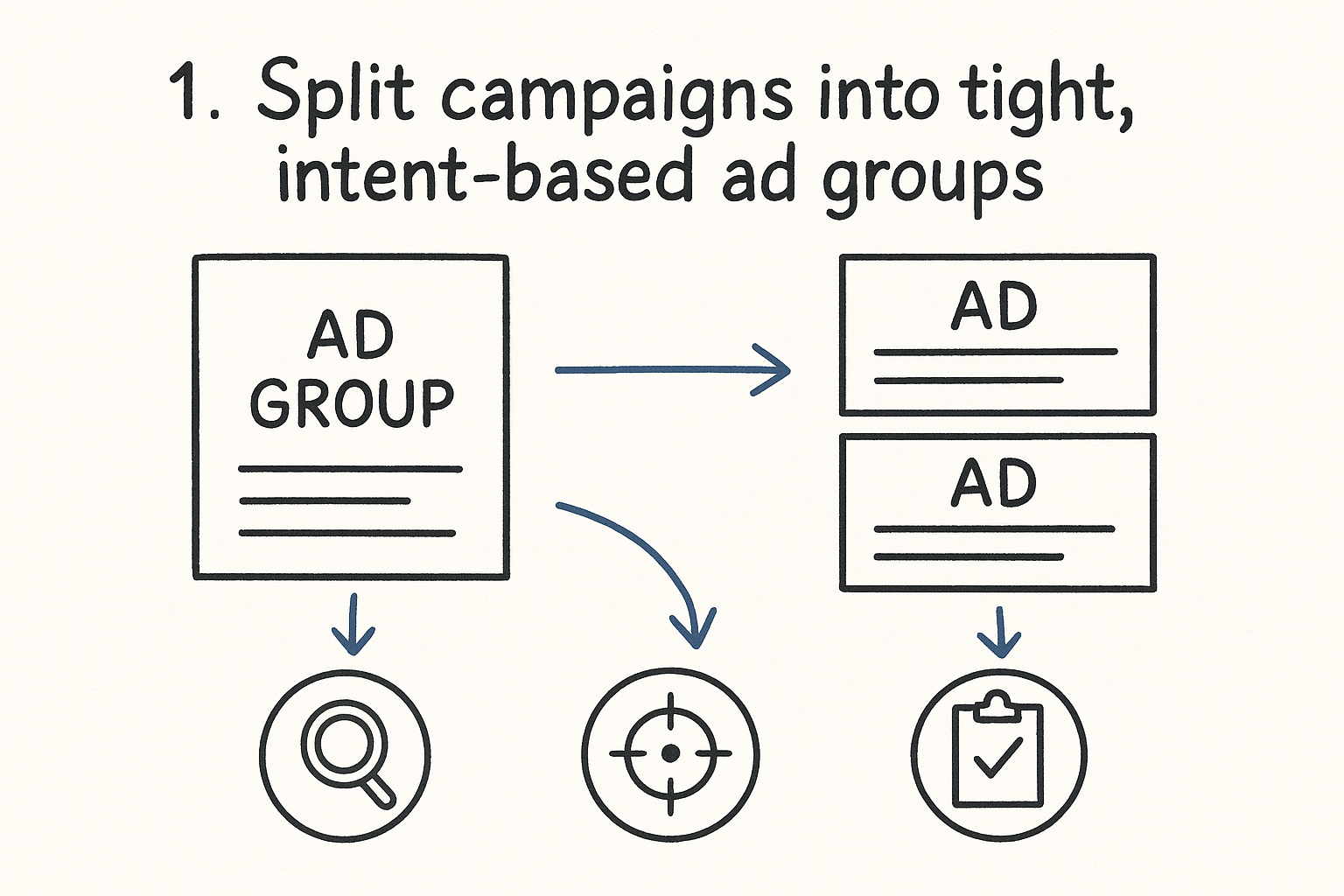
The first fix is structural: build ad groups so that one ad can honestly speak to every keyword inside them. Tight ad groups raise ad relevance and expected CTR together, because the ad can repeat what the searcher typed. This is the base of any plan to improve Google Ads Quality Score.
How to do it
Start from your keyword export and sort it by practice area, then by the specific issue behind the search. Anything that needs different ad wording belongs in its own group. Catch-all groups are the most common reason a legal account shows Below average ad relevance.
- One practice area per campaign, so budgets and reporting stay clean.
- One case type or charge per ad group, such as truck accidents or first-offense DUI.
- A handful of close keyword variants per group, not dozens.
- Brand keywords in their own campaign, since they behave differently.
If one ad cannot honestly answer every keyword in the group, split the group.
Law firm example
A personal injury firm often starts with one group called "accident lawyer" that holds every vehicle type. The ad has to stay generic, so relevance suffers. Splitting the group gives each searcher an ad that names their situation.
2. Write ad copy that mirrors the search
Put the searcher's own wording in your headlines and say what happens after the click. Ad copy that mirrors the search improves ad relevance directly and gives people a reason to click, which supports expected CTR.
How to do it
Build each ad as a responsive search ad, which accepts up to 15 headlines and 4 descriptions. Google shows up to three headlines and two descriptions at a time, so every headline must read well beside the others. Pin only when you must, such as for a required disclaimer, because pinning cuts the combinations Google can test. Also remember that ad strength is not Quality Score. An ad rated Excellent can still sit on a Below average keyword.
- Three or four headlines that carry the core keyword in natural wording.
- Two or three headlines that describe the situation the searcher is in.
- Two or three headlines that give the next step, such as calling or requesting a case review.
- Descriptions that name the practice area, the area you serve, and how to reach you.
- No guarantees, no promised results, and no superlatives like "best". Check your state bar's advertising rules before launch.
Write for the person who typed the search, then reread it as your state bar would.
Law firm example
For the truck accident group from fix 1, the copy could look like the table below. Swap in wording your state bar allows and offers your firm can support.
3. How can you raise expected CTR with assets and tests?
Add every relevant asset and run a steady ad testing routine. Assets, formerly called extensions, make your ad larger and give more reasons to click. Testing removes the weak copy that drags expected CTR down. This is also the direct answer to how to improve CTR in Google Ads.
How to do it
Assets are not a Quality Score input on their own, but a higher CTR is, and assets are one of the most reliable ways to earn it. Sitelinks, callouts, structured snippets, and a call asset suit almost every firm. Pair them with a simple testing habit so the weakest ads stop collecting impressions.
- Keep two or three active ads per ad group so each gets enough data.
- Change one element at a time, such as a headline or a call to action.
- Pause ads that gather many impressions and few clicks.
- Judge winners on conversions as well as clicks. A vague, curiosity-driven ad lifts CTR without lifting cases.
A click that never becomes a call or a form does not count as a win.
Law firm example
Here is what a solid asset set looks like for the accident campaigns above.
4. Block irrelevant searches with negative keywords
Review your search terms report every week and add negative keywords for searches that will never become clients. Irrelevant impressions pile up without clicks, and they pull expected CTR and ad relevance down with them.
How to do it
Open the Search terms report and sort by impressions. Look for queries where the person clearly wants something other than a lawyer. Add them as negatives at campaign level, or build a shared list you can apply to several campaigns. Match types matter for negatives, because a negative does not expand to close variants the way a positive keyword does. Add the common misspellings and plurals as separate entries.
Law firm example
Most legal accounts attract the same kinds of wasted searches. The table shows the groups to look for. Adjust it to your own practice, since a term that is waste for one firm is a client for another.
Be careful with words like "free" and "cost". Many real prospects search them, so check the search terms before you block anything.
Block the searches that could never become a signed case, and nothing more.
5. Send each ad group to a matching landing page
Link every ad group to the page that answers that exact search, not your home page. Message match between the keyword, the ad, and the page is the cheapest landing page experience fix you can make, and it is the heart of how to improve Google Ads Quality Score on the page side.
How to do it
Google looks for relevant, useful content, a transparent and trustworthy page, and easy navigation on any device. For a law firm, that means a page about the exact matter the person searched. Repeat the search in the headline, explain the process in plain English, and give one clear next step. Keep the required attorney advertising disclosures and privacy information visible.
- A headline that echoes the keyword and the ad promise.
- A phone number and a short form visible without scrolling on a phone.
- Content about this case type only, not a menu of every service.
- A single primary action, so the page does not compete with itself.
A searcher who lands on the wrong page leaves before they read a word.
Law firm example
The mapping below shows how fix 1 groups connect to pages. A broad term like "accident lawyer" can go to a general personal injury page, but a specific one should never go there.
6. Fix mobile speed and intake form friction
Make the page load fast on a phone, then shrink the form to what intake needs to start a conversation. Slow pages and clumsy forms are the two things most likely to hold landing page experience at Average, so fixing them is a practical way to improve Quality Score.
How to do it
Run your landing page through PageSpeed Insights and fix the largest items first. Then review the form on your own phone. Contact forms usually do worse on phones than on desktop, so design for the thumb first and let the desktop version follow.
- Compress hero images and remove autoplay video.
- Cut scripts, pop-ups, and chat widgets that block the first screen.
- Put a tap-to-call button above the fold.
- Ask only for what intake needs: the situation, a name, and a phone number.
- Add clear consent wording next to any text-message opt-in.
Every extra field on a mobile form gives a worried person another reason to leave.
Law firm example
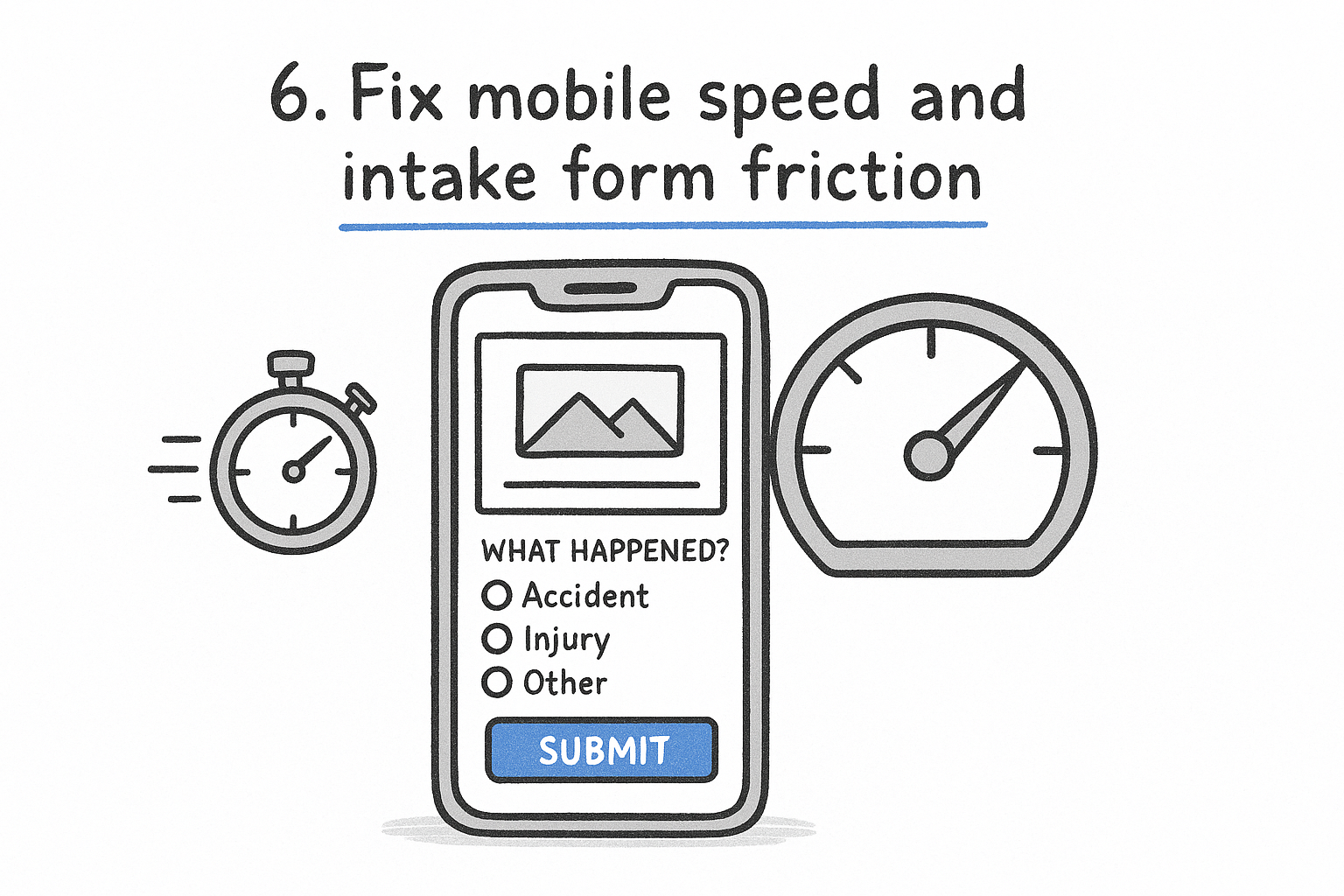
A three-step form works well on a phone because each screen asks one small thing. GavelGrow's hosted intake forms follow this pattern. They are firm-branded, mobile-first, and multi-step, and they embed on any website through an iframe or a script snippet. They also keep a TCPA consent audit log. If page and form work is outside your bandwidth, our law firm conversion optimization service covers intake forms and landing pages.
- Step one: "What happened?" with a short list of case types.
- Step two: name and phone number.
- Step three: consent checkbox and submit.
7. Which low-score keywords should you fix first?
Fix the high-impression keywords with below-average components first, and use an impression-weighted average to find them. Then judge every keyword by signed cases, because a low score on a keyword that signs clients is not an emergency.
How to do it
A simple average hides the keywords that matter. Weighting by impressions shows where a low score costs you most.
- Export your keywords with impressions, Quality Score, and the three component ratings.
- Multiply each keyword's impressions by its score.
- Add the results and divide by total impressions.
- Start with the keywords that carry the most impressions and the lowest scores.
Law firm example
Take three keywords. The simple average of 8, 4, and 3 is 5. Weighted by impressions, the account sits at 6.3, because most traffic runs through the strong keyword.
Weighted score: 63,000 / 10,000 = 6.3. If you lift the truck accident keyword from 4 to 7 using fixes 1 to 6, its row becomes 21,000. The total becomes 72,000 and the weighted score rises to 7.2.
Fix the keyword with the most impressions and the lowest score, not the lowest score alone.
Do not pause a keyword just because its score is low. If it brings signed cases at an acceptable cost, keep it and improve it slowly. The score tells you where the experience is weak, but only your case data tells you whether the keyword pays. GavelGrow's platform credits calls and form leads to their campaign. On Optimize and Managed, Smart Conversions sends signed cases back to Google Ads as offline conversions. It does not change Local Services Ads bidding, since those ads cannot accept that signal.
Put Quality Score to work
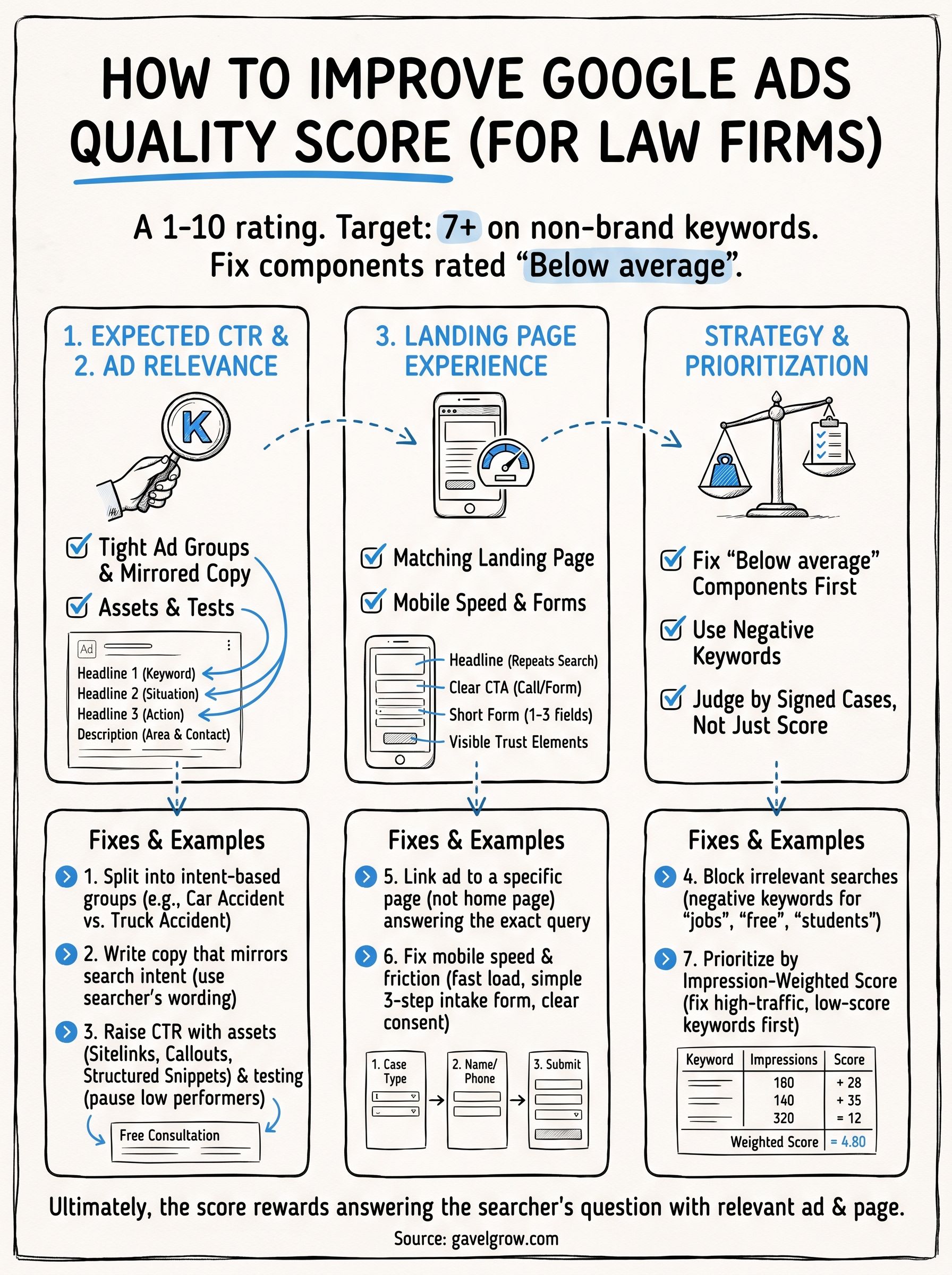
To improve Google Ads Quality Score, read the three component ratings, find the one rated below average, and work through the fixes that target it. Tight ad groups, mirrored ad copy, asset-rich ads, clean search terms, matched landing pages, and fast mobile forms cover nearly every legal account. Prioritize by impressions, and measure the result in signed cases rather than in the score itself.
Quality Score rewards the same thing your future clients reward: an ad and a page that answer the question they asked. Always check your state bar's advertising rules before you publish new copy.
If you would rather have a legal-only team rebuild your campaign structure and ad copy, see our Google Ads management for law firms.