SEO for Family Lawyers: How to Rank and Win More Clients
Categories: Legal Marketing Strategies
 Abram Ninoyan
Founder & Senior Performance Marketer
Credentials: Google Partner, Google Ads Search Certified, Google Ads Display Certified, Google Ads Measurement Certified, Google Analytics (IQ) Certified, HubSpot Inbound Certified, HubSpot Social Media Marketing Certified, Conversion Optimization Certified
Expertise: Google Ads, Meta Ads, Conversion Rate Optimization, GA4 & Google Tag Manager, Lead Generation, Marketing Funnel Optimization, PPC Management
LinkedIn Profile
Someone in your market is typing "divorce lawyer near me" into Google right now, and if your firm isn't on page one, that search ends at a competitor's website. SEO for family lawyers is how...
Key Takeaways
- SEO for Family Lawyers: How to Rank and Win More Clients
- Why SEO matters for family law firms
- Step 1. Research the keywords clients actually search
- Step 2. Claim and optimize your Google Business Profile
SEO for Family Lawyers: How to Rank and Win More Clients
Someone in your market is typing "divorce lawyer near me" into Google right now, and if your firm isn't on page one, that search ends at a competitor's website. SEO for family lawyers is how you fix that: it's the process of optimizing your site, Google Business Profile, and content so people searching for divorce, custody, or child support help find your firm before anyone else's.
This guide gives you a practical answer, not just theory. You'll learn how family law firm SEO differs from generic legal marketing, why local pack rankings matter more than blog traffic for most family law practices, and which ranking factors actually move the needle for attorneys competing in a crowded, high-intent market like divorce and custody law.
Below, you'll find a step-by-step approach covering keyword research for family law niches, on-page optimization, Google Business Profile tactics, link building, and how to track whether your rankings are turning into signed retainers, not just website visitors. If your firm already runs paid ads alongside SEO, you'll also see where attribution tools like GavelGrow's platform fit into measuring which channel actually closes cases.
Why SEO matters for family law firms
Family law is one of the most search-driven practice areas in legal marketing. WordStream's 2024 industry benchmark report puts average cost-per-click for "divorce lawyer" keywords at $6-$9 in competitive metro markets, and pay-per-click spend disappears the moment you stop paying. Organic search visibility works differently: once you rank for "child custody attorney [city]" or "how to file for divorce in [state]," you keep collecting clicks without paying for each one. That compounding effect is why SEO for family lawyers delivers a better long-term cost-per-signed-case than ads alone, even though it takes months to build.
Family law searches are high-intent and time-sensitive
People searching for divorce or custody help aren't browsing. Google's own local search data (Think with Google, 2023) shows that "near me" searches for professional services have grown consistently year over year, and legal services rank among the top categories for immediate, action-oriented intent. Someone typing "emergency custody lawyer" or "file for divorce this week" is often mid-crisis and ready to call the first credible result they find. If your site doesn't answer their question fast, on a page that loads quickly on mobile, you lose them to a competitor whose site does.
The local pack decides who gets the call
Most family law searches trigger Google's local pack, the map and three-listing block above organic results. BrightLocal's 2024 Local Consumer Review Survey found that 87% of consumers used Google to evaluate local businesses in the past year, and for legal services specifically, review count and recency weigh heavily on which three firms Google surfaces. Ranking in that pack matters more than ranking on page one of standard organic results for most single-location family law firms, because the pack sits above the fold and includes your phone number, reviews, and hours before a searcher ever clicks through to a website.
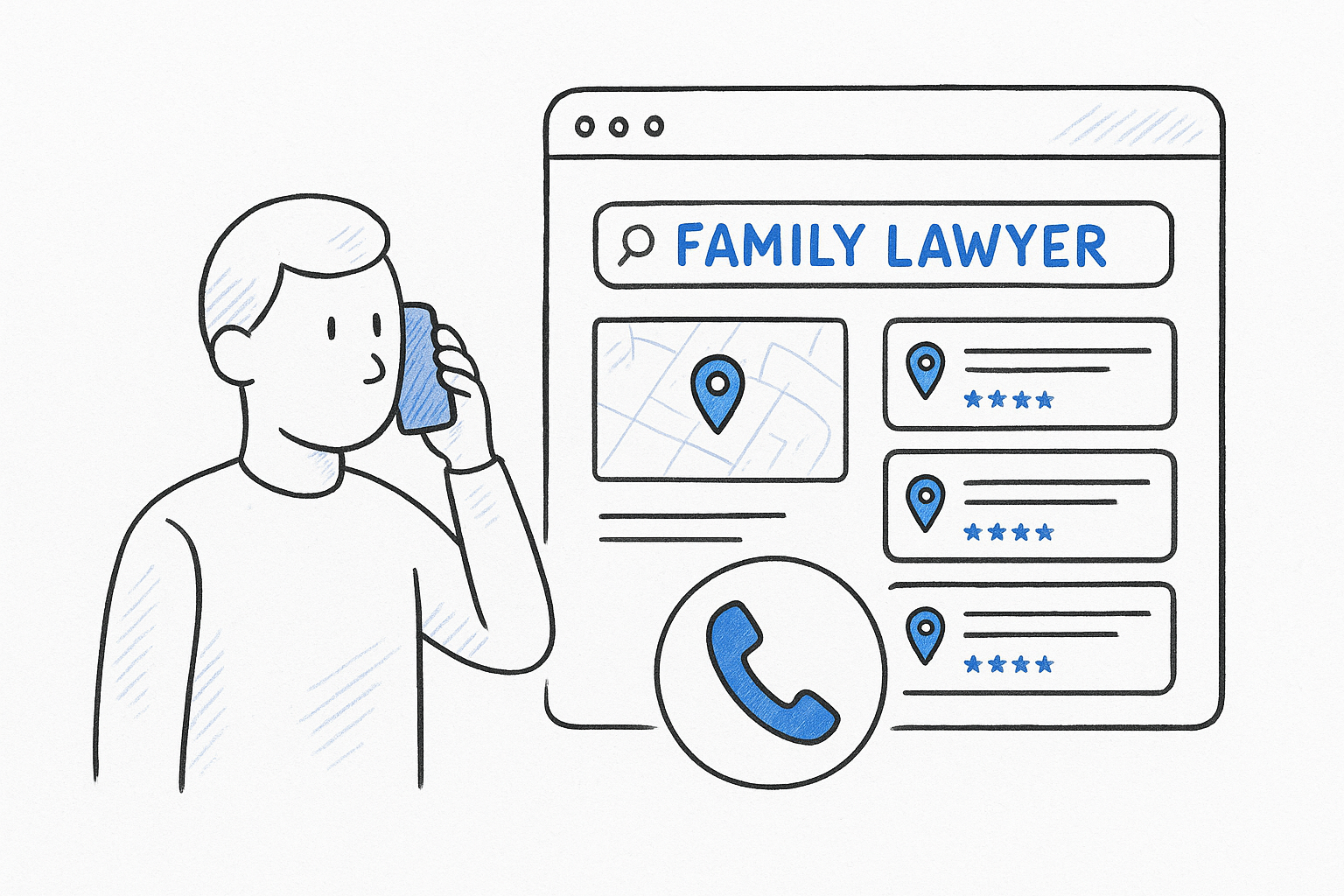
If you're not in the local pack for your practice area and city, you're invisible to most of the people searching for a family lawyer right now.
What happens when you don't rank
Skipping SEO doesn't just mean fewer website visitors. It means paying full price for every single lead through ads indefinitely, competing against firms that have spent years building organic authority, and losing referral-adjacent searches ("is my ex allowed to," "how long does divorce take in [state]") to whichever firm published the answer first. Compare the two paths over a 12-month window:
Google Business Profile optimization and organic content aren't a replacement for every firm's paid strategy, but they're the piece most family law firms underinvest in relative to how much of their case volume search actually drives. Firms that pair the two, tracking both channels through a unified attribution setup, typically see their cost-per-signed-case trend down over time instead of staying flat.
Why measurement changes the calculation
Ranking is only half the equation. A firm that ranks #1 for "custody lawyer" but can't tell which keyword or landing page actually produced a signed retainer is flying blind on budget decisions. That's where platforms built for legal intake, like GavelGrow's marketing dashboard, matter: they connect the search click to the lead to the signed case, so you're not just tracking rankings, you're tracking revenue. The rest of this guide walks through the specific steps, starting with the keyword research that determines whether you're chasing the searches your actual clients type in, or the ones a generic SEO checklist assumes they type in.
Step 1. Research the keywords clients actually search
Most family law firms start keyword research with a generic SEO tool and grab whatever has the highest search volume. That's backwards. A term like "family lawyer" gets searched a lot, but it also pulls in people looking for jobs, law school programs, and free legal advice they'll never pay for. Keyword research for family law works best when you start from the actual crisis your clients are in, not from a volume metric a tool spits out. The goal is matching your pages to the exact phrases someone types when they're deciding whether to call.
Start with practice-area and location modifiers
Family law isn't one practice area, it's a dozen. Divorce, custody, child support, adoption, prenups, and domestic violence protective orders each attract different searchers with different urgency levels. Combine each of those with your city and neighboring suburbs, because "custody lawyer Austin" and "custody lawyer Round Rock" are two separate ranking opportunities, not duplicates. Skipping this step is the single biggest reason firms rank for their homepage but nothing else.
The keywords that convert aren't the ones with the highest search volume, they're the ones that match exactly what your last ten clients typed before they called.
Mine your own intake data for real phrases
Your past leads already told you what they search. Pull the last six months of intake form submissions and phone call transcripts and look for recurring phrasing: "how much does divorce cost in [state]," "can I move out of state with my kids," "emergency custody order." If your firm runs its intake through a platform like GavelGrow's lead pipeline, this data sits in one place instead of scattered across a CRM, a spreadsheet, and a call tracking tool nobody logs into.
Group keywords by intent before you build pages
Once you have a list, sort it by intent so you know what kind of page each keyword needs.
This sorting step matters because it prevents the most common mistake in SEO for family lawyers: writing one blog post per keyword and never building the transactional pages that actually generate calls. Informational content earns trust and links. Transactional pages, covered next, close the deal.
Step 2. Claim and optimize your Google Business Profile
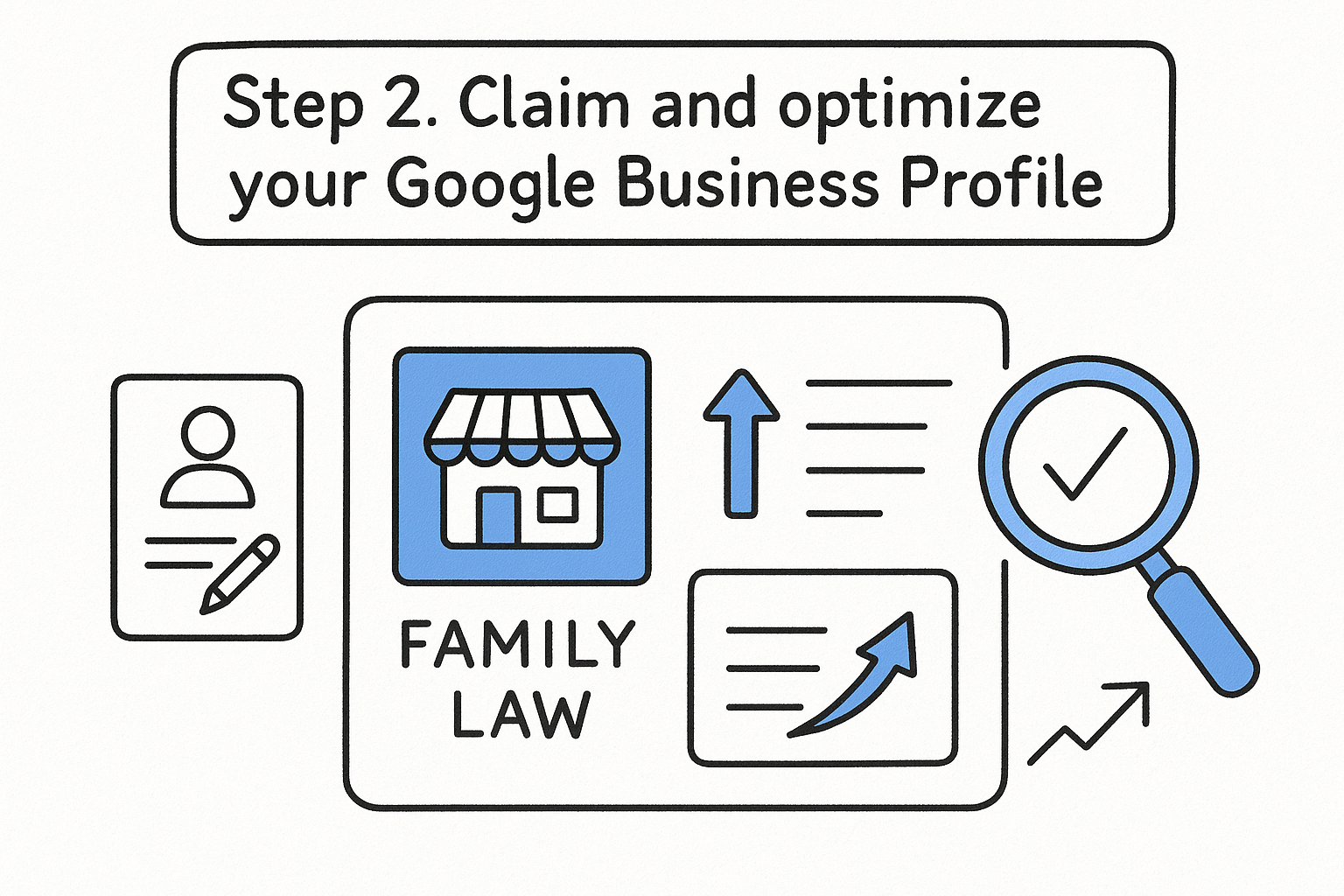
Your Google Business Profile (GBP) carries more weight in SEO for family lawyers than almost any other single ranking factor, because it's the listing that populates the local pack searchers see before they ever click a website. If you haven't claimed yours yet, go to google.com/business, verify your firm through postcard, phone, or video verification, and lock in the listing before a competitor or a scraped directory claims it for you. Firms that skip this step are effectively invisible in the block of results that gets the most clicks for local legal searches.
Fill out every field, not just the basics
Google rewards complete profiles over sparse ones. Fill in your primary category as "Family Law Attorney," add secondary categories like "Divorce Lawyer" or "Child Custody Attorney" if they apply, and list every service you actually handle: divorce, mediation, adoption, prenups, protective orders. Add your service area if you cover multiple cities, upload real photos of your office and attorneys (not stock images), and keep your hours accurate, especially if you offer after-hours consultations for urgent custody matters.
Reviews decide who wins the local pack
BrightLocal's 2024 survey found review count and recency are among the top three local ranking factors Google uses. Build a simple, repeatable ask: send a review request by text within 48 hours of a case closing, while the relief of a resolved custody or divorce matter is still fresh. Don't buy reviews or incentivize them, Google's guidelines prohibit both and will suspend your profile if flagged.
A profile with 40 recent, five-star reviews will outrank a firm with 200 reviews from three years ago.
Respond to every review, positive or negative, within a few days. A thoughtful reply to a one-star review often does more for trust than ten five-star reviews with no engagement from the firm.
Post updates and answer questions proactively
Treat your GBP like a second homepage. Post monthly updates: a case result summary (without violating confidentiality), a new blog post, or a reminder about a filing deadline change in your state. Answer the "Questions & Answers" section yourself before a competitor or a random user posts an inaccurate answer that ranks publicly under your name.
- GBP monthly checklist:
- Add 1 new photo (office, team, or event)
- Publish 1 GBP post (link to new content or update)
- Send review requests to last month's closed cases
- Respond to all new reviews within 72 hours
- Check Q&A section for inaccurate answers
A fully optimized GBP feeds every downstream step in family law firm SEO, since the phone calls and form fills it generates are exactly what you'll route into the location and practice-area pages covered next.
Step 3. Build location and practice area pages
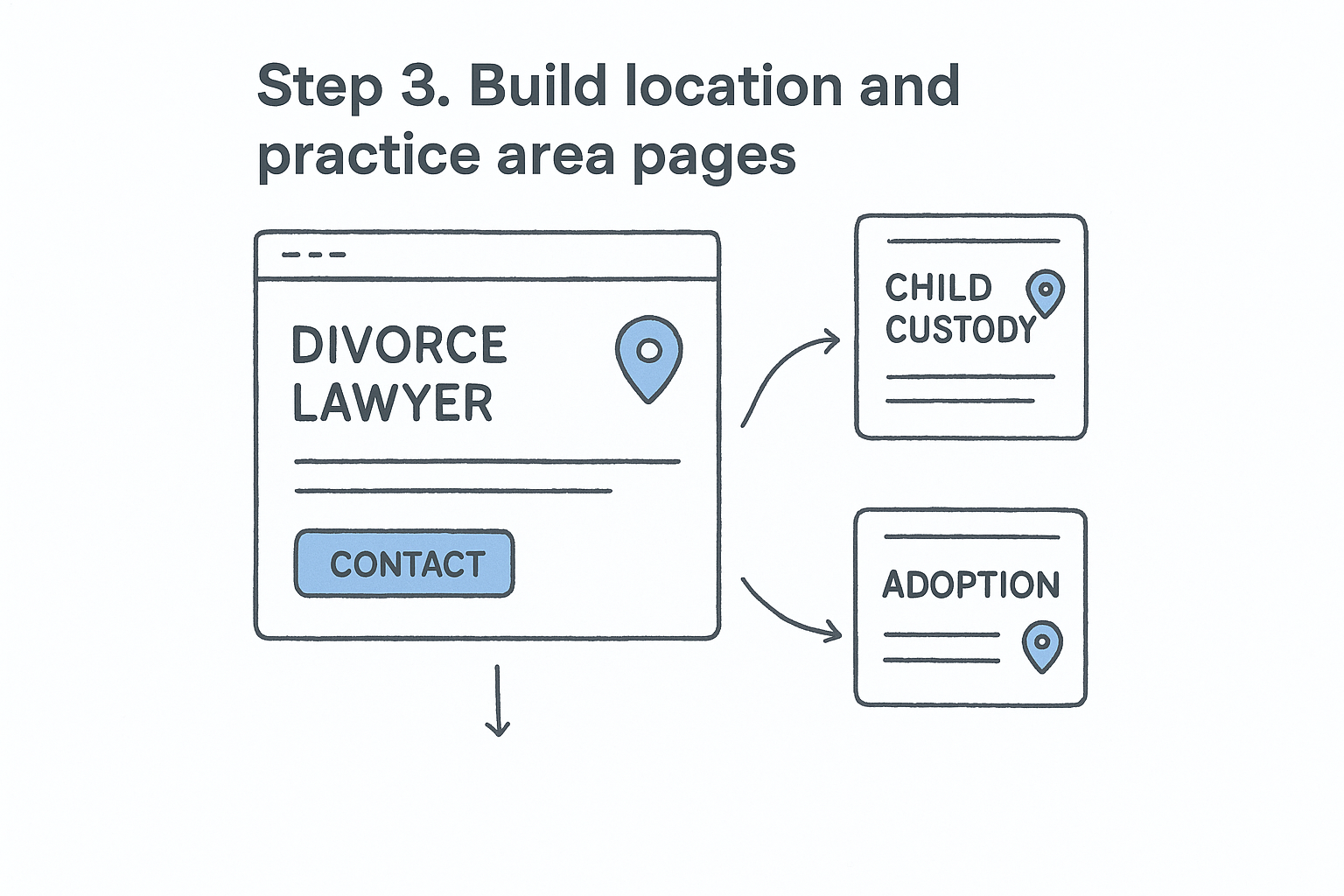
One homepage trying to rank for "divorce lawyer," "custody lawyer," and "adoption attorney" all at once will lose to competitors who built a dedicated page for each. Google matches search queries to the page that best answers them, and a page titled "Family Law Services" rarely beats a page titled "Child Custody Lawyer in Round Rock, TX" for that exact search. Location and practice area pages are how you claim the specific, high-intent searches covered in Step 1 instead of hoping your homepage happens to rank for all of them.
Build one page per practice area
Split your services into their own URLs: divorce, child custody, child support, adoption, prenuptial agreements, and protective orders each deserve a standalone page, not a paragraph buried in a general services list. Each page should answer the questions a searcher in that specific situation actually has, not a watered-down version meant to cover every practice area at once. A custody page should mention modification petitions and relocation rules; a divorce page should mention your state's residency requirement and waiting period.
A page built for "custody lawyer" and a page built for "divorce lawyer" will always outrank one page trying to be both.
Layer in a location page for every city you serve
If you cover more than one city or county, combine each practice area with each location: "Divorce Lawyer Austin," "Divorce Lawyer Round Rock," "Custody Lawyer Cedar Park." Don't duplicate the same text across cities with the location swapped in; Google's John Mueller has repeatedly warned that thin, duplicated location pages get filtered out of results rather than ranked. Reference local courthouses, filing procedures specific to that county, and neighborhoods you actually serve.
Structure every page the same way
Consistency helps both Google and visitors know what to expect from your site. Use this structure as a template for every practice area and location page you build:
Page template:
1. H1 with practice area + location ("Child Custody Lawyer in Austin, TX")
2. 2-3 sentence answer to the core question above the fold
3. Phone number + click-to-call button visible without scrolling
4. Local details: courthouse name, filing timelines, state-specific rules
5. FAQ block (3-5 questions specific to that practice area)
6. Client review or case result relevant to that practice area
7. Contact form embedded, not linked to a separate page
That last point matters more than firms think. Every practice area and location page should have its own embedded intake form rather than a link to a general contact page; each extra click before a form loses conversions. GavelGrow's hosted and embeddable intake forms handle this natively, with mobile-first, multi-step layouts you can drop onto any location or practice area page without a developer, so the traffic these pages earn actually turns into a submitted lead instead of a bounce.
Step 4. Publish content that answers client questions
Once your practice area and location pages are live, blog content fills the gap those transactional pages can't cover: the questions people ask weeks before they're ready to call an attorney. Content marketing for family lawyers works best when it targets the informational keywords you sorted out in Step 1, the "how long does divorce take" and "can I move out of state with my kids" searches that build trust long before someone fills out a form. Skip this step and you cede that entire top-of-funnel audience to whichever competitor bothered to answer first.
Write for the question, not the keyword
Every post should open with a direct, plain-English answer to its title question in the first two or three sentences, then expand with the nuance, state-specific rules, and exceptions that follow. Google's featured snippets favor pages structured this way, and searchers scanning on a phone in a parking lot need the answer before they need your firm's backstory. A post titled "How Long Does Divorce Take in Texas" should state the average timeline in sentence one, not bury it under three paragraphs of firm history.
The firm that answers the question first usually gets the call when the situation turns urgent.
Build a repeatable content calendar
Rather than publishing whatever comes to mind, work from the intent groups you built in Step 1 and assign a cadence:
Monthly content calendar (example):
- Week 1: Informational post (e.g., "Child Support Calculation in [State]")
- Week 2: Comparison post (e.g., "Mediation vs. Litigation for Custody")
- Week 3: Local/legal update (e.g., new filing rule or court change)
- Week 4: FAQ roundup pulled from last month's intake calls
This cadence keeps family law firm SEO content flowing without forcing you to invent topics from scratch every month, since Step 1's intake-data mining already gave you a running list of real client questions.
Turn every post into a lead, not just a read
Informational content that never asks for the next step is a missed opportunity. Every post should end with a short, specific call to action tied to the topic, a custody post might invite the reader to a free consultation about modification petitions, while a divorce-cost post might link to a fee breakdown page. Embed a short intake form in the sidebar or at the end of the post rather than relying on a single header button; GavelGrow's embeddable intake forms drop into a blog template the same way they do on practice area pages, so a reader who's convinced by your answer doesn't have to hunt for a way to reach you. Content that educates without converting builds traffic numbers you can show off, but it won't move your cost-per-signed-case the way a form-equipped post will.
Step 5. Fix the technical SEO issues holding you back
Beautiful content and a fully-built page for every practice area won't rank if the technical foundation underneath your site is broken. Technical SEO for family lawyers covers the unglamorous stuff Google checks before it even reads your content: page speed, mobile usability, secure connections, and whether Googlebot can actually crawl your pages. Firms that skip this step often can't figure out why a competitor with worse content outranks them, and the answer is usually sitting in a site speed report they never ran.
Start with mobile speed, because most searches happen there
Google's own PageSpeed Insights and Search Console tools will flag load-time problems most WordPress-built law firm sites carry: unoptimized images, bloated plugins, and render-blocking scripts. Someone searching "emergency custody lawyer" on their phone in a parking lot won't wait five seconds for your homepage to load; they'll hit back and call the next result. Compress images before upload, delete plugins you don't use, and pick hosting built for speed rather than the cheapest plan available.
A slow website loses the exact client who needs you fastest, right when they're most ready to call.
Run through the core technical checklist
Most firms don't need an SEO agency to catch these; a single audit pass covers the highest-impact fixes.
Technical SEO checklist:
- HTTPS enabled sitewide (no mixed-content warnings)
- Mobile page speed under 3 seconds (test in PageSpeed Insights)
- XML sitemap submitted in Google Search Console
- No duplicate title tags or meta descriptions across pages
- Broken links and 404s fixed or redirected
- Schema markup added for LegalService and Attorney
- Core Web Vitals passing (LCP, CLS, INP)
Work down that list once a quarter, not once and never again. Search Console flags most of these automatically under Core Web Vitals and Coverage, so checking it monthly catches new issues before they compound.
Add schema markup so Google understands your firm
Schema is structured code that tells Google explicitly what your business is, rather than making it guess from the page text. Adding LegalService and Attorney schema, along with FAQ schema on your Q&A content, increases the odds your listing shows rich results, star ratings, business hours, and answer snippets directly in search results. Most WordPress SEO plugins generate basic schema automatically, but a family law firm should verify the attorney name, practice areas, and address fields are filled in correctly rather than left as placeholder defaults.
Fixing these issues rarely produces a dramatic ranking jump on its own, but it removes the ceiling that's been capping every other effort in this guide. A firm running GavelGrow's marketing dashboard alongside a technically sound site can finally trust that a ranking drop reflects a real content or competitive issue, not a broken sitemap nobody noticed.
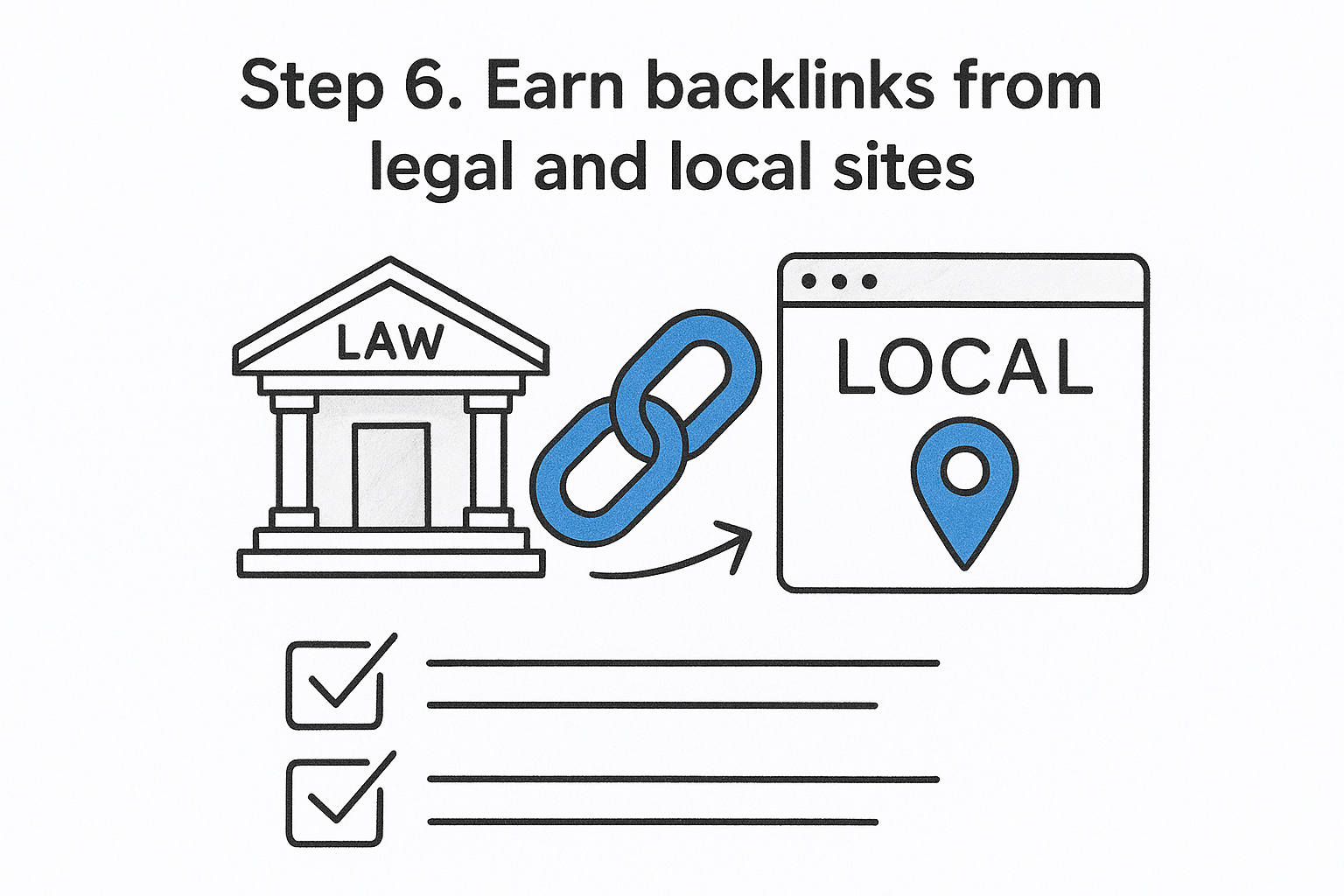
Step 6. Earn backlinks from legal and local sites
Backlinks, links from other websites pointing to yours, remain one of Google's strongest ranking signals for competitive terms like "divorce lawyer" or "custody attorney." Link building for family lawyers doesn't mean buying links or spamming directories; it means earning mentions from sites Google already trusts, your local bar association, a chamber of commerce, a legal aid nonprofit you've partnered with. A single link from your state bar's referral directory often outweighs a dozen links from low-quality guest post networks that exist only to sell links.
Start with the links you're already entitled to
Most firms leave easy links unclaimed because nobody assigned the task. Work through this list before chasing anything harder:
Easy backlink checklist:
- State and local bar association member directories
- Law school alumni association profile (if applicable)
- Chamber of commerce and local business associations
- Legal aid or pro bono organizations you've volunteered with
- Vendor and referral partners (mediators, financial advisors, therapists)
- Press mentions from case results or community involvement
Most of these take a phone call or a five-minute form, not an outreach campaign.
Pitch local and legal publications with something worth linking
Once the easy links are claimed, reach out to local news sites, parenting blogs, and legal publications with something genuinely useful, not a generic "write for us" pitch. Family law lends itself well to this because reporters regularly cover custody disputes, divorce statistics, and family court changes and need a quotable local attorney.
A single quote in a local news story about a custody law change earns more trust, and more link value, than fifty directory submissions.
Here's a pitch template that works because it offers something specific instead of asking for a favor:
Subject: Local attorney source for [topic] story
Hi [Name],
I saw your piece on [specific topic]. I'm a family law attorney
in [city] and handle [X] custody/divorce cases a year. Happy to
provide a quote or background on [specific angle related to their
recent coverage] if you're covering this again.
[Your name]
[Firm name] | [Phone]
Track what you've earned and what's still open
Use Google Search Console's Links report or a spreadsheet to track domains linking to you, and revisit the list quarterly. A firm handling family law firm SEO without outsourcing it should treat link building the same way it treats client follow-up: a short, recurring task list, not a one-time sprint.
Don't chase volume over relevance. Ten links from local news outlets, bar associations, and family-adjacent nonprofits will outperform two hundred links from unrelated directories every time, and they carry no risk of a Google penalty for unnatural link patterns.
Step 7. Speed up lead response with intake automation
All the SEO work in Steps 1 through 6 gets you a stranger's phone number or a submitted form, not a signed case. What happens in the next few minutes decides whether that click turns into revenue or gets lost to the next firm on the local pack. Harvard Business Review's lead response research, widely cited across legal marketing benchmarks, found leads contacted within five minutes are up to 21 times more likely to qualify than leads contacted after thirty minutes. Ranking well and then responding slowly is the same as paying for ads you never run.
Ranking #1 means nothing if the lead sits in your inbox for two hours before anyone calls back.
Automate the first response before a human ever picks up the phone
You can't staff someone to watch every form submission around the clock, so intake automation has to fire the instant a lead comes in, not whenever someone happens to check email. GavelGrow's intake automation sends an SMS and email auto-reply within 60 seconds of a form submission, confirms receipt, and sets expectations for a callback window. That single automated message often prevents the person from immediately calling the next result on the page while they wait to hear from you.
Route leads by urgency, not by arrival order
Not every custody or divorce inquiry carries the same urgency, and treating them all the same wastes your fastest response on someone who filled out a form at 2 a.m. just to compare options. Build a simple triage rule set:
Lead routing rules:
- "Emergency" or "today" keywords in form/call -> immediate SMS + call alert to on-call attorney
- New consultation request, no urgency language -> standard 1-hour callback window
- Existing client follow-up -> route to case manager, not intake
- After-hours submission -> automated reply + next-business-day flag
A lead pipeline that tags urgency automatically, the way GavelGrow's does with last-activity aging and linked-case indicators, means the newest urgent lead never sits buried under five older, lower-priority ones in a shared inbox.
Keep every message consent-compliant by default
Speed can't come at the cost of TCPA compliance, and family law leads are exactly the kind of personal, sensitive inquiries where a compliance misstep turns into a bigger problem than a slow callback. Automated sequences need CTIA opt-out keywords like STOP and HELP handled without manual intervention, and every text needs a documented consent trail in case a lead disputes contact later. This is one area where building your own patchwork of tools gets risky fast; a platform built specifically for legal intake handles the audit log and opt-out logic by default instead of leaving it to whoever configured your CRM two years ago.
Fast, compliant response doesn't replace the SEO work in this guide, it protects the return on it. Every ranking improvement and every backlink you earned in the last six steps is only worth as much as the percentage of resulting leads you actually convert into a signed retainer.
Step 8. Track rankings, leads, and cost per signed case
SEO work you can't measure is a guess dressed up as a strategy. Once your pages are built, your GBP is optimized, and your intake is automated, you need a way to tell which keywords, pages, and campaigns are actually producing signed retainers, not just clicks. Tracking SEO for family lawyers means connecting three separate layers: keyword rankings, lead volume by source, and the cost to acquire each signed case, because a firm that only watches rankings can rank #1 for "divorce lawyer" and still lose money if that page never converts.
Watch rankings, but don't stop there
Google Search Console and a rank tracker will tell you where you sit for "custody lawyer [city]" or "divorce attorney near me," and that's useful diagnostic data. But rankings are a leading indicator, not a business outcome. A page that climbs from position 8 to position 3 means nothing if the phone never rings, and a page stuck on page two might still be quietly producing your best clients if it's the one attorneys actually call from. Check rankings monthly, but treat every ranking change as a prompt to look at the lead data underneath it, not as the finish line.
Rankings tell you where you show up. Only lead-to-case attribution tells you if it mattered.
Tie every lead back to the keyword and page that produced it
This is where most firms lose the thread, because Google Analytics shows you traffic and a CRM shows you cases, but almost nothing connects the two without manual spreadsheet work. GavelGrow's marketing dashboard fires GA4 and Meta Pixel events with transaction IDs on every submitted lead, then tracks that lead through your pipeline to a signed case, so you can see campaign-level and even page-level cost-per-signed-case instead of stopping at cost-per-lead. That distinction matters because a page generating cheap leads that never sign is worse than a page generating fewer, pricier leads that close.
Run this comparison monthly to see where organic search actually stands against your other channels:
Review the numbers on a fixed schedule
Set a recurring monthly review, not an occasional glance when someone asks how marketing is going. Pull rankings, lead volume by source, and cost-per-signed-case into one view and compare against your 500-firm benchmark data if you have access to it, since knowing your numbers in isolation tells you less than knowing how they stack up against comparable family law practices in your market size. A firm that reviews this monthly catches a dropping conversion rate in week three, not three months later when the quarter's already lost.
Turning search visibility into signed cases
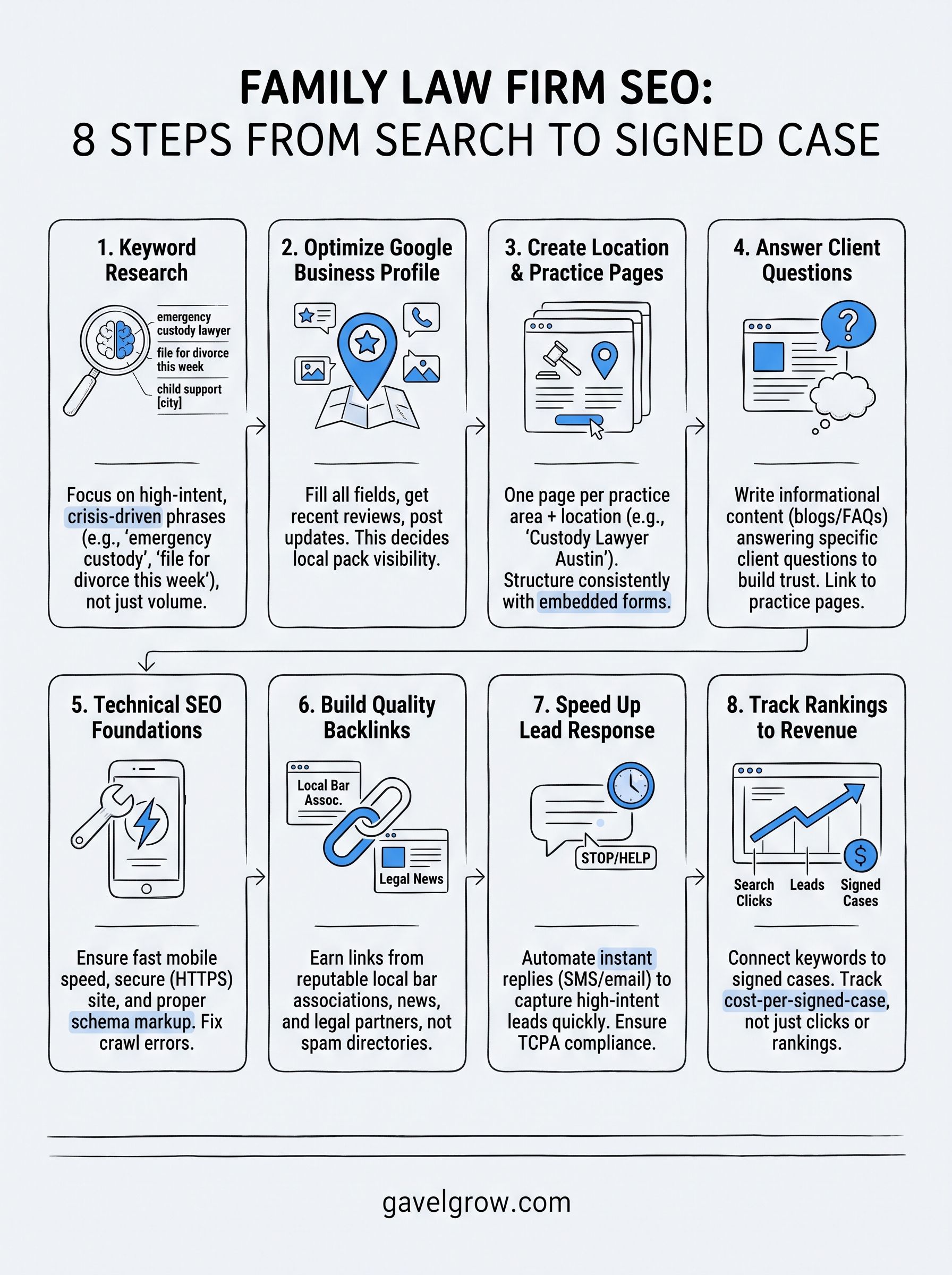
Ranking for "divorce lawyer near me" or "custody attorney [city]" isn't the finish line, it's the entry ticket. SEO for family lawyers only pays off when every ranked page, every GBP click, and every backlink you've earned funnels into a fast, tracked, compliant intake process that turns strangers into signed retainers. Skip the measurement layer and you're left guessing which of the eight steps above actually moved your revenue.
Going forward, treat rankings as a diagnostic, not a scoreboard. Watch lead volume by source, response time, and cost-per-signed-case the same way you watch case outcomes, on a fixed schedule, with real numbers instead of vibes.
If you want that attribution built in from day one instead of stitched together across three disconnected tools, book a free 45-minute strategy call and walk through your current numbers with someone who's done this for 500+ family law firms.
Frequently Asked Questions
What keywords should a family law firm focus on for SEO?
Start with the terms clients actually type, not industry jargon. The highest-value keywords combine your service and location, like "custody lawyer [city]" or "divorce attorney near me," plus the long-tail questions people research first, such as "how is child support calculated in [state]" or "how long does a divorce take." Pull your last six months of intake forms and call notes for the exact phrasing prospects use, since those recurring phrases are the keywords most likely to convert.
How is SEO for family lawyers different from other practice areas?
Family law searches are intensely local and emotionally driven — people search in a moment of stress for a lawyer who practices in their county court, not a statewide brand. The buying cycle is also longer and more research-heavy than something like a car accident, so content that answers custody, support, and process questions matters more. And bar advertising rules govern how you describe outcomes, so any results-based claim needs care.
Do family law firms need to publish blog content to rank?
In competitive markets, usually yes. Family law clients research extensively before they call, and content answering their real questions — filing steps, timelines, custody basics — is how you show up during that research phase and build trust before the first consult. It also feeds the topical relevance Google rewards. The bar is depth and accuracy: a few thorough, attorney-reviewed pages beat a stack of thin, keyword-stuffed posts.
How much do Google reviews affect a family law firm's rankings?
A lot — review count, average rating, and recency are among the strongest prominence signals in local search, and prominence is the ranking factor a smaller firm can most control. Beyond rankings, reviews are decisive for family law clients choosing who to trust with a painful, high-stakes matter. A steady flow of recent, specific reviews outperforms a large pile of old, generic ones.
What are the most common SEO mistakes family law firms make?
The frequent ones: a single generic page trying to rank for every service and city instead of dedicated practice-area and location pages; inconsistent name, address, and phone details across directories that cap map-pack ranking; neglecting Google Business Profile categories and reviews; and, the biggest, never connecting rankings to signed cases, so budget decisions get made on traffic instead of retained clients.
How do you connect family law SEO to actual signed cases?
Track past rankings and traffic to cost per signed case by keyword and page, not just cost per lead. That means connecting each organic lead, including phone calls, back to the search and page that produced it, then following it through intake to a signed retainer. A firm ranking #1 for "custody lawyer" that cannot tell which keyword produced a client is flying blind; the number that matters is which searches actually fill the caseload.
Frequently Asked Questions
What keywords should a family law firm focus on for SEO?
Start with the terms clients actually type, not industry jargon. The highest-value keywords combine your service and location, like "custody lawyer [city]" or "divorce attorney near me," plus the long-tail questions people research first, such as "how is child support calculated in [state]" or "how long does a divorce take." Pull your last six months of intake forms and call notes for the exact phrasing prospects use, since those recurring phrases are the keywords most likely to convert.
How is SEO for family lawyers different from other practice areas?
Family law searches are intensely local and emotionally driven — people search in a moment of stress for a lawyer who practices in their county court, not a statewide brand. The buying cycle is also longer and more research-heavy than something like a car accident, so content that answers custody, support, and process questions matters more. And bar advertising rules govern how you describe outcomes, so any results-based claim needs care.
Do family law firms need to publish blog content to rank?
In competitive markets, usually yes. Family law clients research extensively before they call, and content answering their real questions — filing steps, timelines, custody basics — is how you show up during that research phase and build trust before the first consult. It also feeds the topical relevance Google rewards. The bar is depth and accuracy: a few thorough, attorney-reviewed pages beat a stack of thin, keyword-stuffed posts.
How much do Google reviews affect a family law firm's rankings?
A lot — review count, average rating, and recency are among the strongest prominence signals in local search, and prominence is the ranking factor a smaller firm can most control. Beyond rankings, reviews are decisive for family law clients choosing who to trust with a painful, high-stakes matter. A steady flow of recent, specific reviews outperforms a large pile of old, generic ones.
What are the most common SEO mistakes family law firms make?
The frequent ones: a single generic page trying to rank for every service and city instead of dedicated practice-area and location pages; inconsistent name, address, and phone details across directories that cap map-pack ranking; neglecting Google Business Profile categories and reviews; and, the biggest, never connecting rankings to signed cases, so budget decisions get made on traffic instead of retained clients.
How do you connect family law SEO to actual signed cases?
Track past rankings and traffic to cost per signed case by keyword and page, not just cost per lead. That means connecting each organic lead, including phone calls, back to the search and page that produced it, then following it through intake to a signed retainer. A firm ranking #1 for "custody lawyer" that cannot tell which keyword produced a client is flying blind; the number that matters is which searches actually fill the caseload.