Conversion Rate Optimization Testing for Law Firms: 4 Steps
Categories: Legal Marketing Strategies
 Abram Ninoyan
Founder & Senior Performance Marketer
Credentials: Google Partner, Google Ads Search Certified, Google Ads Display Certified, Google Ads Measurement Certified, Google Analytics (IQ) Certified, HubSpot Inbound Certified, HubSpot Social Media Marketing Certified, Conversion Optimization Certified
Expertise: Google Ads, Meta Ads, Conversion Rate Optimization, GA4 & Google Tag Manager, Lead Generation, Marketing Funnel Optimization, PPC Management
LinkedIn Profile
Conversion rate optimization testing for a law firm means showing two versions of one page element to similar visitors, tracking which version produces more signed cases, and keeping the winner. You d...
Key Takeaways
- Conversion Rate Optimization Testing for Law Firms: 4 Steps
- Why does conversion rate optimization testing matter for law firms?
- Step 1. Measure your baseline and find the leak
- Step 2. Write a hypothesis and choose what to test
Conversion Rate Optimization Testing for Law Firms: 4 Steps
Conversion rate optimization testing for a law firm means showing two versions of one page element to similar visitors, tracking which version produces more signed cases, and keeping the winner. You do it in four steps: measure your baseline, write a hypothesis, run a clean test, and judge the result by signed retainers instead of form fills.
Most firm websites change by opinion. A partner dislikes the hero photo, an agency swaps a button color, and someone shortens the form. Then the firm changes the headline, the form, and the phone number in the same week and checks lead counts a month later. Nobody can tell what moved the numbers. Low traffic makes it worse, because a page with 1,500 visits a month cannot prove a small lift. And the lead count itself misleads you, because a form fill that never answers its phone is not a case.
This guide walks through each step with law firm examples. You will get a table of tests worth running first, the sample-size math for a typical firm page, a copyable hypothesis template, and a test log. GavelGrow has marketed only for law firms since 2015, so the examples use intake forms, tracking numbers, and cost per signed case, not generic ecommerce metrics.
Why does conversion rate optimization testing matter for law firms?
It matters because ad spend buys visits, and testing decides how many of those visits become cases. A landing page that converts 4% of visitors instead of 3% cuts your cost per lead by 25% without touching a bid. Testing is how you find those gains with evidence instead of guesses.
What counts as a conversion for a law firm
A conversion is any contact that can become a client: a form submission, a phone call, a text, or a chat. The conversion that pays you is the signed retainer, and it sits at the end of a longer path: visit, lead, qualified lead, consultation, signed case.
Judge each test at the deepest stage that gives you enough volume. Early on, that is usually qualified leads. Once you have enough signed cases, move to signed cases.
What a CRO test is and what it is not
A conversion rate optimization test is a controlled experiment. Two versions run at the same time, traffic is split at random, and one metric decides the winner. That is why it works: both versions face the same season, the same ad budget, and the same news cycle.
A before-and-after comparison is not a test. If you launch a new page in March and compare it with February, you are also comparing ad copy, bids, and case-filing seasonality. A full site redesign is not a test either. It bundles dozens of changes, so you cannot learn which one mattered. The conversion rate optimization tests in this guide change one thing at a time.
What you need before you start
Do not test until these five things are in place:
- Tracking that counts forms, calls, and texts, each credited to a source.
- At least four weeks of baseline data for the page you will test.
- A traffic estimate, so you know whether the test can finish (Step 3 covers the math).
- Sign-off from whoever reviews your advertising for state bar compliance.
- One person who owns the decision to ship or discard the result.
A test without tracking and a baseline is just a redesign with extra steps.
Step 1. Measure your baseline and find the leak
Your baseline is the current conversion rate and cost per signed case of the page you want to improve, measured over at least four weeks. Without it you cannot tell whether a variant won. The leak is the stage where the most prospects disappear, and it tells you what to test first.

Track every way a client can contact you
Many legal searchers never fill in a form. They tap a phone number. If you only count form fills, your baseline ignores some of your best leads and your test will reward the wrong variant.
Put a tracking number on each page version so every call is credited to the page or campaign that produced it. Hosted intake forms should fire conversion events into your own GA4, Meta Pixel, or Google Tag Manager IDs. GavelGrow's platform does both, and its dashboard shows cost per signed case by campaign, so you see the whole path from ad click to signed retainer.
Find where visitors drop off
Start with the numbers, then watch the behavior behind them.
- Open your funnel report in GA4 and find the step with the biggest drop: landing page to form start, form start to submit, or call click to connected call.
- Split the same report by device. Contact forms usually perform worse on mobile than on desktop, so a mobile-specific problem often hides inside a healthy average.
- Watch session recordings and heatmaps of the page. Look for the field where people stop typing, the button they tap that does nothing, and the section they never scroll to.
- Check your intake side too. How long does a new lead wait for the first reply? The Lead Response Management Study found that leads contacted within five minutes are far more likely to be qualified than those first reached at thirty minutes. Slow follow-up can make a good page look bad.
Record your baseline
Write the baseline down before you change anything. Here is an illustrative example for a single-practice landing page over the last 60 days:
Your own numbers will differ. What matters is that you now have a number to beat. If you want to run this math on your own figures, the cost per acquisition calculator does it in seconds.
Your baseline is the only thing that turns "it feels better" into "it is better."
Step 2. Write a hypothesis and choose what to test
A good hypothesis names the evidence, the change, the metric, and the audience in one sentence. It stops you from testing whatever someone suggested in a meeting, and it makes the result easy to interpret afterward.

Write the hypothesis in one sentence
Use this template. Copy it into your test log and fill in every bracket.
- Because [evidence from Step 1],
- changing [one element] from [version A] to [version B]
- will increase [primary metric] from [baseline] to [target]
- for [audience or device].
A filled-in example: "Because session recordings show mobile visitors abandoning at the case description field, moving that field to step two of a multi-step form will raise mobile form completion from 4.0% to 5.0%." If you cannot fill in the evidence line, go back to Step 1.
Tests worth running first
These are the conversion rate optimization tests that tend to matter most on a law firm site. Start with the first two, since they change what a visitor sees and does on arrival.
Page speed deserves a place on the list, but treat it as a fix, not a test. Compress images and remove heavy scripts, then confirm the change in your analytics.
Rank ideas and set guardrails
When you have more ideas than traffic, score each one from 1 to 10 on three things: potential gain, importance of the page, and ease of building it. Average the three and start at the top. This is the PIE framework, and it is enough for a firm that tests one page at a time.
Then set the guardrails. Every variant is public marketing, so each one needs the same review as your live page:
- Do not test a headline that guarantees or implies a result, or one that calls your firm the "best" or "top" in anything. State bar advertising rules vary by state, so check yours.
- Keep TCPA consent language and your required disclaimers in every variant. Removing them to lift submissions creates risk, and it does not count as a win.
- Never test an unreviewed claim "to see if it works."
Test one change that you can defend in front of your state bar, not five that you cannot.
Step 3. Run the test without corrupting the data
Running a test correctly means choosing the right test type, sizing it to your traffic, and leaving it alone until it finishes. Most failed tests do not fail because the idea was bad. They fail because the setup leaked.
Pick the test type
Four test types cover nearly everything a law firm needs. For most firms, a plain A/B test is the right answer.
Skip multivariate testing unless you have a lot of traffic. Every added combination multiplies the visitors you need, and a single-practice law firm page rarely has them.
How much traffic and time you need
Sample size depends on your baseline rate and the lift you want to detect. A common approximation at 95% confidence and 80% power is: visitors per variant ≈ 15.7 × p̄ × (1 − p̄) ÷ δ², where p̄ is the average of the two rates and δ is the gap between them. For a page that converts at 5% today:
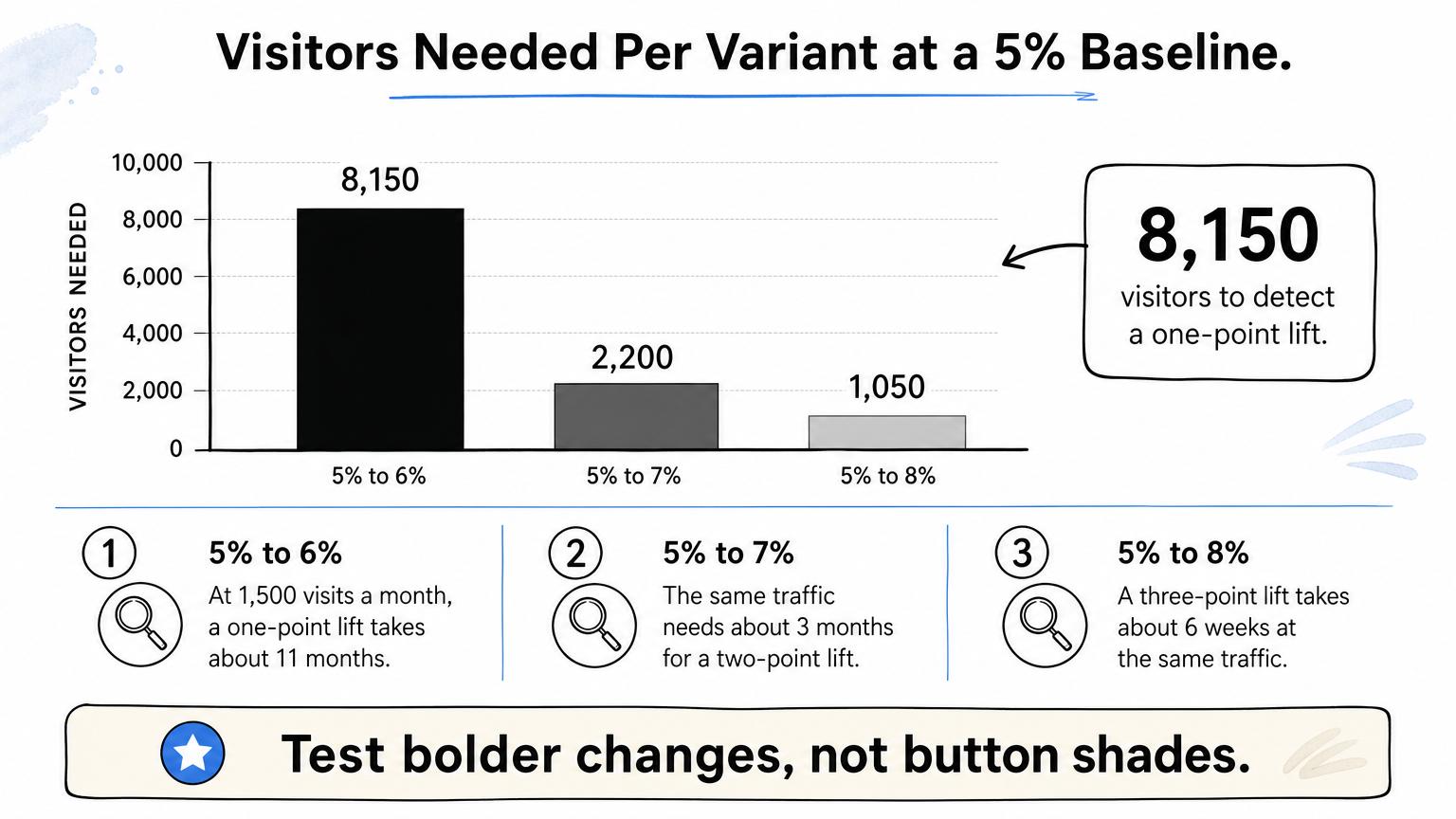
The lesson is blunt. A firm with modest traffic cannot detect a one-point lift in a reasonable time. It can detect a big change, so test bolder changes: a restructured form, a different page layout, or a new offer for the contact, not a button shade. If even the big version needs more than two or three months, test on your highest-traffic page first or combine traffic from similar pages.
Set up and run the test
Work through this list before you launch, and follow it until the test ends:
- Split traffic evenly and at random between the versions.
- Change one element only. If you change two, you will not know which one worked.
- Put a different tracking number on each version so calls are credited correctly. Track includes 2 tracking numbers and Optimize includes 10, so you can test with either.
- Check both versions on a phone and a desktop. Confirm the form submits and the conversion events fire.
- Decide the sample size and minimum run time up front, and write them in your log.
- Run for at least two full weeks so each weekday appears twice. Intake behavior changes between Monday and Saturday.
- Do not change ad budgets, bids, or ad copy during the test.
- Do not stop early because one version looks ahead. Early leads often vanish by the end.
Decide when the test ends before it starts, or the data will talk you into stopping early.
Step 4. Read the results and decide what ships
Read a result in three passes: did the test reach its planned sample, is the difference larger than noise, and did the winner also win on qualified leads and signed cases. Only a version that passes all three ships.
Check significance and sample first
Confirm you hit the sample size and run time you set in Step 3. Then check that the difference clears 95% statistical significance. In plain terms, that means a result this large would show up by chance no more than 5% of the time if the two versions were actually equal.
If the result is inconclusive, do not ship the variant and do not call it a failure. You learned that this element does not move your visitors much. Take the next idea from your ranked list, and make it bolder.
Judge by signed cases, then log it
A variant can win on leads and lose on cases. Say your shorter form produces 120 leads against 96 for the original. That looks like a win. But if only 54 of the 120 qualify (45%) against 58 of 96 (about 60%) for the original, the original produced more qualified leads from the same traffic. The shorter form brought in more people who were never going to hire you.
Legal matters take weeks to close, so keep tracking cases for both versions after the test ends. If you run Google Ads, sending signed cases back as offline conversions teaches the bidding system which clicks produce clients. GavelGrow's Smart Conversions does that on the Optimize plan, and it does not change Local Services Ads bidding.
Log every test, win or lose. This template takes one minute per test and stops your firm from repeating old experiments:
- Test name:
- Page and audience:
- Hypothesis:
- Start and end dates:
- Planned sample per variant:
- Primary metric and baseline:
- Result (leads, qualified, signed):
- Significance reached? Yes / No
- Decision: Ship / Discard / Retest
- What we learned:
- Next test:
The winning version is the one that signs more cases, not the one that fills your inbox faster.
Frequently asked questions
What is the difference between CVR and CTR?
Click-through rate (CTR) is clicks divided by impressions, so it measures how often people who see your ad or listing click it. Conversion rate (CVR) is conversions divided by visitors, so it measures what they do after arriving. Example: an ad shown 1,000 times with 50 clicks has a 5% CTR. If 2 of those 50 visitors contact you, your CVR is 4%. CRO testing targets the second number.
What is the difference between SEO and CRO?
SEO earns more visits from organic search. CRO raises the share of those visitors who contact your firm. The two work in sequence: a page that ranks but converts poorly wastes its traffic, and a page that converts well but gets no visitors has nobody to convert. Because testing needs traffic, firms with steady organic or paid visits get far more out of CRO than firms with a few hundred visits a month.
How long should a CRO test run?
A test should run until it reaches the sample size you calculated and for at least two full weeks, so each day of the week is counted twice. For the 5% to 8% example above on a page with 1,500 visits a month, that is about six weeks. Ending a test early because one version looks ahead is the most common cause of false winners, so fix the end date in advance.
How much traffic does a law firm website need to test?
You need roughly 1,050 visitors per variant to detect a lift from a 5% to an 8% conversion rate, and roughly 8,150 per variant to detect 5% to 6%. That is about 2,100 total visitors for the first case. If your page gets fewer than that in a few months, test larger changes or move the test to your busiest page.
Do state bar rules apply to test variants?
Yes. Each variant is public-facing marketing, so each one needs the same review as your live page. State bars set their own advertising rules, so check yours before launching. Do not promise results, do not call your firm the "best" or "top" at anything, and keep required disclaimers and TCPA consent language in every version. A variant that wins by dropping a required element is a compliance problem, not a result.
Should I count phone calls in my tests?
Yes, and give each variant its own tracking number. Many people who find a law firm online call instead of filling in a form, and a test that ignores them can pick the wrong winner. With per-version tracking numbers, each call is credited to the page that produced it. Track includes 2 numbers, Optimize includes 10, and extra numbers are $10 a month. Tag each call as qualified, callback, unqualified, or spam so your comparison uses quality, not volume.
Start with one clean test
Conversion rate optimization testing works for a law firm when you treat it as a short loop: measure a baseline, write one hypothesis, run one change long enough to trust it, and judge it by signed cases. Keep a log so every result, including the flat ones, shapes the next test.
Pick your highest-traffic page, find the biggest leak in your funnel, and test the boldest change you can defend under your state's advertising rules. If you would rather have a legal-only team plan and run the tests on your intake forms, landing pages, and call handling, see GavelGrow's conversion rate optimization service.
Frequently Asked Questions
What is the difference between CVR and CTR?
Click-through rate (CTR) is clicks divided by impressions, so it measures how often people who see your ad or listing click it. Conversion rate (CVR) is conversions divided by visitors, so it measures what they do after arriving. Example: an ad shown 1,000 times with 50 clicks has a 5% CTR . If 2 of those 50 visitors contact you, your CVR is 4% . CRO testing targets the second number.
What is the difference between SEO and CRO?
SEO earns more visits from organic search. CRO raises the share of those visitors who contact your firm. The two work in sequence: a page that ranks but converts poorly wastes its traffic, and a page that converts well but gets no visitors has nobody to convert. Because testing needs traffic , firms with steady organic or paid visits get far more out of CRO than firms with a few hundred visits a month.
How long should a CRO test run?
A test should run until it reaches the sample size you calculated and for at least two full weeks, so each day of the week is counted twice. For the 5% to 8% example above on a page with 1,500 visits a month, that is about six weeks . Ending a test early because one version looks ahead is the most common cause of false winners, so fix the end date in advance.
How much traffic does a law firm website need to test?
You need roughly 1,050 visitors per variant to detect a lift from a 5% to an 8% conversion rate, and roughly 8,150 per variant to detect 5% to 6%. That is about 2,100 total visitors for the first case. If your page gets fewer than that in a few months, test larger changes or move the test to your busiest page.
Do state bar rules apply to test variants?
Yes. Each variant is public-facing marketing, so each one needs the same review as your live page. State bars set their own advertising rules, so check yours before launching. Do not promise results, do not call your firm the "best" or "top" at anything, and keep required disclaimers and TCPA consent language in every version. A variant that wins by dropping a required element is a compliance problem, not a result.
Should I count phone calls in my tests?
Yes, and give each variant its own tracking number. Many people who find a law firm online call instead of filling in a form, and a test that ignores them can pick the wrong winner. With per-version tracking numbers , each call is credited to the page that produced it. Track includes 2 numbers, Optimize includes 10, and extra numbers are $10 a month. Tag each call as qualified, callback, unqualified, or spam so your comparison uses quality, not volume.