Direct Legal Mail: What It Is and How Law Firms Use It
Categories: Legal Marketing Strategies
 Abram Ninoyan
Founder & Senior Performance Marketer
Credentials: Google Partner, Google Ads Search Certified, Google Ads Display Certified, Google Ads Measurement Certified, Google Analytics (IQ) Certified, HubSpot Inbound Certified, HubSpot Social Media Marketing Certified, Conversion Optimization Certified
Expertise: Google Ads, Meta Ads, Conversion Rate Optimization, GA4 & Google Tag Manager, Lead Generation, Marketing Funnel Optimization, PPC Management
LinkedIn Profile
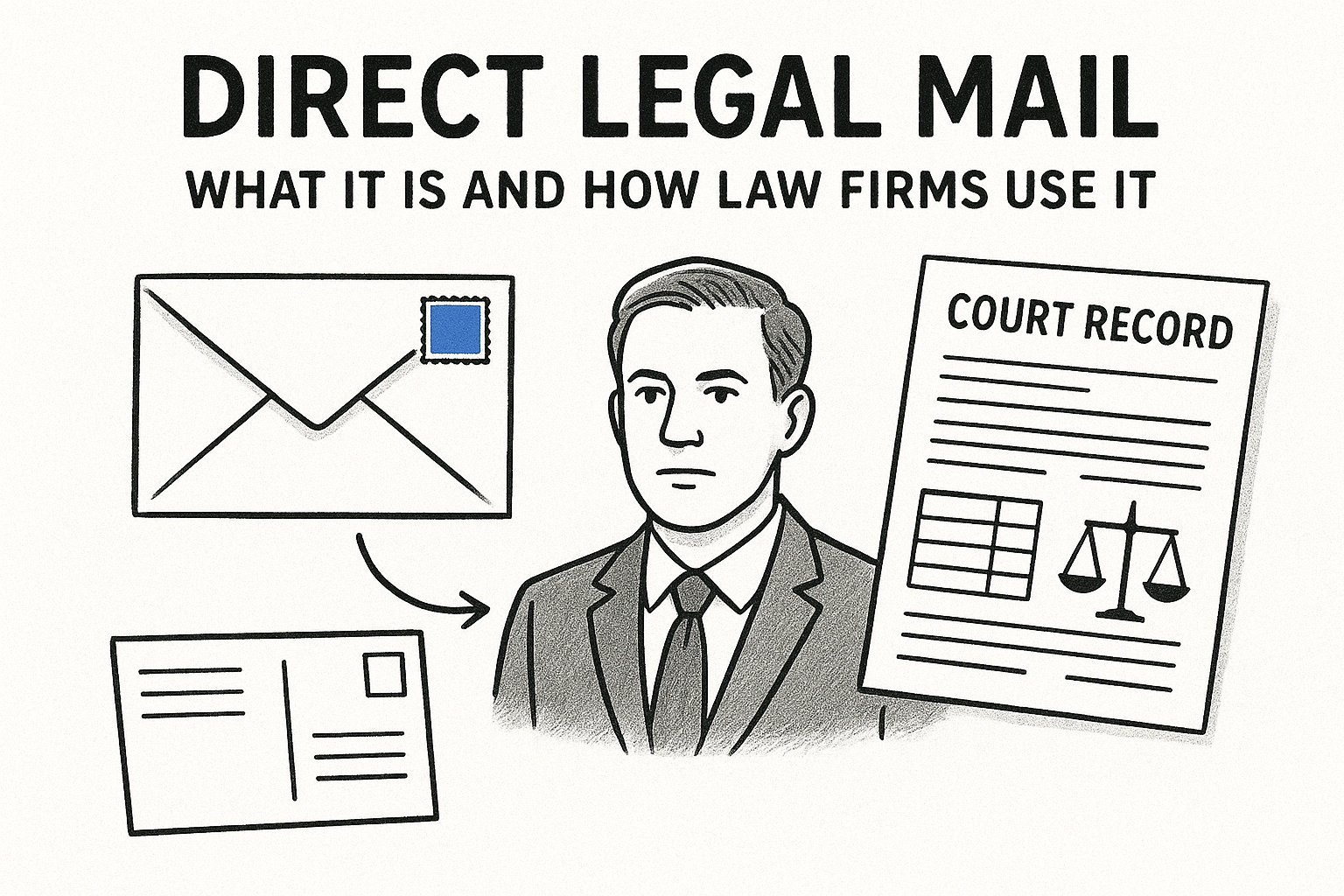
Direct legal mail is the practice of sending letters or postcards to people named in new court filings, so an attorney reaches them while they are still choosing a lawyer. It is most common in crimina...
Key Takeaways
- Direct Legal Mail: What It Is and How Law Firms Use It
- Why do law firms use direct legal mail?
- How to run a direct legal mail campaign
- What rules apply to attorney direct mail?
Direct Legal Mail: What It Is and How Law Firms Use It
Direct legal mail is the practice of sending letters or postcards to people named in new court filings, so an attorney reaches them while they are still choosing a lawyer. It is most common in criminal defense, traffic, bankruptcy and family law. It only pays off when you follow your state bar's advertising rules and track every signed case.
The phrase also names a company, Direct Legal Mail, which sells court-data leads and mailing services in criminal and traffic, bankruptcy, and family law. Other vendors sell similar services, so this article treats the term as a tactic, not as one provider.
Below, you will see why firms use it, how to run a campaign step by step, which rules apply, how to compare providers, and answers to the questions firm owners ask most. GavelGrow has marketed only for law firms since 2015.
Key Takeaways
- What is it? Letters sent to people with new court filings.
- Does it work? It can, if you measure cost per signed case.
- Is it allowed? Usually, but state bar rules on labeling and filing vary.
- Who uses it? Mostly criminal, traffic, bankruptcy and family law firms.
- How do you measure it? Give every mailer its own tracking number.
Why do law firms use direct legal mail?
Law firms use direct legal mail because a court filing tells you when a person is likely to need a lawyer, and a letter can reach them before they have searched for one.
Reaching people at the moment of need
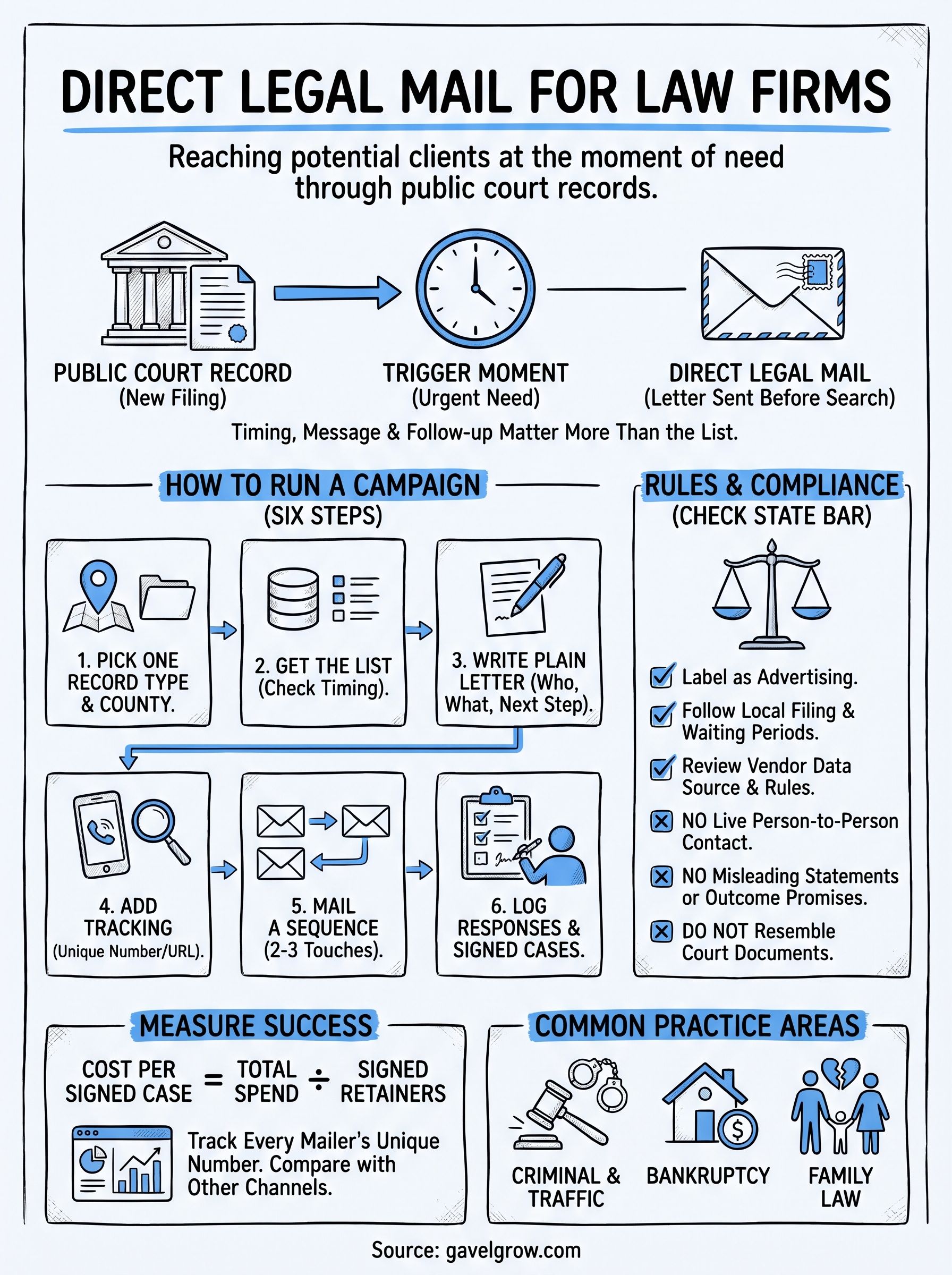
Most marketing waits for a person to search. Direct legal mail starts from a public court record, such as a new criminal charge, a debt collection suit or a divorce petition. The filing date gives you a trigger moment that Google Ads and SEO cannot see.
The tradeoff is competition on timing. The same filings feed vendors that supply many firms, so your letter may land beside several others. That is why the message, your speed and your follow-up matter more than the list itself.
A court filing tells you when someone needs a lawyer, but only your letter and your intake decide who they call.
Where it fits by practice area
Direct legal mail fits practice areas with a clear court record and an urgent need. It fits poorly where the law restricts contact. The table sets out the usual triggers and the main caution for each.
How to run a direct legal mail campaign
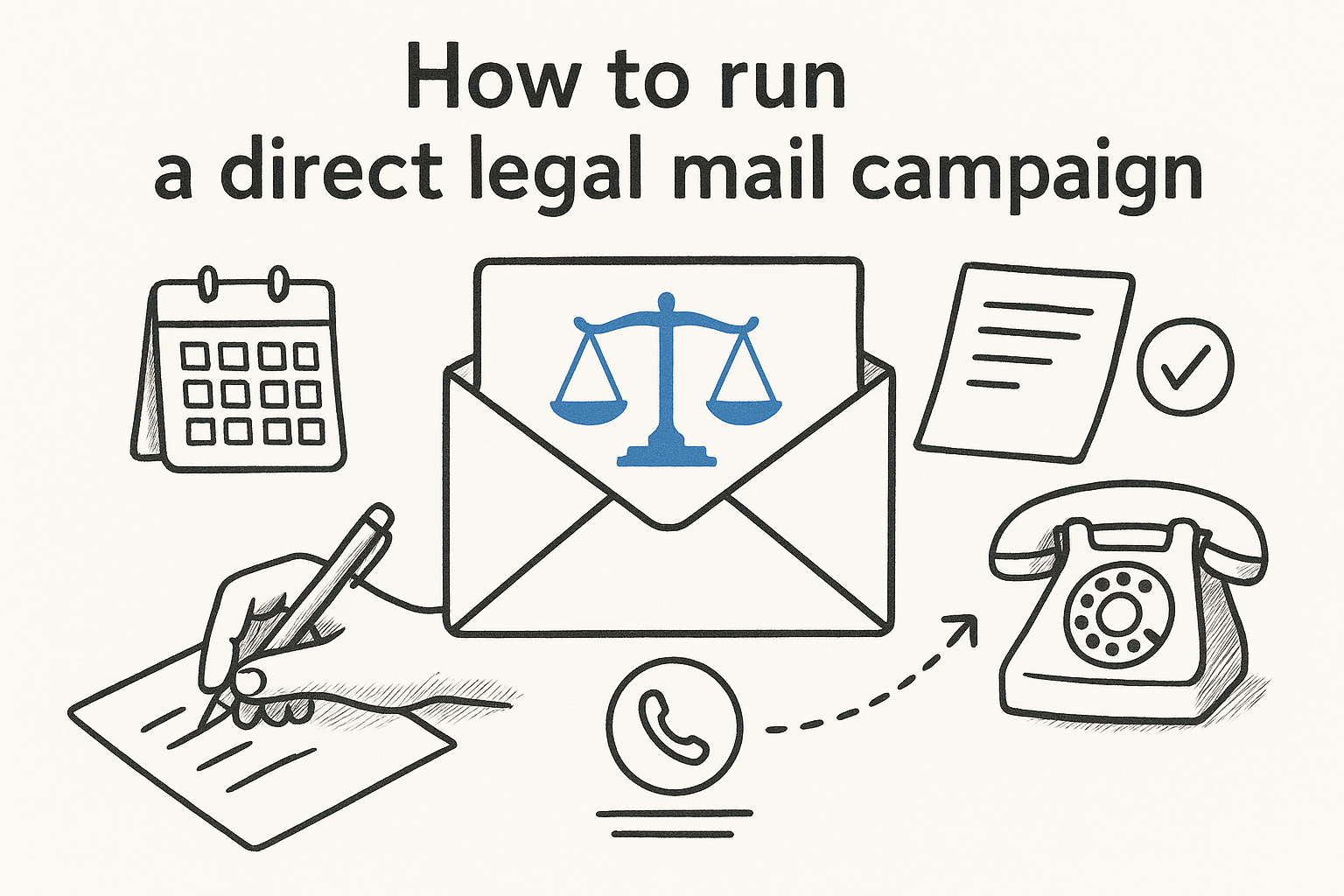
To run a campaign, pick one case type and county, get a clean list, send a compliant letter, and give every mailer its own tracking number.
Six steps from list to signed case
Start small. One case type in one county keeps your data clean and your costs easy to read. Then work through these steps:
- Pick one record type, such as new traffic or criminal filings in a single county.
- Get the list from a vendor or the court, and confirm how soon after filing the records arrive.
- Write a plain letter with who you are, what you handle, one next step and a phone number. Promise no outcomes.
- Add tracking with a unique phone number per mailer and, if you like, a short web address.
- Mail a sequence of two or three touches, spaced a few days apart.
- Log every response as a lead, then mark which ones sign.
What a test costs and what to measure
Measure cost per signed case, not letters sent or calls received. The figures below are placeholder assumptions to show the math, not benchmarks. Replace them with your own vendor quotes and intake results.
Compare that result with what a signed case is worth to your firm, and with your other channels. You can run your own numbers in the cost-per-acquisition calculator.
Tracking is where most mail tests fail. A platform with built-in call tracking, such as GavelGrow's lead and call tracking, ties each call to the campaign that rang the phone, so the mailer gets credit for the signing.
If a mailer has no unique phone number, you cannot say whether it worked.
What rules apply to attorney direct mail?
Attorney direct mail is legal in most states, but each state bar sets its own conditions. Check your jurisdiction's advertising and solicitation rules before you send a single piece. This is general information, not legal advice.
Solicitation and advertising rules
The ABA's Model Rule 7.3 allows targeted written and electronic solicitation but bars live person-to-person contact. Model Rule 7.1 prohibits any false or misleading communication. You can read both in the ABA Model Rules of Professional Conduct. States adopt their own versions.
Some states add requirements on top. Common ones include labeling the piece as advertising, filing a copy with the disciplinary authority, keeping the recipient list for a set period, and waiting periods after an accident. Many also ban mail that resembles a court document. Never promise results, and never call your firm "best" or "top".
Vendor and data responsibility
You stay responsible for every letter that goes out under your name, even when a vendor writes, prints and mails it. Model Rule 5.3 covers your duty to supervise nonlawyer assistance. Approve the final proof, and keep a copy of each version you send.
Court records are public in most places, but access and reuse rules differ by state and by court. Ask your vendor where the data comes from and how it stays within your state's rules. A vendor that cannot answer clearly is a risk to your license, not just your budget.
The vendor can print the letter, but your bar number is on the risk.
How do you choose a direct mail provider?
Choose a provider by deciding how much of the work you want to hand off, then test what each vendor can prove about its data, timing and compliance support.
Three service models
Providers sell different slices of the job. Direct Legal Mail, for example, says on its site that it supplies court-data leads and also runs a Full Service that mails thousands of pieces each weekday.
Questions to ask any vendor
Put these questions to every vendor in writing and compare the answers side by side. Vague replies tell you as much as specific ones.
- Which counties and case types do you cover, and how soon after filing do records arrive?
- Where does your data come from, and how do you stay within state rules?
- Do you sell the same list to competing firms in my market?
- Who handles bar filings, labeling and recipient-list retention?
- What is the price per piece, and what does cancelling look like?
The right vendor answers every question in writing before you pay.
Frequently Asked Questions
Is direct mail legal for lawyers?
Yes, in most states, within limits. ABA Model Rule 7.3 permits targeted written solicitation but prohibits live person-to-person contact, and Rule 7.1 bars misleading statements. Your state may add labeling, filing or waiting-period rules, so read your own state bar's advertising rules before mailing. If a rule is unclear, ask your bar's ethics hotline or counsel for a written answer.
Why do people receive letters from lawyers they never contacted?
Court filings are public in most places, so vendors compile names and addresses from the docket and sell them to firms. When your letter arrives, recipients may call asking how you found them. Tell them plainly that it came from a public court record, and put that answer in your intake script so staff respond the same way every time.
How do you track whether direct mail signs cases?
Give each mailer its own tracking number, then log every call and form as a lead and mark the ones that sign. GavelGrow's Track plan ($199/month) includes 2 call tracking numbers and Optimize ($599/month) includes 10, with extra numbers at $10/month. Every tracked call opens with a recording notice, which supports your consent obligations.
Does direct mail beat Google Ads for law firms?
Neither wins by default. Google Ads catches people who are already searching, while mail reaches people who have a case but have not searched yet. Compare the two on cost per signed case, which is total spend divided by signed retainers, not on cost per lead. Track both in one place so the comparison uses the same definition of a signed case.
How many letters should you send in a first test?
Send enough to see a pattern without committing a large budget. At 25 letters a day, six days a week, four weeks gives you 600 pieces, which is enough to see roughly how many inquiries and signings one case type in one county produces. Keep letter copy, list source and tracking number fixed during the test, so any change in results has an obvious cause.
Where to start with direct legal mail
Direct legal mail works when you treat it as a measured channel, not a mailing habit. Pick one county and case type, check your state bar's rules, give each letter a tracking number, and judge it by cost per signed case. Keep a vendor only if it answers your data and compliance questions in writing.
If you want help setting up the tracking, or want to see how mail compares with your other channels, book a free 45-minute strategy call with GavelGrow.
Frequently Asked Questions
Is direct mail legal for lawyers?
Yes, in most states, within limits. ABA Model Rule 7.3 permits targeted written solicitation but prohibits live person-to-person contact, and Rule 7.1 bars misleading statements. Your state may add labeling, filing or waiting-period rules, so read your own state bar's advertising rules before mailing. If a rule is unclear, ask your bar's ethics hotline or counsel for a written answer.
Why do people receive letters from lawyers they never contacted?
Court filings are public in most places, so vendors compile names and addresses from the docket and sell them to firms. When your letter arrives, recipients may call asking how you found them. Tell them plainly that it came from a public court record, and put that answer in your intake script so staff respond the same way every time.
How do you track whether direct mail signs cases?
Give each mailer its own tracking number, then log every call and form as a lead and mark the ones that sign. GavelGrow's Track plan ($199/month) includes 2 call tracking numbers and Optimize ($599/month) includes 10, with extra numbers at $10/month. Every tracked call opens with a recording notice, which supports your consent obligations.
Does direct mail beat Google Ads for law firms?
Neither wins by default. Google Ads catches people who are already searching, while mail reaches people who have a case but have not searched yet. Compare the two on cost per signed case, which is total spend divided by signed retainers , not on cost per lead. Track both in one place so the comparison uses the same definition of a signed case.
How many letters should you send in a first test?
Send enough to see a pattern without committing a large budget. At 25 letters a day, six days a week, four weeks gives you 600 pieces, which is enough to see roughly how many inquiries and signings one case type in one county produces. Keep letter copy, list source and tracking number fixed during the test, so any change in results has an obvious cause.