Law Firm Intake Outsourcing vs In-House ROI: How to Compare
Categories: Legal Marketing Strategies
 Abram Ninoyan
Founder & Senior Performance Marketer
Credentials: Google Partner, Google Ads Search Certified, Google Ads Display Certified, Google Ads Measurement Certified, Google Analytics (IQ) Certified, HubSpot Inbound Certified, HubSpot Social Media Marketing Certified, Conversion Optimization Certified
Expertise: Google Ads, Meta Ads, Conversion Rate Optimization, GA4 & Google Tag Manager, Lead Generation, Marketing Funnel Optimization, PPC Management
LinkedIn Profile
Law firm intake outsourcing vs in house ROI comes down to coverage and cost per signed case. Outsourcing usually wins when your inquiries arrive outside business hours or in spikes, because you pay fo...
Key Takeaways
- Law Firm Intake Outsourcing vs In-House ROI: How to Compare
- Why does your intake model set your cost per signed case?
- What do in-house and outsourced intake really cost?
- How to calculate intake ROI for your firm
Law Firm Intake Outsourcing vs In-House ROI: How to Compare
Law firm intake outsourcing vs in house ROI comes down to coverage and cost per signed case. Outsourcing usually wins when your inquiries arrive outside business hours or in spikes, because you pay for answered inquiries instead of a salary that covers about a quarter of the week. In-house wins when qualification takes real legal judgment and your volume is steady inside business hours.
Intake ROI is simple to state. It is what you gain in signed cases compared with what you spend to answer, screen, and convert the inquiries your marketing produces. Law firm intake covers everything from the first call or form submission to a signed retainer. In-house means your employees do that work. Outsourced means an outside team does it to your written criteria.
This article builds both costs line by line, works through an example with a break-even sign rate, and gives you rules for choosing a model. GavelGrow has marketed only for law firms since 2015. Every figure in the examples is an illustrative assumption, so replace each one with your own.
Why does your intake model set your cost per signed case?
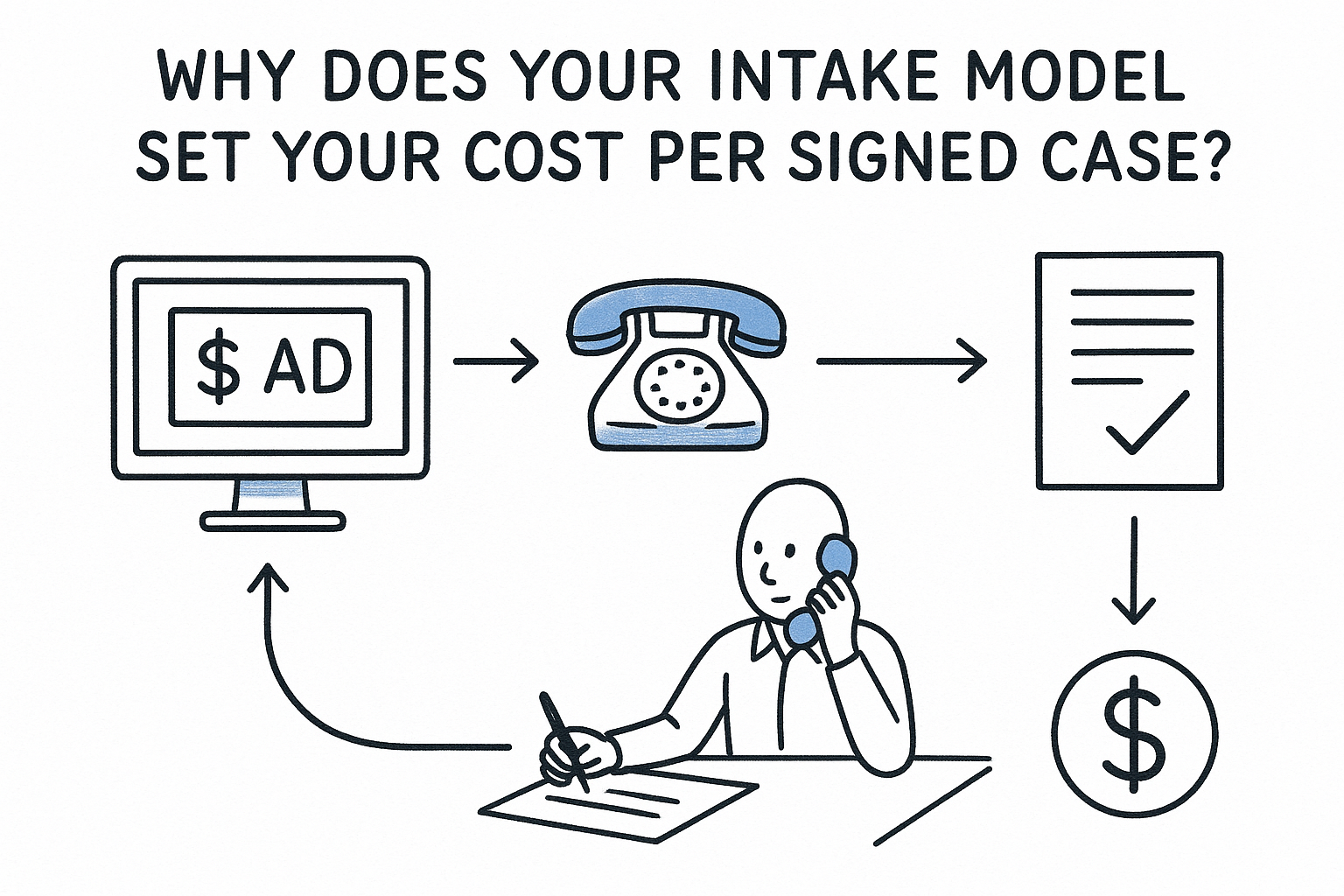
Your intake model sets your cost per signed case because intake is the last stop for your ad spend, and an inquiry that nobody reaches in time is money you cannot recover. A firm can double its marketing budget and see no change in retainers if the phone keeps going to voicemail.
What intake work includes
An intake coordinator or intake specialist turns an inquiry into a scheduled consultation or a signed retainer. The job is more than answering the phone, and it is the full job you are pricing in either model:
- Answering calls, web forms, texts, and chats
- Collecting the facts of the caller's matter
- Screening against your written case criteria
- Running a conflict check
- Scheduling the consult or sending the retainer for e-signature
- Logging the outcome in your case management system
Each step can be done by an employee or by an outside team. What changes is who carries the cost when volume rises, when someone is out sick, or when a caller phones at 8 p.m. on a Saturday. ROI here should be measured as cost per signed case, not cost per call handled. A cheap intake process that signs fewer cases is more expensive than it looks.
Where in-house intake loses signed cases
A single full-time schedule covers about 40 of the 168 hours in a week. That leaves roughly 76% of the week with nobody assigned to answer, including every evening and both weekend days. Your ads, your Google Business Profile, and your Local Services Ads keep running during those hours.
Speed matters too. The Lead Response Management Study found that leads contacted within five minutes are far more likely to be qualified than leads first reached at thirty minutes. That finding measures the odds of qualifying a lead, not signed cases, but the direction is clear. Even inside business hours, a second call arriving while the first is in progress goes unanswered, and lunch breaks, sick days, and vacations open more gaps. People with an urgent legal problem usually call the next firm on the list.
Your ads run 168 hours a week, and one intake seat answers about 40 of them.
What do in-house and outsourced intake really cost?
In-house intake is a fixed cost that multiplies as you add coverage. Outsourced intake is a fee that moves with volume or hours. Both carry costs beyond the sticker price, and comparing a salary to an invoice is the most common mistake.
Building the in-house number
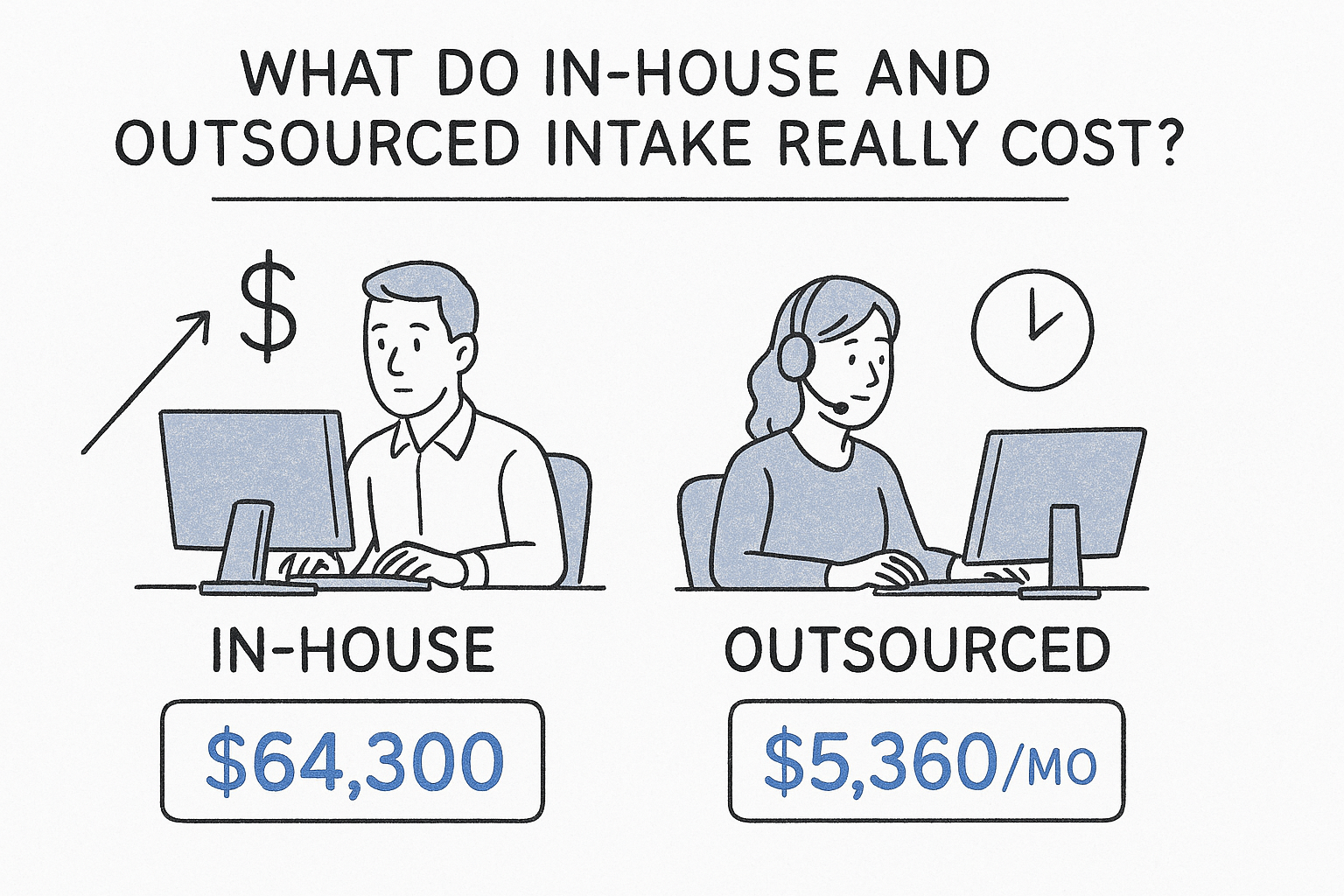
Start with a salary assumption of $45,000 for a dedicated intake specialist. Benefits and employer taxes make up close to 30% of total compensation for private industry workers, according to the Bureau of Labor Statistics Employer Costs for Employee Compensation release. Dividing $45,000 by 0.70 gives about $64,300 a year, or $5,360 a month. Round that to $5,400 once you add a phone line and software seat.
That figure buys one schedule. Covering all 168 hours takes about 4.2 people, since 168 divided by 40 is 4.2, before anyone takes leave. At the same loaded cost, that is roughly $270,000 a year for one continuously staffed seat. Few firms staff it, which is exactly why after-hours inquiries go unanswered.
Then add what never appears on the payroll line:
- Recruiting time and the weeks before a new hire is productive
- Senior attorney or manager hours spent on training and call review
- Turnover, since entry-level intake roles are often short tenure
- Idle paid time during slow periods, and overload during campaign spikes
Building the outsourced number
Outsourced intake is usually priced in one of three ways. A monthly fee for dedicated or shared agents is the most predictable. Per-minute or per-call billing tracks volume closely but rises when your campaigns do well. Pay-per-qualified-lead or pay-per-signed-case arrangements shift risk to the provider, but ask exactly how "qualified" and "signed" are defined and who decides.
Get quotes for your own call volume and hours. Prices vary widely with coverage, practice area, and how technical your screening is, so a figure from someone else's article tells you little. The hidden costs on this side are the time you spend writing criteria, reviewing calls, and coaching the vendor, plus weaker judgment on borderline cases. Here is how the two models compare:
Compare cost per answered inquiry, not salary against invoice, because the two numbers cover different amounts of the week.
How to calculate intake ROI for your firm
Calculate intake ROI by pricing each model per month, estimating how many inquiries each one reaches and signs, and comparing cost per signed case. Then find the break-even sign rate where the cheaper-looking option stops being cheaper.
Pull your baseline first
You need six numbers before any comparison means anything:
- Monthly inquiries from calls, forms, texts, and chats
- The share a live person reaches, including after hours
- Average time to first contact
- Your inquiry-to-signed rate on the inquiries you reach
- Monthly ad spend
- Your monthly intake cost, fully loaded
Most firms can get numbers 5 and 6 quickly and cannot get 1 through 4, because phone calls are not tracked to a campaign. Per-campaign tracking numbers, call recording, outcome tagging, and missed-call reporting close that gap, and GavelGrow's platform features include all four. The firm's own cost per signed case then shows up by campaign instead of as a guess.
A worked example
Take a firm that spends $15,000 a month on ads and receives 120 inquiries. These inputs are assumptions for illustration, not benchmarks. The in-house option is one weekday seat, which reaches 65% of inquiries. The outsourced option has extended coverage, reaches 95%, and costs $7,000 a month. Outsourcing gets a lower sign rate of 13% against 15% in-house, because an in-house person knows the firm's criteria better.
Outsourcing costs $1,600 more per month and adds 3.12 signed cases. That is about $513 in extra spend per added case. If an added case nets your firm more than that in fees, the extra spend pays for itself. You can run the same math with a CPA calculator built for law firms.
Find your break-even point
Do not stop at the headline gap. Outsourced intake matches the in-house cost per signed case of $1,744 when it produces 12.62 cases, since $22,000 divided by $1,744 is about 12.62. On 114 reached inquiries, that means a sign rate of about 11.1%. So the outsourced team can sign 3.9 points fewer than your in-house hire and still tie. Put differently, at a 13% sign rate it only needs to reach about 81% of inquiries to tie.
If your own break-even sits close to your realistic assumptions, the decision rests on judgment and control, not cost. That is the subject of the next section.
The question is not whether outsourcing is cheaper. It is how far its sign rate can fall before in-house wins.
Which intake model fits your firm?
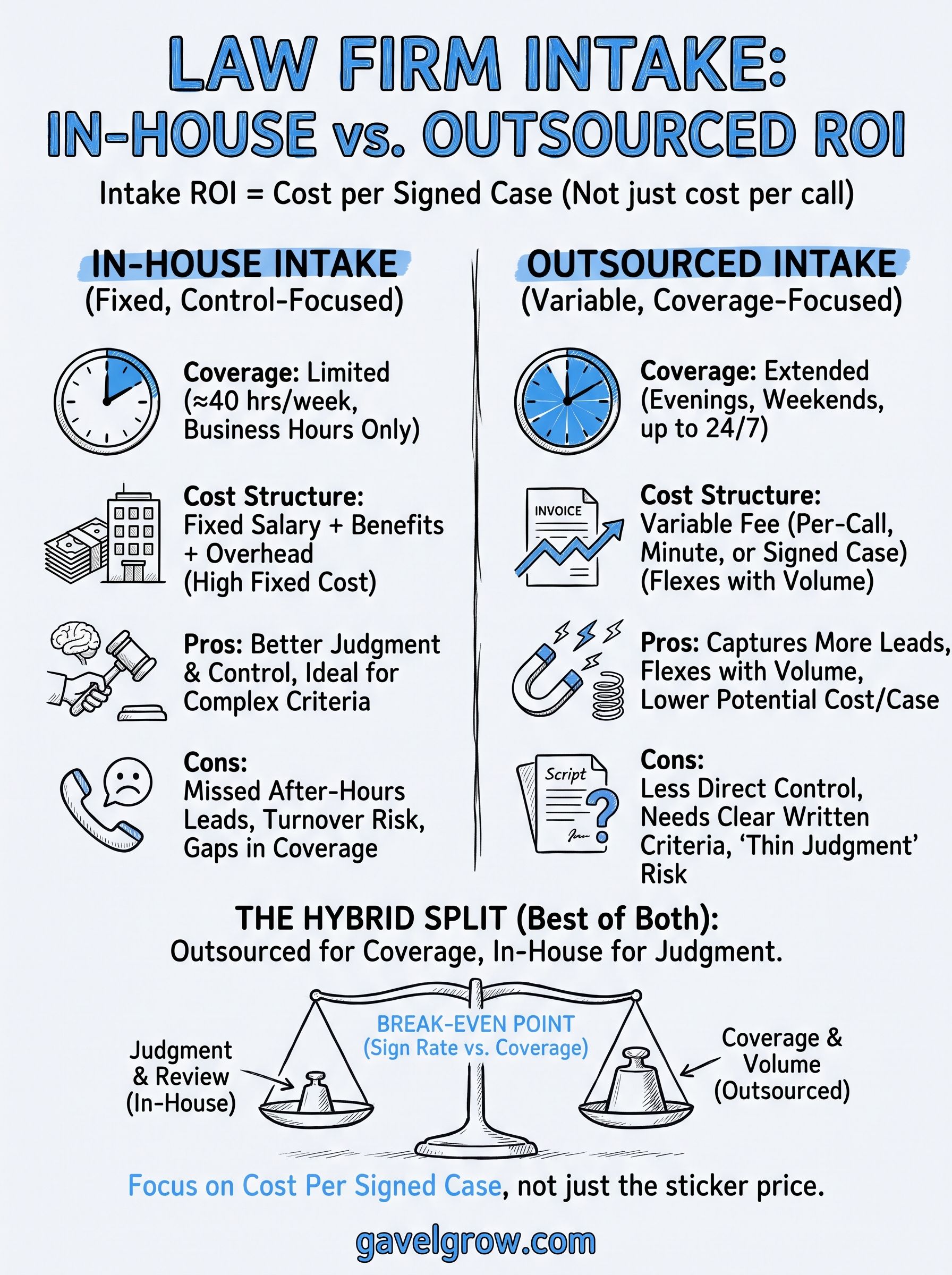
Choose in-house when qualification needs legal judgment and your inquiries land inside staffed hours. Choose outsourced when coverage and volume swings are your problem and your criteria can be written down. Most firms end up with a mix.
Signals that point each way
A solo practitioner with a few calls a day often gets more from a good answering and text-back workflow than from either full model. A mid-size firm running several campaigns across practice areas usually has enough volume to justify a dedicated person plus outside coverage.
The hybrid split
Hybrid is the usual answer because it separates coverage from judgment. An outside team answers every call, applies written criteria, books straightforward consults, and escalates anything ambiguous. Your in-house person reviews escalations, refines the criteria, and works borderline cases during business hours. You stop paying payroll for hours when nothing is handled and keep people where judgment pays.
What to lock down before you outsource
Outsourcing does not move your professional duties to the vendor. ABA Formal Opinion 08-451 says a lawyer who outsources legal or nonlegal support work remains responsible for supervision, confidentiality, and conflict screening. State rules differ, so check your state bar's guidance on nonlawyer assistants and call recording consent. Then get these items in the contract:
- Your written qualification criteria and an escalation path
- Call recordings and outcome records for every inquiry
- Response-time targets by channel, including after hours
- Conflict screening and a confidentiality agreement
- Reporting that ties each inquiry to a campaign and a signed case
- Exit terms and ownership of your data
Without recordings and outcome data, you lose control and gain nothing in return.
Outsource coverage, keep judgment, and demand a recording of every call you pay for.
Frequently asked questions
Is outsourced legal intake cheaper than hiring in-house?
It is usually cheaper per answered inquiry once you need more than a weekday schedule. One in-house seat covers about 40 of 168 weekly hours, and continuous coverage takes about 4.2 people. If nearly all your inquiries land between 9 and 5 and your volume keeps one person busy, a single hire can cost less. Run both through a cost per signed case calculation before deciding.
Coverage hours, not salary, decide which model costs less per signed case.
What does an intake coordinator do at a law firm?
An intake coordinator answers calls and web inquiries, collects the facts of the matter, and screens them against your case criteria. They run the conflict check, schedule the consultation, and send the retainer for e-signature. They also log every outcome in your case management system. Their work decides whether an inquiry you paid for becomes a client, so measure them on signed cases and response time.
What are the pros and cons of in-house versus outsourced intake?
In-house gives you direct control, same-day coaching, and staff who know your criteria, but it carries fixed payroll, turnover risk, and a schedule that covers about 24% of the week. Outsourced gives you broader coverage and flexible capacity, but you give up daily oversight and depend on written criteria. A hybrid keeps the pros of both.
Who is responsible for ethics when I outsource intake?
You are. ABA Formal Opinion 08-451 leaves supervision, confidentiality, and conflict screening with the lawyer even when a vendor does the work. Your contract should require recordings, a conflict screening process, and confidentiality terms. Because states differ on nonlawyer assistants and call recording consent, check your own state bar's rules before you sign.
How do I measure intake ROI if I do not track calls today?
Start tracking each campaign with its own call tracking number, record every call, and tag the outcome as qualified, callback, unqualified, or spam. GavelGrow's Track plan is $199 a month and includes 2 call tracking numbers, and the Track and Optimize plans each come with a 7-day free trial and no credit card. After a month, you can calculate reach and cost per signed case by campaign.
Run your own numbers first
The right intake model is the one with the lowest cost per signed case for your hours, your volume, and your criteria. Outsourcing wins on coverage and flexibility. In-house wins on judgment and control. A hybrid often captures both. The break-even sign rate tells you how much quality you can trade for coverage before the math flips.
Measure your reach and your sign rate before you sign anything. If you want to see where your inquiries go, start a 7-day free trial of the GavelGrow platform and track every call and form to a signed case. You will have the baseline you need to price either model.
Frequently Asked Questions
Is outsourced legal intake cheaper than hiring in-house?
It is usually cheaper per answered inquiry once you need more than a weekday schedule. One in-house seat covers about 40 of 168 weekly hours, and continuous coverage takes about 4.2 people. If nearly all your inquiries land between 9 and 5 and your volume keeps one person busy, a single hire can cost less. Run both through a cost per signed case calculation before deciding. Coverage hours, not salary, decide which model costs less per signed case.
What does an intake coordinator do at a law firm?
An intake coordinator answers calls and web inquiries, collects the facts of the matter, and screens them against your case criteria. They run the conflict check, schedule the consultation, and send the retainer for e-signature. They also log every outcome in your case management system. Their work decides whether an inquiry you paid for becomes a client, so measure them on signed cases and response time.
What are the pros and cons of in-house versus outsourced intake?
In-house gives you direct control, same-day coaching, and staff who know your criteria, but it carries fixed payroll, turnover risk, and a schedule that covers about 24% of the week. Outsourced gives you broader coverage and flexible capacity, but you give up daily oversight and depend on written criteria. A hybrid keeps the pros of both.
Who is responsible for ethics when I outsource intake?
You are. ABA Formal Opinion 08-451 leaves supervision, confidentiality, and conflict screening with the lawyer even when a vendor does the work. Your contract should require recordings, a conflict screening process, and confidentiality terms. Because states differ on nonlawyer assistants and call recording consent, check your own state bar's rules before you sign.
How do I measure intake ROI if I do not track calls today?
Start tracking each campaign with its own call tracking number, record every call, and tag the outcome as qualified, callback, unqualified, or spam. GavelGrow's Track plan is $199 a month and includes 2 call tracking numbers, and the Track and Optimize plans each come with a 7-day free trial and no credit card. After a month, you can calculate reach and cost per signed case by campaign.