5 Legal Marketing Contract Red Flags to Spot Before Signing
Categories: Legal Marketing Strategies
 Abram Ninoyan
Founder & Senior Performance Marketer
Credentials: Google Partner, Google Ads Search Certified, Google Ads Display Certified, Google Ads Measurement Certified, Google Analytics (IQ) Certified, HubSpot Inbound Certified, HubSpot Social Media Marketing Certified, Conversion Optimization Certified
Expertise: Google Ads, Meta Ads, Conversion Rate Optimization, GA4 & Google Tag Manager, Lead Generation, Marketing Funnel Optimization, PPC Management
LinkedIn Profile
The costliest legal marketing contract red flags are five: an agency that owns your ad accounts and data, termination terms that lock you in, hidden fees and ad spend markups, vague scope paired with...
Key Takeaways
- 5 Legal Marketing Contract Red Flags to Spot Before Signing
- 1. Who owns your ad accounts, data, and content?
- 2. Termination clauses that lock you in
- 3. Where do hidden fees and ad spend markups hide?
5 Legal Marketing Contract Red Flags to Spot Before Signing
The costliest legal marketing contract red flags are five: an agency that owns your ad accounts and data, termination terms that lock you in, hidden fees and ad spend markups, vague scope paired with guaranteed results, and pressure to sign without conflict or compliance protections. A contract with none of them is not perfect, but it is one you can leave.
You rarely see these terms in the sales call. The proposal talks about leads and growth, while the agreement talks about work product, renewal windows and pass-through costs. Many firms skim the middle and sign, then learn at month 14 that the Google Ads account was never theirs. By then the leverage sits with the agency.
This article takes each red flag in turn: what the clause looks like, what it costs your firm, and what to ask for instead. GavelGrow has marketed only for law firms since 2015, so we know these terms from the vendor side, and we note how we handle them where it helps. This is general information, not legal advice, and your state bar's advertising rules apply to everything an agency publishes for you.
1. Who owns your ad accounts, data, and content?
Your firm should own all of it. A clause that gives the agency ownership of ad accounts, tracking numbers, analytics or creative work is the most expensive red flag, because leaving means starting over.

What the red flag looks like
Look for wording such as "Agency will create and maintain all accounts" with no statement of whose name is on them. Also watch for "Agency retains rights to work product" and "proprietary reporting." Check every asset the agency will touch:
- Google Ads and Local Services Ads accounts
- Meta, LinkedIn, GA4 and Tag Manager accounts
- Google Business Profile and website access
- Call tracking numbers and call recordings
- Landing page copy, ad copy and design files
Why it costs your firm
If the agency owns the account, your conversion history and quality data stay with them when you leave. A new vendor starts cold, and your ads lose the learning they built up. Tracking numbers work the same way. If the number on your website is leased in the agency's name, it can disappear with them, and your phone leads stop attributing to any campaign.
Some agencies say ownership is a security issue. It is not. You can own the account and give the agency delegated access that you can remove at any time.
If your firm does not own the account, you do not own the results.
What to ask for instead
Ask for a clause that makes ownership explicit. At GavelGrow, ad accounts and tracking numbers are created in the firm's own name.
Client owns all advertising accounts, tracking numbers, analytics
properties, data and deliverables. Agency holds delegated access
that Client may revoke at any time without penalty.
2. Termination clauses that lock you in
A fair agreement lets you leave on about 30 days' written notice. Red flags are minimum terms past 12 months, auto-renewal with a narrow cancellation window, long notice periods and exit fees.
What the red flag looks like
A contract ends in four ways: it expires, both sides agree to end it, one side terminates for breach, or one side terminates for convenience. Bad agreements give you only the first two. Compare the common terms:
Why it costs your firm
Take a hypothetical 24-month agreement at $4,000 a month with a 50% early-termination fee. You decide at month 10 that the work is not performing. Fourteen months remain, or $56,000 of fees, and half of that is $28,000. You would pay it for work you no longer want.
A contract you cannot leave is a loan you cannot repay early.
What to ask for instead
Ask for termination for convenience on 30 days' notice, and a defined material breach with a short cure period. Put renewal dates in your calendar the day you sign. GavelGrow's platform and agency plans are month-to-month, and you can cancel anytime.
3. Where do hidden fees and ad spend markups hide?
They hide in the definition of "ad spend," the fee schedule and the pass-through clauses. A markup means the agency bills you more for media than the ad platform charged it.
What the red flag looks like
Watch for "media budget invoiced through Agency," which means the agency pays Google and bills you. Also check for a percentage-of-spend management fee, which rises as your budget grows. Other signs are vague "platform," "technology" or "reporting" fees, setup charges that are never itemized, and call tracking resold at a markup.
Why it costs your firm
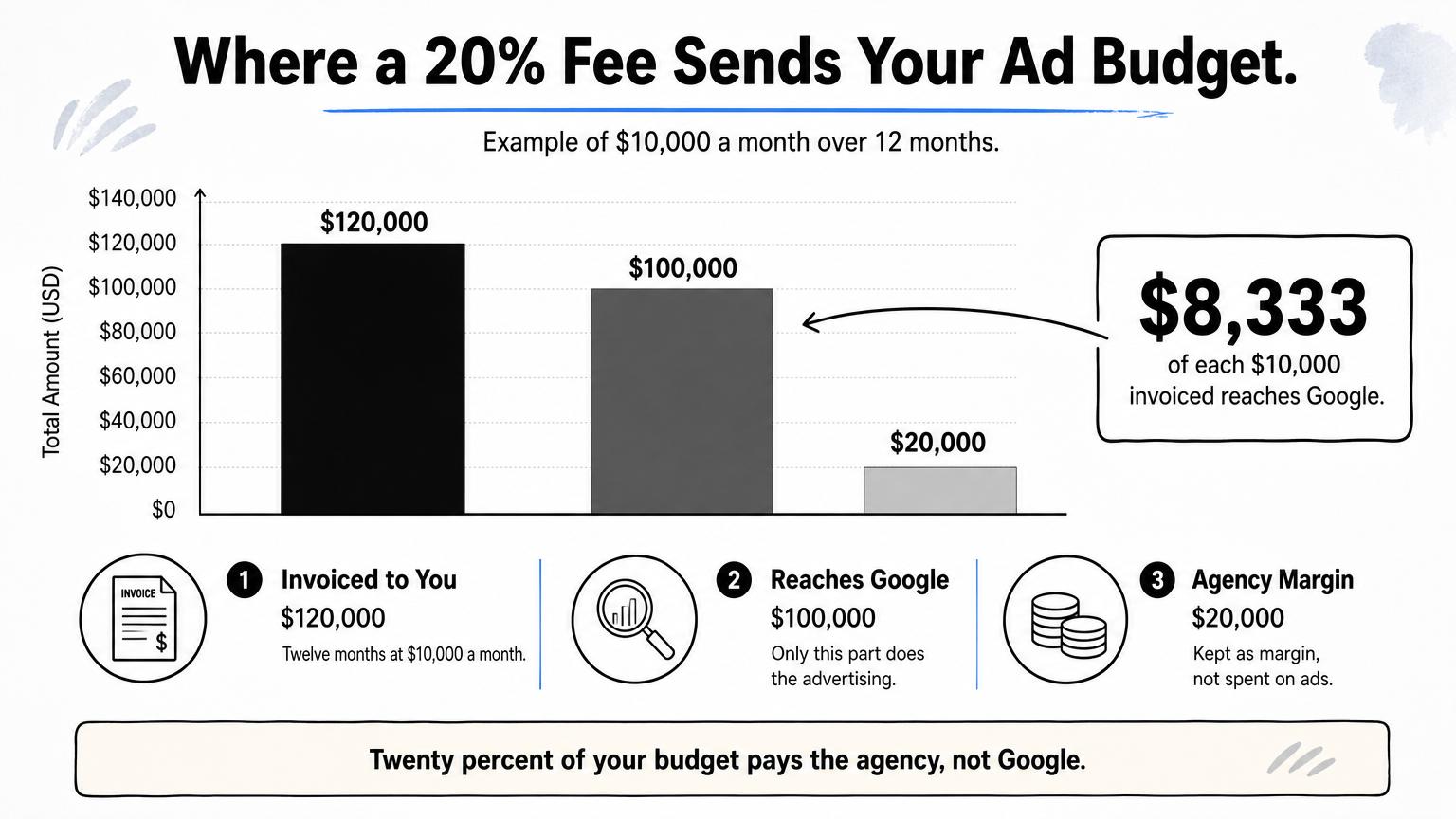
Here is a worked example. You approve $10,000 a month for ads. The agency invoices $10,000, but that figure includes a 20% platform fee. Only $8,333 reaches Google. Over 12 months you pay $120,000, and $100,000 does the advertising. The other $20,000 is margin you never agreed to in plain words.
The fee also skews incentives. An agency paid a percentage of spend earns more when you spend more, whether or not cases sign.
Ask where every ad dollar goes, and get the answer in the contract.
What to ask for instead
Ask for ad spend to be charged straight to your own account or card, with an itemized fee schedule and a written statement that spend carries no markup. GavelGrow charges no markup on client ad spend. Our self-serve plan prices are published on the pricing page, and Managed is scoped on a strategy call, plus ad spend.
4. Vague scope and guaranteed results
A contract that promises outcomes without naming deliverables, reports and metrics gives you nothing to enforce. A guaranteed ranking or case count is a warning sign by itself.
What the red flag looks like
Phrases like "improve rankings," "generate leads," "optimize campaigns" and "as needed" cannot be audited. Ask what counts as a lead. It could be a form fill, a call of any length, or a call that qualifies. Also watch for "guaranteed first-page results" or a guaranteed number of cases. Many state bars restrict promises about results in attorney advertising, so check your own bar's rules.
Why it costs your firm
Without definitions, you cannot prove underperformance. The agency can report clicks and cost per lead while you care about cost per signed case. Legal matters take weeks or months to close, and leads that only phoned often vanish from the report. Those phone leads are frequently your best ones.
If success is not defined in writing, the agency defines it for you.
What to ask for instead
Ask for the following in the contract:
- Named monthly deliverables, with counts
- A written definition of a lead and a qualified lead
- Report dates and direct access to raw data
- Call and form attribution through to signed retainer
- A stated remedy if defined deliverables are missed
You can verify most of this yourself when your firm's call tracking, intake and attribution live in one dashboard.
5. Rushed signing and missing protections
When an agency pushes you to sign this week and says nothing about conflicts or compliance, treat that as a red flag about the agency itself. Good vendors give you time and put protections in writing.

What the red flag looks like
"Pricing expires Friday" is the classic push. The contract may also be silent on competitors, silent on attorney advertising rules, or delivered as a locked PDF with no room for redlines. Refusal to let your counsel review it is its own answer.
Why it costs your firm
An agency that runs campaigns for two direct competitors in your market competes against you for the same keywords and the same intake attention. Compliance is the other gap. Your firm answers to the bar for every ad and page, not the agency, so copy that goes live unreviewed is your risk.
The agency's contract should protect your market and your license, not only its fees.
What to ask for instead
Ask for a conflict clause covering direct competitors in your market, and for your approval of ad copy before it runs. Ask the agency to show it understands your state's advertising rules. It cannot take on your obligations, but it should know them. GavelGrow does not run managed marketing for two direct competitors in the same market, and every ad asset is held for the firm's review before it runs. See our managed services for how that works.
Check these five before you sign
Every red flag above comes down to control. You should control the accounts and data, your exit, your money, your definition of success, and your market and compliance. A contract that gives you those five is one you can sign without worry.
Before you do, read the termination, fee and ownership sections word for word, and get every verbal promise into the document. Take the time you need. A good agency will not mind.
If you want a second opinion on an agreement you are weighing, you can book a free 45-minute strategy call with our legal-only team.