How to Choose a Legal Marketing Agency: Steps and Red Flags
Categories: Legal Marketing Strategies
 Abram Ninoyan
Founder & Senior Performance Marketer
Credentials: Google Partner, Google Ads Search Certified, Google Ads Display Certified, Google Ads Measurement Certified, Google Analytics (IQ) Certified, HubSpot Inbound Certified, HubSpot Social Media Marketing Certified, Conversion Optimization Certified
Expertise: Google Ads, Meta Ads, Conversion Rate Optimization, GA4 & Google Tag Manager, Lead Generation, Marketing Funnel Optimization, PPC Management
LinkedIn Profile
The way to choose a legal marketing agency is to define your goals in signed cases, shortlist agencies that work only with law firms, question each one about measurement, ownership, and staffing, and...
Key Takeaways
- How to Choose a Legal Marketing Agency: Steps and Red Flags
- Why does the agency you choose matter so much?
- Step 1. Set goals and a baseline
- Step 2. Build a shortlist of specialists
How to Choose a Legal Marketing Agency: Steps and Red Flags
The way to choose a legal marketing agency is to define your goals in signed cases, shortlist agencies that work only with law firms, question each one about measurement, ownership, and staffing, and compare written proposals by cost per signed case instead of cost per lead. Walk away from any agency that guarantees rankings, controls your ad accounts, or cannot name the people who will do the work.
Most firms pick an agency the way they pick a restaurant, by the pitch. The pitch is polished and the traffic charts climb. Nobody mentions that the monthly report cannot say which campaign produced a retainer. Six months later you have spent real ad budget, you cannot log into the accounts, and the contract still has three months to run. Your state bar also holds you responsible for what is published in your firm's name, so a careless agency is a compliance risk as well as a financial one.
This guide gives you a five-step process you can run in a few weeks. You get the questions to ask, a red-flag table, and a worked cost example. It comes from GavelGrow, which has marketed only for law firms since 2015 and has served 500+ law firms in that time. We also sell managed marketing, so we wrote the questions to hold any agency to the same standard, ours included.
Key takeaways
- Start by defining signed-case targets and your current cost per signed case.
- Shortlist agencies that work only with law firms and disclose competitor conflicts.
- Judge proposals on cost per signed case, not cost per lead.
- You should own every ad account, tracking number, and data export.
- Walk away from guaranteed rankings, vanity-metric reports, and locked-in contracts.
Why does the agency you choose matter so much?
The agency you choose matters because it controls your ad budget, shapes how prospective clients first see your firm, and holds the data that shows whether any of it works. Choose well and your marketing becomes measurable. Choose badly and you pay to learn the lesson.
What a legal marketing agency actually does
A legal marketing agency plans, builds, and manages the channels that bring prospective clients to your firm, then reports on the results. Services vary, but most fall into five groups:
- Paid advertising: Google Ads, Local Services Ads, and paid social on Facebook, Instagram, and LinkedIn.
- Organic visibility: SEO, local SEO, and Google Business Profile optimization.
- Conversion work: landing pages, intake forms, and call handling.
- Reputation and retention: review management and referral programs.
- Content: practice area pages and articles.
Some agencies cover all five. Others do one or two very well. Neither model is wrong, as long as you know which services the agency runs itself and which it outsources.
Why generic agencies struggle with law firms
Legal marketing differs from retail or home services in ways general agencies often miss. A person with a legal problem may call several firms in one hour, so how fast you respond matters as much as the ad that produced the call. A matter can take weeks or months to reach a signed retainer, so lead counts alone say little about performance. And every ad, page, and testimonial falls under your state bar's advertising rules, which vary from state to state.
An agency new to the legal vertical will learn these lessons on your budget. That does not rule out every general agency, but it does mean you should ask hard questions about their legal experience before you sign.
What a bad choice costs
The first cost is money: ad spend and management fees for months without a clear return. The second is time. Starting over means rebuilding campaigns, and an agency that owns your ad account takes the campaign history with it. The third is risk, because ads that make claims you never reviewed can create bar problems for you, not for the agency.
The real cost of the wrong agency is not the monthly fee. It is the months of data and ad history you cannot take with you.
Step 1. Set goals and a baseline
Before you speak to any agency, write down what you want in signed cases and gather your current numbers. Without both, you cannot judge a proposal, and you cannot tell in six months whether the agency helped.
Write your goal in signed cases
"We want more clients" gives an agency nothing to be held to. A goal tied to retainers does. Fill in this template and share it with every agency you talk to:
We want [number] more signed [practice area] cases per month from [territory], at a cost per signed case under $[amount], within [number] months.
For example, a family law firm might write: "We want 6 more signed cases per month from two counties, at a cost per signed case under $900, within six months." A good agency will test that target against your market and tell you plainly if it is unrealistic. An agency that agrees to everything is selling, not planning.
Pull your baseline numbers
You need a starting point, or every later result is a guess. Gather these figures for the last three to six months:
- Monthly spend by channel, including ads, SEO fees, and directories.
- Leads by source: calls, web forms, chats, and referrals.
- The share of calls answered live, and how quickly you reply to forms.
- Consultations held and retainers signed, by source.
- Your current cost per lead and cost per signed case.
If you cannot fill this list in, that is your first finding, and any agency worth hiring will want to fix tracking before it touches campaigns. GavelGrow's free marketing scorecard walks you through a self-assessment. If you want a rough sense of where your numbers sit, the law firm marketing report shows modelled benchmark ranges by practice area. They are modelled ranges, not measured results from client accounts.
Fix intake before you buy more leads
Marketing feeds intake, and intake decides how many leads become cases. The Lead Response Management Study found that leads contacted within five minutes are far more likely to be qualified than leads first reached at thirty minutes. That measures the odds of qualifying a lead, not signed cases, but the direction is clear.

If calls go to voicemail after 5 p.m. or web forms wait until morning, more leads simply leak out faster. Decide who answers, how quickly, and with what script before the agency starts. Then ask each agency how it will help you close that gap.
More leads poured into a slow intake process is just a more expensive way to lose cases.
Step 2. Build a shortlist of specialists
Shortlist three agencies that work with law firms, and try to get at least one referral from a lawyer you trust. Then screen each one against the same criteria so you compare like with like.
Find candidates through people, not ads
Ask lawyers in other markets or in non-competing practice areas which agency they use and what happened in the first six months. Bar association events and peer groups are good places to ask. Search results show you who invests in SEO, which is useful, but they do not show you who delivers.
Check each agency's own site as well. Does it publish specific, useful legal marketing content, or generic filler that could belong to any industry? Collect five or six names, then cut to three.
Screen each candidate against six criteria
Use the same table for every agency. Fill it in from the sales call and the proposal, not from the website alone.
An agency that hesitates on any of these rows has told you something. Ownership and reporting are the two rows where hesitation is most expensive later.
Handle the exclusivity question
Two direct competitors in one market cannot both hold the top ad position, and an agency serving both has an obvious conflict. Ask whether the agency works for firms that compete with you for the same cases in the same market. Firms in different practice areas or distant cities are usually not a conflict.
Ask for the policy in writing. GavelGrow, for example, does not run marketing for two direct competitors in the same market on managed engagements, and you should expect any agency to state its own rule just as clearly.
Exclusivity does not need to be absolute, but a conflict in your own market should never be a surprise.
Step 3. Ask the right questions on the call
Ask about measurement, ownership, staffing, timelines, and compliance, and listen for specifics. A strong agency answers with numbers, names, and process. A weak one answers with adjectives.
Questions that expose how an agency measures results
Use this table as a script. The right-hand column tells you what a weak answer sounds like.
The third row separates agencies that optimize for leads from agencies that optimize for cases. Feeding signed cases back to Google Ads is how paid campaigns learn which clicks turn into clients.
Questions about strategy and timelines
Ask the agency what it would do with your budget in the first 90 days and why. Then ask how long each channel takes. Paid search can produce leads within weeks of launch once tracking and campaigns are live, though bidding needs time to settle. SEO is slower, usually several months and often six to twelve in competitive markets.
An agency that promises fast results from every channel at once is guessing or selling. Ask which channel it would start with for your goal template, and which it would delay. A clear answer shows the agency has thought about your firm rather than reciting a package.
Questions about intake and follow-up
Ask what happens after the lead arrives. Who responds, how quickly, and what happens when nobody answers? An agency that treats its job as ending at the form submission is leaving the most valuable part of the funnel to chance.
Look for specifics such as instant email replies, follow-up within minutes, missed-call handling, and outcome tagging on every call. You can get this from an agency or from software. GavelGrow's platform puts call tracking, intake forms, and attribution into one dashboard. Whatever you choose, the point is to see every lead through to a signed or lost case, including the ones that only ever phoned.
If an agency cannot show you which campaign produced a signed case, you are being asked to take its success on faith.
Step 4. Screen for red flags
Walk away from any agency that promises outcomes it cannot control, keeps control of your accounts, or reports only vanity metrics. These problems rarely improve after you sign.
Promises that signal a pitch, not a plan
Guaranteed rankings are the classic warning. Nobody outside Google controls its results, and Google's own guidance warns against anyone who claims otherwise. Guaranteed lead counts and guaranteed case outcomes belong in the same bucket.
There is also a bar issue. Rules on misleading communications generally treat promises of results as risky for the lawyer, and you are the one who answers to the bar. Check your own state bar's advertising rules, and be wary of an agency that pushes language you would not feel comfortable defending.
Pressure is a promise too, just an unspoken one. "This price is only good until Friday" means the agency wants a decision before you can compare. A confident agency lets you take the proposal home for a week.
Control traps in the contract
Most expensive mistakes hide in who controls what. Check each of these before you sign.

Reports that hide the answer
A report full of impressions, clicks, and keyword rankings tells you activity happened. It does not tell you whether it paid off. Be cautious of reports that stop at cost per lead, because cost per lead can look excellent while the leads never sign.
Ask for a sample report before you sign. It should show spend, leads, consultations, signed cases, and cost per signed case, broken out by campaign. If the agency cannot produce that, the problem is usually missing tracking, not missing effort.
A report that cannot connect spend to signed cases is a progress update, not accountability.
Step 5. Compare proposals and decide
Compare proposals on what each one costs per signed case, then confirm the contract terms in writing. A proposal that looks cheaper per lead can be the more expensive one per retainer.
Compare on cost per signed case
Ask each agency to state its assumptions: ad spend, fee, expected leads, and expected signing rate. Then run the math yourself. Here is a hypothetical example with two agencies:
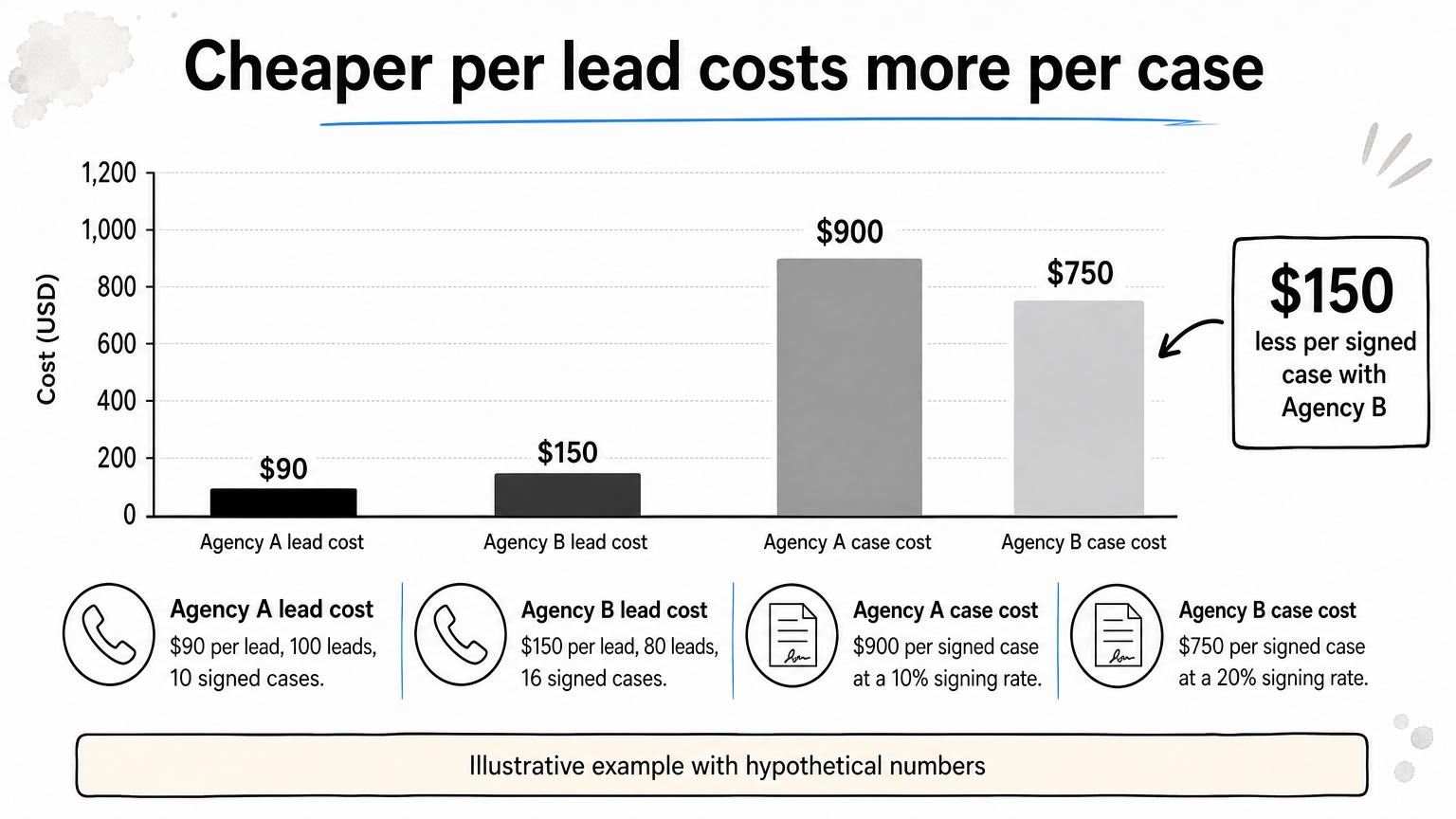
Agency A looks 40% cheaper per lead. Agency B delivers each signed case for $150 less, because its leads sign at 20% instead of 10%. The numbers are illustrative, and the real gap depends on your market and intake. The method is what matters. GavelGrow's free cost per acquisition calculator does the same arithmetic with your figures.
Confirm the contract in writing
Before you sign, make sure the contract states each of these in plain terms:
- Term, renewal, and notice period.
- Fee structure: flat retainer, percentage of ad spend, per-lead pricing, or a mix.
- What the fee covers, and what is ad spend paid on top.
- Monthly deliverables and the reporting schedule.
- Who owns accounts, tracking numbers, content, and data.
- What gets handed over if you leave, and how quickly.
- How ads and pages are approved before they run.
Compare these terms side by side, not just the price. A month-to-month agreement is a good test of an agency's confidence in its own work. GavelGrow's managed service, for example, is month-to-month with ad accounts created in your firm's name and no markup on ad spend, which is the kind of structure you should ask every agency to match.
Agree on a first 90 days
Treat the first three months as a defined test with checkpoints rather than an open-ended commitment:
- Weeks 1 to 2: accounts, call tracking, and intake forms are set up and tested, with a test call and test form logged end to end.
- Day 30: campaigns are live, ads were approved by you, and the first lead data is flowing.
- Day 60: you see cost per lead and early consultation data, with the caveat that signed-case numbers are still thin.
- Day 90: you review results against your goal template and decide whether to continue, adjust, or end the relationship.
Do not judge SEO by this timeline, since it needs longer. Judge it by whether the technical work, content plan, and tracking are in place.
Pick the agency whose proposal you can check against your own numbers, not the one with the best slide deck.
Frequently asked questions
Should you hire a legal-only agency or a general digital agency?
Lean toward an agency that works only with law firms, because it already knows how legal intake, long case timelines, and bar advertising rules affect results. A general agency can still work if it has a track record with law firms and lets you approve every ad. Your advertising falls under your state's version of ABA Model Rule 7.1, which bars false or misleading communications about a lawyer's services, so legal experience matters.
How long does it take to see results from a legal marketing agency?
Paid search can produce leads within weeks once tracking and campaigns are live, although bidding needs a learning period before performance settles. SEO usually takes months, and in competitive markets six to twelve months is common. Judge the first 90 days on whether tracking works, campaigns are live, and you can see cost per lead and early consultations, not on rankings or a finished SEO program.
How much does a legal marketing agency cost?
Agencies typically charge a flat monthly retainer, a percentage of ad spend, a per-lead fee, or a mix, and you pay ad spend to Google or Meta on top. Compare proposals on cost per signed case, not on the fee alone. GavelGrow's self-serve platform costs $199 per month for Track and $599 per month for Optimize, and Managed is scoped on a strategy call plus ad spend. See the pricing page.
Can an agency guarantee rankings or signed cases?
No. Google's own guidance on hiring an SEO warns against anyone who guarantees rankings, and no agency controls how many prospective clients call or how many sign. An honest agency gives you milestones, a measurement plan, and a realistic timeline. Guaranteed outcomes are also risky under many state bar rules, so check yours before approving any ad language.
No honest agency guarantees rankings or signed cases, and your bar rules may not let your ads promise them either.
Should you hire an agency or build an in-house team?
Hire an agency when nobody at your firm has the time or expertise to run campaigns weekly. Go in-house when you have steady volume and a person who can own it. A middle path is running marketing yourself on software. GavelGrow's Track and Optimize plans each include a 7-day free trial with no credit card required. You can see what they cover on the platform page.
What if you already have an agency and doubt it?
Start with access. Confirm your own Google account has admin rights on the Google Ads account, and that the tracking numbers are in your firm's name. Then ask the agency for a report showing cost per signed case by campaign for the last six months. If it cannot produce one, you have a measurement problem to fix before you decide whether to stay or switch.
Pick on signed cases, not pitches
Choosing a legal marketing agency comes down to a short sequence. Define your goal in signed cases, build a shortlist of specialists, ask the questions that expose measurement and ownership, screen for red flags, and compare proposals by cost per signed case with the terms confirmed in writing. Run the same checklist on every agency so the decision rests on evidence instead of charm.
If you want a second opinion on a proposal you are already holding, or want to see how a legal-only team would approach your market, you can book a free 45-minute strategy call with GavelGrow. Bring your baseline numbers and the questions from Step 3, and hold us to them as well.
Frequently Asked Questions
Should you hire a legal-only agency or a general digital agency?
Lean toward an agency that works only with law firms, because it already knows how legal intake, long case timelines, and bar advertising rules affect results. A general agency can still work if it has a track record with law firms and lets you approve every ad. Your advertising falls under your state's version of ABA Model Rule 7.1, which bars false or misleading communications about a lawyer's services, so legal experience matters.
How long does it take to see results from a legal marketing agency?
Paid search can produce leads within weeks once tracking and campaigns are live, although bidding needs a learning period before performance settles. SEO usually takes months, and in competitive markets six to twelve months is common. Judge the first 90 days on whether tracking works, campaigns are live, and you can see cost per lead and early consultations, not on rankings or a finished SEO program.
How much does a legal marketing agency cost?
Agencies typically charge a flat monthly retainer, a percentage of ad spend, a per-lead fee, or a mix, and you pay ad spend to Google or Meta on top. Compare proposals on cost per signed case, not on the fee alone. GavelGrow's self-serve platform costs $199 per month for Track and $599 per month for Optimize, and Managed is scoped on a strategy call plus ad spend. See the pricing page .
Can an agency guarantee rankings or signed cases?
No. Google's own guidance on hiring an SEO warns against anyone who guarantees rankings, and no agency controls how many prospective clients call or how many sign. An honest agency gives you milestones, a measurement plan, and a realistic timeline. Guaranteed outcomes are also risky under many state bar rules, so check yours before approving any ad language. No honest agency guarantees rankings or signed cases, and your bar rules may not let your ads promise them either.
Should you hire an agency or build an in-house team?
Hire an agency when nobody at your firm has the time or expertise to run campaigns weekly. Go in-house when you have steady volume and a person who can own it. A middle path is running marketing yourself on software. GavelGrow's Track and Optimize plans each include a 7-day free trial with no credit card required. You can see what they cover on the platform page.
What if you already have an agency and doubt it?
Start with access. Confirm your own Google account has admin rights on the Google Ads account, and that the tracking numbers are in your firm's name. Then ask the agency for a report showing cost per signed case by campaign for the last six months. If it cannot produce one, you have a measurement problem to fix before you decide whether to stay or switch.