Law Firm SEO Pricing: Monthly Costs by Firm Size and Model
Categories: Legal Marketing Strategies
 Abram Ninoyan
Founder & Senior Performance Marketer
Credentials: Google Partner, Google Ads Search Certified, Google Ads Display Certified, Google Ads Measurement Certified, Google Analytics (IQ) Certified, HubSpot Inbound Certified, HubSpot Social Media Marketing Certified, Conversion Optimization Certified
Expertise: Google Ads, Meta Ads, Conversion Rate Optimization, GA4 & Google Tag Manager, Lead Generation, Marketing Funnel Optimization, PPC Management
LinkedIn Profile
Law firm SEO pricing typically runs $1,000 to $3,500 a month for a solo attorney, $2,500 to $5,000 for a firm of two to five attorneys, and $5,000 to $20,000 or more for mid-size and large firms in co...
Key Takeaways
- Law Firm SEO Pricing: Monthly Costs by Firm Size and Model
- Why does law firm SEO pricing matter before you sign?
- How to estimate your law firm SEO budget by firm size
- What makes law firm SEO cost more or less?
Law Firm SEO Pricing: Monthly Costs by Firm Size and Model
Law firm SEO pricing typically runs $1,000 to $3,500 a month for a solo attorney, $2,500 to $5,000 for a firm of two to five attorneys, and $5,000 to $20,000 or more for mid-size and large firms in competitive markets. The term covers what you pay an agency, freelancer or consultant to improve how your firm appears in organic search results and the local map pack. That work includes technical fixes, content, links and Google Business Profile management. Most providers bill by monthly retainer, and the rest bill by the hour, by fixed package or by one-time project.
This article explains what the law firm SEO cost depends on and how to set a budget for your own firm. It also covers how each billing model works, what a given price should deliver each month, and how to read a quote without being talked into vague deliverables. The last part shows how to measure whether the spend is producing signed cases.
GavelGrow has worked only with law firms since 2015 and has served 500+ law firms since then. Its founder, Abram Ninoyan, is a performance marketer who has stayed in the legal vertical. The ranges below are typical published market ranges, not a GavelGrow rate card. GavelGrow's own SEO work is scoped on a strategy call, so no price for it appears here.
Key Takeaways
- Most firms pay $1,000 to $20,000 or more per month, depending on size.
- A firm of two to five attorneys typically pays $2,500 to $5,000 monthly.
- Monthly retainers dominate, so insist on a written deliverables list.
- Judge SEO by signed cases and cost per signed case, not rankings.
- Expect three to six months before meaningful movement.
Why does law firm SEO pricing matter before you sign?
Law firm SEO pricing matters because SEO is a recurring monthly commitment whose results arrive slowly. A wrong price or a vague scope can cost you a year of billing before you can tell. A retainer also turns a number that looks small into a five- or six-figure line item.
Retainers add up faster than they look
Monthly figures hide the real commitment. Annualize every quote before you compare it with anything else. Then set the annual total next to what the same money buys elsewhere in your firm, such as a part-time hire or a paid search budget.
Judge an SEO quote by its twelve-month total and by what that total produces, never by the monthly number.
Both very cheap and very expensive quotes carry risk
Quotes at the bottom of the market usually buy little real labor. At a few hundred dollars a month, a provider can afford an hour or two of junior attention. That tends to mean an automated report, a templated blog post and a directory submission. Below roughly $1,000 a month, ask exactly who does the work and for how many hours.
Large retainers have their own risk, which is paying for capacity you never use. The worst risk comes from cheap providers who use shortcuts, such as bought links or mass-produced pages. Google's spam policies cover these tactics, and a ranking penalty can cost far more to repair than the original fee.
SEO is slow, so price is also a cash-flow question
Most firms see meaningful movement three to six months after a program starts. Compounding results usually take six to twelve months. Plan on carrying the spend through at least two quarters with little to show for it.
That lag is why SEO and paid search do different jobs. Paid campaigns can produce leads soon after launch, and you pay as the clicks come in. SEO builds an asset that keeps producing after the work is done. If you need cases next month, SEO alone will not get you there.
How to estimate your law firm SEO budget by firm size
Start with the row that matches your firm size, then move up or down for the competitiveness of your practice area and market. Then test the result against your own case values. The ranges below are typical published market ranges, and real quotes land above and below them.
Typical monthly law firm SEO cost by firm size
The rows overlap on purpose. A solo in a hard market can pay what a small firm in an easy one pays. Multi-office firms that want to dominate several markets are sometimes quoted $25,000 to $100,000 or more per month. Treat those figures as an upper bound that applies to very few firms.
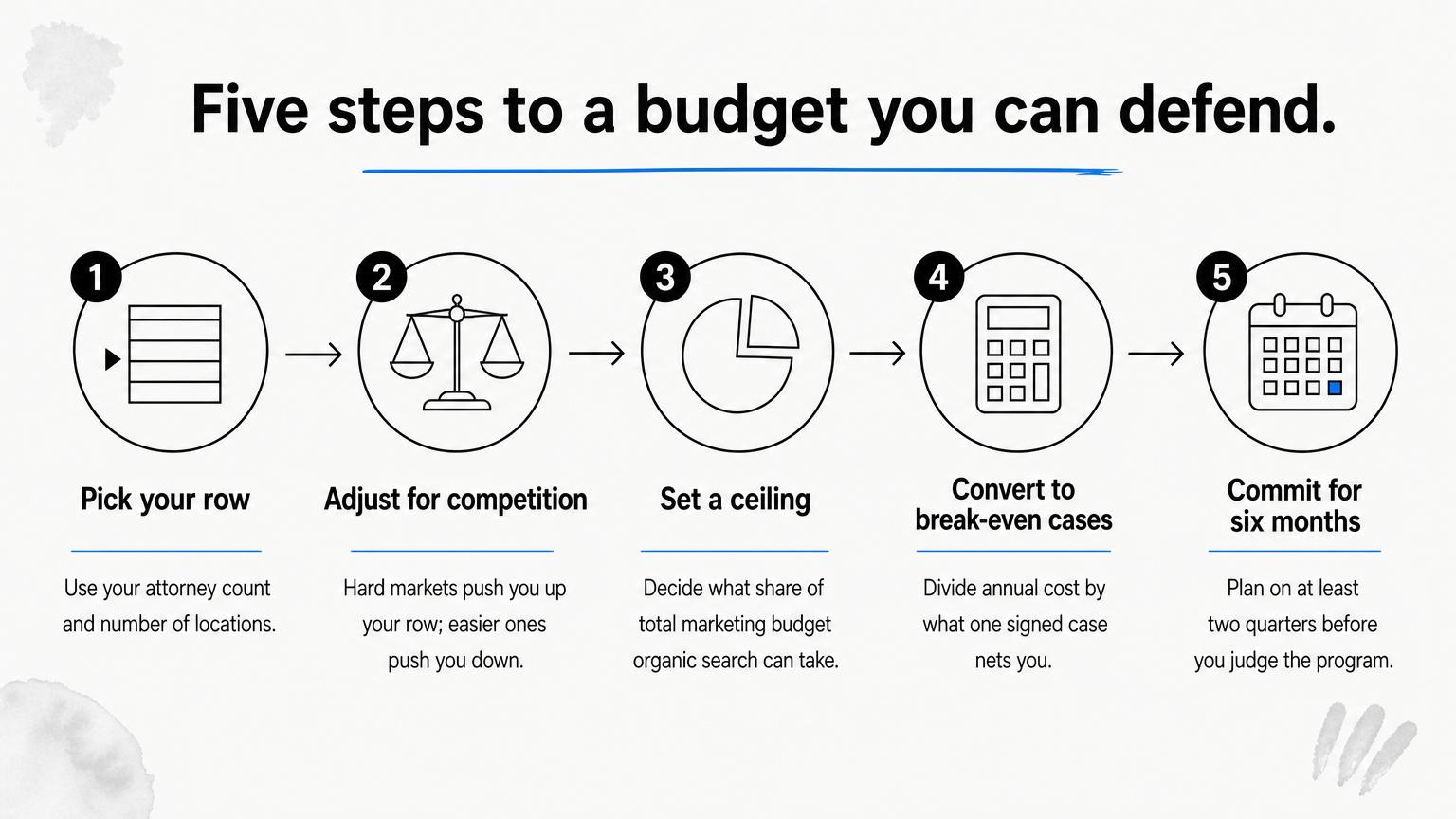
Five steps to a budget you can defend
- Pick your row. Use your attorney count and number of locations.
- Adjust for competition. Personal injury, criminal defense and family law in a large metro push you toward the top of your row. Estate planning or business law in a smaller market pushes you toward the bottom.
- Set a ceiling. Decide what share of your total marketing budget organic search can take, so SEO does not starve the channels that produce cases sooner.
- Convert to break-even cases. Divide the annual cost by what one signed case nets you after the cost of handling it.
- Commit for six months. Plan on at least two quarters before you judge the program, and write that into your budget.
Your budget is right when you can name how many signed cases it must produce to pay for itself.
Worked example: a three-attorney family law firm
Say this firm pays $4,000 a month, which sits inside the small-firm range. That is $48,000 a year. Suppose the average fee on a signed case is $5,000, and handling the case costs about half of that, leaving $2,500 net. This is a hypothetical, so swap in your own numbers.
Break-even is $48,000 divided by $2,500, or about 19 signed cases a year, so roughly 20 cases from organic search. That is under two a month. Whether that is realistic depends on your market and on how well your intake converts the leads that arrive.
What makes law firm SEO cost more or less?
Three things move the price most: how hard your practice area is to rank in, how large and complicated your website needs to be, and who does the work. Each one changes how many skilled hours the provider must spend every month.
Competition and market size
Some practice areas are crowded because each client is worth a lot. A personal injury firm in a large metro competes with many firms that all want the same few top results. Providers price that in, because they need more content, more links and more careful local work to stand out.
Market size works the same way. A big city has more searchers, but it also has more firms chasing them. Ranking in a small town costs less because the field is thinner. The same firm can pay very different amounts depending on where it needs to be visible.
Your website and how many pages it needs
A simple site for a solo with one office is cheaper to optimize than a firm with many practice areas and locations. Every new practice area or location adds keywords to target and pages to write. These are the main page drivers:

- Practice area pages, one for each service you want to rank for.
- Location pages, one for each office or service area, written with real local detail.
- Question content, articles that answer what prospective clients ask before they call.
- Technical condition, since a slow or broken site needs repair before content can help.
If your site has only a handful of thin pages, the first months of a retainer are mostly foundation work billed monthly. Ask the provider to price that foundation separately from the ongoing work.
Who does the work
Agencies, freelancers and in-house hires price differently. Agencies in expensive cities usually carry higher overhead and charge accordingly. A freelancer is often cheaper, but you are buying one person's attention rather than a team. Experience matters too: a provider with a record in legal work can move faster than one learning the field on your budget.
Legal expertise deserves a premium for one practical reason. Law firm content has to be accurate, specific to your state and consistent with your state bar's advertising rules. A generalist who writes "best attorney" copy can create a compliance problem. Check your own state bar's rules, and never accept promises about results in your content.
How do agencies bill for law firm SEO?
Agencies bill law firm SEO in five main ways: hourly rates, monthly retainers, fixed packages, one-time projects and performance-based fees. Monthly retainers are the most common, and performance-based fees are the one to approach with caution.
The five billing models compared
A model is only as good as its written scope, so ask any provider to list what you receive each month.
Why retainers dominate and when they fit
SEO is continuous work. Content has to be written, links earned, listings kept consistent and technical issues fixed as the site changes. A retainer reserves a provider's time for that work. It fits when organic search is a meaningful source of your cases and your site is already in decent shape.
A retainer fits poorly on a broken foundation. If the site is thin or slow, a one-time project to fix it first is often the better use of money. You can then decide whether ongoing work is worth paying for.
Why performance-based SEO is a bad deal for law firms
Paying only for results sounds safe, but it rewards speed. Providers working this way are tempted to use tactics that Google treats as spam, and those tactics can get your site penalized. Your own bar may also restrict how you describe results in advertising.
Rankings are also not cases. A provider paid per ranking can win positions that bring no calls. If you want accountability, tie the reporting to calls, forms and signed cases, and keep the pricing as a transparent retainer or project fee.
What should each price tier deliver every month?
At every tier you should receive a written list of monthly deliverables. Lower tiers cover local visibility and light content, and higher tiers add content production, link work and technical ownership. The table below shows what each tier should realistically include.
What a monthly fee pays for
A serious program, whatever its price, draws on the same core tasks:
- Technical audit and fixes: speed, mobile behavior, indexing and broken pages.
- Keyword research: what prospective clients search for in your practice areas and cities.
- On-page work: titles, headings, page structure and internal links.
- Content: practice area, location and question pages written by someone who understands your state's law.
- Local SEO: Google Business Profile upkeep, citation consistency and review handling.
- Link building: earning mentions from legal directories, local news and relevant sites.
- Reporting: monthly numbers that include calls and forms, not just traffic.
Writers with legal experience commonly charge roughly $150 to $300 per article. Agencies often fold that cost into the retainer. Ask whether it is included or billed separately.
What to expect at each tier
At the lowest tier you are usually buying one competent person's part-time attention. That can be a good deal if the scope is honest. It is a bad deal if the scope is written to sound like the $5,000 program.
Tools and costs outside the retainer
Doing SEO yourself means paying for professional tools. Single subscriptions often run from about $99 to $500 a month, and enterprise platforms can pass $1,500 a month. Google Search Console is free and shows how your site performs in search, though it has fewer features than paid tools.
Agencies usually include their tools in the fee and spread the cost across clients. Even so, ask what sits outside the retainer. Common extras are content writers, paid links or directory fees, and a site rebuild when your current site cannot support the work.
How to judge an agency quote and spot red flags
Judge a quote by its deliverables, its terms and the way the provider talks about results. A good quote lists what you receive each month, who does the work and how you can leave. A bad one leans on proprietary processes and promises.
Seven questions to ask before you sign
- Who does the work each month, and for how many hours?
- What pages, links and fixes will exist in six months that do not exist today?
- Do I own the site, the content and every account you create?
- How is success reported, and does the report show calls, forms and signed cases?
- Do you work with other firms in my practice area and market?
- How do you handle my state bar's advertising rules?
- Can I leave on 30 days' notice?
A provider who answers all seven plainly is worth a conversation. One who answers with "our proprietary process" is not.
Red flags in the proposal
- Guaranteed rankings. Nobody controls Google's results, and a guarantee usually means a meaningless target or a plan to churn you.
- Long lockups. Twelve-month contracts with heavy exit fees protect the agency from its own results.
- Vague deliverables. "Ongoing optimization" is not a deliverable. Pages, links, edits and logs are.
- Traffic-only reports. Sessions and impressions are easy to inflate. A report that cannot tie work to calls and consultations is not measuring the work.
- Content that ignores bar rules. Claims about case results and superlatives such as "best" are regulated in most states.
Any quote you cannot turn into a monthly checklist is a quote you cannot hold anyone to.
Terms that protect your firm
Prefer month-to-month terms or a short initial commitment, with ownership of your domain, site and content spelled out in writing. Ask whether the provider also represents your direct competitors in the same market, because one team cannot serve two firms chasing the same cases. GavelGrow's engagements are month-to-month, its ad accounts stay in the firm's own name, and it does not run marketing for two direct competitors in the same market. Hold every provider to the same standard.
How to tell whether law firm SEO is paying off
You can tell by tracking cost per signed case from organic search, not rankings or traffic. Rankings and visits are early signals. A program that produces neither calls nor signed cases is not working, however good the report looks.
The metrics that matter, in order
Follow the chain from the top down. Rankings lead to traffic, traffic leads to calls and form submissions, and those lead to qualified consultations and then signed retainers. Each step can leak. Strong rankings with weak calls point to page or intake problems, not an SEO problem. Strong calls with few signed cases point to intake and follow-up.
Speed matters at the intake step too. The Lead Response Management Study found that leads contacted within five minutes are far more likely to be qualified than those first reached at thirty minutes. That measures the odds of qualifying a lead, not signed cases. It still shows how much a slow reply can waste of what SEO earns.
The math for one month
Cost per signed case equals your monthly SEO spend divided by the signed cases that came from organic search. Take a hypothetical firm paying $5,000 a month. It gets 40 organic leads, holds 10 consultations and signs 3 cases. That is $5,000 divided by 3, or about $1,667 per signed case.

Compare that figure with the cost per signed case from your other channels. Organic cases often close weeks or months after the first contact, so judge SEO over a rolling quarter rather than one month. GavelGrow's free CPA calculator does this division for you.
Tracking organic leads through to signed cases
Measurement fails when calls and forms go unattributed. Give every call and form a recorded source, and carry that source through to the signed case. GavelGrow's platform records tracked calls and intake form leads against the campaign that produced them and follows each lead through to a signed retainer. Self-serve plans start at $199 a month for Track and $599 a month for Optimize, with a 7-day free trial and no card required. See the pricing page for details.
If your provider cannot show you signed cases by source, you are paying for activity instead of outcomes.
Frequently Asked Questions
These are the questions managing partners and marketing directors ask most when they compare quotes.
The simplest test of any SEO price is whether you can name the signed cases it needs to produce.
How much does an agency charge for law firm SEO?
Most agencies charge a monthly retainer. A solo attorney typically pays $1,000 to $3,500, a firm of two to five attorneys $2,500 to $5,000, and a mid-size firm $5,000 to $9,500. Hourly work commonly runs $75 to $200 per hour. Quotes vary with practice area competition and market size, so compare the deliverables list, not only the monthly figure.
Does SEO work for law firms?
SEO works for law firms because people search Google when they need a lawyer, and local results often show map-pack listings built from your Google Business Profile. It does not work fast or on command. Most firms see meaningful movement in three to six months. No honest provider can guarantee rankings or cases, and your content must follow your state bar's advertising rules.
Is $5,000 a month too much for law firm SEO?
Not if the program is sized to your market. $5,000 a month is $60,000 a year, the top of the typical small-firm range and the low end for mid-size firms. It makes sense when your practice area is competitive, organic search is a real source of cases and the provider lists monthly deliverables. For a solo in a small market, it is likely too much.
How long before I see results from law firm SEO?
Plan for three to six months before meaningful movement and six to twelve months before results compound. The wait depends on the state of your site and how contested your market is. A site with thin pages needs foundation work first, which delays visible gains. Track calls and forms monthly so you can see early signs well before signed cases arrive.
Should I hire an agency or do SEO in-house?
Doing it in-house means paying for tools yourself, with single subscriptions often running $99 to $500 a month, plus staff time. Google Search Console is free but limited. An agency usually includes tools in its fee and brings a team. In-house works when someone on your staff has real SEO skill and the hours to spend. Otherwise a legal-focused provider is usually the more efficient choice.
Can I pay an SEO company only for results?
You can, but it is rarely wise. Performance-based deals reward speed, which pushes providers toward tactics that can breach Google's spam policies and trigger penalties. Rankings also do not equal cases. A provider paid per ranking can win positions that bring no calls. Tie your reporting to calls, forms and signed cases instead, and keep the fee transparent.
What to do with these numbers
Law firm SEO pricing comes down to a few decisions. Pick the row that matches your firm, adjust for competition, and annualize the quote. Then require a written monthly deliverables list and measure the result in signed cases. A fair price is one you can tie to a break-even number of cases, and an unfair one hides behind vague scope or long contracts.
If you want a legal-only team to scope organic search for your firm and report in signed cases, talk to GavelGrow about its done-for-you SEO service.
Frequently Asked Questions
How much does an agency charge for law firm SEO?
Most agencies charge a monthly retainer. A solo attorney typically pays $1,000 to $3,500, a firm of two to five attorneys $2,500 to $5,000, and a mid-size firm $5,000 to $9,500. Hourly work commonly runs $75 to $200 per hour. Quotes vary with practice area competition and market size, so compare the deliverables list , not only the monthly figure.
Does SEO work for law firms?
SEO works for law firms because people search Google when they need a lawyer, and local results often show map-pack listings built from your Google Business Profile. It does not work fast or on command. Most firms see meaningful movement in three to six months . No honest provider can guarantee rankings or cases, and your content must follow your state bar's advertising rules.
Is $5,000 a month too much for law firm SEO?
Not if the program is sized to your market. $5,000 a month is $60,000 a year , the top of the typical small-firm range and the low end for mid-size firms. It makes sense when your practice area is competitive, organic search is a real source of cases and the provider lists monthly deliverables. For a solo in a small market, it is likely too much.
How long before I see results from law firm SEO?
Plan for three to six months before meaningful movement and six to twelve months before results compound. The wait depends on the state of your site and how contested your market is. A site with thin pages needs foundation work first , which delays visible gains. Track calls and forms monthly so you can see early signs well before signed cases arrive.
Should I hire an agency or do SEO in-house?
Doing it in-house means paying for tools yourself, with single subscriptions often running $99 to $500 a month , plus staff time. Google Search Console is free but limited. An agency usually includes tools in its fee and brings a team. In-house works when someone on your staff has real SEO skill and the hours to spend. Otherwise a legal-focused provider is usually the more efficient choice.
Can I pay an SEO company only for results?
You can, but it is rarely wise. Performance-based deals reward speed, which pushes providers toward tactics that can breach Google's spam policies and trigger penalties. Rankings also do not equal cases. A provider paid per ranking can win positions that bring no calls. Tie your reporting to calls, forms and signed cases instead, and keep the fee transparent.