Law Firm Marketing Agency vs In-House Marketer: 3 Steps
Categories: Legal Marketing Strategies
 Abram Ninoyan
Founder & Senior Performance Marketer
Credentials: Google Partner, Google Ads Search Certified, Google Ads Display Certified, Google Ads Measurement Certified, Google Analytics (IQ) Certified, HubSpot Inbound Certified, HubSpot Social Media Marketing Certified, Conversion Optimization Certified
Expertise: Google Ads, Meta Ads, Conversion Rate Optimization, GA4 & Google Tag Manager, Lead Generation, Marketing Funnel Optimization, PPC Management
LinkedIn Profile
The law firm marketing agency vs in-house marketer decision comes down to coverage, cost and control. Choose an agency when you need several channels running soon and no partner has time to manage a h...
Key Takeaways
- Law Firm Marketing Agency vs In-House Marketer: 3 Steps
- What separates an agency from an in-house marketer?
- Step 1. Price both options on the same scope
- Step 2. Match the model to your firm size
Law Firm Marketing Agency vs In-House Marketer: 3 Steps
The law firm marketing agency vs in-house marketer decision comes down to coverage, cost and control. Choose an agency when you need several channels running soon and no partner has time to manage a hire. Choose an in-house marketer when you have a full-time job's worth of steady work and someone to manage it. Choose a hybrid when you have both.
Most firms get stuck because the comparison is uneven. A salary is easy to see, an agency fee arrives as a proposal, and ad spend hides inside both. One hire is also expected to run ads, SEO, intake, reviews and reporting, and nobody has checked who owns the accounts.
GavelGrow has marketed only for law firms since 2015. We sell both a self-serve platform for in-house teams and managed campaigns, so we have a stake in this question. This guide walks through three steps that work whichever way you land: price both options on the same scope, match the model to your firm size, and lock in ownership and supervision.
What separates an agency from an in-house marketer?
An in-house marketer is one employee who learns your firm deeply. An agency is a team of specialists who bring range. The real difference between agency and in-house marketing is depth of context versus breadth of skill, and most law firms need more breadth than one person can supply.
What one marketer can realistically cover
Law firm marketing is several jobs, each with its own platform and weekly routine. A single hire inherits all of them on day one:

- Google Ads and Local Services Ads: keyword and negative keyword work, verification, budgets, rating every lead.
- Local SEO and Google Business Profile: location pages, profile posts, review routines, consistent firm details.
- Paid social: creative that wears out, instant forms, follow-up on leads that are slower to warm up.
- Content and video: planning, filming, editing and publishing on a schedule.
- Intake and tracking: call tracking, forms, follow-up sequences and source reporting.
A strong marketer is usually good at two or three of these. The rest get learned on your budget or quietly left alone. That is not a flaw in the person. It is the shape of the job, and it is why firms with one generalist often see ads running well while reviews, content and reporting stall.
What an agency adds and where it falls short
An agency gives you specialists for each channel and lets you scale scope up or down without payroll. If one person leaves, the account does not go dark. That matters when you cannot afford a gap in lead flow.
The tradeoffs are real. An agency splits its attention across clients, knows your partners less well, and still needs one person at your firm to direct and approve the work. Ask any agency whether it works for competing firms in your market. GavelGrow does not run managed marketing for two direct competitors in the same market, and you should expect a clear answer from anyone you hire.
An in-house hire gives you depth about your firm, and an agency gives you range across channels.
Step 1. Price both options on the same scope
Compare the two options on the same list of channels, with ad spend removed from both sides. Ad spend goes to Google or Meta either way, so leaving it in only muddies the comparison between a salary and an agency fee.
What an in-house marketer really costs
The salary is the smallest-looking part of the bill. Add payroll taxes and benefits, the software the person needs, recruiting, onboarding, turnover risk and the partner time spent managing them. The table below works through one example. The salary and the 25% load are assumptions for illustration, so replace them with your own market's numbers.
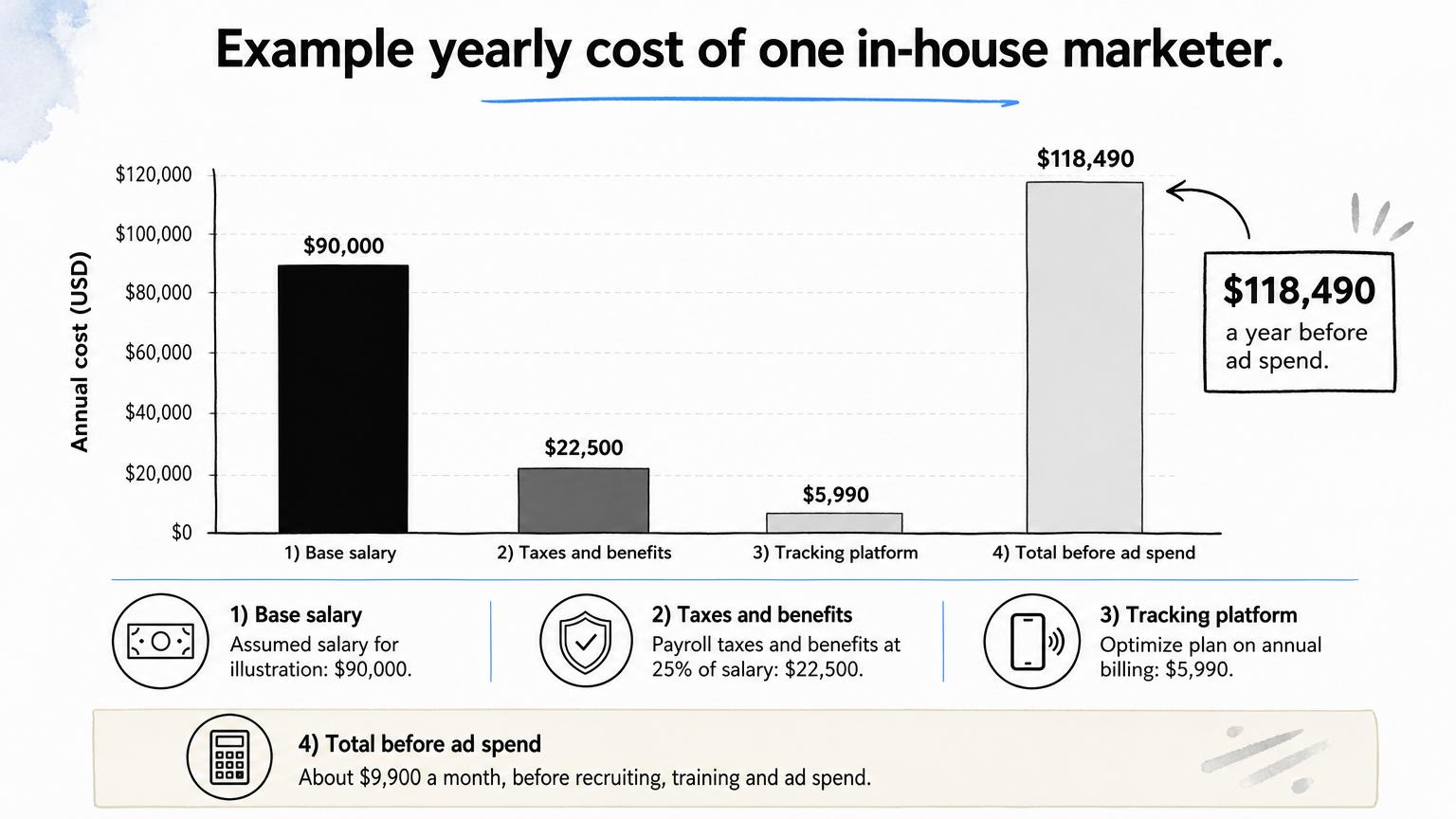
That is about $9,900 a month before recruiting, training and ad spend. It also leaves out partner time. Three hours a week of oversight is 156 hours a year, so multiply that by your own billing rate to see the full price of the hire.
How to price an agency against the same scope
Write down the channels you want covered, then ask each agency to quote that exact list. Agency fees depend on scope, so most are set on a call, and a quote that bundles ad spend into the fee is hard to compare. Ask three things: is ad spend billed at cost with no markup, who owns the accounts, and what is the notice period. GavelGrow's Managed service is scoped on a strategy call, plus ad spend, and we charge no markup on that spend.
If you hire in-house, price the tools too. The self-serve plans on GavelGrow's pricing page run $199 a month for Track and $599 a month for Optimize, which is where the $5,990 annual figure in the table comes from.
A salary is not the cost of a hire. Salary plus benefits, tools and management time is.
Step 2. Match the model to your firm size
Match the model to your firm, not the other way around. Smaller firms with nobody to manage a hire usually do better with an agency. Growing firms with steady work do well with a hybrid. Larger firms with events and referral networks can justify an in-house team.
Where each model fits
Two signals matter more than headcount: how many channels you need running at once and how many partner hours a week you can give. If you need three or more channels within weeks and nobody has an hour a week for a marketer, hire an agency. If the work is steady, event-heavy or relationship-driven, such as monthly seminars for estate planning prospects, an in-house marketer earns the salary.
How to split the work in a hybrid
A hybrid works when each side owns what it does best and both report to the same partner. Write the split down so nothing falls between them:
- In-house owns: lawyer videos, referral and community relationships, content approvals, and intake follow-up.
- In-house also owns reviews: ask every client for a public review, never only the happy ones, and never offer incentives.
- Agency owns: Google Ads, Local Services Ads, SEO, tracking and reporting.
- Shared: a monthly review of cost per signed case.
The in-house person also becomes the translator between attorneys and the agency, turning "we want more DUI cases" into a clear brief. That keeps the agency aligned and spares your hire from having to be an expert in everything.
Hire in-house for relationships and volume, and use an agency for range and speed.
Step 3. Lock in ownership, supervision and proof
Whichever model wins, keep every account in your firm's name, keep a lawyer responsible for what goes public, and judge the work by signed cases. These three rules matter more than the model you pick, and they make a later switch a login change instead of a rebuild.
Keep accounts and numbers in your firm's name
Create or confirm each of these in the firm's name before anyone starts work:

- Google Ads and Local Services Ads accounts
- Meta business portfolio and ad account
- Google Business Profile
- Domain, website hosting and analytics
- Call tracking numbers
- CRM and intake forms
Keep Admin access with a partner and give your marketer or agency standard access. At GavelGrow, ad accounts and tracking numbers are created in the firm's own name, and plans are month-to-month, so you can cancel anytime without losing your data trail.
Supervise marketing under your bar rules
Hiring a marketer does not hand off responsibility. ABA Model Rule 5.3 requires lawyers with managerial authority to make reasonable efforts to ensure a nonlawyer's conduct fits their professional obligations. It covers nonlawyers employed or retained by the firm, so agencies count. States adopt their own versions and advertising rules, so check your state bar's current rules.
In practice, a lawyer approves every public ad, post and page before it runs. Your marketer should also have your state's rules on testimonials, past results and "specialist" claims in writing. This is marketing guidance, not legal advice.
Measure cost per signed case, not leads
Judge both options on cost per signed case, because a cheap lead that never signs is expensive. That requires click-to-retainer attribution, including the leads that only phoned. The GavelGrow platform ties each call to the campaign that rang the phone through tracking numbers and carries it through to the signed retainer, whoever runs your ads.
If neither option can show you cost per signed case, neither is ready to be hired.
Frequently asked questions
These are the questions firms ask most once they have run the numbers on both options.
The best model is the one your firm can manage, measure and own.
Is an agency or an in-house marketer better for a solo lawyer?
For most solo lawyers, an agency or a self-serve platform is the better start. Nobody is available to manage a hire, and one person rarely covers ads, SEO and intake. GavelGrow's Track plan costs $199 a month and includes a 7-day free trial with no credit card, so you can see your own click-to-case numbers before committing to a salary.
Should my first marketing hire be a marketer or an intake person?
Often it is the intake person. More leads into a phone nobody answers raises your cost per signed case. The Lead Response Management Study found that leads contacted within five minutes are far more likely to be qualified than leads first reached at thirty minutes. That measures the odds of qualifying a lead, not signed cases, but it shows why speed to first response deserves attention before extra ad budget.
Can I switch from an agency to in-house without losing rankings?
Yes, if you change one thing at a time. Keep the agency through a handover period, collect every account login, analytics property and tracking number, and have the new hire document what works before touching it. The costly mistake is a rebuild that changes URL structures and rewrites ranking pages at once, which can erase search visibility built over years.
What does GavelGrow cost compared with hiring someone?
Self-serve is Track at $199 a month or Optimize at $599 a month, with Optimize at $5,990 a year on annual billing, plus your own ad spend. Extra seats are $79 a month. Managed is scoped on a strategy call, plus ad spend. Compare either against the salary-plus-load example in Step 1, using the same channel list.
How long should I give either option before judging it?
Give paid channels several weeks of data and SEO several months. Then review in fixed blocks by cost per signed case. Legal matters take time to close, so expect a lag between a lead and a signed retainer. Judge the early weeks on lead quality and speed to contact, then on signed cases as they close, and set that review calendar in writing before the work starts.
Pick the model your firm can manage
The choice of a law firm marketing agency vs in-house marketer is not about which is better in general. It is about coverage, cost and control for your firm. Price both on the same channel list with ad spend set aside, and match the model to your size and the partner hours you can give. Then keep accounts in your name, approve everything public, and judge results by cost per signed case.
Smaller firms tend to land on an agency or a platform, larger firms on in-house plus specialists, and a hybrid suits the firms in between. Whatever you choose, the ownership and measurement rules above keep the decision reversible.
If you want a second opinion on your numbers, book a free 45-minute strategy call with GavelGrow and we will go through your channels and your options together.
Frequently Asked Questions
Is an agency or an in-house marketer better for a solo lawyer?
For most solo lawyers, an agency or a self-serve platform is the better start. Nobody is available to manage a hire , and one person rarely covers ads, SEO and intake. GavelGrow's Track plan costs $199 a month and includes a 7-day free trial with no credit card , so you can see your own click-to-case numbers before committing to a salary.
Should my first marketing hire be a marketer or an intake person?
Often it is the intake person . More leads into a phone nobody answers raises your cost per signed case. The Lead Response Management Study found that leads contacted within five minutes are far more likely to be qualified than leads first reached at thirty minutes. That measures the odds of qualifying a lead, not signed cases, but it shows why speed to first response deserves attention before extra ad budget.
Can I switch from an agency to in-house without losing rankings?
Yes, if you change one thing at a time . Keep the agency through a handover period, collect every account login, analytics property and tracking number, and have the new hire document what works before touching it. The costly mistake is a rebuild that changes URL structures and rewrites ranking pages at once, which can erase search visibility built over years.
What does GavelGrow cost compared with hiring someone?
Self-serve is Track at $199 a month or Optimize at $599 a month , with Optimize at $5,990 a year on annual billing, plus your own ad spend. Extra seats are $79 a month. Managed is scoped on a strategy call, plus ad spend . Compare either against the salary-plus-load example in Step 1, using the same channel list.
How long should I give either option before judging it?
Give paid channels several weeks of data and SEO several months. Then review in fixed blocks by cost per signed case. Legal matters take time to close, so expect a lag between a lead and a signed retainer . Judge the early weeks on lead quality and speed to contact, then on signed cases as they close, and set that review calendar in writing before the work starts.