SEO for Criminal Defense Lawyers: How to Rank and Sign Cases
Categories: Legal Marketing Strategies
 Abram Ninoyan
Founder & Senior Performance Marketer
Credentials: Google Partner, Google Ads Search Certified, Google Ads Display Certified, Google Ads Measurement Certified, Google Analytics (IQ) Certified, HubSpot Inbound Certified, HubSpot Social Media Marketing Certified, Conversion Optimization Certified
Expertise: Google Ads, Meta Ads, Conversion Rate Optimization, GA4 & Google Tag Manager, Lead Generation, Marketing Funnel Optimization, PPC Management
LinkedIn Profile
Someone gets arrested at 2 a.m. and searches "criminal defense lawyer near me" from a phone in a holding area waiting room or from a worried family member's kitchen table. If your firm isn't...
Key Takeaways
- SEO for Criminal Defense Lawyers: How to Rank and Sign Cases
- Why SEO matters for criminal defense law firms
- Step 1. Find the keywords your future clients search
- Step 2. Optimize your website and local listings
SEO for Criminal Defense Lawyers: How to Rank and Sign Cases
Someone gets arrested at 2 a.m. and searches "criminal defense lawyer near me" from a phone in a holding area waiting room or from a worried family member's kitchen table. If your firm isn't on that first page, you don't get the call. That's the entire game with seo for criminal defense lawyers: showing up in the map pack and organic results at the exact moment someone needs a lawyer now, not next week.
Ranking well takes more than a nicely designed website. It means a Google Business Profile built around the practice areas people actually search (DUI, drug charges, assault, warrants), location pages for every county you cover, and content that answers the questions someone types in a panic. SEO for criminal lawyers also has to survive close scrutiny from Google on trust signals, since "your money or your life" categories like legal services get held to a higher bar for reviews, citations, and site authority.
This guide walks through the specific tactics that move rankings and, more importantly, turn those visitors into signed cases: on-page and local SEO fundamentals, content that targets urgent search intent, review strategy, and how to track which pages actually produce retained clients rather than just clicks.
If you would rather have this built and run than learn it, GavelGrow's law firm SEO agency does the county pages, the profile and the tracking, and is judged on signed cases.
Why SEO matters for criminal defense law firms
Criminal charges don't wait for business hours, and neither do the searches that follow them. A DUI stop, a domestic violence accusation, or a warrant sweep sends someone straight to their phone, usually within minutes of the arrest or the moment they hear about it. Local search visibility is what puts your firm in front of that person before a competitor does, and ranking a law firm in local search results is a discipline of its own. Firms that treat their website as a digital brochure instead of a lead-generation asset are handing those searches to whoever ranks above them.
Paid ads get expensive fast, organic compounds
Google Ads and Local Services Ads work, but you pay for every click, every time, and criminal defense keywords are some of the most expensive in legal marketing, which is why the combined SEO and Google Ads setup for defense firms matters so much. Organic rankings cost you time and consistent effort instead of a bid you're competing on forever. A location page or blog post that ranks well keeps sending calls for months or years without an incremental dollar spent per click. That doesn't mean you should drop paid search, it means SEO is the channel that makes your cost per signed case go down over time instead of staying flat.
The firm that ranks organically for "DUI lawyer" in its own county gets calls for free, every single day, while competitors keep paying for the same click.
Trust signals carry more weight in legal search
Google treats legal services as a "your money or your life" category, which means it holds firms to a stricter bar on trust before ranking them well. Reviews, consistent business listings, clear attorney credentials, and a site that actually explains how a criminal case moves through the courts all factor into whether Google trusts your firm enough to surface it. A thin site with a phone number and a stock photo won't out-rank a firm that's built real depth around its practice areas, even with a bigger ad budget behind it.
Comparing the two channels
Attribution ties it back to signed cases
Ranking for the right keywords means nothing if you can't tell which pages are actually producing retained clients versus one-off calls that go nowhere. Tracking call sources, form submissions, and case outcomes back to the specific page or keyword that generated them is how you know your SEO work is paying off, not just generating traffic. That kind of full-funnel view, from a search query to a signed retainer, is exactly what GavelGrow's marketing dashboard is built to give firms that are tired of guessing which channel actually closes cases.
Step 1. Find the keywords your future clients search
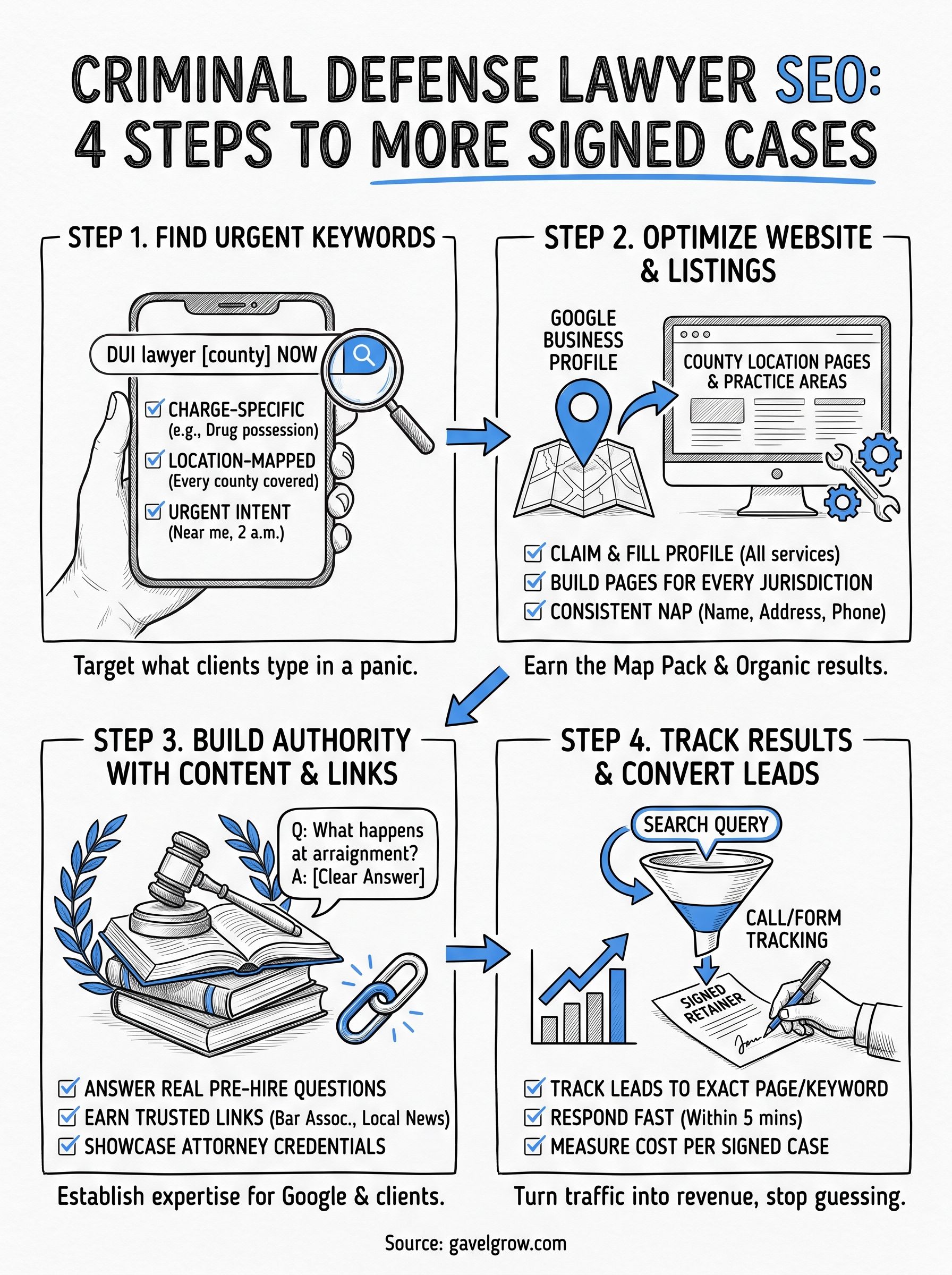
Before you touch a single page on your site, figure out what someone actually types when they're scared and searching for help. Criminal defense keyword research isn't about generic terms like "lawyer" or "attorney", it's about the specific charge, the specific county, and the specific moment someone is in. Someone facing a first DUI searches differently than someone facing a felony drug charge, and your keyword list needs to reflect that split.
Start with charge-specific, urgent-intent terms
Build your list around the charges you actually handle, paired with location and urgency modifiers, the same way these eight keyword approaches for lawyers work. A firm that only targets "criminal defense lawyer" is competing against every general-practice attorney in the state, while charge-specific terms bring in people who are ready to call today.
- "DUI lawyer [county name]"
- "drug possession attorney near me"
- "domestic violence defense lawyer [city]"
- "warrant lawyer [county name]"
- "assault charge attorney [city]"
- "expungement lawyer [state]"
A charge-specific keyword brings in someone ready to hire this week, a generic one brings in someone still comparing options.
Map keywords to your actual coverage area
Once you have the charge list, cross it with every county and court jurisdiction you cover, not just your home city. SEO for criminal lawyers working across multiple counties means you need separate keyword sets for each one, because someone arrested in a neighboring county searches with that county's name, not yours.
Use Google's own Keyword Planner to check search volume for each combination before you build pages around them. Skip terms with zero measurable volume in your area and prioritize the ones tied to charges you actually litigate often, since ranking for a keyword you rarely handle just brings in calls you'll refer out anyway.
Write the list down in a spreadsheet with columns for charge type, location, and search volume. That document becomes the blueprint for the location and practice-area pages you'll build in the next step.
Step 2. Optimize your website and local listings
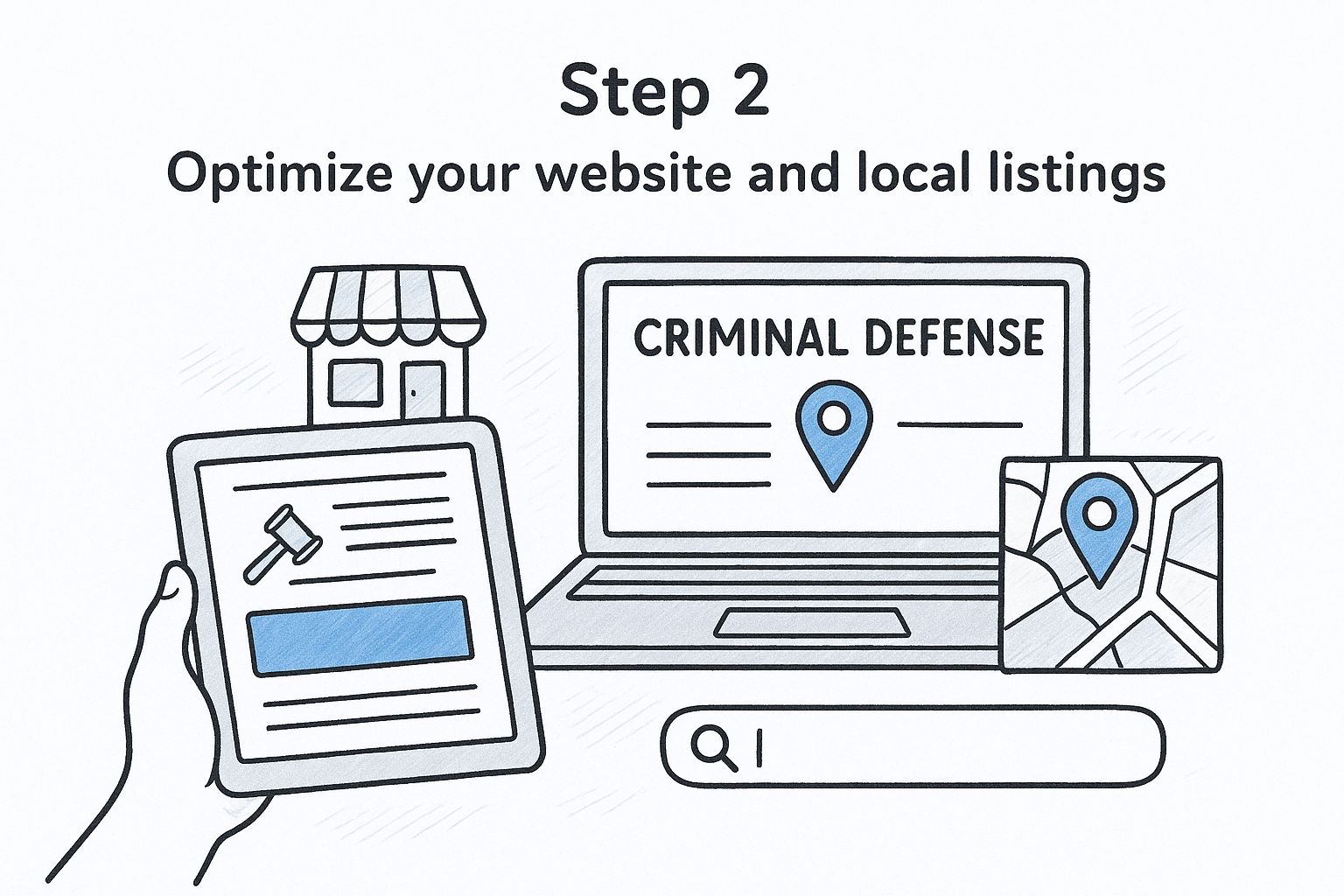
Once you know the keywords, the next move is making sure your website and your Google Business Profile actually target them. Local SEO optimization for a criminal defense firm starts with the map pack, because that's where most of the urgent, near-me searches get answered before anyone scrolls to organic results.
Build a Google Business Profile that earns the map pack
When setting up a Google Business Profile for lawyers, fill out every practice area as a separate service on your profile instead of listing "criminal defense" once and calling it done. Add real photos of your office and attorneys, post updates when you handle a notable case type, and keep your hours accurate since someone searching at 2 a.m. wants to know if you actually answer after hours. Consistency matters here: your name, address, and phone number need to match exactly across your website, your profile, and every legal directory you're listed on, because mismatched listings quietly erode the trust signals Google uses to rank legal sites.
A Google Business Profile with vague service categories loses the map pack to a competitor who listed "DUI defense" by name.
Build a location page for every county you cover
Each county or court jurisdiction from your keyword list needs its own page, not a single "areas we serve" page that lists ten cities in one paragraph. Reference the actual courthouse, mention how your firm handles arraignments there, and link to your main practice-area pages. This is exactly the kind of structured, ongoing work GavelGrow's SEO and local optimization services handle for firms that don't have time to build and maintain dozens of these pages themselves.
Fix the technical basics that block rankings
Check that your site loads fast on mobile, since most of these searches happen on a phone in a stressful moment, and work through the technical SEO fixes that speed up crawling. Confirm your intake form works without lag, your phone number is clickable, and your title tags reflect the exact charge and location terms from Step 1 rather than generic phrases.
Step 3. Build content and links that establish authority
Ranking a location page is one thing, keeping it there through algorithm updates is another. Google wants to see that your firm actually knows criminal law, not just that you filled a page with keywords. Authority-building content answers the exact questions someone facing charges is asking, in plain language, written by someone who's actually stood in that courtroom.

Write content that answers real pre-hire questions
People researching a criminal charge want to know what happens next, not a legal treatise. Build a content calendar around questions like these using a content strategy framework for law firms, and answer each one on its own page rather than burying five answers in a single generic blog post:
- "What happens at a DUI arraignment in [county]?"
- "Can a first-time drug possession charge be expunged?"
- "How long does a domestic violence case take to resolve?"
- "What's the difference between a misdemeanor and felony assault charge here?"
Content that answers the exact question in someone's head at 2 a.m. earns more trust, and more links, than a page stuffed with keywords.
Earn links that signal real trust
Links from other legal sites, local news, and bar association pages tell Google your firm is a real, recognized authority rather than a content mill, which is the whole point of link building in SEO. Get listed on your state and county bar directories, sponsor a local event tied to your community, and offer to comment when local news covers a case type you handle. Guest contributions to legitimate legal publications work too, as long as they're written by an attorney at your firm and not outsourced to a content farm with no legal background.
Keep attorney bios and credentials front and center
Every practice-area and location page should link back to the attorney who actually handles that charge type, with a bio that lists bar admission, years practicing, and notable case types. This is one of the clearest expertise signals Google looks for in a YMYL category like legal services, and it's also what a scared reader wants to see before they pick up the phone. A thin "About Us" page with no attorney detail undercuts every other page on your site, no matter how well it's optimized.
Step 4. Track results and convert traffic into signed cases
Ranking for the right keywords is worthless if you can't tell which pages actually turn into signed retainers. Attribution tracking should follow every visitor from the search result they clicked through to the signed retainer, through the call or form they submitted, to whether that lead became a paying client. Without that link, you're guessing which pages to keep investing in and which ones are just generating traffic that goes nowhere.
Track calls and forms back to the exact page
Set up call tracking numbers on every location and practice-area page, and route those calls through software that logs which page and keyword generated each call, not just that a call happened. Do the same with your intake forms. Call and form tracking at this level tells you that your "DUI lawyer [county]" page produces retained clients every month while your general "criminal defense" page produces mostly tire-kickers, so you know where to put your next round of content and link-building effort.
A page that ranks well but never gets tracked back to a signed case is a page you're optimizing blind.
Watch how fast your team responds
Ranking gets someone to your site, but response speed decides whether that lead becomes a client. The Lead Response Management Study found leads contacted within five minutes are far more likely to be qualified than leads first reached at thirty minutes. A 2 a.m. search doesn't wait for business hours, so your intake process needs after-hours coverage or automated text replies that keep the person engaged until an attorney can call back, alongside the intake and landing page fixes that stop losing cases.
Connect it to cost per signed case
Pulling all of this into one view, cost per lead by page, conversion rate by keyword, and cost per signed case by practice area, is what lets you see which SEO efforts are actually worth scaling. This is the exact reporting gap GavelGrow's marketing dashboard fills for firms that have been measuring clicks instead of cases.
Where your firm goes from here
Ranking for the right criminal defense keywords isn't a one-time project. Charges change, counties add jurisdictions, and Google keeps raising the bar on trust signals for legal sites. The firms that win the map pack and organic results are the ones treating local SEO as ongoing work: fresh location pages, real attorney credentials, tracked calls, and content that answers the exact question someone types at 2 a.m.
You don't have to build all of this alone while still running cases. Done-for-you SEO from a legal-only team means county pages get built, listings stay consistent, and links get earned while you're in court instead of in a keyword spreadsheet.
If you'd rather hand off the keyword research, the location pages, and the link building to a team that only works with law firms, see managed SEO and local search for criminal defense firms and what a real growth plan looks like for your practice areas.
Frequently asked questions about SEO for criminal defense lawyers
What keywords should a criminal defense firm target?
The charges people actually search in a panic, such as DUI, drug possession, assault, domestic violence and warrants, each combined with the county or city you practice in, rather than the broad phrase criminal defense lawyer on its own. Someone searching for a DUI lawyer in a specific county at two in the morning is a different person from someone researching sentencing guidelines, and each needs its own page. Pull real terms from Search Console rather than guessing.
How important is the Google Business Profile for criminal defense SEO?
It decides who gets the after-hours call. Most urgent criminal searches happen on a phone and resolve in the map pack, where the profile is what ranks, not the website. Set the primary category to the most specific one that fits, Criminal justice attorney rather than Lawyer, keep hours and service areas accurate, and treat reviews as an ongoing process rather than a one-time push.
Should a criminal defense firm build a page for every county it covers?
For every county where you genuinely appear in court, yes, and each page should say something true about that court system: where it sits, how arraignments run, what a first appearance looks like there. A page per county that swaps the name and repeats the same text adds nothing Google rewards and can read as the doorway-page pattern it penalizes.
How long does SEO take to work for a criminal defense firm?
Longer than paid search, and not on a fixed schedule. Specific charge-plus-county terms usually move before the broad competitive phrases do, because there is less competition for them. Run paid search alongside if you need cases now, and treat organic as the channel that lowers cost per signed case over time rather than the one that fills next week's calendar.
How do you know whether SEO is producing signed cases rather than calls?
Give the site a tracking number so calls carry their source page through intake, capture the landing page with every form, and match signed retainers back to the page that started them. Criminal defense intake produces a lot of calls that go nowhere, from the wrong jurisdiction, with no case, or shopping on price, so a page that ranks and rings is not necessarily a page that signs. Cost per signed case by page is the number to run the program on.
Frequently Asked Questions
What keywords should a criminal defense firm target?
The charges people actually search in a panic, such as DUI, drug possession, assault, domestic violence and warrants, each combined with the county or city you practice in, rather than the broad phrase criminal defense lawyer on its own. Someone searching for a DUI lawyer in a specific county at two in the morning is a different person from someone researching sentencing guidelines, and each needs its own page. Pull real terms from Search Console rather than guessing.
How important is the Google Business Profile for criminal defense SEO?
It decides who gets the after-hours call. Most urgent criminal searches happen on a phone and resolve in the map pack, where the profile is what ranks, not the website. Set the primary category to the most specific one that fits, Criminal justice attorney rather than Lawyer, keep hours and service areas accurate, and treat reviews as an ongoing process rather than a one-time push.
Should a criminal defense firm build a page for every county it covers?
For every county where you genuinely appear in court, yes, and each page should say something true about that court system: where it sits, how arraignments run, what a first appearance looks like there. A page per county that swaps the name and repeats the same text adds nothing Google rewards and can read as the doorway-page pattern it penalizes.
How long does SEO take to work for a criminal defense firm?
Longer than paid search, and not on a fixed schedule. Specific charge-plus-county terms usually move before the broad competitive phrases do, because there is less competition for them. Run paid search alongside if you need cases now, and treat organic as the channel that lowers cost per signed case over time rather than the one that fills next week's calendar.
How do you know whether SEO is producing signed cases rather than calls?
Give the site a tracking number so calls carry their source page through intake, capture the landing page with every form, and match signed retainers back to the page that started them. Criminal defense intake produces a lot of calls that go nowhere, from the wrong jurisdiction, with no case, or shopping on price, so a page that ranks and rings is not necessarily a page that signs. Cost per signed case by page is the number to run the program on.