How to Build a Law Firm Marketing Strategy That Signs Cases
Categories: Legal Marketing Strategies
 Abram Ninoyan
Founder & Senior Performance Marketer
Credentials: Google Partner, Google Ads Search Certified, Google Ads Display Certified, Google Ads Measurement Certified, Google Analytics (IQ) Certified, HubSpot Inbound Certified, HubSpot Social Media Marketing Certified, Conversion Optimization Certified
Expertise: Google Ads, Meta Ads, Conversion Rate Optimization, GA4 & Google Tag Manager, Lead Generation, Marketing Funnel Optimization, PPC Management
LinkedIn Profile
A law firm marketing strategy built around leads instead of signed cases will waste your budget no matter how much you spend. Most firms track clicks, calls, and form fills, then lose the thread the m...
Key Takeaways
- How to Build a Law Firm Marketing Strategy That Signs Cases
- Why most law firm marketing plans never sign a case
- Step 1. Set goals and define your ideal client
- Step 2. Research your market and competitors
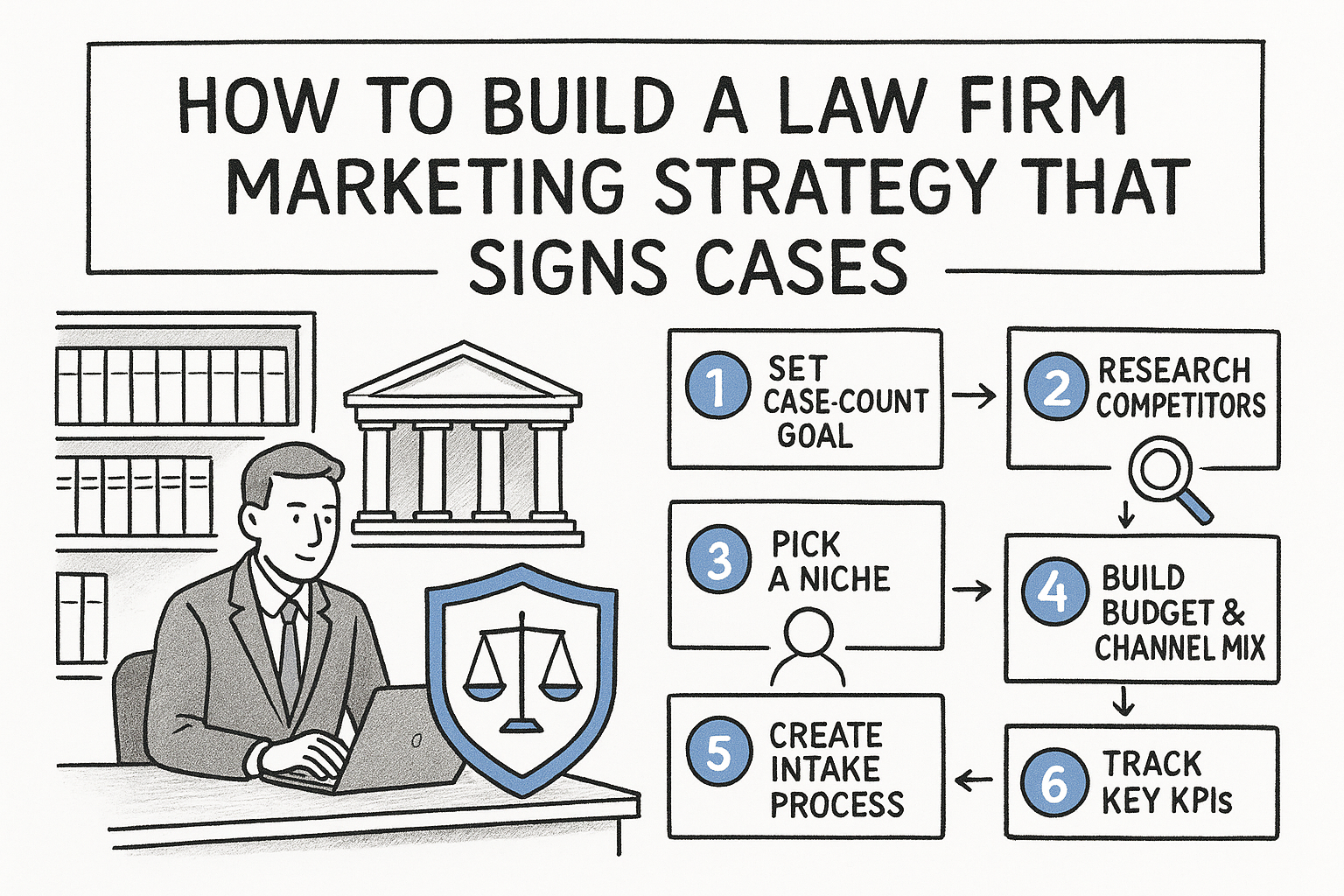
How to Build a Law Firm Marketing Strategy That Signs Cases
A law firm marketing strategy built around leads instead of signed cases will waste your budget no matter how much you spend. Most firms track clicks, calls, and form fills, then lose the thread the moment a lead turns into an actual client. You end up guessing which channel actually pays your bills.
The fix is a strategy that maps every dollar from ad click to signed retainer, not just to a phone call or a submitted form. That means picking channels that fit your practice area, building an intake process fast enough to catch leads while they're still deciding, and measuring cost per signed case instead of cost per lead. Firms that skip this step often look busy on paper while their actual case count stays flat.
This guide walks through the strategy piece by piece: choosing the right marketing channels for your practice area, setting a realistic budget, building intake and follow-up systems that don't lose leads to slow response times, and tracking the numbers that tell you what's actually working. You'll leave with a plan you can put in front of your partners this week, not another list of generic marketing tips.
Why most law firm marketing plans never sign a case
Most firms build a marketing plan around channels instead of outcomes. They decide to run Google Ads, boost a few Facebook posts, and maybe hire someone for local SEO, then call that a strategy. None of that is wrong on its own, but none of it answers the only question that matters: how many of those leads become signed clients? Without that number, you're spending money on faith.
You're optimizing for the wrong metric
Ask most managing partners how their marketing performs and you'll hear about lead volume, cost per click, or maybe cost per lead. Almost none of them can tell you what each signed case actually costs to acquire, broken out by practice area. That gap is the whole problem. A campaign that generates 80 leads at $40 each looks better on a spreadsheet than one generating 30 leads at $90 each, until you find out the second campaign signed nine cases and the first signed two.
A cheap lead that never signs costs more than an expensive one that does.
This is why a law firm marketing strategy has to be built backward from signed retainers, not forward from ad spend. If you're only watching cost per lead, you're flying blind on the number that actually funds your firm.
Tactics get bolted on instead of built into a system
Many firms treat marketing as a rotating list of tactics: try Local Services Ads for a quarter, switch to SEO, add a referral push, drop it all when a partner gets busy with trial prep. Each tactic might work in isolation, but without a consistent intake process and clear attribution behind it, you can't tell which one actually moved the needle. You end up repeating whatever felt good last time instead of what the data supports.
Compare the two approaches:
Firms in the left column often look busy. Firms in the right column know exactly which dollar produced which case.
Follow-up speed kills more deals than bad ads
Even a well-targeted campaign falls apart if nobody calls the lead back fast enough. The Lead Response Management Study found that leads contacted within five minutes are far more likely to qualify than leads first reached after thirty minutes. That's not a conversion stat, it's about whether the lead is even still worth pursuing by the time you reach them. If your intake process routes leads through a general inbox or waits for someone to check voicemail between depositions, you're losing winnable cases before anyone calls them back.
Generic marketing advice rarely mentions this because it applies to every industry equally. But legal leads behave differently than most: a person searching for a personal injury attorney at 11 p.m. is often calling three firms in a row. Whoever answers first, or texts back first, usually wins the case. That single detail explains more flat case counts than any ad platform ever will, and it's exactly the kind of gap a platform like GavelGrow's marketing dashboard is built to close by tying speed to lead all the way through to signed retainers.
Step 1. Set goals and define your ideal client
Before you pick a single channel, write down what you actually want your marketing to produce. Not "more leads" or "more visibility," but a specific case count for a specific practice area over a specific window. "Sign 15 new personal injury cases per month at a cost per signed case under $1,800" gives you something you can measure. "Grow our online presence" does not.
Turn a vague goal into a number you can track
Start with your firm's capacity. How many new matters can your intake attorneys and associates actually handle without cases sitting untouched for weeks? That number sets the ceiling for your goal. Then work backward from your historical intake-to-signed rate, if you have one, or a conservative estimate if you don't, to figure out how many qualified leads you need each month to hit that case count.
A marketing goal that isn't tied to a case count isn't a goal, it's a wish.
Define who you're actually trying to reach
Once the number is set, get specific about who you're marketing to. "Anyone who's been in a car accident" isn't a client profile, it's the entire population of your state. A usable ideal client profile narrows the field enough that your messaging, your ad targeting, and your intake questions all point the same direction.
Work through these questions for each practice area you market:
- What's the injury, charge, or legal event that triggers their search? (rear-end collision, DUI arrest, divorce filing)
- What's their likely case value range, and does your firm want that range?
- How urgent is their need? Are they searching today or shopping for weeks?
- What device and time of day do they search on? Late-night mobile searches behave differently than weekday desktop research.
- What objection or fear stops them from calling a firm right away?
Answering these for personal injury will look nothing like the answers for estate planning or business law, which is exactly the point. A firm running multiple practice areas needs a separate profile for each one, not a single blended persona that fits none of them well.
Write both the case-count goal and the client profile down somewhere your whole team can see them. Every decision in the next five steps, which channels you fund, what your ads say, how fast intake responds, gets judged against these two things.
Step 2. Research your market and competitors
Once you know your case-count goal and your ideal client, spend a week looking at what's already happening in your market before you spend a dollar on ads. Competitor research tells you which channels are already saturated, which practice areas are underserved, and roughly what it costs to compete for the searches you want. Skip this step and you're setting a budget on guesswork instead of what your market actually looks like.
Find out who's already spending to reach your client
Search the exact terms your ideal client would type, from an incognito browser window, for phrases like "car accident lawyer [your city]" or "divorce attorney near me," and write down what you see. Do this over a couple of weeks, not once, since ad rotation and budgets shift daily.
- Which firms run paid ads on your top keywords, and how consistently they show up week to week
- What their ads promise: free consultation, no fee unless they win, guaranteed callback time
- How many reviews their Google Business Profile carries and what the average rating looks like
- Whether they've built dedicated pages for sub-niches you haven't touched, like rideshare accidents or specific DUI charges
You can't out-market a firm you haven't studied first.
This same exercise works for local SEO. Note which firms rank organically for your core terms and whether their content covers practice areas you're missing entirely.
Check what the keywords actually cost before you commit
Pull cost-per-click ranges for your core terms using Google's own Keyword Planner, then weigh that number against what a signed case in your practice area is actually worth. A $150 click for a mass tort keyword can still be cheap if the average case value clears $40,000; that same click price would be reckless for a routine traffic matter, which is why PPC cost ranges by practice area are worth checking before you bid. If you're not sure where your numbers should land relative to comparable firms, GavelGrow's modelled benchmark ranges for cost per lead and cost per signed case by practice area give you a sanity check before you lock in a budget your partners will hold you to.
Market research isn't a one-time exercise either. Revisit it every quarter, since new firms enter markets, ad prices shift with the seasons, and a competitor's sudden review push can change how you need to respond.
Step 3. Pick a niche and a core message
With a client profile in hand, decide how narrow you're going to get. Trying to market "personal injury" broadly against firms that spend seven figures a year rarely works for a mid-size practice. Narrowing to truck accidents or rideshare collisions within that broader category lets you write ads, landing pages, and intake scripts that speak directly to a specific situation instead of a generic one. A niche legal marketing focus doesn't mean turning away other work, it means putting your marketing dollars behind the sub-area where you can actually compete for attention.
Narrow enough to own a search, not just enter it
Check the research you gathered in Step 2 for gaps. If every competitor's ad copy says "free consultation" and "no fee unless we win," that phrase is table stakes, not a differentiator. Look instead for practice-area angles nobody in your market has built a dedicated page for. Sub-niches worth testing include:
- A specific injury type (traumatic brain injury, spinal cord injury) within personal injury
- A specific charge severity (first-offense DUI vs. felony DUI) within criminal defense
- A specific business stage (startup formation vs. dispute resolution) within business law
- A specific immigration status (family-based vs. employment-based) within immigration law
Picking one or two of these to lead with gives your firm's brand message somewhere to attach itself instead of floating above a generic practice-area page.
Write a message that answers the objection, not just the offer
Once you've picked the angle, build your message around the specific fear or hesitation your ideal client profile surfaced in Step 1. Someone searching for a DUI attorney at midnight isn't primarily wondering if you're experienced, they're wondering if you'll actually pick up the phone and what happens tomorrow morning. Someone comparing personal injury firms is often weighing whether a smaller firm will give their case real attention against a bigger name that might settle fast and move on.
A message built for everyone convinces no one; a message built for one worried person on their worst day gets the call.
Test this message across every channel touchpoint, your ads, your intake form headline, your call script, so a lead hears the same promise from click to phone call. Consistency here matters more than clever copy. State bar advertising rules vary, so before you finalize any claim about outcomes or experience, check your own state bar's rules on attorney advertising rather than assuming what worked for a competitor is safe for you.
Step 4. Set your budget and channel mix
Your budget shouldn't start as a percentage of revenue or whatever your last agency recommended. It should start with the case-count goal you set in Step 1 and work backward from there. If you need 15 signed personal injury cases a month and your market's cost per signed case runs in the low thousands, multiply that out and you have a real number to bring to your partners instead of a guess dressed up as a plan.

Work backward from your case-count goal
Say your goal is 15 signed cases a month and your intake-to-signed rate historically runs around 20%. That means you need roughly 75 qualified leads a month to hit the goal. If your market research from Step 2 puts cost per lead for your practice area in a given range, multiply that range by 75 to get a monthly ad budget floor, or run the math in a cost-per-case calculator. Add in the cost of your call tracking numbers, intake tools, and any agency fees, and you have a full picture instead of a single ad-spend line.
A budget built from your case goal survives partner scrutiny; a budget built from last year's number doesn't.
Match channels to how your ideal client searches
The client profile you built earlier tells you where to spend, not a generic list of "best channels for lawyers." A mass tort shop chasing nationwide reach needs a different mix than a solo family law practice serving one county.
Most firms end up running two or three channels at once, not one. That's fine as long as each channel reports back to the same case-per-dollar number rather than sitting in its own dashboard.
Decide between running it yourself and having it managed
Once you know your budget and channel mix, decide who's going to run it. A firm testing one channel with a small team can start on a self-serve plan from $199 a month and add channels as budget grows. A firm with a media budget of $15,000 a month or more, or without the bandwidth to manage campaigns internally, is usually better served by GavelGrow's managed marketing services, where a legal-only team builds and runs the campaigns while you focus on the cases they bring in.
Step 5. Build your intake and follow-up process
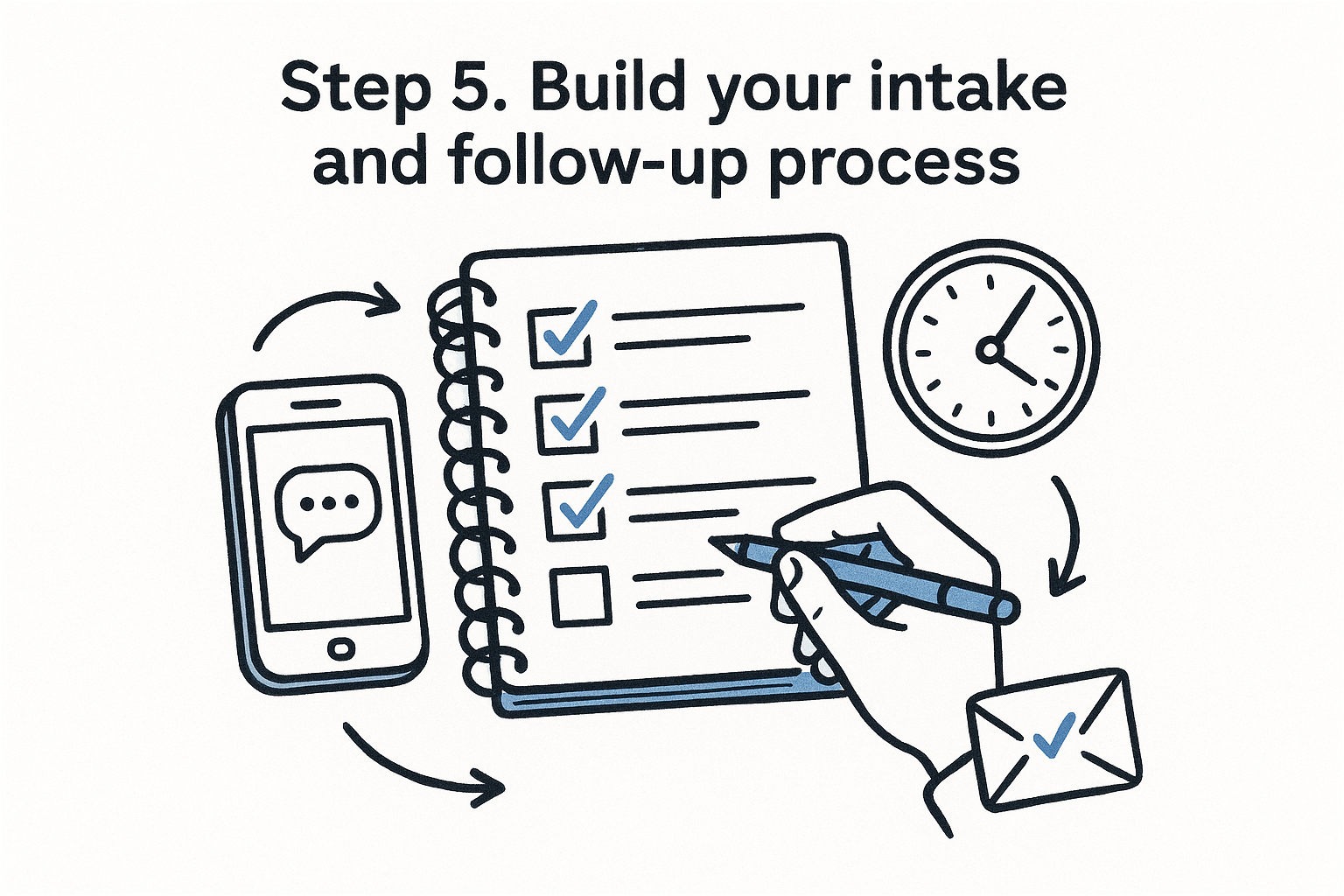
A channel mix and budget mean nothing if the leads they generate sit in a shared inbox until someone gets around to them. Your intake process is the part of the strategy that turns paid traffic into signed retainers, and it deserves as much planning as the ads that feed it. Firms that skip this step often see decent lead volume and flat case counts, then blame the marketing when the real gap is where intake breaks down in the first ten minutes after someone submits a form.
Respond within minutes, not hours
Build your intake around speed first, script second. The Lead Response Management Study found that leads contacted within five minutes are far more likely to qualify than leads first reached after thirty minutes, and legal leads are especially unforgiving because someone searching for an attorney at night is usually calling several firms back to back. Whoever texts or calls back first is often the one who gets the case, regardless of which firm has the better ad.
The firm that answers first usually signs the case, not the firm with the better ad.
Build a follow-up sequence that doesn't rely on memory
Don't leave nurturing leads who don't sign right away to whoever happens to check the intake line that day. Set an intake workflow that runs itself the moment a lead comes in, then hands off to a person once contact is made:
Immediate (0-1 min): Auto-reply SMS + email confirming receipt
5 min: Call attempt #1
15 min: Call attempt #2 + follow-up text
1 hour: Call attempt #3
24 hours: Email with next steps if no contact yet
3 days: Final check-in text before marking cold
GavelGrow's intake automation fires this kind of sequence within 60 seconds of lead capture and logs every SMS, call, and email in one thread per lead, so nobody has to piece together what already happened from three different tools.
Route leads so nothing sits untouched
Once contact is made, route the lead to the right attorney or intake specialist based on practice area and case value, not whoever is free that hour. Tag every lead as qualified, callback, unqualified, or spam as soon as you know, since that tagging is what makes Step 6's numbers accurate instead of guesswork. A legal intake process that skips tagging looks fine on paper right up until you try to figure out which channel actually produced your best cases.
Step 6. Track the KPIs that predict signed cases
Every step before this one only pays off if you actually look at the numbers it produces. A law firm marketing strategy without a KPI review is just a plan you hope is working. The goal here isn't to drown in dashboards, it's to watch a short list of metrics that actually predict whether a lead turns into a signed case, then act on what they tell you every month.

Watch the metrics that lead to signed cases, not just leads
Lead volume and cost per lead are the easiest numbers to pull, which is exactly why most firms stop there. The metrics that actually matter sit one or two steps further down the funnel, closer to the retainer than the click.
Cost per lead tells you what you spent. Cost per signed case tells you what you earned.
Running ads, call tracking, and intake through separate tools makes connecting each case back to its marketing source a monthly scramble of exporting spreadsheets and matching phone numbers by hand. A platform like GavelGrow's dashboard that ties ad spend to signed retainers does this automatically, so cost per signed case shows up by campaign and practice area without anyone building a spreadsheet from scratch.
Set a review cadence your team actually keeps
Picking the right KPIs only matters if someone reviews them on a fixed schedule instead of whenever a partner remembers to ask. Set a rhythm that fits how fast your practice areas move:
- Weekly: lead volume, speed to first contact, missed-call rate
- Monthly: cost per lead, lead-to-signed rate, cost per signed case by channel
- Quarterly: channel mix performance against your original case-count goal from Step 1
Feed what you find back into the earlier steps. If one channel's cost per signed case creeps up for two months straight, that's your signal to shift budget in Step 4, not a reason to wait for the next annual planning meeting.
Making your marketing strategy stick
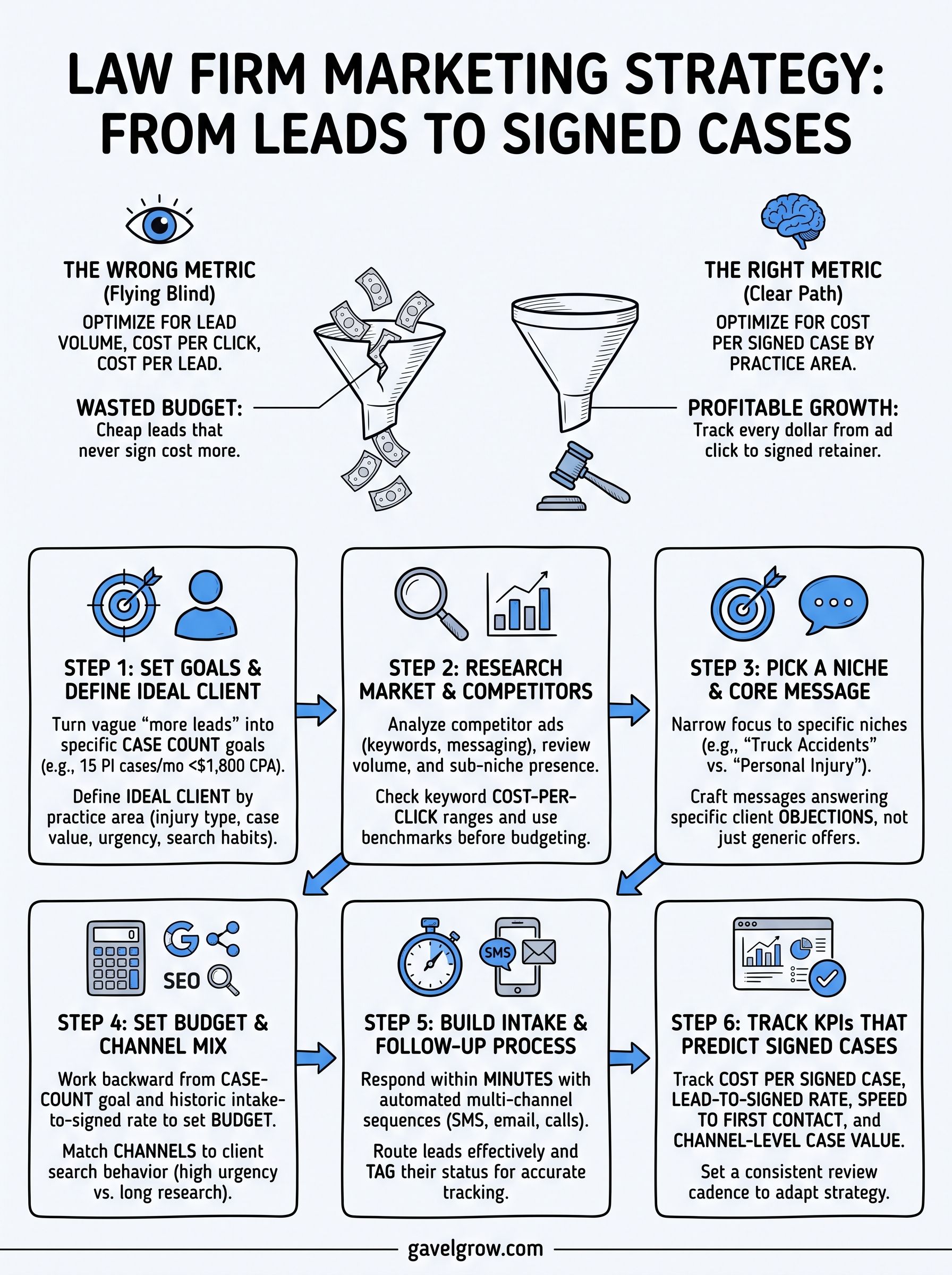
A law firm marketing strategy only works if you actually revisit it. Goals drift, competitors change their ads, and a channel that performed well last spring can quietly stop paying off. Build the six steps into a recurring habit, not a document you write once and file away: recheck your case-count goal every quarter, rerun competitor research twice a year, and let your KPI review decide where budget moves next, not a partner's gut feeling.
Getting this right without the right tooling is possible but slow, since spreadsheets and disconnected call-tracking accounts make cost per signed case hard to see clearly. If you'd rather talk through your specific practice area, budget, and channel mix with someone who's built this for other firms, talk it through on a free 45-minute strategy call with GavelGrow. You'll walk away with a plan built for your numbers, not a generic template.