First Touch vs Last Touch Attribution: A Law Firm Guide
Categories: Legal Marketing Strategies
 Abram Ninoyan
Founder & Senior Performance Marketer
Credentials: Google Partner, Google Ads Search Certified, Google Ads Display Certified, Google Ads Measurement Certified, Google Analytics (IQ) Certified, HubSpot Inbound Certified, HubSpot Social Media Marketing Certified, Conversion Optimization Certified
Expertise: Google Ads, Meta Ads, Conversion Rate Optimization, GA4 & Google Tag Manager, Lead Generation, Marketing Funnel Optimization, PPC Management
LinkedIn Profile
First touch vs last touch attribution is a choice about which marketing contact gets 100% of the credit for a signed case: the first one, or the final one before the client signs. Neither works well a...
Key Takeaways
- First Touch vs Last Touch Attribution: A Law Firm Guide
- Why does first touch vs last touch attribution matter?
- How do you compare first and last touch on your cases?
- Which model fits your firm, first touch or last touch?
First Touch vs Last Touch Attribution: A Law Firm Guide
First touch vs last touch attribution is a choice about which marketing contact gets 100% of the credit for a signed case: the first one, or the final one before the client signs. Neither works well alone for a law firm, so measure both against signed retainers and compare them before you move any budget.
Picture a client who finds your blog post on a Monday, clicks a retargeted ad on Thursday, and calls from a branded search the following week. First touch credits the blog post. Last touch credits the branded search. It is one signed case with two different stories about what is working. GavelGrow has marketed only for law firms since 2015, and this disagreement is worth settling before you read any marketing report.
This guide covers why the choice matters, how to compare both models on your own cases, where each one fits, and when to move to multi-touch attribution.
Key Takeaways
- First touch credits where a client found you; last touch credits what closed them.
- Neither model alone is enough for a firm with long, phone-heavy matters.
- Measure credit against signed retainers, not form fills or raw leads.
- Run both models side by side before changing any ad budget.
- Move to multi-touch once you have steady signed-case volume.
Why does first touch vs last touch attribution matter?
It matters because the model you read decides which channels look profitable, and that decides where your next ad dollar goes. A report built on the wrong model can make a channel that starts your cases look worthless.
The same cases, two budget decisions
Here is an illustration with made-up numbers. A firm spends $10,000 in a month and signs 10 cases, so the blended cost is $1,000 per signed case. Each model splits the credit differently.
Start with Meta. Last touch gives it zero cases, so that report says to cut it, while first touch shows it started three. Now look at Google Ads. First touch makes it your most expensive channel at about $1,333 per case, and last touch makes it your cheapest at $800. Neither report is wrong. Each answers a different question and hides the answer to the other.
A model does not measure your marketing. It decides which part of your marketing gets to look good.
Why law firms feel the gap more than most
Legal matters stretch the distance between first contact and signature. A potential client often reads, compares several firms, and calls days or weeks after the first visit. The longer that gap, the more likely the last touch is just the moment of calling, not the reason for calling.
Phone calls add a second problem. Many people never fill out a form, so a report that sees only web forms misses them in both models. Calls need tracking numbers tied to each campaign, and signed cases need to flow back to the lead record. GavelGrow's call tracking, intake and attribution features are built around that gap, and you can run your own cost per signed case math with the cost-per-acquisition calculator.
How do you compare first and last touch on your cases?
Define a signed retainer as the conversion, record every touch for each lead, then report the same signed cases twice, once by first touch and once by last touch. You need consistent records more than you need a new tool.
Start with signed retainers, not form fills
A form fill is not a client. If you credit leads, both models reward the channels that produce cheap leads, including spam and unqualified inquiries. Credit signed retainers instead, and tie each one back to the lead that started it. In GavelGrow, case management carries attribution from the originating lead through the signed retainer, and the marketing dashboard shows campaign-level cost per signed case rather than cost per lead.
Walk one client through both models
Take a driver hurt in a crash. Her path looks like this:
- Day 1: finds a blog post through organic search.
- Day 4: clicks a retargeted Meta ad and reads a practice-area page.
- Day 8: searches your firm name, clicks a Google ad, and calls a tracking number.
- Day 10: signs the retainer.
First touch gives the case to organic search. Last touch gives it to the branded Google ad. The Meta ad that brought her back gets nothing in either report, which is the case for eventually looking at the whole path.
Run both models on the same signed cases, and the channels that win in only one report are where your decisions need the most care.
Capture the data and set the lookback window
Five habits make the comparison reliable:
- Give every campaign its own tracking number and consistently tagged landing page links, so each call and visit carries its source.
- Store the first source on the lead record when it is captured and never overwrite it. Store the latest source separately each time the person returns.
- Set the lookback window longer than your usual gap between first contact and signed retainer. An inquiry that signs within a day or two needs a short window. A matter that sits for weeks needs a longer one. Many analytics tools cap the window, so check yours.
- Ask at intake how the client heard about you and record the answer. It will not match your reports perfectly, and the mismatches are informative.
- Send signed cases back to your ad platform. GavelGrow's Smart Conversions sends signed cases to Google Ads as offline conversions on Optimize and Managed, with a preview on Track. It does not change Local Services Ads bidding, because Local Services Ads cannot accept that signal.
Which model fits your firm, first touch or last touch?
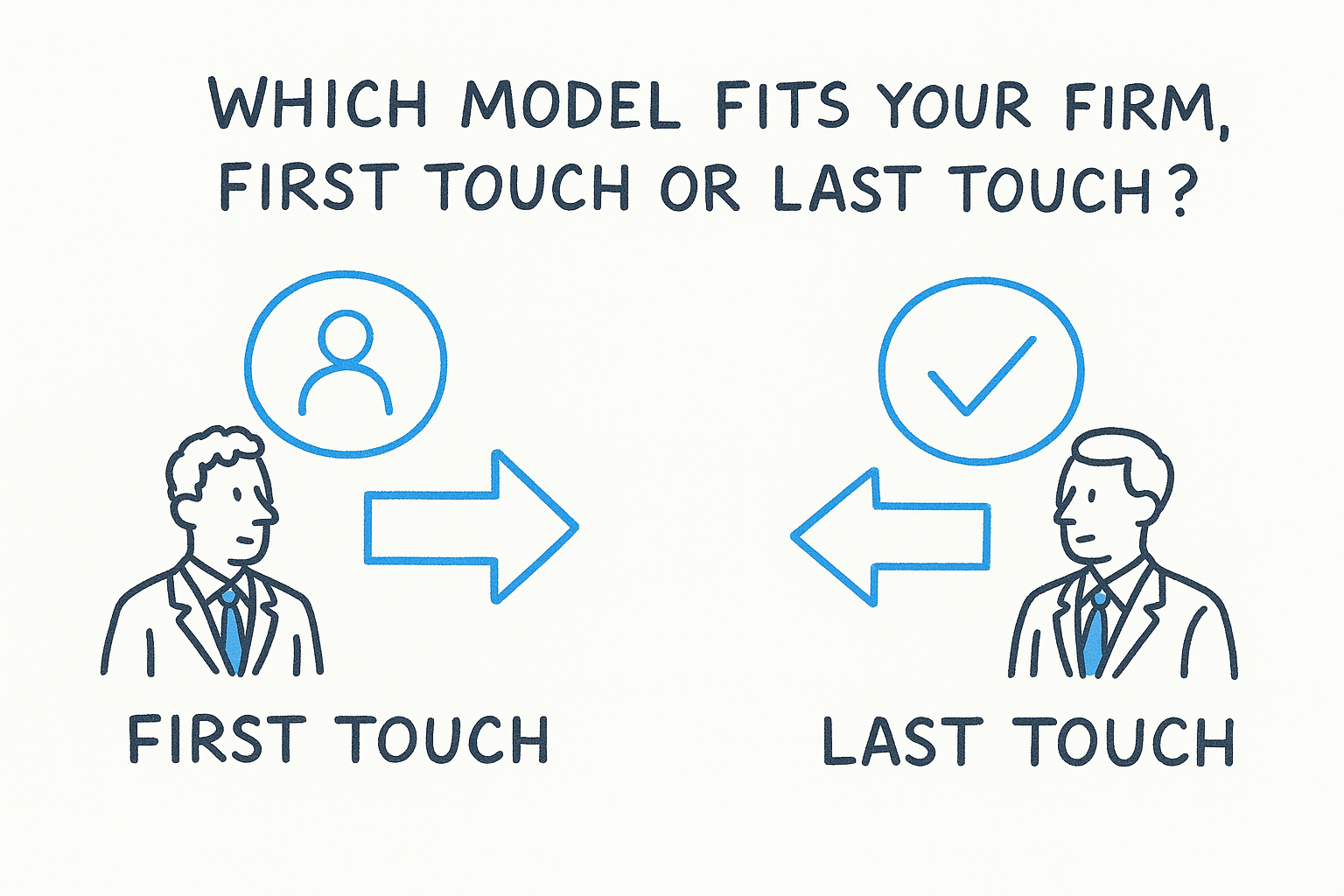
Use first touch to judge how well you find new clients, and last touch to judge how well you convert people who already know you. Most firms need both views, because they diagnose different problems.
Where first touch earns its place
First touch is simple to set up and easy to explain to partners. It fits a firm entering a new market or practice area, where the question is which channels introduce you to the right people. It also lets you compare cases by origin, for example whether cases that began with organic search are worth more than cases that began with paid social.
The weakness is everything after the first contact. Follow-up, retargeting and intake work get zero credit, so first touch pushes budget toward awareness and away from what closes cases. It also breaks when your lookback window is shorter than your sales cycle, because a middle touch can pass for the first one.
Where last touch earns its place
Last touch is just as simple and points at the action closest to the signature. It suits short matters, judging landing pages and intake performance, and checking which ads drive immediate calls.
Its main drawback is over-crediting the final click. Branded search, direct visits and the number dialed last collect credit for demand that other marketing created. The blog, video or billboard that made someone search your name shows as zero, so teams cut the awareness work that feeds everything else.
First touch and last touch side by side
A model is only wrong when you ask it a question it was never built to answer.
When should you move to multi-touch attribution?
Move once you sign enough cases each month for a split of credit to mean something, and once your single-touch reports keep disagreeing about your biggest channels. Before that, running first and last touch side by side is the better choice.
The main multi-touch models in plain terms
Multi-touch attribution spreads credit across several contacts instead of one. Four models cover most of what you will meet:
- Linear: every touch gets equal credit.
- Time decay: touches closer to signing get more credit.
- Position-based (U-shaped): the first and last touch get the largest shares, commonly 40% each, and the middle touches split the rest.
- Data-driven: software estimates credit from the conversion patterns in your account, which needs steady volume to be reliable.
Each one still rests on the tracking described above. A multi-touch model fed incomplete paths, with calls missing or sources overwritten, only spreads bad data across more touches.
Signs you have outgrown single-touch
You are probably ready when most of these are true:
- Your first and last touch reports rank the same channel very differently.
- Most signed cases involve three or more contacts, such as an ad, a site visit and a call.
- You sign a steady number of cases every month, not a handful.
- You are about to move a meaningful share of your budget.
Even then, treat the model as a guide. Test a budget change with a small shift and watch signed cases, not the model's output, to confirm what it told you.
Let a model suggest the experiment, and let your signed cases decide the result.
Frequently Asked Questions
What is first touch vs last touch attribution?
First touch gives 100% of the credit for a signed case to the first recorded contact, such as an organic search visit. Last touch gives 100% to the final contact before signing, such as a call after a branded search. Both are single-touch models, so they ignore every contact in between. The useful comparison for your firm is the same set of signed retainers reported under each model.
Both models are right about their one touch and silent about every other.
What is the drawback of last touch attribution?
Last touch over-credits the final step and gives zero credit to everything that built demand earlier. Branded search, direct visits and the last phone number dialed collect the credit, so budget drifts away from content, social and other awareness work. For a law firm there is a second risk: if the final touch is a phone call and your reports do not track calls, that case may not show up at all.
What is the best attribution setting for Facebook ads?
No single setting is best, because Meta's reports only see touches that happened on Meta. Choose a window that matches the gap between click and signed retainer in your own case records, then compare Meta's numbers with your lead and case data. If Meta reports leads that never sign, trust your signed cases over the platform's count.
How long should a lookback window be for a law firm?
Longer than your usual gap between first contact and signed retainer. Pull the dates from your case records, find the median number of days from lead created to retainer signed, and add a buffer so most cases fall inside the window. Many analytics tools cap the window, so check the limit in yours before you rely on first touch.
Does attribution count leads who only call?
It does when calls are tracked to a campaign. With GavelGrow, every call to a tracking number is recorded and credited to its campaign, and every tracked call opens with a recording notice. Track includes 2 call tracking numbers and Optimize includes 10, and extra numbers are $10 per month. Without per-campaign numbers, phone-only leads vanish from both models.
Pick the question before the model
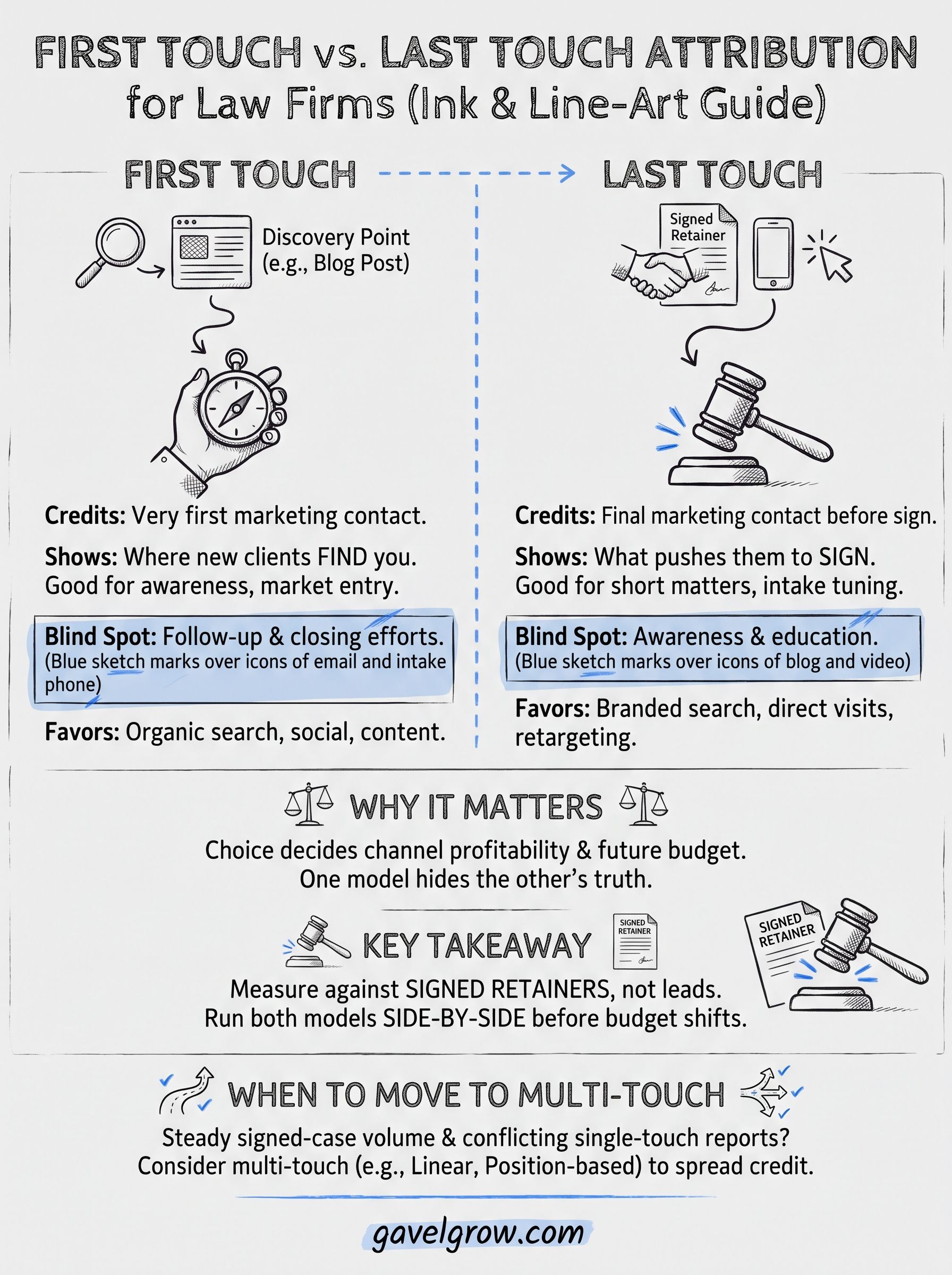
First touch tells you how clients find you, last touch tells you what closes them, and neither tells you the whole story. Credit signed retainers, record every contact, run both reports on the same cases, and move to multi-touch when your volume and your questions justify it.
If you would rather not stitch call tracking, intake and attribution together yourself, you can try GavelGrow's platform free for 7 days, with no credit card required, and see which campaigns your signed cases came from.
Frequently Asked Questions
What is first touch vs last touch attribution?
First touch gives 100% of the credit for a signed case to the first recorded contact, such as an organic search visit. Last touch gives 100% to the final contact before signing, such as a call after a branded search. Both are single-touch models, so they ignore every contact in between. The useful comparison for your firm is the same set of signed retainers reported under each model. Both models are right about their one touch and silent about every other.
What is the drawback of last touch attribution?
Last touch over-credits the final step and gives zero credit to everything that built demand earlier. Branded search, direct visits and the last phone number dialed collect the credit, so budget drifts away from content, social and other awareness work. For a law firm there is a second risk: if the final touch is a phone call and your reports do not track calls, that case may not show up at all.
What is the best attribution setting for Facebook ads?
No single setting is best, because Meta's reports only see touches that happened on Meta. Choose a window that matches the gap between click and signed retainer in your own case records, then compare Meta's numbers with your lead and case data. If Meta reports leads that never sign, trust your signed cases over the platform's count.
How long should a lookback window be for a law firm?
Longer than your usual gap between first contact and signed retainer. Pull the dates from your case records, find the median number of days from lead created to retainer signed, and add a buffer so most cases fall inside the window. Many analytics tools cap the window, so check the limit in yours before you rely on first touch.
Does attribution count leads who only call?
It does when calls are tracked to a campaign. With GavelGrow, every call to a tracking number is recorded and credited to its campaign, and every tracked call opens with a recording notice. Track includes 2 call tracking numbers and Optimize includes 10, and extra numbers are $10 per month. Without per-campaign numbers, phone-only leads vanish from both models.