Law Firm Advertising Rules by State: 5 Rulebooks to Know
Categories: Legal Marketing Strategies
 Abram Ninoyan
Founder & Senior Performance Marketer
Credentials: Google Partner, Google Ads Search Certified, Google Ads Display Certified, Google Ads Measurement Certified, Google Analytics (IQ) Certified, HubSpot Inbound Certified, HubSpot Social Media Marketing Certified, Conversion Optimization Certified
Expertise: Google Ads, Meta Ads, Conversion Rate Optimization, GA4 & Google Tag Manager, Lead Generation, Marketing Funnel Optimization, PPC Management
LinkedIn Profile
The law firm advertising rules by state share one backbone, ABA Model Rules 7.1, 7.2 and 7.3, and each state then adds its own requirements on top. Every state bans false or misleading claims and live...
Key Takeaways
- Law Firm Advertising Rules by State: 5 Rulebooks to Know
- Which advertising rules do nearly every state share?
- 1. California: what do the SB 37 changes require?
- 2. Florida: filing, labels, and the 30-day rule
Law Firm Advertising Rules by State: 5 Rulebooks to Know
The law firm advertising rules by state share one backbone, ABA Model Rules 7.1, 7.2 and 7.3, and each state then adds its own requirements on top. Every state bans false or misleading claims and live solicitation of people who need a lawyer. The extras are where firms get caught: bar filing, mandatory labels, past-results disclaimers, record retention and post-accident waiting periods. California suits firms that cite awards or results. Florida and Texas matter most if you run ads or letters that need bar review. New York suits direct-response firms, and New Jersey suits firms that lean on comparisons and specialist credentials.
If you run a firm or its marketing, you cannot hand an agency one rulebook. An ad that passes in one state may need a label in New York, a filing in Florida and an award badge removed in California. A bar complaint can start from a single footer line.
This guide sets out the shared baseline, then five state rulebooks, then a method for checking any other state. GavelGrow has marketed only for law firms since 2015, so we write from the marketing side: what your ads, forms and mailers have to carry. This is not legal advice. Rules change, so confirm every point against your own state bar's current text.
Which advertising rules do nearly every state share?
Nearly every state starts from the same three rules: Rule 7.1 bans false or misleading communications, Rule 7.2 allows advertising through any written, recorded or electronic channel, and Rule 7.3 restricts live solicitation. Learn this baseline first, because every state rulebook below is a variation on it.
The Model Rules baseline
The ABA Model Rules of Professional Conduct are a template, not binding law. Each state supreme court decides what to adopt, so the numbering and wording in your state will differ. The table shows the baseline and where states usually add to it.
Where states pull apart
Since Bates v. State Bar of Arizona (1977), truthful lawyer advertising has been protected commercial speech. States can still regulate ads that are misleading, and they do it in different ways. Four differences drive most compliance mistakes:
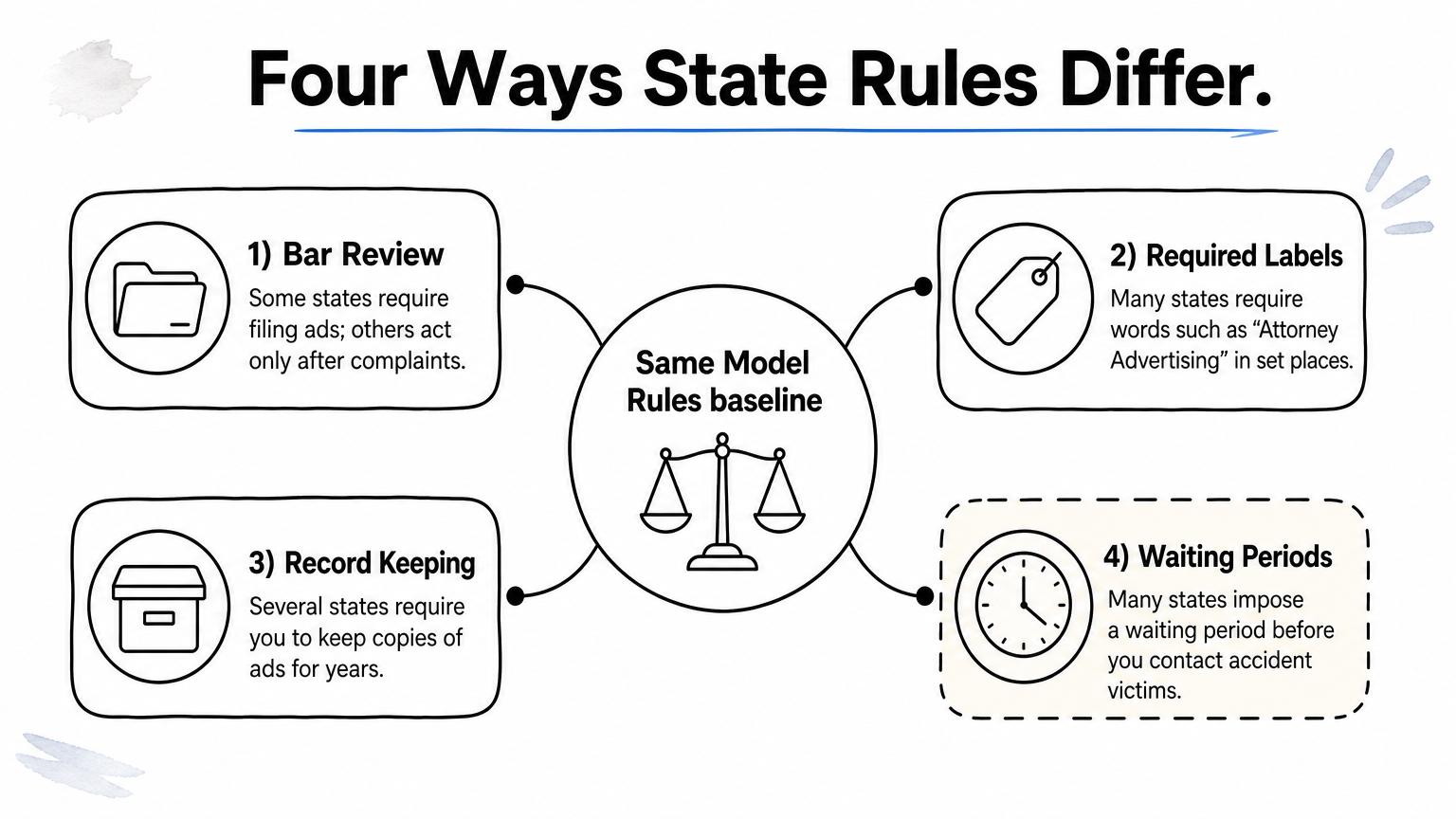
- Review: some states want ads filed with the bar, others investigate only after a complaint.
- Labels: many states require words such as "Attorney Advertising" in set places.
- Records: several states require you to keep copies of ads for years.
- Timing: many states impose a waiting period before you contact accident victims.
The Model Rules tell you the rule of thumb, but only your state's text tells you what to put on the page.
1. California: what do the SB 37 changes require?
California now has the heaviest financial penalties of the five states here. Senate Bill 37 took effect on January 1, 2026, and it changed both what ads must say and how violations are punished.

What the rules require
California regulates lawyer advertising through Rules of Professional Conduct 7.1 to 7.3 and the State Bar Act, Business and Professions Code sections 6157 to 6158.9. For your marketing, these points matter most:
- You may not describe your skills, experience or record with misleading, false or deceptive statements.
- You may not cite recognition or an award that was conditioned on paying a fee, cost or other payment.
- Ads must disclose the city, town or county of at least one bona fide office, or the office address listed with the State Bar.
- Results messages without adequate context are presumptively misleading, and depictions of injuries or accident scenes need appropriate disclaimers.
- For an ad found in violation, statutory damages run from $5,000 to $100,000 per unique advertisement, or three times actual damages if larger, plus attorney fees and injunctive relief.
In California, an award you paid to receive is an award you cannot advertise.
What to do before you publish
Start with an award and badge audit. For every badge on your site and in your ads, ask whether the organization required a payment as a condition of the recognition. Remove any that did. Then add the office disclosure to your ads and site footer.
Next, count your unique ads, because the penalty attaches per unique advertisement. This is arithmetic, not a prediction: 12 unique ads found in violation would carry statutory damages from $60,000 (12 × $5,000) to $1,200,000 (12 × $100,000), or three times actual damages if that is larger. Every extra ad variant adds exposure.
2. Florida: filing, labels, and the 30-day rule
Florida is the state most associated with sending ads to the bar for review. Its rules sit in a long, detailed subchapter, so a firm copying a template from another state will usually miss something.

What the rules require
Florida regulates lawyer advertising in Subchapter 4-7 of the Rules Regulating The Florida Bar. The points that trip up multi-state firms:
- Filing: most advertisements must be filed with The Florida Bar for review, with exemptions for some basic content. Confirm the current timing and exemptions in the rule.
- Identification: ads should name a responsible lawyer or the firm and give an office location.
- Quality claims: statements that characterize the quality of your services must be objectively verifiable, so adjectives like "aggressive" or "caring" invite scrutiny.
- Direct mail: targeted mailers must carry the advertising label the rule prescribes. Copy the exact wording from the rule text.
- Waiting period: Florida bars targeted written solicitation of accident or disaster victims and their families for 30 days, a restriction the U.S. Supreme Court upheld in Florida Bar v. Went For It (1995).
In Florida, the question is not only whether your ad is truthful but whether the Bar has had the chance to review it.
What to do before you publish
Keep a Florida filing log with one row per ad: version, date first used, date filed and the reply you received. Treat the filing step like a court deadline, not a marketing afterthought, because a missed filing is easy to prove and hard to explain.
For mailers, pull the label wording from the current rule rather than from an old template. Put the 30-day window in your campaign calendar so your mail vendor's earliest send date falls after it closes.
3. Texas: what must you file with the State Bar?
Texas pairs a numbered set of advertising rules with a bar department that reviews filings. It also has criminal exposure for improper solicitation, which most other states do not emphasize.
What the rules require
Texas advertising rules sit in Part VII of the Texas Disciplinary Rules of Professional Conduct, rules 7.01 to 7.07, which cover firm names, communications, public media ads, written and electronic solicitations, and filing requirements. In practice:
- Filing: most public advertising and many solicitation letters must be filed with the State Bar's advertising review staff, with a fee and a short deadline measured from first use. Confirm the current deadline and exemptions.
- Competence: you must be competent in the field of law you advertise.
- Specialization: you cannot say you are specialized or certified without holding the credential the rules recognize.
- Solicitation: targeted letters and electronic messages carry mandatory labels and wording, and rule 7.05 limits what you can send to accident victims.
- Criminal law: Texas Penal Code section 38.12 (barratry) reaches improper solicitation, so in-person and phone outreach to injured people deserves extra caution.
A Texas ad is not finished when it is designed; it is finished when it is filed.
What to do before you publish
Give someone ownership of the Texas filing step, and make it part of your launch checklist for every new ad, letter and landing page. A campaign that goes live on Monday with no filing is the kind of gap a competitor's complaint will find.
If you advertise in Texas and elsewhere, check specialist language first. Phrases like "board certified" or "specialist" are the claims most likely to need a named credential, and they are easy to remove from copy if you cannot support them.
4. New York: labels, disclaimers, and record keeping
New York's rulebook reads like a checklist, which makes it a useful model for any firm that wants a repeatable ad review process.
What the rules require
New York's rules sit in Rules of Professional Conduct 7.1 to 7.5 (22 NYCRR Part 1200). The distinctive requirements:
- Label: advertisements must carry the words "Attorney Advertising", in the placement the rule specifies.
- Past results: a statement about prior results must be accompanied by the disclaimer "Prior results do not guarantee a similar outcome."
- Office information: ads must include your principal law office address and telephone number.
- Pre-approval and retention: a lawyer in the firm must approve each ad before it runs, and you must keep a copy for at least three years after dissemination.
- Solicitation: targeted solicitations must be filed with the attorney disciplinary committee for your district, and solicitation tied to a specific personal injury or wrongful death incident is barred for 30 days after the incident, with narrow exceptions.
New York turns ad compliance into paperwork: a label, a disclaimer, an approval and a file.
What to do before you publish
Create a one-page ad approval form that records the approving lawyer, the date and the version. Pair it with an archive of every ad that ran, including web pages, social posts and paid creative. If your ad accounts are in your firm's name, platform history gives you part of that record, but screenshots of final creative are safer.
Check every results statement for the disclaimer, including video captions and short social posts. Short formats are where the disclaimer usually gets cut for space.
5. New Jersey: what do the claims rules limit?
New Jersey's rules focus on what you say about yourself compared with other lawyers. If your copy relies on "more experienced" or "proven record" language, this is the rulebook to read slowly.
What the rules require
New Jersey regulates lawyer advertising through Rules of Professional Conduct 7.1 to 7.5. The points that matter for marketing:
- Comparisons: you may not compare your services with other lawyers' services unless the comparison can be factually substantiated.
- Expectations: you may not create an unjustified expectation about results, even with statements that are literally true.
- Identification: ads must name at least one responsible attorney and give an office location.
- Records: New Jersey keeps the requirement to retain a copy or recording of each ad, for three years, with a record of when and where it ran.
- Specialties: the New Jersey Supreme Court certifies attorneys in select practice areas, and RPC 7.4 controls how you may state a credential. Use "certified" only for credentials the rule recognizes.
In New Jersey, a true statement can still be a violation if it makes clients expect more than you can promise.
What to do before you publish
Substantiate every comparison you cannot delete. Keep the evidence file next to the ad: what the claim means, where the number came from and the date you checked it. Most firms find that half their comparative language disappears at this step.
Then rewrite results language around what you handled rather than what clients should expect. "We handle serious injury cases" is a description. "We win big for clients" is an expectation.
How do you check the rules for any other state?
To check any other state, read its supreme court's published rules (usually Rules 7.1 to 7.5 or the state's equivalent) and then its bar's advertising and ethics pages. The five states above are examples of the variations you will meet, not a complete list.
Start with primary sources
Use these sources, in this order:
- The rule text on your state supreme court or bar website, not a summary on a vendor page.
- The bar's advertising or ethics page, which often lists filing requirements, labels and forms.
- Ethics opinions on websites, social media, lead generation and testimonials.
- The bar's ethics hotline, if it has one, for questions your own reading cannot settle.
Run a pre-publication checklist
Before any ad, mailer, landing page or social post goes live, run this list:
- Does it name the responsible lawyer and an office location where your state requires them?
- Does it carry the right label, such as "Attorney Advertising"?
- Does every results statement have your state's disclaimer, or no results statement at all?
- Is every claim verifiable, with superlatives like "best" removed?
- Is every specialist or certification claim backed by a recognized credential and named properly?
- Has the ad been filed or approved where your state requires it, and is a copy archived?
- For targeted outreach, have you checked the waiting period and the solicitation limits?
Plan multi-state campaigns around the strictest rule
If an ad reaches people in several states, draft to the strictest rule that applies and then trim only where counsel confirms you can. It is cheaper than running state-specific versions of every ad.
Bar rules are one layer. Texting and call recording are another. GavelGrow's platform keeps a TCPA consent audit log on hosted intake forms and opens every tracked call with a recording notice, but it does not replace a review by your bar counsel. On managed engagements, our legal-only team holds every ad asset for your review before it runs, which gives your approving lawyer a built-in checkpoint.
Draft to your strictest state, then loosen only with counsel's sign-off.
Check your own rulebook before you publish
Law firm advertising rules by state agree on the basics: be truthful, do not mislead, do not solicit live. They differ on labels, filings, disclaimers, records and waiting periods, and those differences carry the real risk. California penalizes per unique ad, Florida and Texas put ads in front of the bar, New York wants labels and records, and New Jersey polices claims and comparisons.
Read your own state's current rule text, run the checklist on every ad, and keep an archive. If you want a second set of eyes on how your marketing, intake forms and ad approvals fit together, book a free strategy call with GavelGrow.