How to Build a Law Firm Branding Strategy That Fits
Categories: Legal Marketing Strategies
 Abram Ninoyan
Founder & Senior Performance Marketer
Credentials: Google Partner, Google Ads Search Certified, Google Ads Display Certified, Google Ads Measurement Certified, Google Analytics (IQ) Certified, HubSpot Inbound Certified, HubSpot Social Media Marketing Certified, Conversion Optimization Certified
Expertise: Google Ads, Meta Ads, Conversion Rate Optimization, GA4 & Google Tag Manager, Lead Generation, Marketing Funnel Optimization, PPC Management
LinkedIn Profile
Walk into five personal injury firm websites in your city and you'll see the same stock photo of a handshake, the same tagline about "aggressive representation," and the same navy-and-gold c...
Key Takeaways
- How to Build a Law Firm Branding Strategy That Fits
- Why your law firm needs a branding strategy that fits
- Step 1. Define your ideal client and practice positioning
- Step 2. Craft your core message and value proposition
How to Build a Law Firm Branding Strategy That Fits
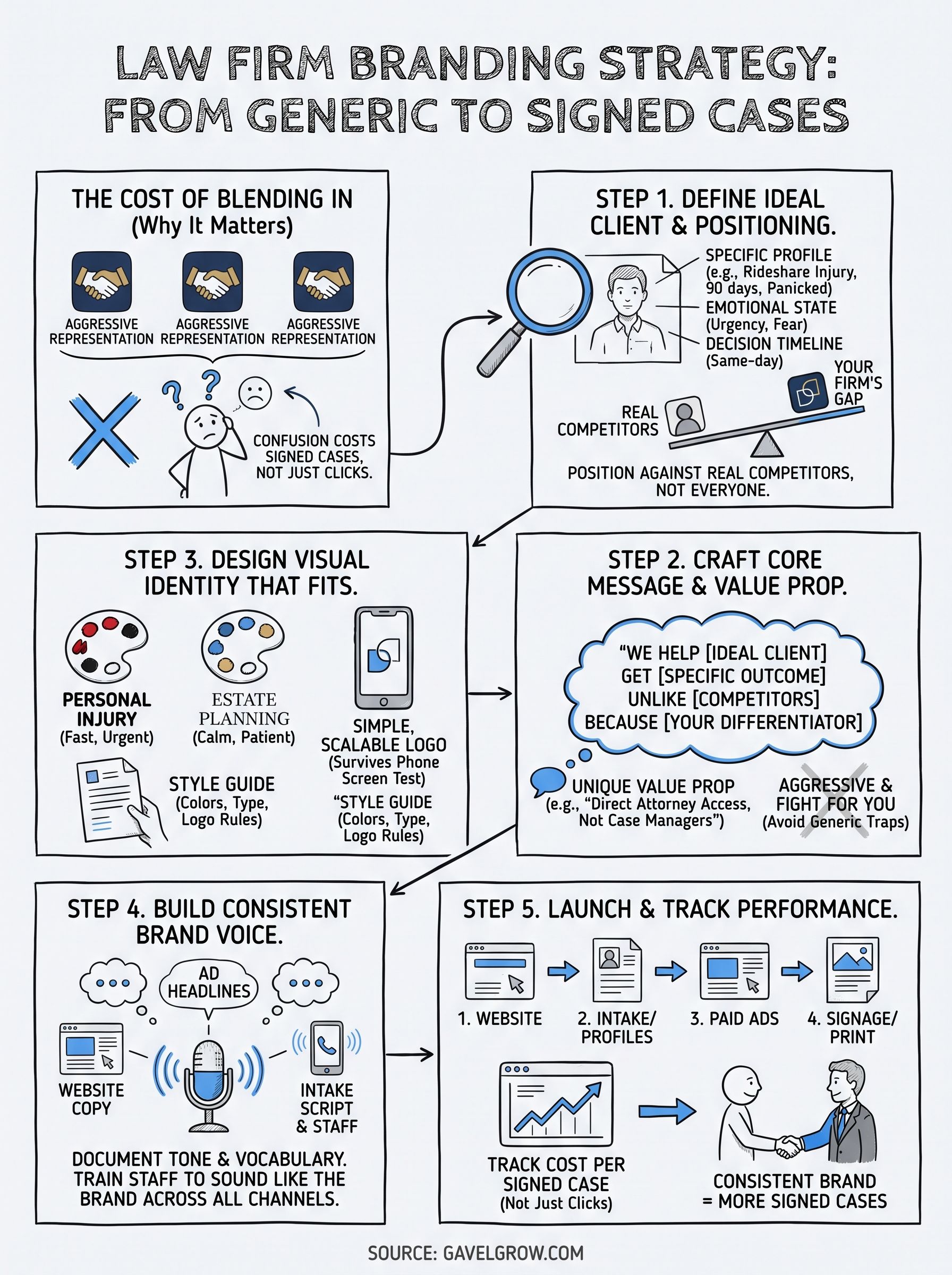
Walk into five personal injury firm websites in your city and you'll see the same stock photo of a handshake, the same tagline about "aggressive representation," and the same navy-and-gold color scheme. That sameness is exactly why law firm branding matters more than most managing partners assume. When clients can't tell your firm apart from the one down the street, that confusion costs you signed cases, not just clicks on an ad.
A branding strategy that fits your firm connects your messaging and visual identity to how prospective clients actually make decisions under stress, whether they're searching for a divorce lawyer at midnight or calling around after an accident. Done right, it shapes everything from your logo to your intake script, and it should tie directly into your marketing execution, not sit in a separate binder nobody opens.
This guide walks through how to build that strategy step by step, with practical examples from real practice areas and guidance on keeping your brand consistent across your website, ads, and intake process, so the identity you build actually shows up in case attribution, not just in how the website looks.
Why your law firm needs a branding strategy that fits
The cost of a brand that blends in
Generic branding doesn't just look forgettable, it actively costs you money. When your law firm brand identity is indistinguishable from three competitors in the same practice area, prospective clients default to whoever shows up first or cheapest, and that usually means a price-shopping conversation instead of a trust-based one. Firms with a fitted legal brand strategy see the opposite effect: clients arrive already leaning toward hiring them because the messaging matched what they were feeling when they searched. That difference shows up directly in your marketing dashboard as a lower cost per signed case, not just a nicer-looking website.
Branding shapes trust before a client ever calls
Before anyone dials your office, they've already formed an opinion of your firm from your website copy, your Google Business Profile photos, and the tone of your ads. A strong brand identity that builds lasting authority answers the unspoken question every stressed client asks: can I trust this firm with something this serious? Personal injury clients want confidence and urgency. Family law clients want calm and discretion. Estate planning clients want patience and clarity. Get the tone wrong and you lose them before intake even starts.
A law firm's brand isn't the logo, it's the first impression that decides whether a scared or angry client picks up the phone.
Consistency ties your brand to signed cases, not just clicks
Consistency is where most firms quietly fail. The website says one thing, the Google Ads copy says another, and the intake form asks questions in a tone that doesn't match either. Every disconnect is a small trust leak, and stressed clients notice leaks. A law firm marketing strategy built on one clear brand voice removes that friction at each touchpoint:
- Website and landing pages: same value proposition, same tone, every page
- Paid ads (Google Ads, Local Services Ads, social): headlines that echo the site's promise, not generic "call now" copy
- Intake forms and SMS sequences: language that sounds like the same firm the client just read about
- Call scripts: staff trained to reinforce the same positioning, not wing it
When those pieces line up, attribution gets cleaner too. You can actually trace a signed case back to the campaign and message that resonated, instead of guessing which ad "probably" worked. GavelGrow's full-funnel marketing dashboard for law firms is built around that kind of view, tying brand messaging to the campaigns that actually produce retainers rather than raw lead counts.
Different practice areas need different brand signals
Personal injury, family law, and estate planning clients are searching under wildly different emotional states, and your brand needs to reflect that rather than applying one tone across every page.
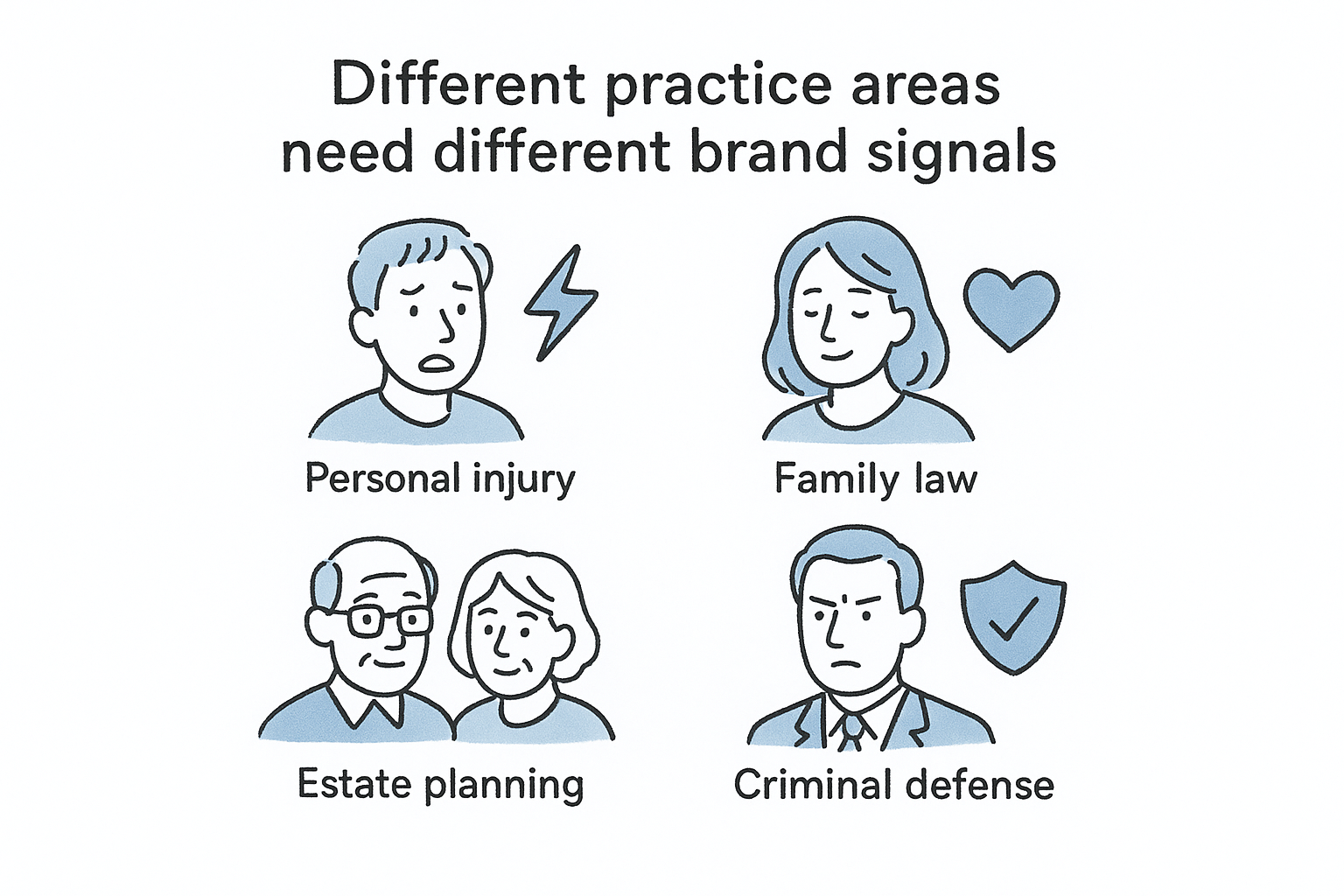
Treating every practice area the same is one of the fastest ways to waste ad spend on a message that never lands. If your firm handles multiple practice areas, each one may need its own sub-brand tone even under a shared visual identity, and marketing built around a specific practice area is where that distinction usually starts. Firms that run marketing through GavelGrow's managed marketing team often start exactly here, aligning brand tone by practice area before a single ad goes live.
Step 1. Define your ideal client and practice positioning
Start by naming exactly who you want calling your office, not a vague "anyone with a legal problem." A defined ideal client for a personal injury firm might be someone injured in a rideshare accident within the last 90 days who hasn't hired a lawyer yet, not "accident victims" broadly. That specificity changes your ad targeting, your website copy, and even which practice-area pages you build out first. Firms that skip this step end up with a law firm brand identity that tries to speak to everyone and ends up resonating with no one.
Get specific about who you actually want to serve
Write down the client profile in concrete terms before you touch a logo or tagline. Include the details that actually change how you market:
- Practice area and sub-niche: mass tort vs. single-incident auto accidents, contested divorce vs. uncontested
- Case value range: whether you're built for high-value litigation or high-volume smaller claims
- Emotional state at time of search: panicked, angry, embarrassed, financially desperate
- Decision timeline: same-day urgency versus weeks of research
- Geography: single-market local reach or statewide/nationwide intake
If you can't describe your ideal client in one sentence, your marketing can't speak to them either.
Position against your real competitors, not everyone in the market
Positioning only works when you know who you're actually up against for that specific client, not every firm in your practice area citywide. Size up the three or four firms your prospective clients most likely compare you to, based on who ranks for the same searches and who runs ads on the same keywords, and identify the gap you fill better than they do. Maybe they're volume shops with call centers and you offer direct attorney access. Maybe they're generalists and you're the only firm in your market that handles nothing but workers' comp. That gap becomes the foundation of your practice area positioning.
Note where your state bar's advertising rules apply here too. Comparative claims and superlatives like "best" or "top" carry real restrictions in most states, so build your positioning around what makes you different, not unverifiable claims about being the best option in your market. Check your own state bar's advertising rules, and see what a compliant law firm ad can actually claim, before finalizing any positioning language that touches on comparisons or results.
Step 2. Craft your core message and value proposition
Once you know exactly who you're targeting, boil that down into a single sentence you could say out loud to a stressed prospective client on the phone. Your core value proposition isn't a tagline for the homepage banner, it's the answer to "why should I hire you instead of the firm I found five minutes ago on Google?" If your team can't recite it consistently, your website copy and your intake calls will drift apart, and that drift is exactly the kind of inconsistency that erodes trust before a case ever signs.
Turn your positioning into one core message
Building this sentence gets easier with a simple formula you fill in using the specifics from Step 1:
We help [ideal client] who [specific situation/pain point]
get [specific outcome or process advantage]
unlike [generalist competitors], because [your real differentiator].
An example for a workers' comp firm might read: "We help injured warehouse workers who've had a claim denied get direct attorney access from day one, unlike volume firms that hand cases to paralegals, because we only handle workers' comp appeals." That sentence isn't advertising copy yet, but it's the spine every headline, page, and script should trace back to.
If your firm's value proposition could be copied word-for-word onto a competitor's site, it isn't a value proposition yet.
Avoid the traps that make every firm sound the same
Generic phrases like "aggressive representation" or "we fight for you" show up on so many legal websites that they've stopped meaning anything to a reader comparing options at 11pm. Skip them in favor of specifics: response time, direct attorney contact, case results process, or a niche focus your competitors don't claim. Also watch your state bar's advertising rules here, since results-based claims and superlatives carry real restrictions in most states, so lean on process and access differentiators instead of unverifiable outcome promises.
Test the message where clients actually meet it
Before you commit the wording everywhere, run it through your intake forms and landing pages, your Google Ads headlines, and your first-call script, and see whether it sounds natural in all three. GavelGrow's platform lets you connect that messaging directly to lead capture and call tracking, so you can see which version of the value proposition actually turns leads into signed cases before you lock it into your visual identity in the next step.
Step 3. Design a visual identity that fits your firm
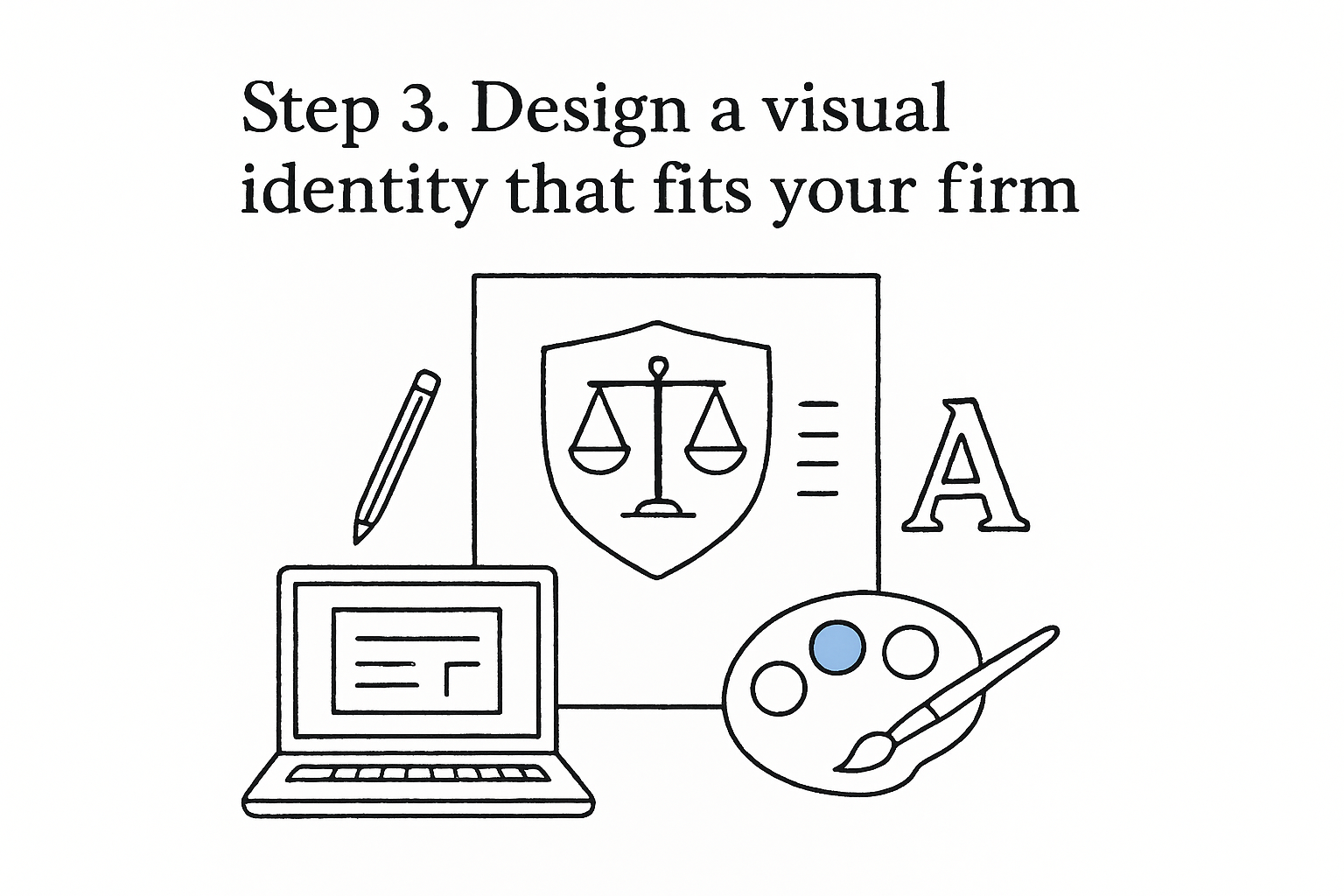
Once your message is locked, your visual identity has one job: signal that message at a glance before anyone reads a word of copy. Good law firm branding never starts with a logo, it starts with the positioning you already defined in Step 1, then translates it into color, type, and imagery a scared or angry prospect can process in under three seconds on a phone screen.
Pick colors and type that match how clients feel, not what looks impressive
Color carries meaning before language does, and legal audiences read it fast. Deep navy and gold read as established and safe, which works for estate planning but can feel slow for a personal injury firm trying to signal urgency. Warmer reds and bold sans-serif type push energy and speed, which fits accident and criminal defense work but can feel aggressive on a family law site. Match the palette to the emotional signal you mapped earlier:
A logo that looks great in a design mockup but confuses a scared client is a bad logo, no matter how clean it is.
Build a logo that survives a phone screen and a courthouse sign
Skip anything with fine detail, gradients, or more than two colors. Your logo has to hold up shrunk down to a favicon, printed on a courthouse directory, and stamped on a car wrap, so simplicity beats cleverness every time. Test any concept at 32 pixels before you approve it. If it turns into a blur, it fails the test regardless of how it looks on a full-size mockup.
Apply the system everywhere a client sees you
Once you settle on colors, type, and logo, document them in a one-page style guide and hand it to everyone touching your marketing, including your web developer, ad designer, and whoever manages your Google Business Profile photos. Consistency here matters more than any individual design choice, because a mismatched visual identity across your website built to turn visitors into signed clients, ads, and signage recreates the same trust leak that inconsistent messaging causes. If your firm works with GavelGrow's agency services, your designer can build campaign creative directly against that style guide so every ad matches the site a lead lands on next.
Step 4. Build a consistent brand voice and messaging
Visual identity gets clients to stop scrolling, but brand voice is what keeps them reading and eventually dialing your number. Voice is the specific words, sentence length, and tone your firm uses everywhere it talks, from your homepage headline to the text message a lead gets 30 seconds after filling out a form. A firm that looks sharp but sounds like a template in every channel still confuses prospective clients, because the mismatch between polish and personality reads as inauthentic.
Write a brand voice guide your whole team can use
Document the voice the same way you documented colors and type in Step 3, with concrete rules instead of vague adjectives like "professional" or "friendly." A usable guide answers questions your web copywriter, ad manager, and front-desk staff will all face:
- Sentence length: short and direct for personal injury urgency, or longer and measured for estate planning reassurance
- Words to use: "free case review," "direct attorney access," "same-day callback"
- Words to avoid: "aggressive," "fight for you," and other phrases every competitor already claims
- Point of view: first person plural ("we handle") versus attorney-led ("I personally review")
- Reading level: aim for a level a stressed client can process on a phone screen, not a brief written for a judge
Your brand voice isn't what you sound like in a partner meeting, it's what you sound like to someone who's scared and skimming your site at midnight.
Match voice to channel without losing consistency
Your Google Ads headline, your hosted intake form, and your call script all need the same voice even though the format changes. A form question can be shorter and more direct than a homepage paragraph, but it shouldn't introduce a different personality. GavelGrow's legal intake automation sends SMS and email sequences within 60 seconds of lead capture, and that speed only builds trust if the wording matches the tone the lead just read on your ad and landing page.
Train intake and call staff to sound like the brand
Writing the guide accomplishes nothing if the person answering your phones improvises. Share the voice guide in onboarding, review actual call recordings against it monthly, and correct drift early. Zealous, warm, and calm are all valid brand voices, but only if every staff member delivers the same one your marketing already promised.
Step 5. Launch your brand and track how it performs
Rolling out a new brand strategy all at once, across your website, ads, signage, and intake scripts, invites chaos and mismatched messaging in the transition window. A phased launch protects the consistency you just built in Steps 3 and 4, and it gives you a chance to catch a tone or visual mismatch before it reaches every channel at full volume. Treat launch as a sequence, not a single event.

Roll out your brand in phases, not all at once
Sequence the rollout so each piece reinforces the last instead of confusing existing clients and referral sources:
- Website first: update copy, colors, and logo on the core pages before touching ads
- Google Business Profile and intake forms next: match the new voice and visual system clients see immediately after clicking an ad
- Paid campaigns third: refresh Google Ads, Local Services Ads, and social creative to echo the new site
- Signage, print, and staff scripts last: physical assets take longer to update and matter less to the first impression than digital touchpoints
Track brand performance against cost per signed case
A brand refresh means nothing if you can't see whether it actually changed how prospects behave. Watch cost per signed case by campaign before and after launch, not just click volume or form fills, since a rebranded law firm that generates more leads at the same conversion rate hasn't actually improved anything. GavelGrow's marketing dashboard ties each campaign's messaging back to signed retainers, so you can see whether the new value proposition from Step 2 is closing more cases or just attracting more clicks.
A brand launch that doesn't change your cost per signed case is a redesign, not a strategy.
Revisit your brand as your firm grows
Your positioning from Step 1 should get reviewed every year or whenever your firm adds a new practice area, expands into a new market, or notices its ideal client has shifted. Firms that treat branding as a one-time project let the visual identity and messaging drift out of sync with who they actually serve now. If you're evaluating whether your current setup supports that kind of ongoing tracking, GavelGrow's monthly plan tiers break down which one gives you the reporting depth to keep measuring brand performance as your firm changes.
Frequently asked questions about law firm branding
Should a law firm brand around the partners' names or a separate firm name?
Both work, and the choice is strategic rather than aesthetic. Named-partner branding builds on reputation an attorney already has and suits practices where clients hire a specific person. A separate brand name travels better if you plan to add partners, sell the practice, or grow past the founders — a firm named for two people becomes awkward when there are nine.
Will changing our firm name hurt our search rankings?
It can, temporarily, and the damage is mostly avoidable. Rankings are tied to the domain and its history, so keep the same domain if you can. If you must move, map every old URL to its replacement with permanent redirects, update your Google Business Profile and legal directory listings, and expect a period of fluctuation before things settle.
Can a small firm compete with a larger firm's brand?
Yes, and usually by not competing on the same ground. Large firms compete on breadth and ad budget. A small firm wins on specificity: one practice area, one client type, one clearly stated difference such as direct attorney access or a published response time. A narrow brand a client recognizes beats a broad one they cannot distinguish.
Does a rebrand mean changing the name and logo?
Often not. Much of what makes a firm's brand feel dated is messaging, photography, and inconsistent application rather than the mark itself. A refresh that sharpens positioning, rewrites the core message, and applies one visual system consistently across the site, signage, and intake will do more than a new logo attached to the same undifferentiated claims.
How much should a law firm budget for branding?
It varies widely with scope, and the useful comparison is not the invoice. A positioning-and-messaging engagement costs a fraction of a full identity system with new visual assets across every channel. Decide which you actually need first, then judge the spend against whether cost per signed case moves, since a brand that changes nothing measurable was a redesign.
Making branding work for your firm
A branding strategy only earns its keep when it changes behavior, not just appearance. Get specific about who you're serving, build a message that couldn't sit on a competitor's homepage, and design a visual identity that signals the right emotion before a scared client reads a word. Consistency across your website, ads, and intake process is what turns that identity into signed cases instead of a nicer-looking site nobody notices differently.
Building this well takes more than a weekend and a logo file. If you'd rather talk through your firm's positioning, messaging, and how it should show up across your campaigns with someone who's done this for 500+ law firms, book a free 45-minute branding and marketing strategy call. You'll walk away with a clearer read on what's actually working in your marketing and what your brand still needs to say.
Frequently Asked Questions
Should a law firm brand around the partners' names or a separate firm name?
Both work, and the choice is strategic rather than aesthetic. Named-partner branding builds on reputation an attorney already has and suits practices where clients hire a specific person. A separate brand name travels better if you plan to add partners, sell the practice, or grow past the founders — a firm named for two people becomes awkward when there are nine.
Will changing our firm name hurt our search rankings?
It can, temporarily, and the damage is mostly avoidable. Rankings are tied to the domain and its history, so keep the same domain if you can. If you must move, map every old URL to its replacement with permanent redirects, update your Google Business Profile and legal directory listings, and expect a period of fluctuation before things settle.
Can a small firm compete with a larger firm's brand?
Yes, and usually by not competing on the same ground. Large firms compete on breadth and ad budget. A small firm wins on specificity: one practice area, one client type, one clearly stated difference such as direct attorney access or a published response time. A narrow brand a client recognizes beats a broad one they cannot distinguish.
Does a rebrand mean changing the name and logo?
Often not. Much of what makes a firm's brand feel dated is messaging, photography, and inconsistent application rather than the mark itself. A refresh that sharpens positioning, rewrites the core message, and applies one visual system consistently across the site, signage, and intake will do more than a new logo attached to the same undifferentiated claims.
How much should a law firm budget for branding?
It varies widely with scope, and the useful comparison is not the invoice. A positioning-and-messaging engagement costs a fraction of a full identity system with new visual assets across every channel. Decide which you actually need first, then judge the spend against whether cost per signed case moves, since a brand that changes nothing measurable was a redesign.