Class Action Lawyer Marketing: What It Is and How It Works
Categories: Legal Marketing Strategies
 Abram Ninoyan
Founder & Senior Performance Marketer
Credentials: Google Partner, Google Ads Search Certified, Google Ads Display Certified, Google Ads Measurement Certified, Google Analytics (IQ) Certified, HubSpot Inbound Certified, HubSpot Social Media Marketing Certified, Conversion Optimization Certified
Expertise: Google Ads, Meta Ads, Conversion Rate Optimization, GA4 & Google Tag Manager, Lead Generation, Marketing Funnel Optimization, PPC Management
LinkedIn Profile
Class action lawyer marketing is a distinct discipline, not a scaled-up version of a personal injury campaign. You're not chasing one signed retainer per lead. You're building a case around a common i...
Key Takeaways
- Class Action Lawyer Marketing: What It Is and How It Works
- Why does class action marketing need its own playbook?
- How does class action lawyer marketing actually work?
- What results should a class action campaign produce?
Class Action Lawyer Marketing: What It Is and How It Works
Class action lawyer marketing is a distinct discipline, not a scaled-up version of a personal injury campaign. You're not chasing one signed retainer per lead. You're building a case around a common injury, defective product, or data breach, and you need enough qualified claimants to justify certifying a class or joining an MDL. That changes everything about how you spend, how you track results, and what counts as a win.
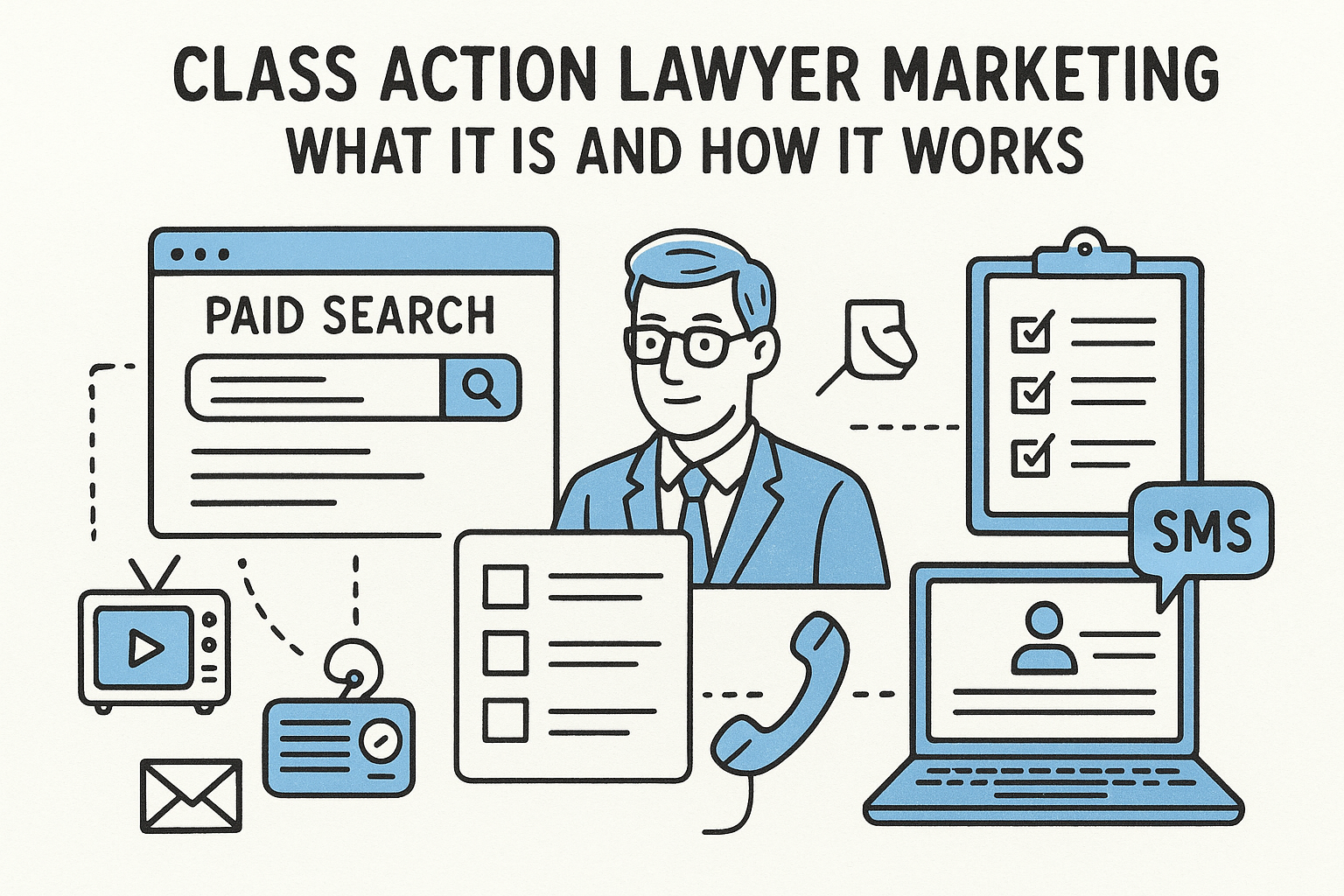
At its core, this type of marketing means running paid and organic campaigns designed to surface large numbers of affected people fast, then filtering them through intake so your firm can identify viable claimants before a filing deadline or statute of limitations closes the window. It blends mass tort advertising tactics, national media buying, and legal-specific intake systems that can handle volume without losing the leads who only called and never filled out a form.
This article breaks down what class action lawyer marketing actually involves, how it differs from marketing a solo-practice injury firm, what channels perform best for nationwide case sourcing, and how firms measure cost per qualified claimant instead of cost per lead.
Why does class action marketing need its own playbook?
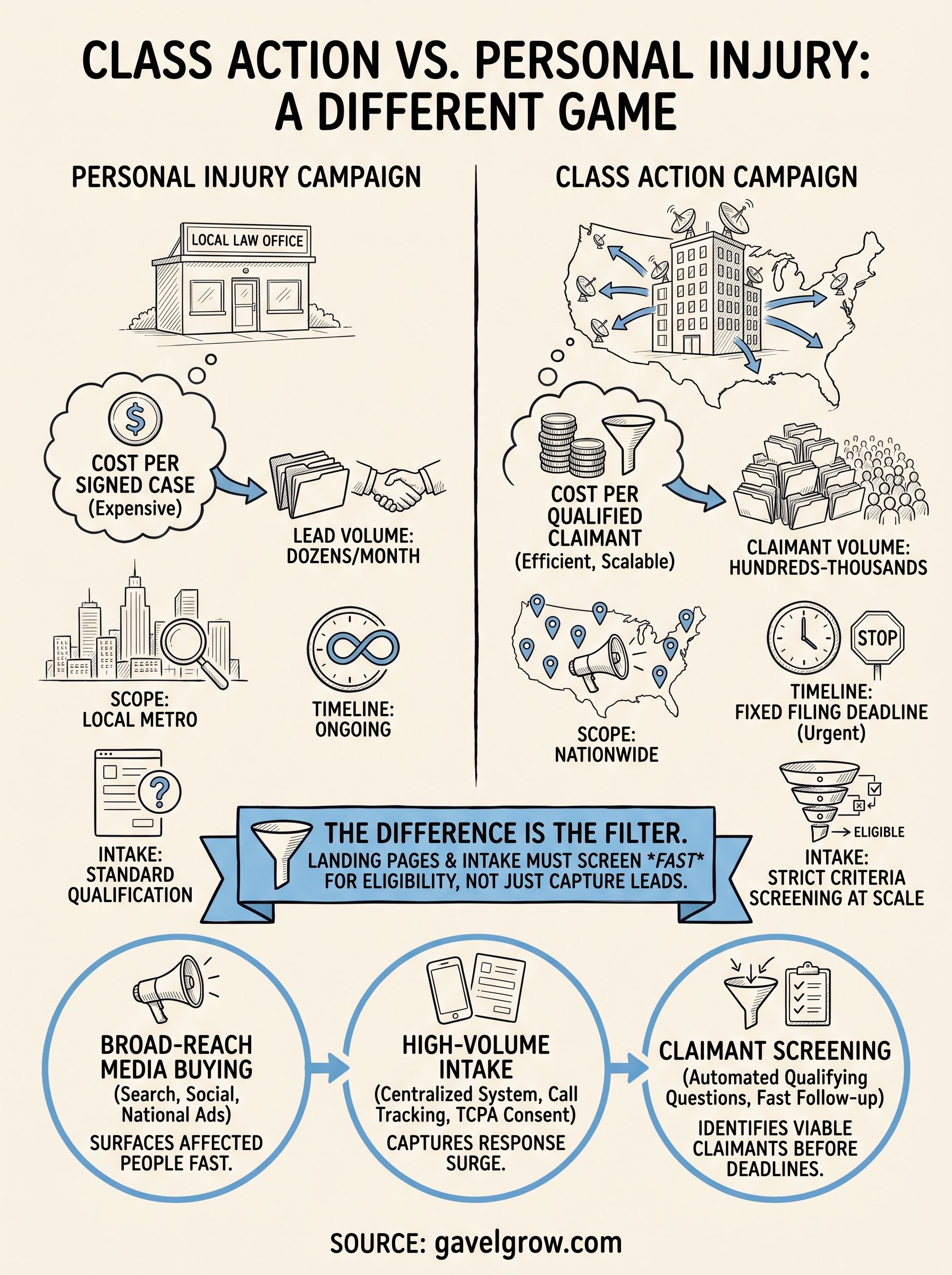
Running a class action campaign like a personal injury campaign wastes money fast. A PI firm optimizes for a handful of high-value signed cases a month. A class action or mass tort case needs hundreds or thousands of qualified claimants before a firm can even justify filing, because the economics of certifying a class or joining an MDL depend on scale. Cost per signed case stops being the primary metric; cost per qualified claimant takes over, and that number has to stay low across huge volume, not just on a few expensive clicks.
The math runs on volume, not single retainers
Geography also works differently. A local PI firm buys ads in one metro and measures against local competitors. A class action campaign often has to run nationwide, or at least across every state where the injury, product, or data breach occurred, which means buying media in dozens of markets simultaneously and tracking performance by state, not by ZIP code. That single shift multiplies the number of campaigns, landing pages, and call tracking numbers a firm has to manage at once.
Deadlines compress the timeline
Statutes of limitations and court filing deadlines don't bend for a marketing plan that's still ramping up. If a firm has eight weeks to build a claimant pool before a filing window closes, every day of slow ad approval, weak landing page copy, or delayed lead follow-up shrinks the pool that actually matters. That pressure is why national media buying for class actions leans heavily on channels that can scale in days, not months, and why campaigns often run in bursts rather than a steady always-on spend.
A class action campaign that can't screen claimants fast enough is really just an expensive way to generate noise.
Intake has to hold up under a surge
Underneath all of it sits the intake problem. A campaign built to attract thousands of responses will attract thousands of responses, including people who don't meet the class criteria at all. Without a system built for volume, a firm drowns in unqualified submissions and the genuine claimants get lost in the pile. Screening questions have to be built into the intake form itself, TCPA consent has to be captured at the moment of submission, and the leads who only called, never filling out a form, still need to get logged, tagged, and matched back to the campaign that generated them. This is where firms running mass volume outgrow spreadsheets and generic contact forms fast, and where a platform purpose-built for legal intake and call tracking earns its keep instead of being a nice-to-have.
How does class action lawyer marketing actually work?
Class action lawyer marketing runs on three connected stages: broad-reach media buying, high-volume intake, and claimant screening. Firms buy paid search, national cable or streaming spots, and social ads targeted at people who match the injury or product profile, not a local zip code. Each channel feeds into a centralized intake system, because a claimant who sees a TV spot in Ohio and a Facebook ad in Texas both need to land in the same pipeline, tagged by campaign source, so the firm knows what's working and what's burning budget.
Landing pages do the qualifying work first
Before a lead ever reaches a paralegal, the landing page itself has to screen for basic eligibility, which is where conversion optimization for claimant landing pages and intake forms earns its keep. Good pages ask pointed questions upfront, exposure dates, product names, diagnosis codes, or purchase history, so the intake team isn't wasting time on people who never qualify for the class. This single step often cuts unqualified volume in half before a human ever touches the file.
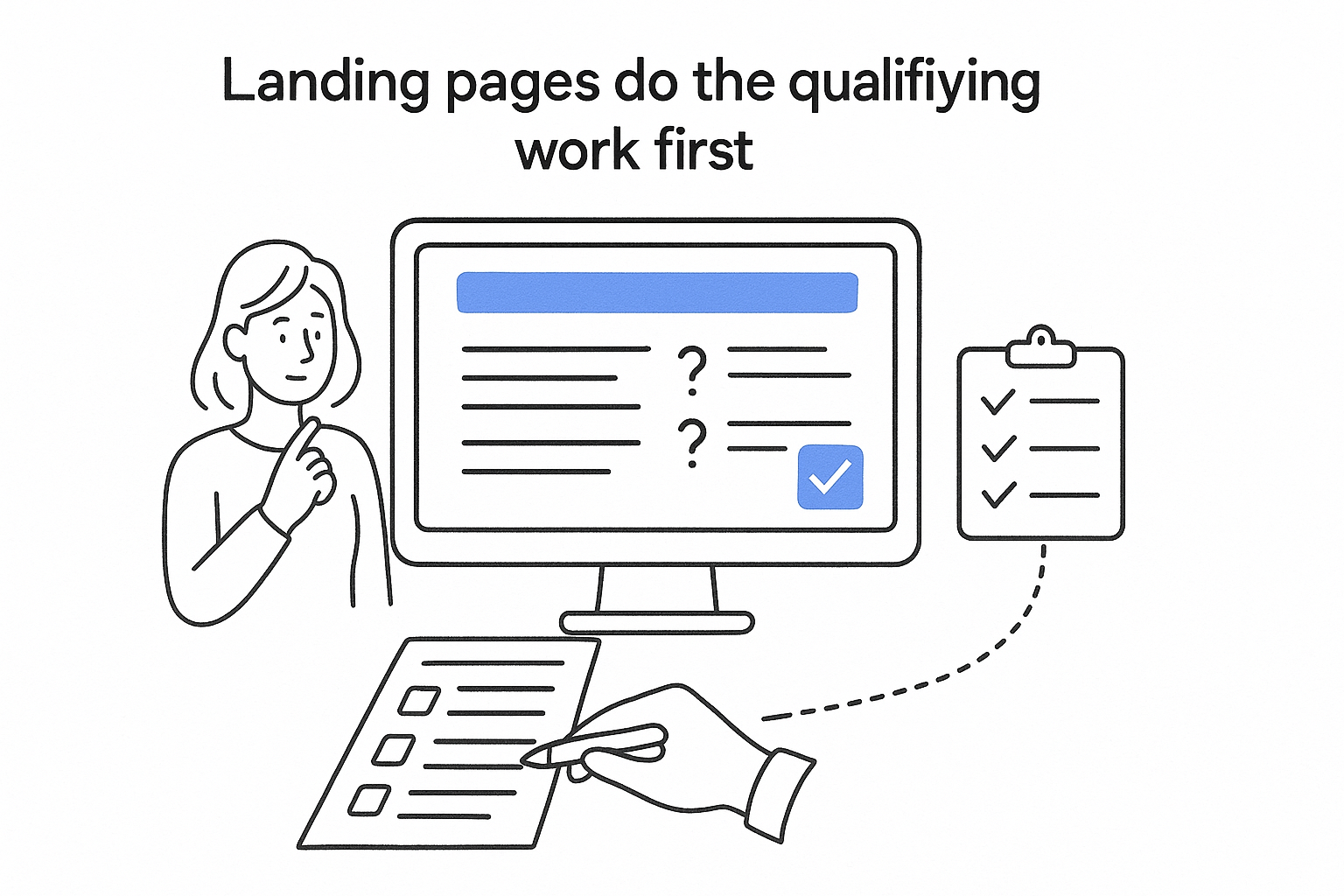
The best class action landing pages do half the screening before a paralegal ever picks up the phone.
Call tracking has to match calls to campaigns
Many claimants skip the form entirely and just call. That's normal in legal advertising for class actions, especially with older populations affected by defective drugs or devices. Without call tracking tied to each ad source, a firm loses the ability to tell which channel actually produced qualified claimants versus which one just drove noise. Dedicated tracking numbers per campaign, paired with recorded calls and outcome tagging, close that gap.
Sequenced follow-up keeps the pool from leaking
Lastly, automated SMS and email intake sequences keep claimants engaged while intake staff work through the queue. A claimant who submits a form and hears nothing for three days often assumes the firm isn't interested and moves on, or worse, signs with a competing firm running the same campaign in a different market. Fast, consistent follow-up, fired within minutes of submission, protects the pool a firm just spent heavily to build.
What results should a class action campaign produce?
A class action campaign succeeds or fails on claimant volume, not lead volume. The number that matters is how many people who submitted a form or called actually meet the class criteria, because a firm can generate thousands of raw leads and still fall short of the pool needed to justify filing. Firms should expect weekly reporting that separates total submissions from qualified claimants, broken out by channel and by state, so a campaign spending heavily in one market that isn't producing eligible people gets reallocated fast instead of burning budget for another month.
Cost per qualified claimant is the number that matters
Every dollar spent should trace back to a cost per qualified claimant, not a blended cost per lead. A campaign that looks cheap on a cost-per-lead basis can be far more expensive once you strip out the people who never had the right exposure dates or diagnosis. Firms tracking this correctly can see, campaign by campaign, which channel is actually filling the class and which one is just generating volume.
If you can't separate cost per lead from cost per qualified claimant, you don't actually know what your campaign is costing you.
Speed and attribution round out the picture
Given the deadline pressure built into most class actions, results also need to include speed to contact: how fast a claimant hears back after submitting a form or leaving a voicemail. Slow follow-up doesn't just lose a claimant, it can push someone toward a competing firm running the identical campaign in a different market. Attribution has to hold up across every channel at once, including phone calls that never touched a form, which is why firms running this kind of volume lean on a platform like GavelGrow's marketing dashboard built to unify call tracking, intake, and campaign-level cost data in one view rather than reconciling three separate tools by hand.
Having that unified view also means a firm can spot a state where intake is lagging before the claimant pool there dries up entirely.
Moving forward with class action marketing
Class action lawyer marketing rewards firms that treat it as its own discipline, not a bigger version of standard injury advertising. Volume, screening, and speed decide whether a campaign fills a class before the filing deadline closes, and the firms that win are the ones tracking cost per qualified claimant from day one instead of discovering the gap after the budget's gone. National media buying without a matching intake system just produces an expensive pile of unqualified submissions.
If your firm is weighing whether to run this in-house or hand it to a team that's done it before, the honest answer depends on how fast you need to scale and how much intake infrastructure you already have. Either way, you need attribution that holds up across states, channels, and phone calls that never touched a form. Book a free 45-minute strategy call with GavelGrow and walk through what a claimant-sourcing campaign would look like for your case.