What Is PPC Management? A Plain-English Guide for Law Firms
Categories: Legal Marketing Strategies
 Abram Ninoyan
Founder & Senior Performance Marketer
Credentials: Google Partner, Google Ads Search Certified, Google Ads Display Certified, Google Ads Measurement Certified, Google Analytics (IQ) Certified, HubSpot Inbound Certified, HubSpot Social Media Marketing Certified, Conversion Optimization Certified
Expertise: Google Ads, Meta Ads, Conversion Rate Optimization, GA4 & Google Tag Manager, Lead Generation, Marketing Funnel Optimization, PPC Management
LinkedIn Profile
What is PPC management? It is the ongoing work of building, running, and improving pay-per-click ad campaigns so that every dollar of ad spend moves a prospective client closer to a signed case. In pa...
Key Takeaways
- Why does PPC management matter for law firms?
- What does a PPC manager do?
- How do you manage PPC campaigns step by step?
- Should you manage PPC in-house or hire help?
What is PPC management? It is the ongoing work of building, running, and improving pay-per-click ad campaigns so that every dollar of ad spend moves a prospective client closer to a signed case.
In pay-per-click advertising, you pay each time someone clicks your ad on Google, Microsoft Advertising, Meta, or LinkedIn. Management is the people and process behind those clicks. It covers choosing keywords, writing ads, setting bids and budgets, tracking what happens after the click, and cutting what does not work. Left alone, a campaign keeps spending whether or not it produces clients.
This guide explains why PPC management matters, what a PPC manager actually does, and how to run the routine yourself. It also covers when to hand it off. GavelGrow has served 500+ law firms since 2015 and works only with law firms, so every example here comes from legal marketing.
Key Takeaways
- PPC management is the ongoing work of running, testing, and tuning paid ad campaigns.
- A PPC manager handles keywords, ads, bids, tracking, and reporting.
- Judge law firm PPC by cost per signed case, not cost per click.
- Whoever manages your ads, your firm should own the ad account.
Why does PPC management matter for law firms?
PPC management matters because legal clicks are expensive and an unmanaged campaign pays for searches that never become clients. Legal terms tend to be among the costlier clicks in paid search, so small leaks add up quickly.
Where unmanaged ad spend leaks
Most wasted spend comes from the same handful of problems:
- Irrelevant searches. Broad keywords can match people looking for legal forms, jobs, or free advice, not a lawyer.
- Wrong territory. Ads that reach people outside the area where you are licensed or want cases.
- Dead hours. Ads running when nobody answers the phone or returns a form submission.
- Missing tracking. Without conversion data, the platform cannot learn which clicks matter.
- Set and forget. Budgets and bids drift while the market changes around them.
Each of these is cheap to fix once you see it. The problem is that nobody sees it without someone reviewing the account on a regular schedule.
Why signed cases are the right yardstick
Cost per click and cost per lead are easy to read, and they mislead. The number that matters to a firm is cost per signed case, because that is what pays for the marketing.
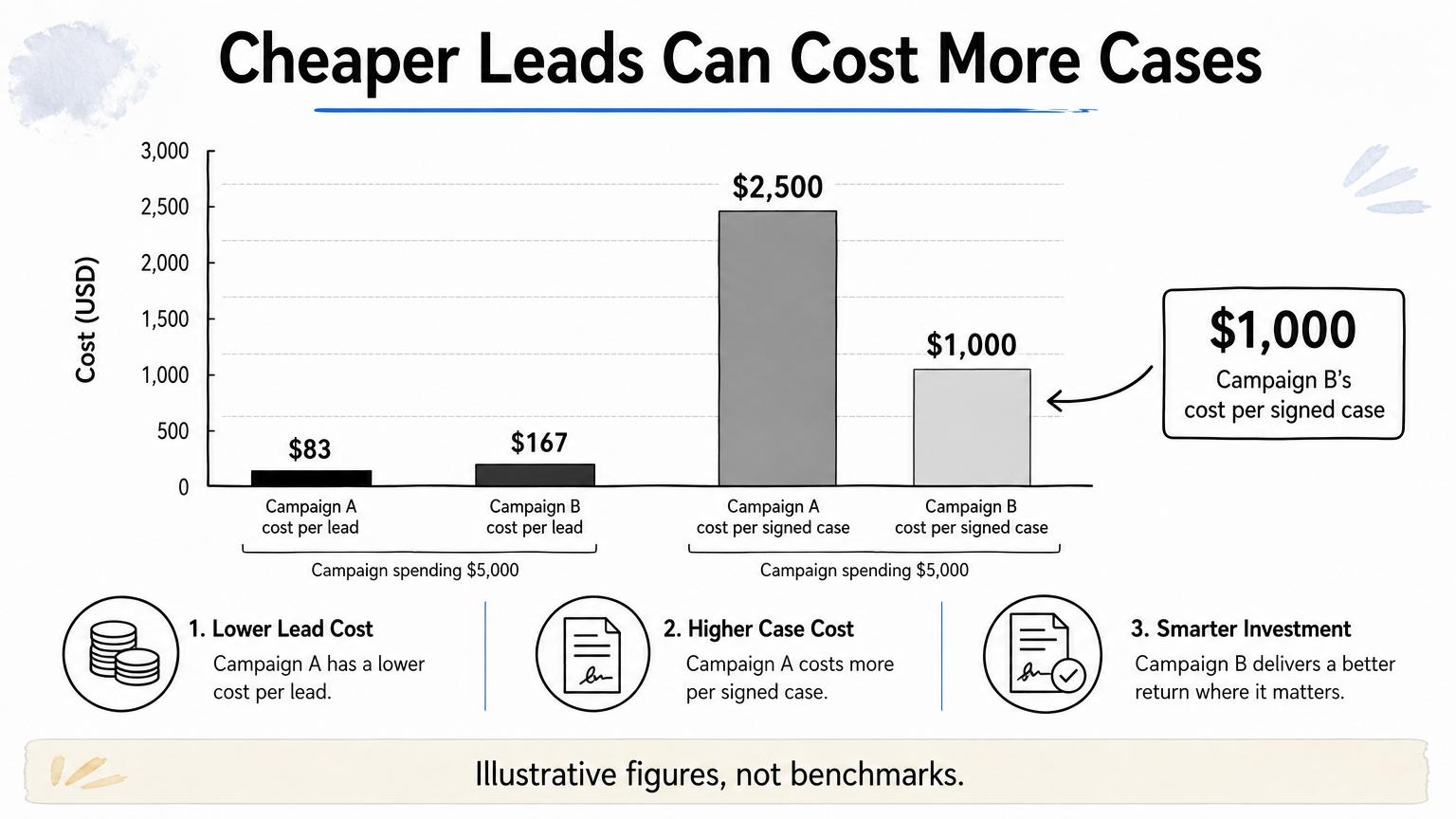
Here is an illustrative example with made-up figures, not benchmarks. Two campaigns each spend $5,000 in a month:
- Campaign A: $5,000 spend, 60 leads at about $83 each, and 2 signed cases. Cost per signed case is $2,500.
- Campaign B: $5,000 spend, 30 leads at about $167 each, and 5 signed cases. Cost per signed case is $1,000.
Campaign A looks twice as efficient on cost per lead. Campaign B delivers a signed case at 40% of the cost. A manager who optimizes for leads would cut the wrong campaign.
Cost per lead tells you what traffic cost. Cost per signed case tells you whether the marketing worked.
What does a PPC manager do?
A PPC manager owns the performance of your paid campaigns from the first keyword to the monthly report. The role is also called a PPC specialist, and a "PPC job" simply means a position doing this work, either in-house at a firm or at an agency.
The core tasks
- Keyword research: finding the searches that signal need for a lawyer, then adding negative keywords to block the rest. Law firm angle: separate "car accident lawyer" intent from "car accident statistics".
- Campaign structure: grouping keywords and ads by practice area and territory. Law firm angle: one practice area and one market per campaign keeps reporting clean.
- Ad copy and testing: writing ads, then testing headlines and offers. Law firm angle: copy must follow your state bar's advertising rules.
- Bids and budget: deciding how much each click or lead is worth and how to split spend. Law firm angle: shift budget toward the cases that sign, not the leads that pile up.
- Conversion tracking: recording forms, calls and texts, then tying them to a campaign. Law firm angle: include the prospects who only ever phoned.
- Landing pages and intake: making sure the click lands somewhere that converts. Law firm angle: mobile forms and fast follow-up decide many outcomes.
- Reporting: showing spend, leads and signed cases by campaign. Law firm angle: report revenue outcomes, not impressions.
Which channels fall under PPC
Google Ads search campaigns are the center of most legal PPC. Microsoft Advertising works the same way on Bing. Meta and LinkedIn run paid social, which reaches people who are not searching yet. Local Services Ads are a separate Google product, and they charge per lead rather than per click. A good manager treats these as one budget and compares them on cost per signed case.

A PPC manager's real job is turning ad spend into signed cases, and everything on the task list serves that goal.
How do you manage PPC campaigns step by step?
You manage PPC by setting a signed-case target, tracking every conversion, structuring campaigns by practice area, and then reviewing search terms and results on a steady schedule. Here is the routine in order.
Build the foundation
- Set a target cost per signed case. Work backward from what a signed case is worth to your firm and what you can afford to pay for one. This number drives every later decision. The CPA calculator can help you do the math.
- Track every conversion. Count form submissions, tracked phone calls, and texts. Then record which leads signed, so you know which campaigns earned the result.
- Structure by practice area and territory. Keep personal injury separate from family law, and one market separate from another. Mixed campaigns hide what is working.
- Write compliant ads. Do not promise results. Do not call your firm "best" or "top." Check your own state bar's advertising rules before ads go live, since they vary by state.
Tracking is where many firms stall, because calls and signed cases live in different systems. GavelGrow's platform puts call tracking, intake, and click-to-signed-case attribution in one dashboard. On the Optimize plan, Smart Conversions sends signed cases back to Google Ads as offline conversions, so Google can learn from your real outcomes.
Run the review loop
- Set budgets and bids, then give them time. Frequent large changes make it hard to tell what caused a result. Adjust in steps.
- Review search terms and add negatives. Read the actual searches that triggered your ads. Block the irrelevant ones. This is usually the quickest source of savings.
- Test one change at a time. Change a headline, an offer, or a landing page, and compare results before changing anything else.
Then check what happens after the click. The Lead Response Management Study found that leads contacted within five minutes are far more likely to be qualified than leads first reached at thirty minutes. That measures the odds of qualifying a lead, not conversion or signed cases. Even so, it is a reason to fix slow follow-up before you raise any budget.
Fix tracking first, then search terms, then ads. Skipping tracking means every later decision rests on guesswork.
Should you manage PPC in-house or hire help?
Manage PPC in-house if someone at your firm can review the account every week and you have clean tracking. Hire help if nobody has that time or you want campaigns built and run for you.
Comparing your options
- Run it yourself with a platform: best for solo to mid-size firms with a marketing-minded owner or manager. The trade-off is that it takes weekly attention and learning time.
- Hire an in-house specialist: best for larger firms with steady spend. The trade-off is salary, training and one person's view.
- Hire an agency or managed service: best for firms that want results without running the tools. The trade-off is that you depend on the provider's reporting and honesty.
GavelGrow offers two routes on the same platform. Self-serve runs $199 a month on Track or $599 a month on Optimize, plus your ad spend, with a 7-day free trial and no credit card. Managed is scoped on a strategy call, plus ad spend. The pricing page shows what each plan includes.
What to require from any manager
Whoever you choose, insist on a few terms. Your firm owns the ad account, so you can leave with your history intact. Ask whether the provider marks up your ad spend. Require reporting by signed case, not clicks. Ask whether the provider works for your direct competitors in your market, because a conflict there is hard to detect from outside. Do not accept guaranteed results, since no one can honestly promise them.

The right PPC manager is the one who shows you signed cases and lets you keep the keys to your ad account.
Frequently asked questions
These are the questions law firm owners and marketing directors ask most often about PPC management.
What does PPC stand for in business?
PPC stands for pay-per-click, an advertising model where you pay only when someone clicks your ad. It appears on search engines such as Google and Bing, and on social platforms such as Meta and LinkedIn. You set a budget and a maximum bid, and the platform runs an auction each time a relevant search or view happens. Management is the work of tuning that process.
Is PPC management the same as SEM?
The two terms overlap, and many people use them interchangeably. Search engine marketing (SEM) usually means paid search on Google and Bing. PPC is broader, because it also includes paid social ads on Meta or LinkedIn. SEO, by contrast, earns organic rankings without per-click fees. Most firms benefit from running paid and organic channels together.
Do Local Services Ads count as PPC management?
Yes, in practice, though they work differently. Local Services Ads charge per lead rather than per click, and lawyers can earn a Google Screened badge. They also run on a separate setup from search campaigns. A manager should compare them with search campaigns on cost per signed case. One caveat: sending signed cases back to Google as offline conversions does not change Local Services Ads bidding, because those ads cannot accept that signal.
How much does PPC management cost?
Providers usually charge a flat monthly fee, a percentage of ad spend, or an hourly rate. Your ad spend is paid to the platform and is separate from the management fee. GavelGrow's self-serve plans are published at $199 and $599 a month, and Managed is scoped on a strategy call. Compare any quote against what you would pay one in-house hire.
Can PPC management guarantee cases?
No. Anyone who guarantees cases is making a promise they cannot keep, and state bars regulate legal advertising claims. Good management improves your odds by cutting waste, tracking results, and testing ads. Rules differ by state, so check your own bar's advertising rules before approving any ad copy or landing page.
A trustworthy PPC manager will promise transparency and a method, never a specific number of cases.
Where to go from here
PPC management is the steady work behind paid ads: choosing the right searches, writing compliant ads, tracking every call and form, and judging the results by cost per signed case. Firms that skip that work pay for clicks that never turn into clients. Firms that do it well can shift budget toward the campaigns that actually sign cases.
If you have the time, start with tracking and a weekly search-term review. If you would rather have a legal-only team handle it, see how GavelGrow's managed Google Ads service for law firms builds and runs campaigns while your ad account stays in your name.
Frequently Asked Questions
What does PPC stand for in business?
PPC stands for pay-per-click, an advertising model where you pay only when someone clicks your ad. It appears on search engines such as Google and Bing, and on social platforms such as Meta and LinkedIn. You set a budget and a maximum bid , and the platform runs an auction each time a relevant search or view happens. Management is the work of tuning that process.
Is PPC management the same as SEM?
The two terms overlap, and many people use them interchangeably. Search engine marketing (SEM) usually means paid search on Google and Bing. PPC is broader, because it also includes paid social ads on Meta or LinkedIn. SEO, by contrast, earns organic rankings without per-click fees. Most firms benefit from running paid and organic channels together.
Do Local Services Ads count as PPC management?
Yes, in practice, though they work differently. Local Services Ads charge per lead rather than per click , and lawyers can earn a Google Screened badge. They also run on a separate setup from search campaigns. A manager should compare them with search campaigns on cost per signed case. One caveat: sending signed cases back to Google as offline conversions does not change Local Services Ads bidding, because those ads cannot accept that signal.
How much does PPC management cost?
Providers usually charge a flat monthly fee, a percentage of ad spend, or an hourly rate. Your ad spend is paid to the platform and is separate from the management fee. GavelGrow's self-serve plans are published at $199 and $599 a month, and Managed is scoped on a strategy call. Compare any quote against what you would pay one in-house hire.
Can PPC management guarantee cases?
No. Anyone who guarantees cases is making a promise they cannot keep, and state bars regulate legal advertising claims. Good management improves your odds by cutting waste, tracking results, and testing ads. Rules differ by state, so check your own bar's advertising rules before approving any ad copy or landing page. A trustworthy PPC manager will promise transparency and a method, never a specific number of cases.