How to Do Social Media Marketing for Attorneys
Categories: Legal Marketing Strategies
 Abram Ninoyan
Founder & Senior Performance Marketer
Credentials: Google Partner, Google Ads Search Certified, Google Ads Display Certified, Google Ads Measurement Certified, Google Analytics (IQ) Certified, HubSpot Inbound Certified, HubSpot Social Media Marketing Certified, Conversion Optimization Certified
Expertise: Google Ads, Meta Ads, Conversion Rate Optimization, GA4 & Google Tag Manager, Lead Generation, Marketing Funnel Optimization, PPC Management
LinkedIn Profile
Social media marketing for attorneys works when you treat it as a lead-generation channel, not a branding exercise, and tie every post and ad back to signed cases. Most firms post inconsistently and c...
Key Takeaways
- How to Do Social Media Marketing for Attorneys
- Why social media marketing matters for law firms
- Step 1. Define your goals and target audience
- Step 2. Choose the right platforms for your practice
How to Do Social Media Marketing for Attorneys
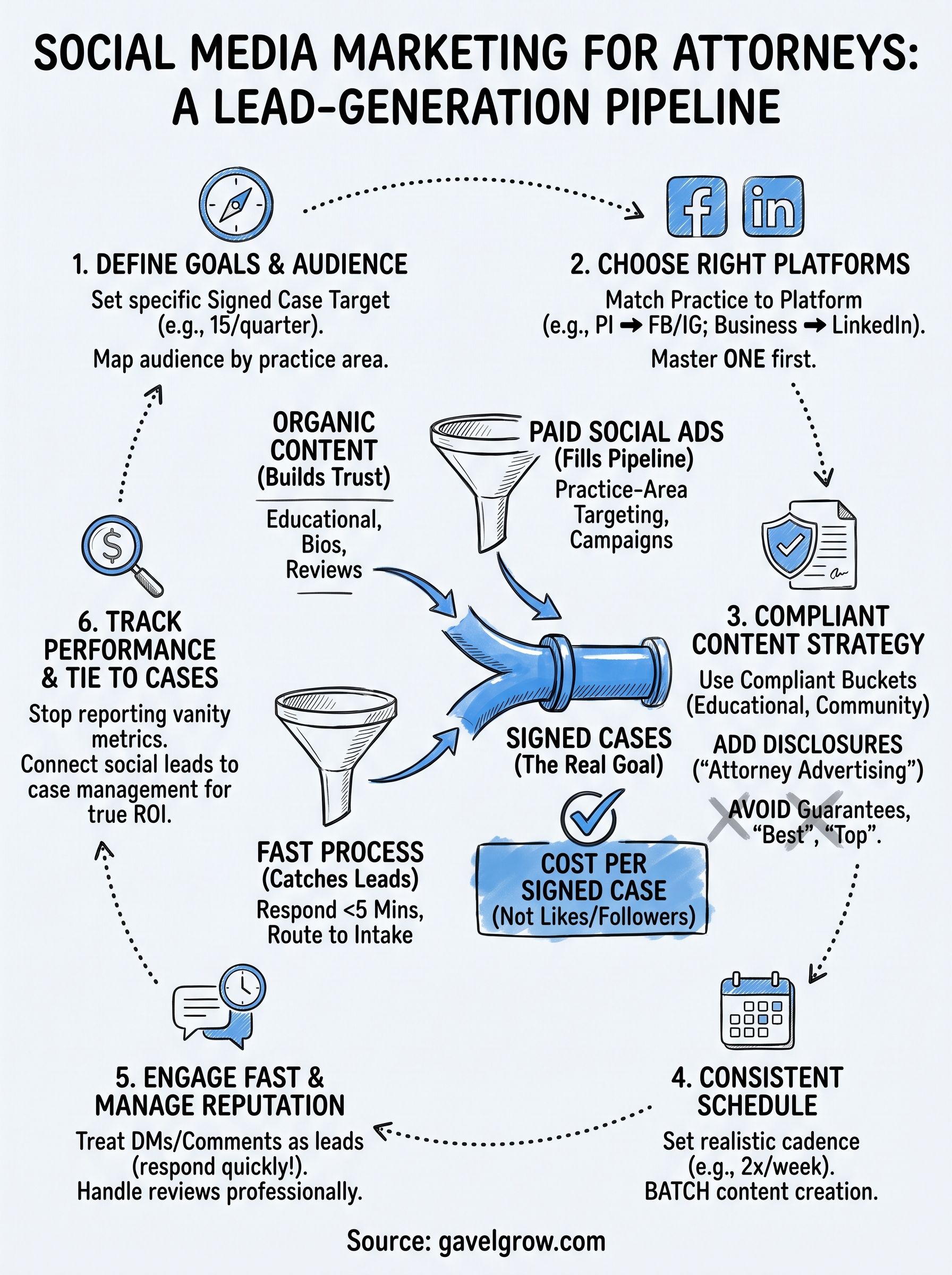
Social media marketing for attorneys works when you treat it as a lead-generation channel, not a branding exercise, and tie every post and ad back to signed cases. Most firms post inconsistently and call it a strategy, then wonder why the phone never rings. The firms that grow from social treat it as paid lead generation with compliance built in, not free advertising.
The real answer is a mix of platform-specific organic content, paid social campaigns aimed at your practice area, and a process that catches every lead who messages you on Facebook or comments on an ad. Organic content builds trust with local prospects; paid social fills your pipeline on a schedule you control, and neither works if leads sit unanswered in a DM inbox for days.
This guide covers what to post by practice area, how much to budget for paid social, and how to route every social lead into a system that tracks cost per signed case instead of likes. We also flag the state bar advertising rules that apply to social platforms, so your firm grows without compliance risk.
Why social media marketing matters for law firms
Prospects research an attorney on social media long before they pick up the phone. A person searching for a personal injury lawyer after a car accident will check your Facebook reviews, scroll your Instagram, and read your last few posts before deciding you're worth calling. If your profile is empty or your last post is from eight months ago, you've lost that lead to the firm down the street with an active page. This is why law firm social media marketing isn't optional anymore, it's part of how people vet you the same way they'd check your Google Business Profile.
Where clients decide before they ever call
Different practice areas live on different platforms, and the research behavior changes with the case type. A family law prospect scrolling Instagram at midnight is in a different headspace than a business owner researching an employment attorney on LinkedIn during work hours. Personal injury and mass tort firms tend to see the most volume from Facebook and Instagram, where video content and client testimonials travel fast. Estate planning and business law firms often get more traction on LinkedIn, where the audience already thinks in terms of long-term relationships. Understanding this mismatch matters because posting the wrong content on the wrong platform wastes budget without moving a single case toward signature.
The compliance risk that trips up firms first
Many firms jump into social ads without checking the advertising rules that govern law firm ads in their state, and that's where things go wrong fast. Some states require an "Attorney Advertising" disclosure on any paid post that mentions services or results. Nearly all of them prohibit language that promises or guarantees an outcome, and most restrict using words like "best" or "top" to describe your firm. A single boosted post with a testimonial claiming a guaranteed settlement can trigger a bar complaint, so every piece of content, organic or paid, needs a compliance pass before it goes live. Check your own state bar's advertising rules before you publish anything that references case results or client outcomes.
Social media only grows a law firm when every lead gets tracked back to a signed case, not just a like or a comment.
Organic builds trust, paid fills the pipeline
Organic and paid social solve different problems, and firms that only run one end up leaving cases on the table. Organic content, think client testimonials, case result posts (compliant with disclosures), attorney bios, and community involvement, builds the trust that makes a stranger comfortable calling a stranger about their legal problem. Paid social, run through paid social campaigns on Facebook, Instagram, and LinkedIn, puts your firm in front of people who match your ideal client profile before they've even started searching Google.
Running both channels well takes more coordination than most in-house marketing teams have bandwidth for, which is why many firms hand paid social to a team that specializes in legal marketing. GavelGrow's outsourced ad management for law firms builds and runs these campaigns so every social lead lands in a pipeline instead of a DM your staff forgets to check.
Step 1. Define your goals and target audience
Before you schedule a single post, write down what a win actually looks like for your firm. "More engagement" isn't a goal, it's a vanity metric that won't pay your overhead. A defined goal, like 15 signed personal injury cases per quarter from paid social, gives you something to measure against and forces every later decision, platform choice, ad budget, content topic, back to that number.
Get specific about what counts as a win
Most firms skip this step and end up chasing follower counts instead of signed retainers. Pin your goal to a number you can track: consultations booked, calls answered, or cases signed, not likes or shares. If you're a solo estate planning attorney, your goal might be 20 qualified consultation requests a month from Facebook. If you're a mass tort shop, it might be a specific cost-per-signed-case target across paid campaigns. Write the number down and revisit it monthly, because a goal nobody checks isn't a goal, it's a wish.
A social media goal that isn't tied to a signed case number is just content for content's sake.
Map your audience by practice area
Define who you're actually trying to reach before you touch a platform's ad manager. Your target audience for personal injury looks nothing like your audience for business law, and treating them the same wastes ad spend on people who will never call. Ask yourself these questions for every practice area you market:
- What age range and life stage does this client fall into? (A DUI client skews younger than an estate planning client.)
- What triggered their search? (A car accident, a divorce filing, a business dispute.)
- What device are they likely using when they see your ad? Most social traffic is mobile, and that changes how your landing page and intake form need to perform.
- What geography matters? A single-location personal injury firm needs tight local radius targeting; a mass tort campaign can go nationwide.
- What objection stops them from calling immediately? Cost, embarrassment, distrust of lawyers in general?
Answering these questions for each practice area you handle keeps your content and ad targeting specific instead of generic, and specific is what turns a scroll into a phone call. If you handle more than one practice area, build a separate audience profile for each one rather than one blended persona that fits none of them well.
Step 2. Choose the right platforms for your practice
Not every platform deserves your budget, and spreading thin across five networks is how firms burn money without moving a single case forward. Choosing the right platforms starts with matching where your ideal client actually spends time, not where your marketing manager personally likes to post. A criminal defense firm chasing leads on LinkedIn is wasting effort; a business law firm ignoring LinkedIn is doing the same.
Match the platform to the practice area
GavelGrow works with firms across personal injury, family law, criminal defense, immigration, and estate planning, and the platform mix looks different for each one. Facebook still carries the widest reach and the strongest ad targeting for local, high-emotion cases like personal injury and family law. Instagram works well for firms with visual storytelling, think before-and-after case narratives, attorney day-in-the-life content, and video testimonials. LinkedIn earns its keep with business law, employment law, and estate planning, where the audience is already thinking in terms of contracts and long-term planning. TikTok has become a real acquisition channel for younger-skewing practice areas like DUI defense and some immigration work, though the compliance bar there is just as high as anywhere else.
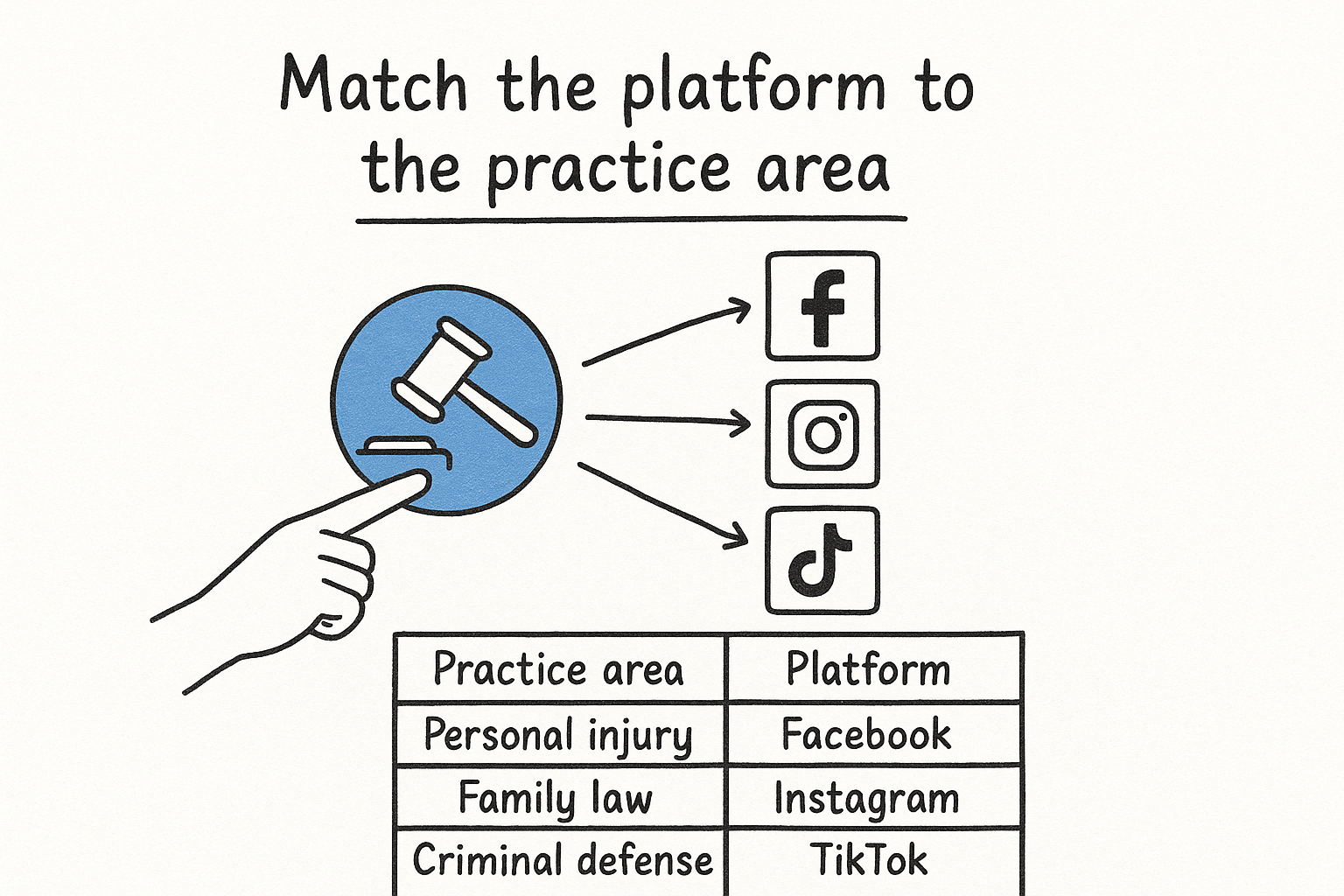
Pick one primary platform per practice area and master it before you spread your team thin across five.
Run one channel well before adding another
One mistake shows up over and over: firms launch on every platform at once, then can't keep up with posting, ads, or the leads that come in. Running a single connected ad account well, whether that's Google Ads, Local Services, or Meta, beats a mediocre presence everywhere. If you're just getting started, GavelGrow's self-serve marketing platform connects one ad account on the Track plan so you can prove out a channel before scaling to unlimited accounts on Optimize.
Step 3. Build a compliant content strategy
Every post you publish needs to survive contact with your state bar's advertising rules before it survives contact with your audience. A compliant content strategy isn't a restriction on creativity, it's the foundation that keeps a viral post from turning into a bar complaint. Build your content calendar around a repeatable framework for planning content with categories that both perform well and clear compliance review, so you're never scrambling to defend a post after it's already live.
What to post without triggering a review
Sort your content into buckets before you start writing captions, and run each bucket through the same compliance checklist every time:
- Educational content: explain a legal process, a deadline, or a common mistake, without promising an outcome for anyone who reads it.
- Attorney and staff spotlights: build trust through personality, credentials, and community ties rather than results.
- Case result posts: only where your state bar allows them, and always with the required disclaimer language attached.
- Client testimonials: check whether your state requires a disclaimer that results vary by case before you publish one.
- Community involvement: sponsorships, local events, and pro bono work humanize your firm without any compliance risk at all.
Framing your calendar this way keeps every post defensible and gives your team a repeatable process instead of a judgment call made under deadline pressure.
The disclosures that protect your license
Guarantees and superlatives are the fastest way to draw bar scrutiny, so strip them out before anything goes live. Never write "guaranteed win," "best personal injury lawyer," or "top-rated firm" in ad copy or organic captions, even if a past client used that language in a review you're quoting. Most states also require an "Attorney Advertising" label on paid posts referencing your services, and some extend that requirement to organic content too.
A single unchecked claim in a boosted post can undo months of trust-building organic content.
Build a short pre-publish checklist your whole team uses, whether that's an office manager scheduling posts or an outside agency running your campaigns:
- Does this post promise or imply a result?
- Does it use "best," "top," or similar superlatives?
- Does it need an attorney advertising disclosure?
- Would a client testimonial here need a disclaimer?
Run every piece of content through that list once, and compliance stops being an afterthought and becomes part of how your firm publishes, full stop.
Step 4. Create a consistent posting schedule
A consistent posting schedule beats a brilliant post published once a month, every time. Prospects notice when a firm's last update is from six months ago, and that gap reads as "we're not really active here," even if the practice is thriving. Building a realistic content calendar matters more than chasing a perfect post, because the algorithm and the audience both reward accounts that show up on a schedule they can predict.
Set a realistic cadence per platform
Different platforms punish inconsistency differently, so match your posting frequency to what you can actually sustain long-term rather than what a marketing blog recommends for every industry at once.
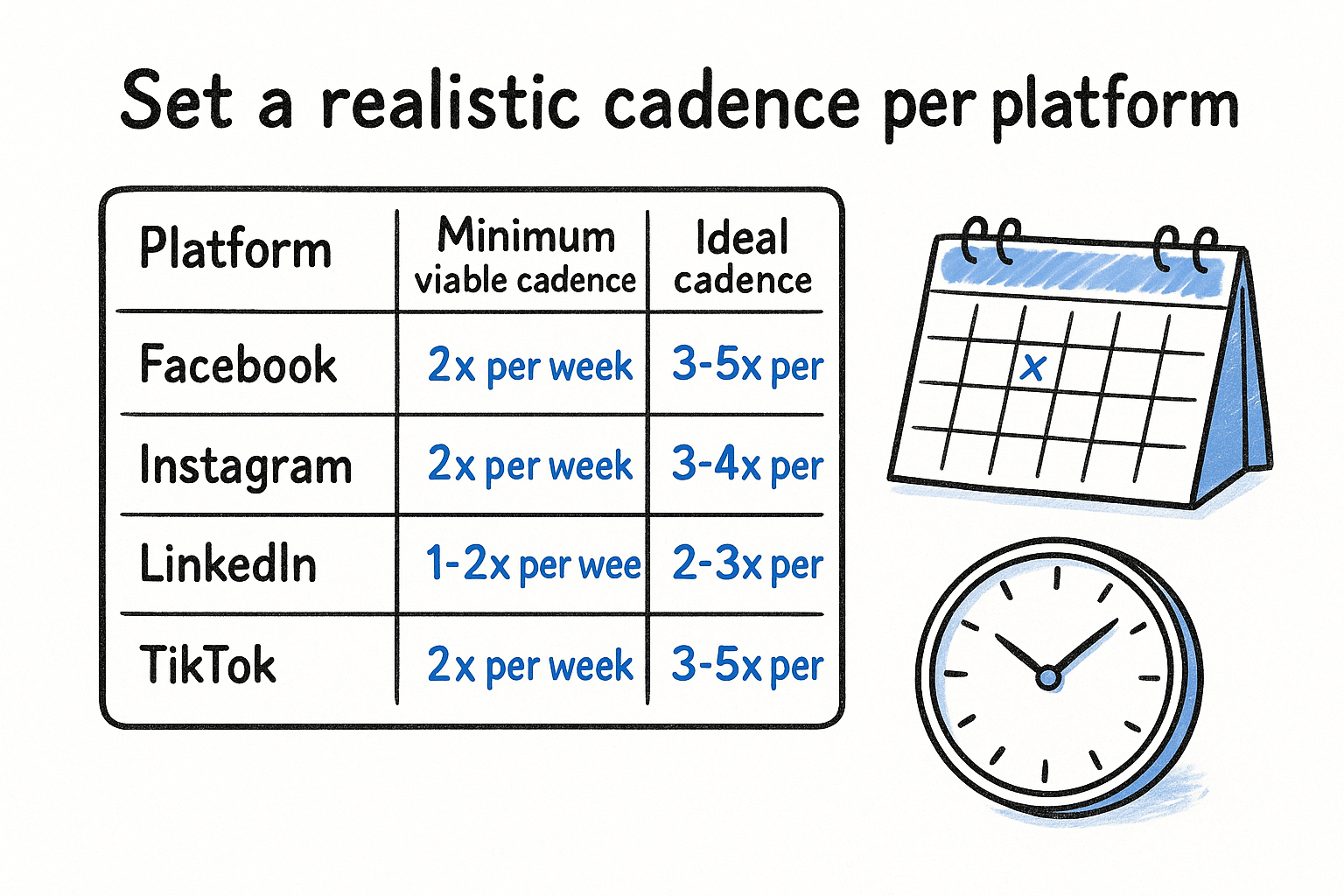
Commit to the minimum viable cadence before promising yourself the ideal one. A firm that reliably posts twice a week on Facebook for a year builds more trust than one that posts daily for three weeks and then goes quiet through a trial.
Showing up twice a week for a year beats posting daily for a month and then disappearing.
Batch your content instead of posting live
Most firms fail at consistency because someone tries to write and post in the moment, between client calls and court appearances. Batching solves this: block two hours once a month, write and record everything at once, then load it into a scheduling tool like Meta Business Suite so posts go out automatically on your set cadence. Draft your educational posts, attorney spotlights, and testimonial captions all in one sitting, then queue them out across the following weeks.
Running batching well also means planning around known dates: filing deadlines, open enrollment periods, or seasonal spikes in divorce filings and DUI arrests around holidays. Build a simple monthly template your team fills in every batch session:
Week 1: Educational post (process explainer)
Week 2: Attorney/staff spotlight
Week 3: Client testimonial or case result (compliance-checked)
Week 4: Community involvement or firm news
This template keeps your content mix balanced without forcing anyone to brainstorm from scratch every week, and it makes the compliance checklist from Step 3 something you run once per batch instead of once per post under deadline pressure.
Step 5. Engage with your audience and manage your reputation
Social media stops being marketing and starts being customer service the moment someone comments on your post or slides into your DMs. Real social media engagement tactics mean someone on your team checks every channel daily, not once a week when they remember. A prospect who messages your Facebook page with "do you handle car accident cases in my county" is a lead, and leads that sit unanswered for two days go call the firm that answered in ten minutes.
Respond fast to every message and comment
Treat every DM, comment, and review reply as part of your intake process, not an afterthought handled between other tasks. The Lead Response Management Study found that leads contacted within five minutes are far more likely to be qualified than those first reached at thirty minutes, which is why so many law firm leads never get a callback and why a social media message is a lead the same way a phone call or web form is. Assign someone to check every platform's inbox at set times throughout the day, and route anything that looks like a real case inquiry into your intake system immediately rather than leaving it in a native app your staff forgets to open. GavelGrow's unified inbox and intake tools pull SMS, email, and voicemail into one view per lead, and firms that route social messages the same way stop losing prospects to a forgotten notification.
A DM that sits unanswered for two days is a lead you paid to generate and then handed to a competitor.
Handle reviews the right way
Reputation management for attorneys on social media and on your Google Business Profile moves together, and how you handle reviews matters as much as how many you collect. Ask every client for a review, not just the ones you think will say something glowing, because Google's review policies prohibit soliciting only satisfied clients or offering anything in exchange for a review. Resolve complaints directly with the client first, never by routing them to a private form before they can post publicly, since that practice also violates platform policy and reads as evasive to anyone who later finds the thread. Respond professionally to every public review, good or bad, because prospects read your responses as closely as they read the reviews themselves. A firm that answers a one-star review calmly and factually often looks more trustworthy than one with a wall of unanswered five-star praise.
Step 6. Track performance and tie it to signed cases
Followers and likes tell you nothing about whether social media marketing for attorneys is actually paying for itself. The only number that matters at the end of the month is how many leads from Facebook, Instagram, or LinkedIn turned into signed retainers, and what each of those cases cost you to acquire. Every dashboard you check should answer one question: is this platform sending cases, or just sending engagement?
Stop reporting on vanity metrics
Most platform-native analytics dashboards push you toward metrics that flatter the account manager, not the firm's bottom line. Reach, impressions, and follower growth can all climb while your intake pipeline stays empty, so reframe your monthly report around the metrics that prove marketing returns and actually predict revenue.
If your social media report doesn't end with a cost per signed case, it's not a report, it's a highlight reel.
Connect social leads to your case management
Getting from "cost per lead" to "cost per signed case" requires attribution that survives the handoff between your ad platform and your intake team, and that's where most firms lose the thread. A lead that messages your Facebook page needs to land in the same system as a lead who called your connected ad account's tracking number, tagged with the campaign that produced it, so nothing gets lost in a native inbox nobody checks after 5pm. GavelGrow's marketing dashboard tracks full-funnel ROI from the ad click through the signed case, and Smart Conversions feeds signed cases back into your Google Ads and Local Services bidding so the platform learns which campaigns actually produce clients, not just clicks. Per-firm conversion tracking also fires GA4 and Meta Pixel events natively, so your own ad accounts learn the same lesson your intake team already knows: some campaigns fill your pipeline, and others just fill your feed. Compare your numbers against modelled practice-area benchmark ranges on the pricing page calculator to see whether your cost per signed case is competitive before you commit next quarter's budget to the same channel.
Frequently asked questions about social media marketing for attorneys
Can attorneys give legal advice on social media?
Explaining how a legal process works is fine; telling a specific person what to do in their situation is where firms get into trouble. Answering a commenter's facts with tailored guidance can look like advice and, in some circumstances, like the start of an attorney-client relationship. Keep public answers general and move anything fact-specific to a private consultation.
Should attorneys post from a personal profile or the firm's page?
Both, doing different jobs. Personal attorney profiles usually earn more reach and trust, because people follow people. The firm page is the durable asset: it survives staff changes, carries reviews and ad accounts, and is what a prospect checks when verifying a firm is real. Post from the attorney, and make sure the firm page is complete enough to withstand that check.
Can a firm respond to a negative comment without breaching confidentiality?
Yes, but only by staying generic. Confirming that someone was a client, or correcting their account with case details, can disclose confidential information even when the commenter revealed it first. The safe response acknowledges the concern, states the firm takes it seriously, and moves the conversation offline — never a point-by-point rebuttal.
Do attorneys need a disclaimer on social media profiles?
Often, and requirements vary by state. Several jurisdictions expect an attorney-advertising notice, a statement that posts are not legal advice, or a note that results vary — and some treat profile bios as advertising in their own right. Check your state bar's rules for profile-level requirements, not just the ones covering individual posts.
How long before social media produces signed cases?
Longer than most firms expect from organic, faster from paid. Organic reach compounds over months, so judge it on consultation requests rather than followers. Paid social can generate leads within days, though quality varies until targeting and intake are tuned. Either way, set the measurement window before you start so you are not judging a channel on its first fortnight.
Putting your strategy into action
Social media marketing for attorneys only works when you run it like a pipeline, not a bulletin board. Goals define what you're chasing, the right platforms put your content in front of people who actually search for your practice area, and compliance keeps every post defensible. None of that matters if leads sit unanswered in a DM inbox, and none of it proves out without cost per signed case attached to every campaign.
Start small if you need to. Pick one platform, define one goal, and build the intake habit before you add complexity. Where most firms stall is attribution, connecting a Facebook comment or a boosted ad to a signed retainer weeks later. If your team is guessing instead of tracking, that's the gap worth closing first. Book a free 45-minute call with GavelGrow's legal marketing team and walk through where your social spend is actually landing.
Frequently Asked Questions
Can attorneys give legal advice on social media?
Explaining how a legal process works is fine; telling a specific person what to do in their situation is where firms get into trouble. Answering a commenter's facts with tailored guidance can look like advice and, in some circumstances, like the start of an attorney-client relationship. Keep public answers general and move anything fact-specific to a private consultation.
Should attorneys post from a personal profile or the firm's page?
Both, doing different jobs. Personal attorney profiles usually earn more reach and trust, because people follow people. The firm page is the durable asset: it survives staff changes, carries reviews and ad accounts, and is what a prospect checks when verifying a firm is real. Post from the attorney, and make sure the firm page is complete enough to withstand that check.
Can a firm respond to a negative comment without breaching confidentiality?
Yes, but only by staying generic. Confirming that someone was a client, or correcting their account with case details, can disclose confidential information even when the commenter revealed it first. The safe response acknowledges the concern, states the firm takes it seriously, and moves the conversation offline — never a point-by-point rebuttal.
Do attorneys need a disclaimer on social media profiles?
Often, and requirements vary by state. Several jurisdictions expect an attorney-advertising notice, a statement that posts are not legal advice, or a note that results vary — and some treat profile bios as advertising in their own right. Check your state bar's rules for profile-level requirements, not just the ones covering individual posts.
How long before social media produces signed cases?
Longer than most firms expect from organic, faster from paid. Organic reach compounds over months, so judge it on consultation requests rather than followers. Paid social can generate leads within days, though quality varies until targeting and intake are tuned. Either way, set the measurement window before you start so you are not judging a channel on its first fortnight.