Content Strategy Framework: How to Build One for Law Firms
Categories: Legal Marketing Strategies
 Abram Ninoyan
Founder & Senior Performance Marketer
Credentials: Google Partner, Google Ads Search Certified, Google Ads Display Certified, Google Ads Measurement Certified, Google Analytics (IQ) Certified, HubSpot Inbound Certified, HubSpot Social Media Marketing Certified, Conversion Optimization Certified
Expertise: Google Ads, Meta Ads, Conversion Rate Optimization, GA4 & Google Tag Manager, Lead Generation, Marketing Funnel Optimization, PPC Management
LinkedIn Profile
Most law firm blogs die a slow death. A partner writes three posts, traffic doesn't move, and the whole thing gets abandoned by month four. That's what happens without a real content strategy framewor...
Key Takeaways
- Content Strategy Framework: How to Build One for Law Firms
- Why law firms need a content strategy framework
- Step 1. Set goals tied to signed cases, not just traffic
- Step 2. Map your audience by practice area and funnel stage
Content Strategy Framework: How to Build One for Law Firms
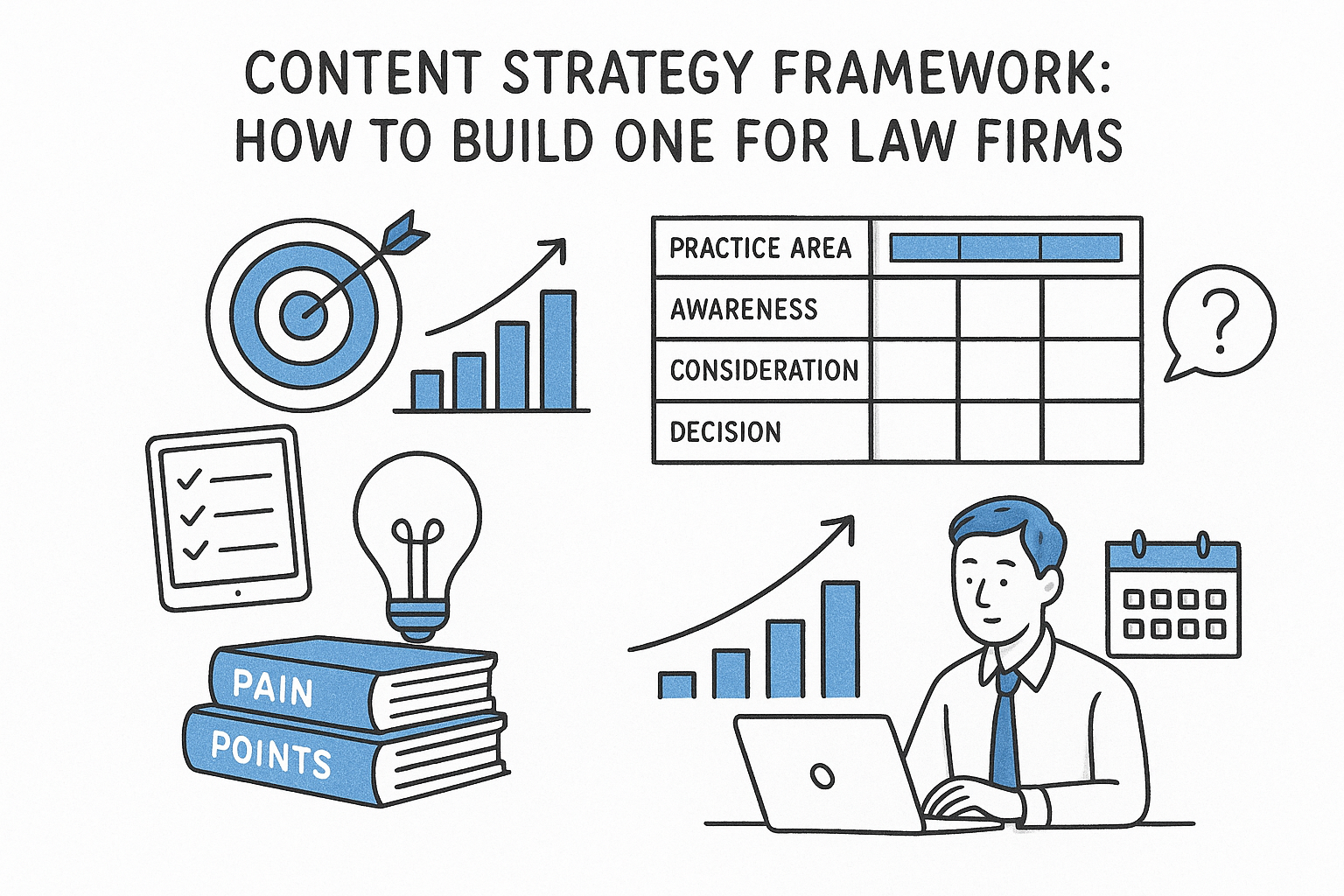
Most law firm blogs die a slow death. A partner writes three posts, traffic doesn't move, and the whole thing gets abandoned by month four. That's what happens without a real content strategy framework: a repeatable system that ties every article, video, or FAQ page to a practice area, a buyer question, and a measurable case-acquisition goal.
Building one for a law firm isn't the same as building one for a SaaS company or an e-commerce brand. You're working inside state-bar advertising rules, a 6-12 month sales cycle, and practice areas like personal injury or family law where trust is decided before a phone call ever happens. A working framework starts with audience and practice-area mapping, moves through keyword and topic selection, and ends with attribution back to signed cases, not just page views or rankings.
This guide walks through that process step by step: how to audit what you already have, pick topics your ideal clients actually search for, structure a publishing calendar you can sustain, and connect content output to intake data so you know which articles produce retainers and which just produce traffic.
Why law firms need a content strategy framework
The cost of publishing without a plan
Most firms start blogging because a competitor ranks on Google, not because they've mapped out what a prospective client actually needs to read before picking up the phone. Random publishing produces articles that rank for nothing, answer no real question, and never show up in a client's search history on the way to hiring a lawyer, which is the reason most law firm blogs quietly fail. Firms that treat content as a documented system convert search visibility into clients far more reliably than those publishing at random, yet most law firms still treat blogging as a side project an associate handles between filings instead of a system with owners and deadlines.
What a framework actually fixes
A real content strategy framework forces you to decide, before anyone writes a word, which practice area a piece serves, which funnel stage the reader is in, and how you'll measure whether it worked. That last part is where most firms fall apart: they can tell you how many blog visitors they got last month, but not how many of those visitors became signed cases. Signed-case attribution, meaning tracing a click all the way through to a signed retainer, is the whole point of the exercise. Without it, you're guessing whether your content budget produces retainers or just keeps someone busy.
A content strategy without a way to trace clicks to signed cases isn't a strategy, it's a hobby.
Compliance and trust as built-in constraints
Legal content also carries baggage other industries don't deal with. State bar advertising rules restrict how you describe outcomes, testimonials, and guarantees, and a 6-12 month sales cycle means a reader who finds your immigration or mass tort article today might not call until next spring. A workable framework plans nurture content that keeps leads warm for that gap instead of only top-of-funnel posts, and it builds bar-compliant language in from the start rather than fixing claims after a compliance review flags them.
Connecting content to intake
Firms that get this right treat content as an input to their intake pipeline, not a standalone project sitting off to the side. When a blog post drives a call or a form fill, that lead needs to land in the same lead pipeline you use for paid ads, tagged with the article that produced it. Without that link back to intake, you can't tell whether your family law FAQ page is generating retainers or just page views, and that gap is exactly what a documented content strategy framework is supposed to close.
Step 1. Set goals tied to signed cases, not just traffic
Start with a number, not a wish
Don't set a goal like "grow blog traffic 20% this quarter." Set one like "produce 15 signed cases from organic content by Q3." Traffic-based goals reward you for publishing volume; case-based goals force every topic decision back through the question of whether it actually moves a prospective client toward calling your office. If you can't tie a goal to a signed retainer, it's not a marketing goal, it's an activity log.
If your content goal doesn't mention a signed case, it's not a goal, it's a to-do list.
Pick metrics that survive the sales cycle
Rankings and pageviews feel good in a monthly report, but they don't pay rent, which is why it helps to know how to calculate, track, and improve marketing returns first. Build your scorecard around the metrics that actually predict revenue:
A firm running personal injury content, for example, might discover their car accident FAQ page drives plenty of traffic but almost no retainers, while a shorter piece on "what to do after a hit-and-run" converts at three times the rate.
Set the tracking up before you publish
Goals without tracking infrastructure stay aspirational. Before you write anything, confirm your marketing dashboard can trace a click on a specific article through form submission, intake, and case signature. GavelGrow's per-firm lead tracking and attribution software fires GA4 and Meta Pixel events at lead capture, so you know which piece of content actually produced the case, not just the click.
Step 2. Map your audience by practice area and funnel stage
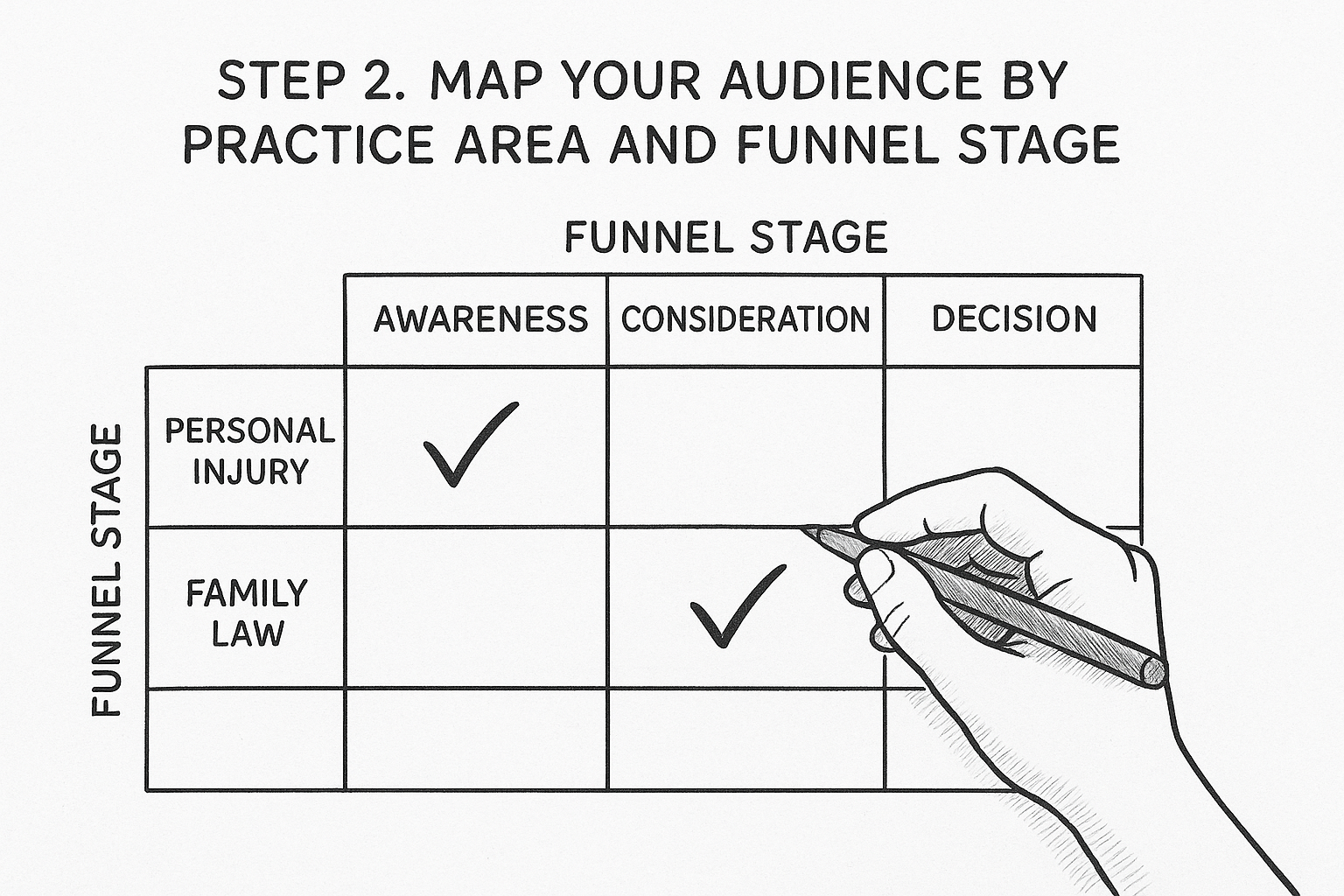
Every practice area searches differently, and a content marketing strategy that ignores that difference wastes effort on topics nobody in your target market is typing into Google. A personal injury prospect Googles "who's at fault in a rear-end accident" the day after a crash. An estate planning prospect researches for months before ever contacting a lawyer. Map both the practice area and the funnel stage before you assign a single topic, the same way you'd go about building an attorney lead generation funnel stage by stage, or you'll end up with a blog full of posts written for readers who don't exist.
Build a simple audience grid
Start with a grid that crosses practice area against funnel stage. Each cell should get its own topic list, tone, and call-to-action:
A blog written for one funnel stage only reaches one third of the clients you could be converting.
Use intake data, not guesses
Firms that already run intake through a lead pipeline have a shortcut here: pull the questions prospects ask on intake calls and turn the recurring ones into topics. GavelGrow's call tracking and unified inbox surface exactly which questions show up again and again before a caller ever mentions signing, which tells you where your audience mapping is missing content.
Step 3. Build content pillars around client pain points
Start from the fear, not the keyword
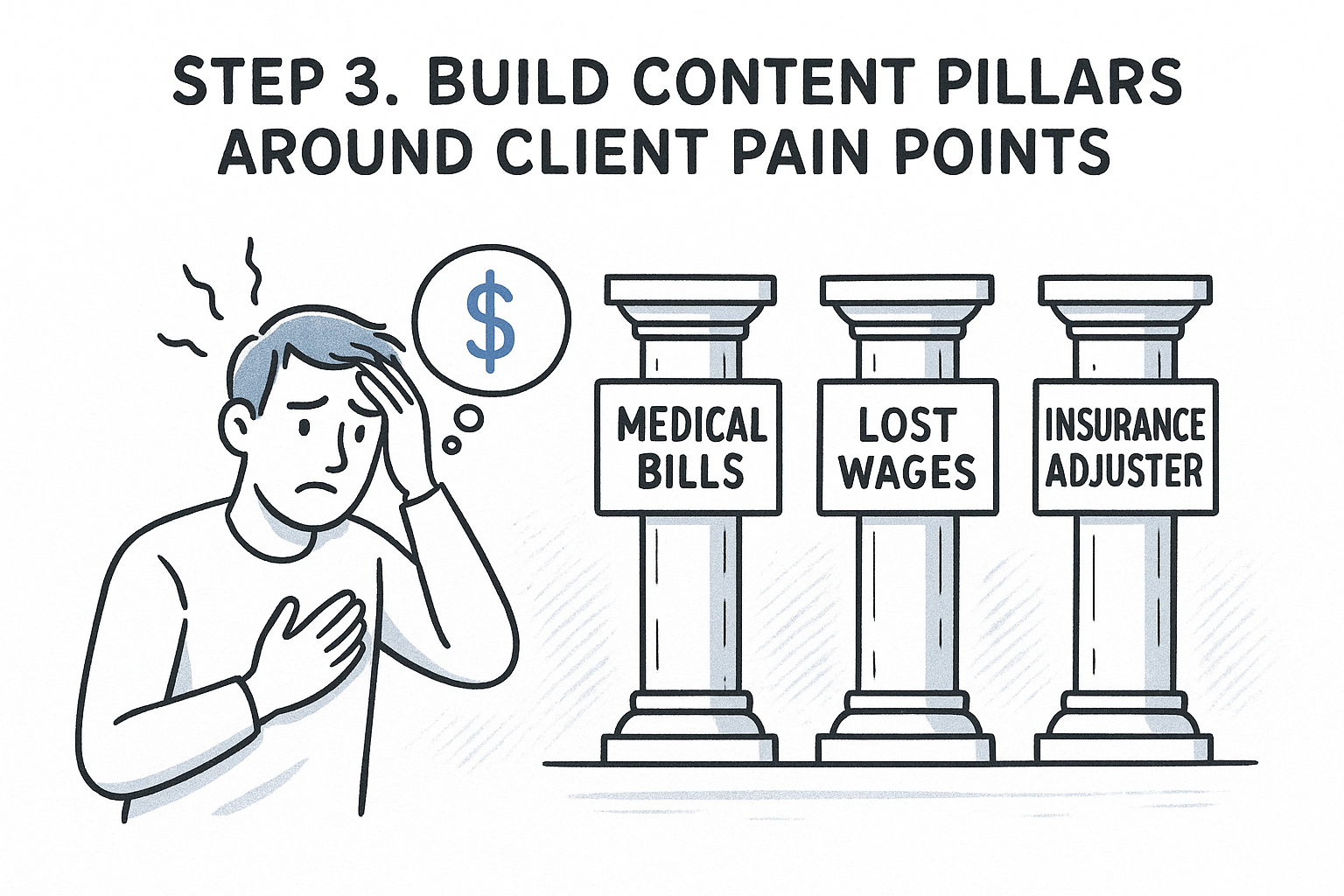
Keyword research for lawyers tells you what people type, but client pain points tell you why they're typing it. A car accident victim isn't just searching "personal injury lawyer near me," they're worried about missed paychecks, mounting medical bills, and an insurance adjuster calling before they've even seen a doctor. Build your content pillars around those underlying worries first, then let keyword data confirm the phrasing. A pillar like "paying medical bills after a car accident" spins off a dozen articles an adjuster-focused keyword list would never surface on its own.
Content built around a keyword ranks. Content built around a fear converts.
Map pillars to practice-area realities
Each practice area carries its own recurring anxieties, and your pillars should mirror them directly:
- Personal injury: medical bill pressure, lost wages, dealing with insurance adjusters
- Family law: custody uncertainty, financial fallout of divorce, protecting kids through the process
- Estate planning: fear of dying without a plan, blended-family disputes, avoiding probate delays
- Criminal defense: what happens at arraignment, bail logistics, protecting a job or license
Once you've listed the pain points for a practice area, cluster them into three or four pillars and let every future article fall under one. That structure keeps your blog from turning into a pile of disconnected posts and gives you a clear answer when someone asks what your content actually covers.
Pressure-test pillars against real cases
Before locking in a pillar list, run it past intake staff and the attorneys who handle those practice areas. If nobody on the phones recognizes the pain points you've picked, you're building pillars around assumptions instead of the questions clients actually bring in the door.
Step 4. Plan your workflow, calendar, and distribution
Assign ownership before you write a single topic
Every pillar and topic list you built in Step 3 dies without a name attached to it. Decide who writes, who reviews for bar-compliance language, and who publishes, and put deadlines on all three. Firms that skip this step end up with a folder of half-finished drafts and an associate who quietly stopped writing three months ago because nobody ever followed up.
Build a calendar that matches your intake reality
An editorial calendar for a law firm should map publishing frequency to how much your intake team can actually handle, not to some arbitrary "two posts a week" rule copied from a marketing blog. A solo practitioner might sustain two pillar articles a month plus one FAQ update. A larger firm running multiple practice areas can split output across attorneys and staff writers.
A calendar you can't sustain past month three isn't a content strategy, it's a countdown to abandonment.
Distribute past the blog itself
Publishing is only half the job. Repurpose each pillar article into a short video for your Google Business Profile, a client-facing email, and a social post pointing back to the source page. Route every resulting lead through automation workflows every law firm should build so an SMS or email sequence fires within 60 seconds, since content that finally earns a click deserves a fast response, not a lead sitting unanswered in someone's inbox until Monday.
Turning your framework into signed cases
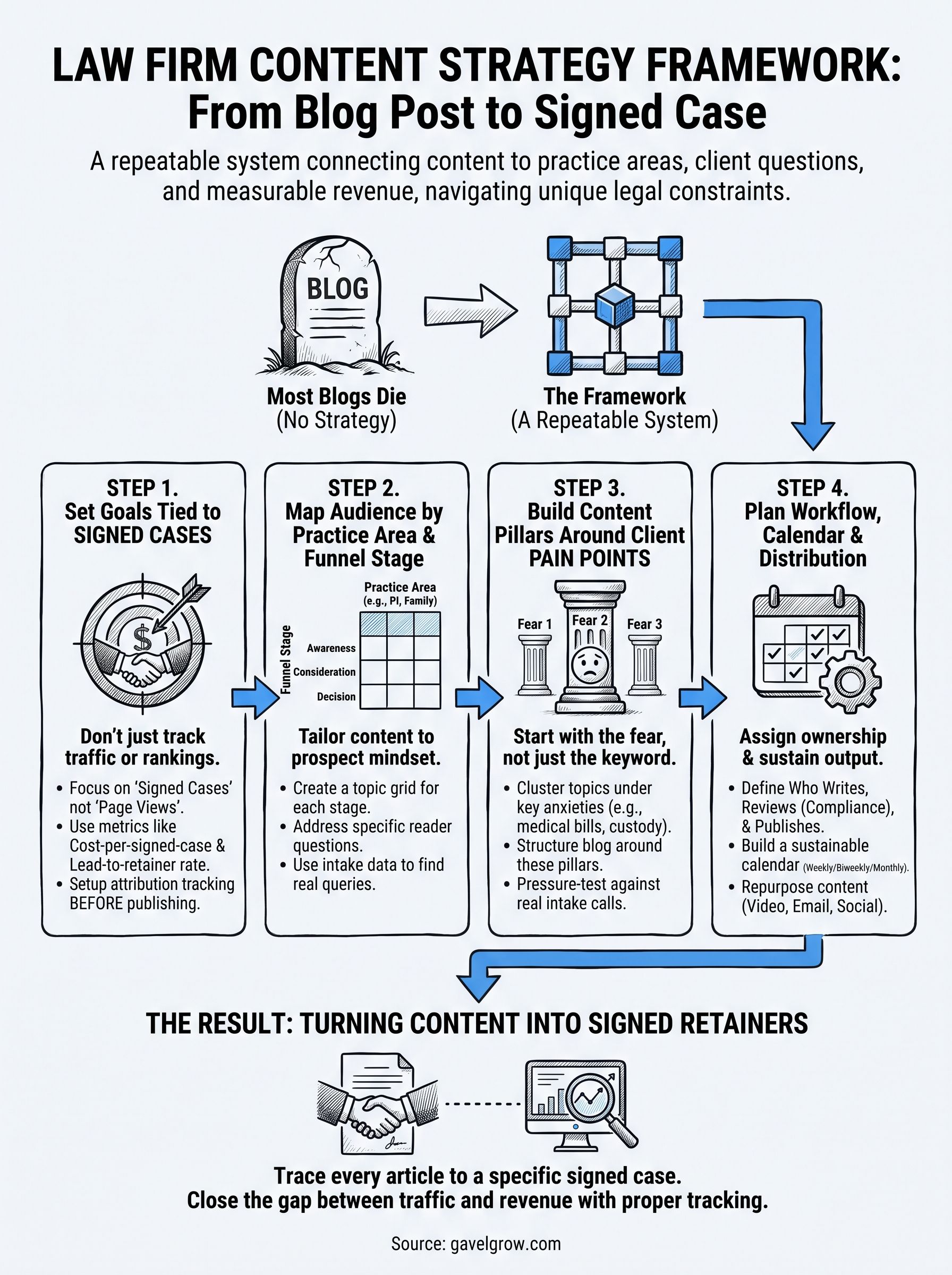
A content strategy framework only earns its keep when you can trace a specific article to a specific retainer. Skip the goals, audience mapping, pillars, or workflow from the steps above, and you're back to publishing blindly and hoping something ranks. Follow them in order, and you get a system where every post has an owner, a practice area, a funnel stage, and a way to measure whether it produced a client instead of just a pageview.
The hard part isn't writing the content. It's connecting what you publish to the calls and form fills it generates, then proving which pieces actually turn into signed cases. That's the exact gap GavelGrow's marketing dashboard closes, tracking every lead from the article that produced it through to the signature. If you'd rather walk through your specific practice areas with someone who's built this for 500+ firms, map your content plan on a free 45-minute call.
Frequently Asked Questions
What is a content strategy framework, and why does a law firm need one?
A content strategy framework is the system that decides what you publish, for whom, and how you measure it, instead of writing blog posts at random because a competitor ranks. For law firms it matters because legal keywords are competitive and clients research heavily before calling, so content built around real client questions and tied to signed cases outperforms scattered publishing that ranks for nothing and produces no clients.
How is a content strategy framework different from a content calendar?
A calendar is a schedule; a framework is the strategy behind it. The framework sets goals tied to signed cases, maps your audience by practice area and funnel stage, and defines the content pillars worth building around client pain points. The calendar is the last step, where that strategy becomes specific titles and deadlines. A calendar without a framework just fills slots; a framework without a calendar never ships.
What content pillars should a law firm build around?
Build pillars around the questions prospects actually ask before hiring, organized by practice area and stage of the decision: process questions (filing steps, timelines), money questions (fees, settlements, costs), and reassurance questions (what happens next, is my situation normal). Pull recurring questions from your intake calls, since those are the topics most likely to reach someone on the path to hiring a lawyer.
How do you tie a law firm's content to signed cases instead of traffic?
Set goals in signed cases, not pageviews, and put tracking in place before you publish: your analytics and intake need to trace a click on a specific article through form submission and intake to a signed retainer. Then judge each piece by cost per signed case, not traffic. Content that ranks but never connects to a client is a vanity metric; the framework only works if you can prove which pieces produce revenue.
How much content does a law firm need to publish to see results?
Consistency and depth beat volume. A few thorough, attorney-reviewed pages that fully answer a real client question outperform a stack of thin weekly posts. Most firms do better publishing one strong piece per topic on a steady cadence they can actually sustain than chasing a high post count. Match the volume to what your team can produce accurately, since legal content carries a higher accuracy bar than most industries.
How long does a content strategy take to produce signed cases?
Content compounds slowly: most firms see meaningful organic traffic in three to six months and signed cases from that traffic over six to twelve, with competitive practice areas taking longer. The pieces you publish keep working long after you write them, which is why content is an asset rather than a campaign, but it rewards firms that treat it as ongoing maintenance rather than a one-time push.
Frequently Asked Questions
What is a content strategy framework, and why does a law firm need one?
A content strategy framework is the system that decides what you publish, for whom, and how you measure it, instead of writing blog posts at random because a competitor ranks. For law firms it matters because legal keywords are competitive and clients research heavily before calling, so content built around real client questions and tied to signed cases outperforms scattered publishing that ranks for nothing and produces no clients.
How is a content strategy framework different from a content calendar?
A calendar is a schedule; a framework is the strategy behind it. The framework sets goals tied to signed cases, maps your audience by practice area and funnel stage, and defines the content pillars worth building around client pain points. The calendar is the last step, where that strategy becomes specific titles and deadlines. A calendar without a framework just fills slots; a framework without a calendar never ships.
What content pillars should a law firm build around?
Build pillars around the questions prospects actually ask before hiring, organized by practice area and stage of the decision: process questions (filing steps, timelines), money questions (fees, settlements, costs), and reassurance questions (what happens next, is my situation normal). Pull recurring questions from your intake calls, since those are the topics most likely to reach someone on the path to hiring a lawyer.
How do you tie a law firm's content to signed cases instead of traffic?
Set goals in signed cases, not pageviews, and put tracking in place before you publish: your analytics and intake need to trace a click on a specific article through form submission and intake to a signed retainer. Then judge each piece by cost per signed case, not traffic. Content that ranks but never connects to a client is a vanity metric; the framework only works if you can prove which pieces produce revenue.
How much content does a law firm need to publish to see results?
Consistency and depth beat volume. A few thorough, attorney-reviewed pages that fully answer a real client question outperform a stack of thin weekly posts. Most firms do better publishing one strong piece per topic on a steady cadence they can actually sustain than chasing a high post count. Match the volume to what your team can produce accurately, since legal content carries a higher accuracy bar than most industries.
How long does a content strategy take to produce signed cases?
Content compounds slowly: most firms see meaningful organic traffic in three to six months and signed cases from that traffic over six to twelve, with competitive practice areas taking longer. The pieces you publish keep working long after you write them, which is why content is an asset rather than a campaign, but it rewards firms that treat it as ongoing maintenance rather than a one-time push.