How Long Does Law Firm Intake Take? Timelines by Stage
Categories: Legal Marketing Strategies
 Abram Ninoyan
Founder & Senior Performance Marketer
Credentials: Google Partner, Google Ads Search Certified, Google Ads Display Certified, Google Ads Measurement Certified, Google Analytics (IQ) Certified, HubSpot Inbound Certified, HubSpot Social Media Marketing Certified, Conversion Optimization Certified
Expertise: Google Ads, Meta Ads, Conversion Rate Optimization, GA4 & Google Tag Manager, Lead Generation, Marketing Funnel Optimization, PPC Management
LinkedIn Profile
How long does law firm intake take? For most firms, a clean intake runs from the first call or form submission to a signed retainer in anywhere from same-day to about two weeks, depending on practice...
Key Takeaways
- Why does intake speed matter for signed cases?
- How long does each stage of intake typically take?
- What factors slow down or speed up your timeline?
- How can your firm shorten intake without cutting corners?
How long does law firm intake take? For most firms, a clean intake runs from the first call or form submission to a signed retainer in anywhere from same-day to about two weeks, depending on practice area and how fast your staff follows up. Mass tort cases often need medical records before a firm will sign, while a straightforward estate planning consult can close in a single call. If your firm is watching that timeline stretch past a week with no clear reason, something in your intake process is costing you signed cases, not just time.
The honest answer is that intake speed depends on three things: how quickly you make first contact, how many steps stand between a lead and a signature, and whether your team tracks where leads stall. A lead contacted within minutes is far more likely to qualify than one reached half an hour later, so response speed matters more than almost anything else you control. Practice area, case complexity, and required documentation set the outer bounds, but your process sets the floor.
This article breaks down realistic intake timelines by practice area, the factors that stretch or shrink them, and how firms use tools like automated intake sequences and a connected lead pipeline, the kind built into the GavelGrow platform, to cut dead time out of the process.
Why does intake speed matter for signed cases?
Speed is not a nice-to-have in legal intake. It is the difference between a signed retainer and a lead who called three other firms before you finished dialing back. The Lead Response Management Study found that leads contacted within five minutes are far more likely to qualify than those first reached at thirty minutes. That is a statement about qualification odds, not guaranteed signings, but the direction is clear: every minute you wait, your odds of ever talking to that person again drop.
A lead you reach in five minutes is worth more than a lead you reach perfectly in five hours.
Think about what happens between the first call and the signed engagement letter. Each additional step, a callback that gets missed (and how often those callbacks never happen at all), a form that sits unread in an inbox, a consult that has to be rescheduled, gives the prospect time to hire someone else or simply lose motivation. Personal injury and mass tort leads in particular tend to shop around; many contact more than one firm before anyone calls them back. If your intake process takes days to get a callback scheduled, you are not competing on the quality of your representation. You are losing on logistics before the prospect ever hears your pitch.
Slow intake wastes the marketing spend that got the lead there
Every lead that stalls in intake is a lead your firm already paid for. Whether that cost came from a Google Ads click, a Local Services Ads call, or a referral relationship you have nurtured for years, the acquisition cost is sunk the moment the lead reaches your intake team. When that lead goes cold because nobody followed up for two days, you are not just losing a case, you are erasing the return on that specific ad dollar. Firms that know how to calculate what a signed case really costs them, not just cost per lead, see this clearly: a $150 lead that never gets a callback is a pure loss, while the same lead contacted in minutes might close into a five-figure case.
Staff and case managers feel the drag too
Beyond the marketing math, slow intake creates real friction inside the firm. Attorneys end up reviewing stale leads that have gone quiet, paralegals chase down documents from prospects who have already stopped answering, and nobody tracks the intake numbers that reveal where leads drop off or has a clear view of where a given lead actually sits in the pipeline. A connected lead pipeline, like the one built into the GavelGrow platform, gives your staff a single view of every lead's last activity, so nothing sits untouched for days without anyone noticing. That visibility alone can shorten a firm's intake timeline, simply because stalled leads stop hiding.
Ultimately, intake speed is a proxy for how well your firm respects a prospective client's time and urgency. Someone calling about a car accident or a custody dispute is usually calling because something in their life just went sideways. A firm that responds fast and moves them efficiently toward a signed retainer signals competence before the first meeting even happens. A firm that takes a week to call back signals the opposite, no matter how good the actual legal work turns out to be.
How long does each stage of intake typically take?
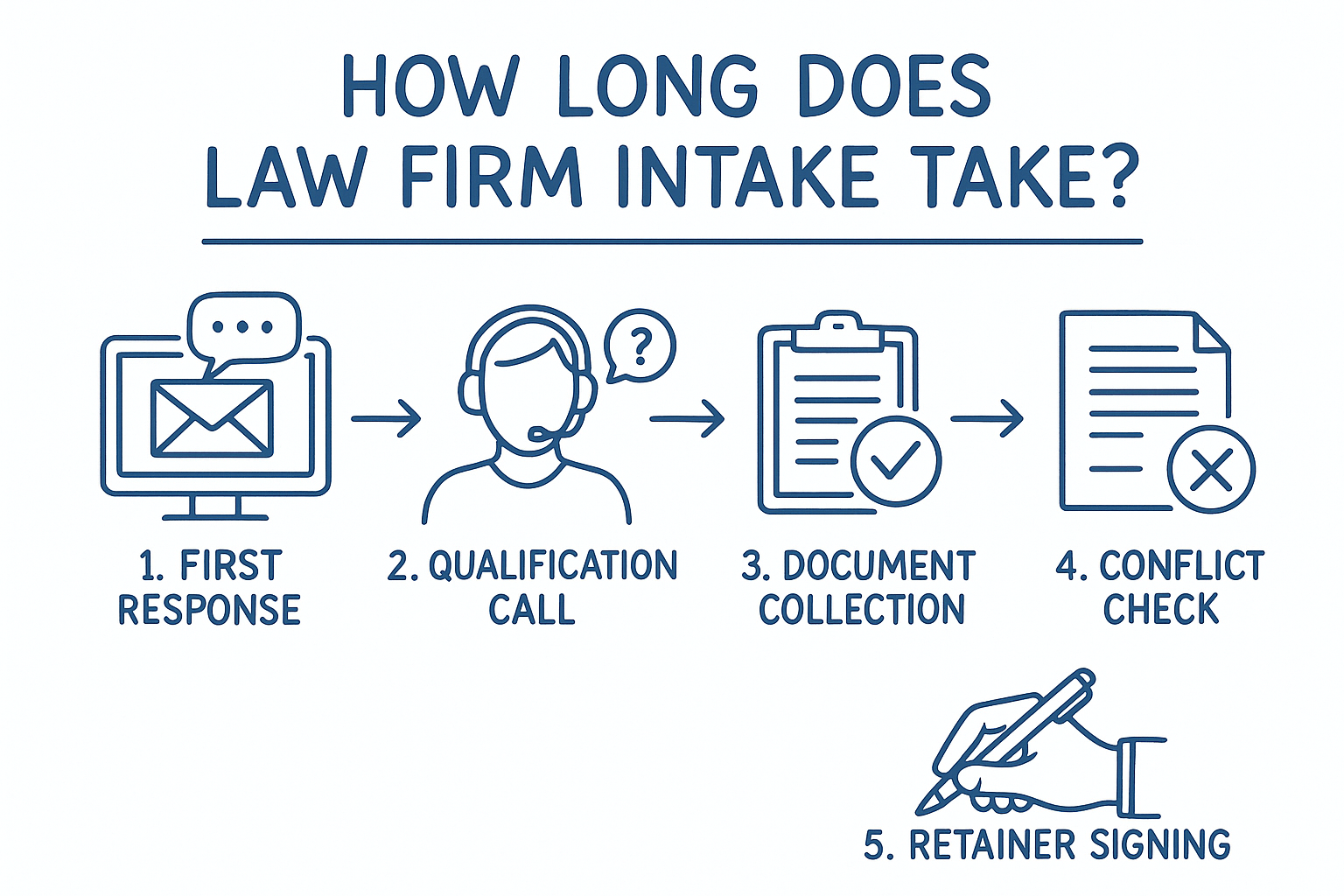
Break intake into its component stages and the timeline gets a lot less mysterious. Most legal intake runs through five distinct steps, and each one has a realistic window you can measure against. Knowing those windows lets you spot exactly where your firm's process is bleeding time, instead of guessing that "intake feels slow."
If you can't name which stage is stalling, you can't fix your intake timeline.
The five stages, start to finish
Complex practice areas like mass tort will run longer at the documentation stage, and simpler matters like a will or an uncontested filing can skip steps entirely. Here's a realistic breakdown for a firm running a reasonably tight process:
- First response: minutes to a few hours. Confirm you got the inquiry and book the qualification call.
- Qualification call: usually the same day. Confirm the case fits and capture the name of every party involved.
- Conflict check: same day to two days. Clear it before you ask for documents or detailed facts.
- Document collection: one to ten days for most matters, longer when medical records are involved.
- Retainer signing: same day to a week. Send the engagement letter for e-signature as soon as you accept the case.
Where the clock actually stops
Notice that only one stage, document collection, genuinely requires waiting on outside parties. Every other stage is entirely within your firm's control, which is exactly why an intake sequence that starts within minutes of lead capture, paired with automated reminders for missing paperwork, compresses the total timeline without touching the parts you can't rush. A firm that automates the controllable stages and simply monitors the uncontrollable one can take days off its average intake, even in document-heavy practice areas.
What factors slow down or speed up your timeline?
Practice area sets the outer limits of your intake timeline before your team even picks up the phone. A mass tort case usually needs medical records, prior treatment history, and sometimes a signed HIPAA authorization before anyone can evaluate the claim, so a two-week timeline is normal, not a failure. An estate planning consult, by contrast, often needs nothing more than a conversation and a signature, which is why those cases can close same-day when the rest of your process cooperates.
Staffing and coverage explain most of the variation between firms in the same practice area. A solo practitioner juggling court appearances will naturally respond slower than a firm with a dedicated intake specialist watching the phone and inbox all day. Weekend and after-hours coverage matters just as much: a lead who calls Friday night and hears back Monday morning has had two full days to call a competitor instead.
The gap between a fast firm and a slow one is rarely talent. It's whether anyone was watching the pipeline.
Process friction, the category that holds most common intake failures firms never notice, is the factor most firms underestimate. Consider what typically adds days to an otherwise simple case:
- Manual data entry between a paper intake form and your case management system, with all the hidden costs manual intake carries
- No auto-reply, leaving leads wondering if the form even submitted
- Missed calls with no callback trigger, so the lead has to call back themselves
- Conflict checks that wait for an available attorney instead of running as soon as you have the parties' names
- No visibility into stalled leads, so a cold lead sits untouched for a week before anyone notices
Outside factors, like a records request stuck at a hospital or a police report that hasn't been filed yet, are genuinely outside your control. Everything on that list above isn't. Firms using a connected lead pipeline can see exactly which stage a lead is stuck in, which turns a vague sense that "intake feels slow" into a specific, fixable bottleneck.
How can your firm shorten intake without cutting corners?
Shortening intake does not mean rushing prospects into a signature before they understand what they are signing. It means removing the dead time between steps that add no value, the gaps where a lead waits on your firm rather than the other way around. Cutting corners looks like skipping the conflict check. Cutting dead time looks like running that same check the moment you have the parties' names, instead of waiting for an attorney to free up.
Fast intake and thorough intake are not opposites. Dead time is the only thing standing between them.
Start with the controllable stages identified earlier. A few changes tend to help without touching case quality:
- Automate first response so every lead gets a call attempt or SMS within minutes, not hours
- Run the conflict check immediately once you have the parties' names, so document requests can go out as soon as it clears
- Set a stall alert on any lead untouched for more than 24 hours, so nothing goes cold silently
- Standardize your qualification script, using script changes that lift call-to-client conversion, so any staff member can screen a case correctly on the first call
- Send automated reminders for missing paperwork instead of waiting for the prospect to remember
Each of these targets a specific bottleneck rather than the process as a whole, which is why they work without sacrificing thoroughness.
Technology closes most of the remaining gap. An intake sequence that sends the first text and email within minutes of lead capture, combined with one inbox that keeps each lead's texts and emails in a single thread, means nobody has to remember to follow up manually, and the tools, workflows, and ROI tracking behind intake automation are worth studying before you build one. GavelGrow's platform runs these sequences from the same lead pipeline your staff already works from and flags every lead nobody has contacted yet, so speeding up intake does not require a second login or a separate subscription. Texting in those sequences starts once carriers approve your firm's registration. Firms that pair automation with a genuinely standardized qualification process tend to see the biggest timeline drop, because the two changes reinforce each other: automation handles the response speed, and a clear script handles consistency once a human picks up.
Making every minute of intake count
Realistic intake timelines run from same-day to about two weeks, and the honest truth is that most of that range is set by document collection, not by your firm's own speed. Everything else, first response, qualification, conflict checks, retainer signing, is within your control. Skipping steps to save a day isn't the goal; removing dead time between steps is. That distinction is what separates a firm that closes fast from one that just feels rushed.
Start by naming which stage actually stalls in your process. Watch it for a week before you change anything. Once you know the bottleneck, fixing it is usually a process change, not a personality change on your staff.
If you want a clearer picture of where your firm's intake speed and cost per signed case actually stand, schedule a free 45-minute intake and marketing strategy call and walk through your numbers with someone who works exclusively with law firms.
Frequently asked questions about law firm intake time
How fast should a law firm respond to a new lead?
As close to five minutes as you can staff for. In the Lead Response Management Study, leads first called within five minutes were 21 times more likely to qualify than leads first called at 30 minutes, a measure of the odds of qualifying, not of signing. Few firms can answer every call live, so the practical target is an automatic reply to every web form, a callback within minutes during business hours, and after-hours calls routed to a person or an answering service instead of voicemail.
When should a law firm run a conflict check during intake?
Before the prospect shares the details of their case. ABA Model Rule 1.18 protects what a prospective client tells you even if you never take the matter, and the rule's comment advises limiting the initial consultation to only the information reasonably needed to decide whether to take it. In practice, capture the name of every party on the first call, run the check right away, and wait until it clears before you request medical records or other documents. Your state's version of Rule 1.18 may differ, so confirm it.
Can a client sign a fee agreement electronically?
Generally, yes. The federal E-SIGN Act, in force since 2000, says a contract or signature can't be denied legal effect solely because it's electronic, so an e-signed engagement letter is usually as binding as a paper one. That matters for contingency cases, because ABA Model Rule 1.5(c) requires a contingent fee agreement to be in a writing signed by the client. Sending it for e-signature right after you accept the case can take days off the final stage. Some states add disclosure requirements for contingency agreements, so check yours first.
Why does document collection take so long in injury cases?
Because it depends on people outside your firm. Under HIPAA's right of access, a provider currently has up to 30 days to act on a patient's request for their own records, plus one 30-day extension if it explains the delay in writing. You can't make a hospital move faster, but you can send the request the day the conflict check clears, use the provider's own request form or portal, and set a follow-up reminder well before the deadline instead of waiting to see whether the records arrive.
Does response time affect Google Local Services Ads?
Yes. Google lists your responsiveness to customer inquiries and requests as a factor in how Local Services Ads rank, says missed calls may negatively affect it, and counts average response time toward your profile quality alongside your rating and number of reviews. So a slow first response costs you twice with these ads: the lead you paid for goes cold, and a pattern of missed calls can push your future ads down. Answer ad calls live whenever you can, and reply to message leads quickly.
Frequently Asked Questions
How fast should a law firm respond to a new lead?
As close to five minutes as you can staff for. In the Lead Response Management Study, leads first called within five minutes were 21 times more likely to qualify than leads first called at 30 minutes, a measure of the odds of qualifying, not of signing. Few firms can answer every call live, so the practical target is an automatic reply to every web form, a callback within minutes during business hours, and after-hours calls routed to a person or an answering service instead of voicemail.
When should a law firm run a conflict check during intake?
Before the prospect shares the details of their case. ABA Model Rule 1.18 protects what a prospective client tells you even if you never take the matter, and the rule's comment advises limiting the initial consultation to only the information reasonably needed to decide whether to take it. In practice, capture the name of every party on the first call, run the check right away, and wait until it clears before you request medical records or other documents. Your state's version of Rule 1.18 may differ, so confirm it.
Can a client sign a fee agreement electronically?
Generally, yes. The federal E-SIGN Act, in force since 2000, says a contract or signature can't be denied legal effect solely because it's electronic, so an e-signed engagement letter is usually as binding as a paper one. That matters for contingency cases, because ABA Model Rule 1.5(c) requires a contingent fee agreement to be in a writing signed by the client. Sending it for e-signature right after you accept the case can take days off the final stage. Some states add disclosure requirements for contingency agreements, so check yours first.
Why does document collection take so long in injury cases?
Because it depends on people outside your firm. Under HIPAA's right of access, a provider currently has up to 30 days to act on a patient's request for their own records, plus one 30-day extension if it explains the delay in writing. You can't make a hospital move faster, but you can send the request the day the conflict check clears, use the provider's own request form or portal, and set a follow-up reminder well before the deadline instead of waiting to see whether the records arrive.
Does response time affect Google Local Services Ads?
Yes. Google lists your responsiveness to customer inquiries and requests as a factor in how Local Services Ads rank, says missed calls may negatively affect it, and counts average response time toward your profile quality alongside your rating and number of reviews. So a slow first response costs you twice with these ads: the lead you paid for goes cold, and a pattern of missed calls can push your future ads down. Answer ad calls live whenever you can, and reply to message leads quickly.