Law Firm Google Ads Agency vs Doing It Yourself: Real Costs
Categories: Legal Marketing Strategies
 Abram Ninoyan
Founder & Senior Performance Marketer
Credentials: Google Partner, Google Ads Search Certified, Google Ads Display Certified, Google Ads Measurement Certified, Google Analytics (IQ) Certified, HubSpot Inbound Certified, HubSpot Social Media Marketing Certified, Conversion Optimization Certified
Expertise: Google Ads, Meta Ads, Conversion Rate Optimization, GA4 & Google Tag Manager, Lead Generation, Marketing Funnel Optimization, PPC Management
LinkedIn Profile
The law firm Google Ads agency vs doing it yourself choice has a practical answer. Hire a legal specialist when a few months of beginner mistakes would cost more than the management fee. Run Google Ad...
Key Takeaways
- Law Firm Google Ads Agency vs Doing It Yourself: Real Costs
- Why does the agency or DIY choice matter for law firms?
- How do agency and DIY Google Ads costs compare?
- When should you hire an agency and when should you DIY?
Law Firm Google Ads Agency vs Doing It Yourself: Real Costs
The law firm Google Ads agency vs doing it yourself choice has a practical answer. Hire a legal specialist when a few months of beginner mistakes would cost more than the management fee. Run Google Ads yourself only when your budget is small, your practice area is less competitive, and someone at your firm can give it real hours every week.
Doing it yourself means an attorney or staff member builds and manages the campaigns in your firm's own Google Ads account. Using an agency means an outside team does that work for a fee. Both routes can share the same account, call tracking and intake process. The difference is who carries the learning curve.
This guide compares the two on cost, performance and time, with a worked example at $10,000 a month. You will also get a decision checklist and steps for making either route work. GavelGrow has served 500+ law firms since 2015 and offers both a self-serve platform and a managed service, so we have no reason to pretend one route fits everyone.
Key Takeaways
- Should you hire an agency? Yes, when mistakes would cost more than the fee.
- Can you run it yourself? Yes, with call tracking and weekly negative keywords.
- What does DIY really cost? Billable hours plus wasted clicks, not only ad spend.
- How should you judge results? By cost per signed case, never raw leads.
- Must you choose one? No, you can pair your own tracking with an agency.
Why does the agency or DIY choice matter for law firms?
Legal is one of the most expensive categories in paid search, so a setup mistake costs real money within days. The same error that wastes a few dollars in a cheap category can burn hundreds here.
Why legal clicks punish beginners
Clicks in personal injury, criminal defense and mass tort campaigns often cost tens of dollars, and sometimes far more. One broad-match keyword with no negative keyword list can send your budget to people looking for jobs, free advice or a different kind of lawyer. Google bills those clicks the same as a real prospect's.
The second problem is measurement. A click that becomes a form fill is not a signed case, and legal matters close over weeks or months. Many prospects also phone instead of filling out a form, so a firm without call tracking sees only part of what its ads produce. That makes the wrong campaigns look good and the right ones look weak.
What each option means in practice
You have three realistic routes, and the ad account should belong to your firm in all of them:
- Doing it yourself: an attorney or staff member manages campaigns alongside other work.
- Hiring in-house: a dedicated marketer, which adds salary, payroll taxes and tools, so it rarely makes sense unless spend is large.
- Using an agency: outside specialists build and run the campaigns for a fee.
The cheapest lead is rarely the cheapest signed case.
How do agency and DIY Google Ads costs compare?
DIY looks cheaper because there is no fee, but you pay in billable hours, wasted clicks during the learning curve and missing tools. An agency's cost sits on an invoice, which makes it feel larger than it is.
The cost factors side by side
Agency pricing models differ a lot, so get the fee structure in writing and ask whether ad spend carries any markup.
A worked example at $10,000 a month
Suppose your firm spends $10,000 a month and a partner spends 8 hours monthly on campaigns, valued at $300 an hour. That is $2,400 in time. If 20% of clicks are irrelevant in the early months, that is $2,000 in wasted ad spend. Add an Optimize plan at $599 for tracking and attribution, and DIY costs $4,999 a month before you count missed cases.
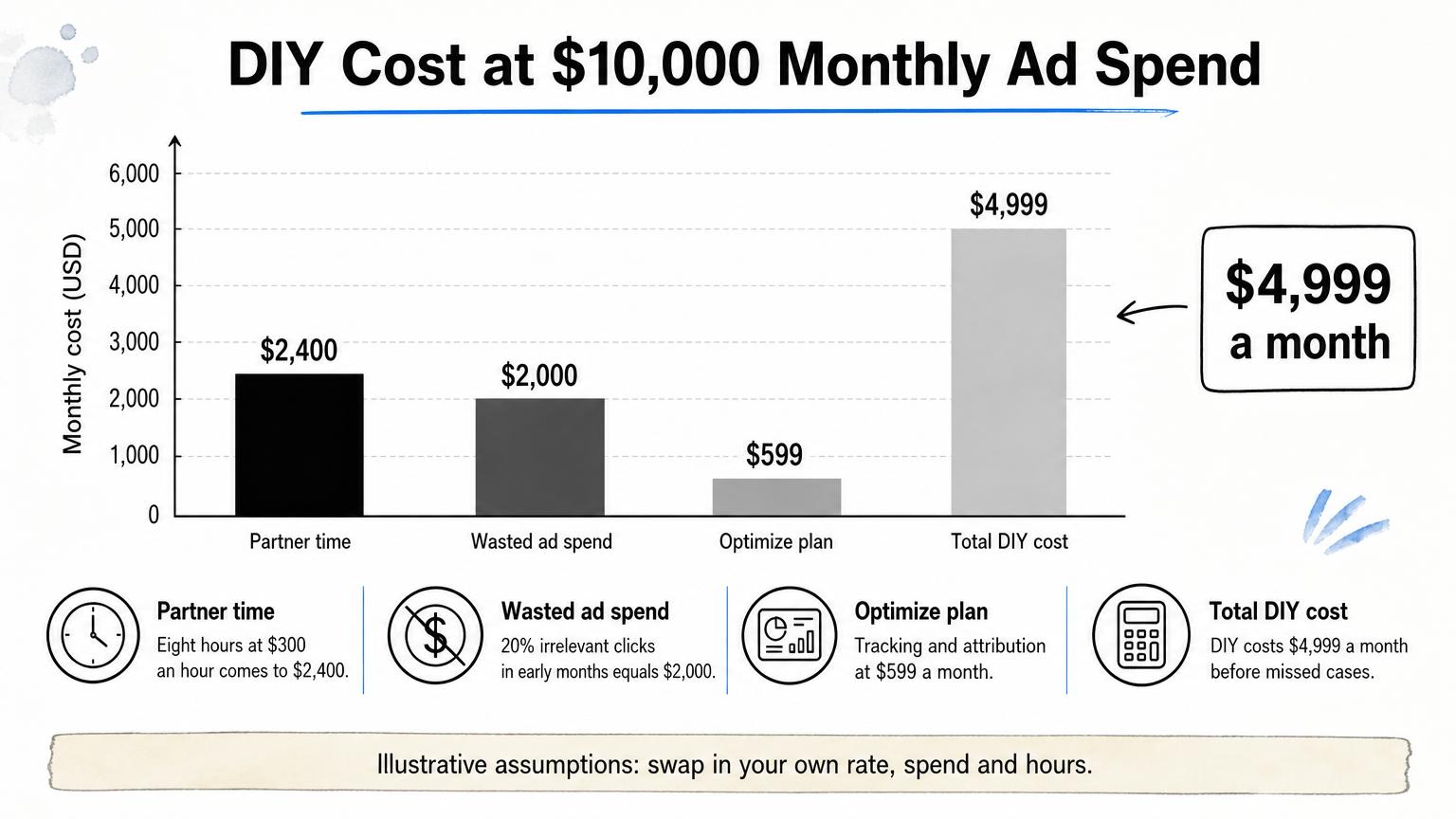
The question for any agency is whether its fee plus the waste it leaves behind comes in under that number. These are illustrative assumptions, so swap in your own hourly rate, spend and hours. The CPA calculator helps with the arithmetic.
Where performance differs
An agency's edge is repetition. A legal specialist starts with proven negative lists, ad tests and landing page structures, and has already seen which setups fail. Your edge is case knowledge. You know which matters you want, which you refer out and what a qualified call sounds like.
The gap is widest in competitive practice areas, where one bad keyword is expensive. It is narrowest in narrower, lower-cost areas such as estate planning. Time follows the same pattern: an agency removes the weekly maintenance load, while DIY keeps it on your calendar.
You are not choosing between free and paid. You are choosing who pays for the learning curve.
When should you hire an agency and when should you DIY?
Hire an agency when your spend is meaningful, your practice area is competitive and nobody can give campaigns about five hours a week. Do it yourself when the opposite is true.
Signs an agency fits your firm
- Your monthly spend is high enough that 20% waste would hurt.
- You practice in personal injury, criminal defense, mass torts or another high-cost area.
- Your cost per lead keeps rising and you cannot tell why.
- You want ads, landing pages and intake improved together.
- No one on staff has real Google Ads experience.
Signs doing it yourself can work
DIY fits a small, steady budget in a narrower practice area, run by someone who will check the search terms report every week. It also fits a firm with a staff member who already knows paid search. A full-time in-house hire only makes sense at very high spend, because salary and tools sit on top of the ad budget.
The hybrid route
You can also run your own campaigns on software that tracks every call and signed case, then bring in help later. Or you can keep an agency and add your own tracking so you see what it delivers. Either way, your own attribution data is what keeps the decision honest.
If you cannot see cost per signed case, you cannot judge either option.
How to make either choice work
Whichever route you pick, the same foundations decide the result: you own the account, you track calls and signed cases, and you judge results on a long enough timeline.
If you run it yourself
- Create the ad account in your firm's name and keep billing under your control.
- Track forms and calls with a separate number per campaign, so each call credits a campaign.
- Start narrow with exact and phrase match, and review search terms weekly to add negatives.
- Answer every lead fast, because a slow reply wastes the click you paid for.
- Judge on cost per signed case after 60 to 90 days, not on leads from week one.
GavelGrow's self-serve platform covers steps 2 and 5. Track is $199 a month and Optimize is $599, and Optimize sends signed cases back to Google Ads as offline conversions. Both include a 7-day free trial with no credit card, and the pricing page lists the add-ons.
If you hire an agency
Ask five questions before you sign. Who owns the ad account and phone numbers? Does the agency work for a competitor in your market? Is the fee flat, a percentage of spend, or marked up? Will reports show cost per signed case? Is the contract month to month?
Also ask how ad copy is checked against your state bar's advertising rules, because they vary by state and the responsibility is yours. GavelGrow's managed service is scoped on a strategy call plus ad spend, with a named contact, no markup on ad spend and accounts in your firm's name.
Own the account, own the data, and make every report end in signed cases.
Frequently Asked Questions
These are the questions firms ask most when weighing this decision.
How much should a law firm spend on Google Ads before hiring an agency?
There is no universal threshold. Compare the fee to the waste a beginner is likely to create. At $5,000 a month, 20% irrelevant clicks costs $1,000, and your own time comes on top. If an agency's fee is lower than your waste plus your hours, hiring pays for itself. Below a small budget, an agency may not take the account.
Do I need call tracking if I run Google Ads myself?
Yes, because many legal prospects phone instead of filling out a form. Without tracking numbers, those calls never appear in your campaign reports. GavelGrow's Track plan includes 2 call tracking numbers, and Optimize includes 10. Every tracked call opens with a recording notice, and calls are credited to the campaign that produced them.
How long before I know if Google Ads is working for my firm?
Plan on 60 to 90 days. Legal matters close slowly, so early lead counts say little about signed retainers. Most firms read a reliable cost per signed case with GavelGrow at that point. Ending a test at three weeks usually means judging campaigns before the first cases have signed.
Judge Google Ads by signed cases over 60 to 90 days, not by clicks this week.
Who should own the Google Ads account?
Your firm should, always. If an agency owns the account, you lose your history and your tracking numbers when you leave. GavelGrow creates ad accounts and tracking numbers in the firm's own name, and they stay there if you cancel. Get the same promise in writing from any provider before you sign.
Can I use software while an agency runs my ads?
Yes. Software gives you your own view of what the agency delivers. GavelGrow can run alongside an agency your firm already has. On Optimize, signed cases are sent back to Google Ads as offline conversions, which helps the campaigns learn from retainers instead of form fills.
Making the call for your firm
An agency is the safer choice when spend is meaningful, your practice area is competitive and your time is billable. Doing it yourself works when the budget is small, the area is narrower and someone can review search terms weekly. In both cases, the hidden costs matter more than the visible ones, so add up your hours and your likely waste before you compare fees.
Whichever route you pick, own the account, track every call and judge on cost per signed case over 60 to 90 days. If you want a legal-only team to build and run your campaigns, see managed Google Ads for law firms and scope it on a strategy call.
Frequently Asked Questions
How much should a law firm spend on Google Ads before hiring an agency?
There is no universal threshold. Compare the fee to the waste a beginner is likely to create. At $5,000 a month, 20% irrelevant clicks costs $1,000, and your own time comes on top. If an agency's fee is lower than your waste plus your hours, hiring pays for itself. Below a small budget, an agency may not take the account.
Do I need call tracking if I run Google Ads myself?
Yes, because many legal prospects phone instead of filling out a form. Without tracking numbers, those calls never appear in your campaign reports. GavelGrow's Track plan includes 2 call tracking numbers, and Optimize includes 10. Every tracked call opens with a recording notice, and calls are credited to the campaign that produced them.
How long before I know if Google Ads is working for my firm?
Plan on 60 to 90 days. Legal matters close slowly, so early lead counts say little about signed retainers. Most firms read a reliable cost per signed case with GavelGrow at that point. Ending a test at three weeks usually means judging campaigns before the first cases have signed. Judge Google Ads by signed cases over 60 to 90 days, not by clicks this week.
Who should own the Google Ads account?
Your firm should, always. If an agency owns the account, you lose your history and your tracking numbers when you leave. GavelGrow creates ad accounts and tracking numbers in the firm's own name, and they stay there if you cancel. Get the same promise in writing from any provider before you sign.
Can I use software while an agency runs my ads?
Yes. Software gives you your own view of what the agency delivers. GavelGrow can run alongside an agency your firm already has. On Optimize, signed cases are sent back to Google Ads as offline conversions, which helps the campaigns learn from retainers instead of form fills.