How Long Does Law Firm SEO Take? A Month-by-Month Timeline
Categories: Legal Marketing Strategies
 Abram Ninoyan
Founder & Senior Performance Marketer
Credentials: Google Partner, Google Ads Search Certified, Google Ads Display Certified, Google Ads Measurement Certified, Google Analytics (IQ) Certified, HubSpot Inbound Certified, HubSpot Social Media Marketing Certified, Conversion Optimization Certified
Expertise: Google Ads, Meta Ads, Conversion Rate Optimization, GA4 & Google Tag Manager, Lead Generation, Marketing Funnel Optimization, PPC Management
LinkedIn Profile
How long does law firm SEO take? Most firms see first measurable movement, such as more impressions, long-tail rankings and map pack gains, within three to six months. Steady calls from competitive te...
Key Takeaways
- How Long Does Law Firm SEO Take? A Month-by-Month Timeline
- Why does law firm SEO take months to work?
- How long does law firm SEO take, phase by phase?
- What speeds up or slows down your SEO timeline?
How Long Does Law Firm SEO Take? A Month-by-Month Timeline
How long does law firm SEO take? Most firms see first measurable movement, such as more impressions, long-tail rankings and map pack gains, within three to six months. Steady calls from competitive terms usually follow in six to twelve months. Crowded practice areas in large metros can take longer than a year.
Search engine optimization is the work of making your site, your Google Business Profile and your reputation signals easier for Google to find, understand and trust. For a law firm, it only counts as working when organic search produces calls, forms and signed retainers you can trace. A ranking report full of green arrows does not count. That gap between visible rankings and signed cases is why the timeline runs longer than most managing partners expect.
This guide covers why the clock runs slow, what happens in each phase, what speeds you up or holds you back, and how to test an agency's promises before you sign. GavelGrow has served 500+ law firms since 2015 and works only in legal, so this is written for a firm owner or marketing director, not a general small-business reader. Treat every range as typical, not guaranteed, and check your state bar's advertising rules before you publish any claim about results.
Key Takeaways
- Early signals appear in three to six months; steady leads take six to twelve.
- Nobody can honestly guarantee page one for competitive legal terms in 30 days.
- Local map results can move sooner than organic rankings for narrow searches.
- Competition, domain age and a real local presence set your pace.
- Judge progress by calls and signed cases, not ranking reports alone.
Why does law firm SEO take months to work?
Law firm SEO takes months because Google has to find, test and trust your pages, and because legal search is crowded with firms that started investing years before you did. A bigger invoice does not remove either problem.
Google has to find, test and trust your pages
New or changed pages are usually crawled within days, but being crawled is not the same as ranking. Google tests where a page belongs, compares it with competing pages and watches how searchers respond. Google's SEO starter guide describes SEO as often being about small modifications to your site, which matches what you see in practice: no single change moves a competitive ranking overnight.
Trust also builds from signals that cannot be rushed. Reviews arrive one client at a time, local organizations link to you after real involvement, and a content library grows a page or two at a time, not a hundred in a day. Each signal is small. Over months they separate a firm Google trusts from a firm it has barely seen.
Legal is one of the most contested searches
Terms such as "personal injury lawyer" or "divorce attorney" attract firms that have funded SEO for years. Those firms hold a head start in links, reviews and content, so the gap you must close depends on your market. A criminal defense firm in a mid-sized city typically moves sooner than a personal injury firm in a major metro, and neither timeline means something is broken.
Rules add friction too. Attorney advertising rules vary by state, so many aggressive tactics other industries use are off the table. Every page that describes results needs a check against your own state bar's rules. That pushes legal SEO toward slower, steadier work: useful pages, a clean Google Business Profile, and earned reviews and links.
Why the timeline matters to your budget
Paid search starts producing clicks the day you fund it and stops the day you stop. SEO runs the other way. You pay before you see results, and the results keep coming for as long as your pages hold their rankings. That makes the timeline a budgeting question with three decisions attached:
- Runway: commit to at least six months before the first verdict and twelve before you judge total return.
- Bridge: keep Google Ads or Local Services Ads running while organic builds.
- Patience: decide in advance that you will not cut spend at month four.
SEO costs you before it pays you, so the timeline is a budgeting question as much as a marketing one.
How long does law firm SEO take, phase by phase?
Plan on foundation work in months one and two, first signals by month four, traction by month six, and steady leads between months six and twelve. Competitive terms and brand-new domains push every phase later.
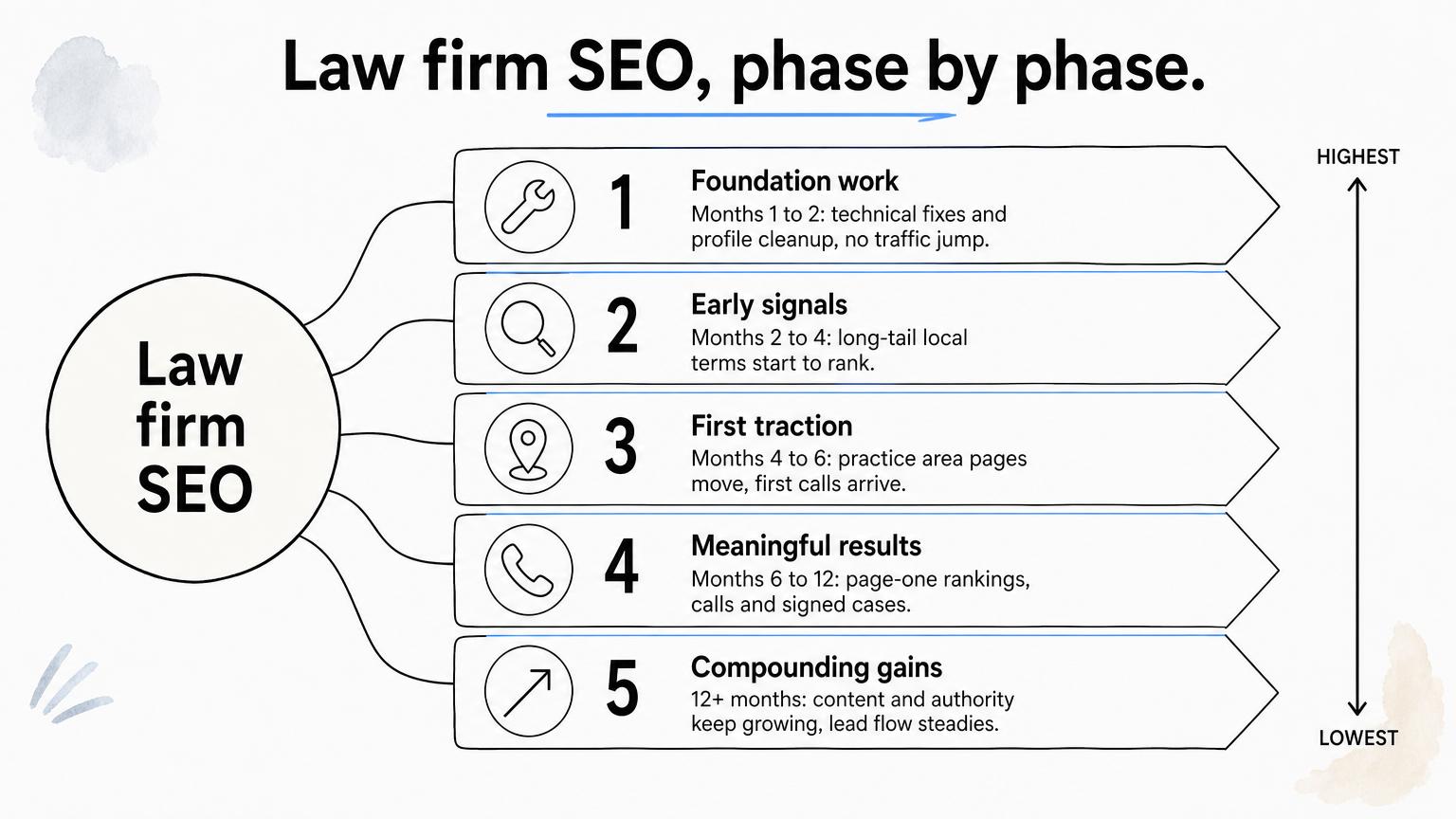
The timeline at a glance
The windows below overlap because markets differ. Use them as a map, not a calendar.
Months 1 to 3: invisible work, and that is normal
Expect almost no visible movement. This stretch is technical and structural: fixing crawl errors, cleaning up site structure, completing your Google Business Profile, making your name, address and phone number identical across directories, and building location-specific practice area pages. A firm that checks its rank for "personal injury lawyer" in week six and sees nothing is not behind schedule. Ask for proof of work, not traffic graphs: a list of fixed issues, indexed pages and a finished profile.
One caution applies. If an agency shows a traffic graph climbing in month one, ask what moved and why. Early wins on a low-competition term are possible. But an agency that cannot name the page and the query is showing you a vanity metric.
Months 3 to 6: the first real movement
Movement starts with the easy terms, not the famous ones. Long-tail practice area pages, specific case types, question searches and less crowded local markets rank first because fewer firms compete for them. For local searches, map pack appearances for narrow queries often arrive before organic gains, and searches for your firm's name tick up as more people see you.
Here is a worked calendar. A firm that starts on January 1 should have its foundation finished by the end of February, see first long-tail and map pack gains in March and April, and have a fair first read in June. Month four is also where many firms lose patience and cut budget, usually right before long-tail pages start converting.
Months 6 to 12 and beyond: leads you can count
Between months six and twelve, a well-run program shows page-one rankings for several relevant terms and a regular flow of calls and form fills from organic and map results. The metric shifts from traffic to lead quality and signed cases. Bottom-of-funnel pages, such as "hire a family law attorney in your city", convert fast once they rank. They are also the most competitive pages on your site.
Signed cases lag leads, because many legal matters take weeks to sign. A cost per signed case from organic will stay noisy for a while even when calls rise. After twelve months, gains compound. A guide you published a year and a half ago still brings in prospects with no ad spend, and competitors need real effort to displace it. Keep investing, because competitors keep publishing and rankings need upkeep.
Months one to three are invisible by design, so judge them on proof of work, not on traffic.
What speeds up or slows down your SEO timeline?
Five things set your pace: market competition, the age and health of your domain, your local presence, how focused your content is, and how consistently you execute. You control the last three.
What speeds results up
Firms that move fastest tend to share the same habits:
- A real office in the market you serve. Google's local results favor businesses with a verified physical presence near the searcher. A virtual address lowers your ceiling.
- A narrow focus. One or two practice areas in one market rank faster than five areas across three counties.
- Genuinely local pages. Each page names the city, addresses local concerns and differs from your other pages. Boilerplate with the city name swapped reads as thin content.
- Review requests to every client. Ask every client at the close of the matter, resolve complaints with the client directly, and reply professionally to every public review. Google's review policies prohibit filtering who gets asked and offering incentives.
- Local links from real ties. Bar associations, nonprofits and civic groups link to firms they actually know.
You cannot control how crowded your market is, but you control your focus, your consistency and how real your local presence looks.
What slows results down
A brand-new domain starts with no history, which can add several months to any range above. An unverified or incomplete Google Business Profile cannot compete with complete ones, and unresolved technical problems cap what good content can do.
Some delays come from your side of the table. Inconsistent listings across directories confuse local signals. A site with no dedicated page per practice area and city competes with one hand tied behind its back. Changing your target practice areas every few months restarts the clock each time. If you add a new area, treat it as a second track instead of replacing the first.
Typical pace by situation
Practice area changes the competition, so the same budget buys different speeds. If you want to see how this plays out for your own area, GavelGrow's practice-area pages cover the differences. The table below shows illustrative patterns, not forecasts.
How can you judge an agency's SEO timeline promises?
Judge a promise by whether it names what will change, by when, and how you will see it. Google's guidance on hiring an SEO warns against anyone who guarantees rankings, so a credible agency gives you milestones tied to the phases above, not a promised position.
Red flags in a timeline pitch
Walk away or push back hard when you hear any of these:
- A guaranteed ranking, or "page one in 30 days" for a term like your city plus your practice area. Either the term is too small to matter or the tactic risks a penalty.
- No account of months one to three. If the agency cannot say what it will do before rankings move, you are paying for a black box.
- Reports built on rankings and traffic only, with no calls, forms or signed cases.
- Copy that promises outcomes or uses superlatives about your firm. Many state bars restrict both, so check yours.
- A conflict you were not told about. Ask whether the agency works for your direct competitors in your market.
Questions to ask before you sign
Put these to every agency, and ask for the answers in writing:
- Which phase does my market fall into, and why?
- What exactly will you deliver in months one to three?
- Which terms will you target first, and how competitive are they?
- What should I see at 90 days, six months and twelve months?
- How will you report calls and signed cases, not just rankings?
- Who owns the site, profile and tracking numbers if I leave, and is the contract month-to-month?
Turn the answers into checkpoints. At 90 days, the foundation work should be documented and finished. At six months, you should see early signals and a first handful of organic calls. At twelve months, you should be able to count signed cases from organic search.
Measure by signed cases, not rankings
Rankings are a leading indicator. Retainers are the result. Give your phone calls a way to be counted by source, capture the source on every form lead, and follow each lead through to a signed case. Phone-only prospects are the easiest to lose, because many never fill out a form.

GavelGrow's platform ties each call to the campaign that rang the phone through tracking numbers, and it shows referral and organic matters as their own sources so they do not flatter paid campaigns. The Track plan is $199 per month with a 7-day free trial and no credit card. The platform can run alongside an agency you already have.
A good SEO timeline is a set of checkpoints you can verify, not a date by which someone promises you rankings.
Frequently asked questions
How long does SEO usually take for any business?
A common working range is four to twelve months before SEO shows clear, repeatable results. Narrow, low-competition terms can respond sooner. Law firms usually land in the middle to long end of that range because legal terms are crowded and because signed cases trail leads. If a provider quotes you weeks for a competitive keyword, ask which keyword it means and what a ranking for it is worth to your firm.
Can a law firm rank on page one in 30 days?
Only for narrow searches. A well-built page that answers a specific local question, such as how a child support modification works in your state, can reach page one within weeks. A term like your city plus "car accident lawyer" cannot. When an agency promises 30 days, ask it to name the exact queries, and then ask how many calls those queries are likely to send you.
What is the 80/20 rule in SEO?
The 80/20 rule is a rule of thumb that about 20 percent of your effort produces 80 percent of your results. For a law firm, a small set of assets, usually your Google Business Profile, your core practice-and-city pages and your reviews, tends to drive most organic calls. A long tail of articles adds the rest slowly. It is a heuristic, not a measured law, so confirm it against your own call data before you shift budget.
Should you run Google Ads while SEO builds?
For most firms, yes. Google Ads and Local Services Ads start delivering the day they go live, while organic needs months, so paid channels carry case volume during the build. As organic rankings begin producing calls, you can shift budget gradually instead of switching abruptly. Track every channel by source so that the shift is based on signed cases, not on gut feel.
Is six months enough to judge law firm SEO?
Six months is enough to judge proof of work and early signals, not total return. By then you should see finished foundation work, indexed city pages, rising impressions, long-tail or map pack rankings and a first handful of organic calls. If none exist and the agency cannot explain why, escalate. If they exist but case volume is low, extend to twelve months before deciding, especially in personal injury or family law in a large market.
Six months tells you whether the work is real; twelve months tells you whether it pays.
Plan for a year, not a month
Law firm SEO runs on a clock of months because Google builds trust slowly and legal search is crowded. Expect invisible foundation work first, early signals between months three and six, and steady leads between months six and twelve. Your market, your domain, your local presence and your consistency decide where in those ranges you land.
Hold every agency to checkpoints you can verify, and measure success by calls and signed cases rather than by rankings alone. If someone guarantees page one in 30 days for a competitive term, treat it as a warning, not an offer.
If you want a legal-only team to build and run your organic and local search program, look at GavelGrow's law firm SEO service.
Frequently Asked Questions
How long does SEO usually take for any business?
A common working range is four to twelve months before SEO shows clear, repeatable results. Narrow, low-competition terms can respond sooner. Law firms usually land in the middle to long end of that range because legal terms are crowded and because signed cases trail leads . If a provider quotes you weeks for a competitive keyword, ask which keyword it means and what a ranking for it is worth to your firm.
Can a law firm rank on page one in 30 days?
Only for narrow searches. A well-built page that answers a specific local question, such as how a child support modification works in your state, can reach page one within weeks . A term like your city plus "car accident lawyer" cannot. When an agency promises 30 days, ask it to name the exact queries , and then ask how many calls those queries are likely to send you.
What is the 80/20 rule in SEO?
The 80/20 rule is a rule of thumb that about 20 percent of your effort produces 80 percent of your results. For a law firm, a small set of assets, usually your Google Business Profile, your core practice-and-city pages and your reviews , tends to drive most organic calls. A long tail of articles adds the rest slowly. It is a heuristic, not a measured law, so confirm it against your own call data before you shift budget.
Should you run Google Ads while SEO builds?
For most firms, yes. Google Ads and Local Services Ads start delivering the day they go live , while organic needs months, so paid channels carry case volume during the build. As organic rankings begin producing calls, you can shift budget gradually instead of switching abruptly. Track every channel by source so that the shift is based on signed cases, not on gut feel.
Is six months enough to judge law firm SEO?
Six months is enough to judge proof of work and early signals , not total return. By then you should see finished foundation work, indexed city pages, rising impressions, long-tail or map pack rankings and a first handful of organic calls. If none exist and the agency cannot explain why, escalate. If they exist but case volume is low, extend to twelve months before deciding, especially in personal injury or family law in a large market. Six months tells you whether the work is real; twelve months tells you whether it pays.