How to Set a Law Firm Marketing Budget: Benchmarks by Size
Categories: Legal Marketing Strategies
 Abram Ninoyan
Founder & Senior Performance Marketer
Credentials: Google Partner, Google Ads Search Certified, Google Ads Display Certified, Google Ads Measurement Certified, Google Analytics (IQ) Certified, HubSpot Inbound Certified, HubSpot Social Media Marketing Certified, Conversion Optimization Certified
Expertise: Google Ads, Meta Ads, Conversion Rate Optimization, GA4 & Google Tag Manager, Lead Generation, Marketing Funnel Optimization, PPC Management
LinkedIn Profile
The right law firm marketing budget is a percentage of gross revenue tied to your growth goal. Plan on roughly 2% to 5% to hold steady, 5% to 10% to grow, and 10% to 20% or more for competitive consum...
Key Takeaways
- How to Set a Law Firm Marketing Budget: Benchmarks by Size
- How much should a law firm spend on marketing?
- Step 1. Pick your number from revenue and goal
- Step 2. Split the budget across channels
How to Set a Law Firm Marketing Budget: Benchmarks by Size
The right law firm marketing budget is a percentage of gross revenue tied to your growth goal. Plan on roughly 2% to 5% to hold steady, 5% to 10% to grow, and 10% to 20% or more for competitive consumer practices such as personal injury. Pick your number, split it across the channels that already sign cases, test it against cost per signed case, and review it every quarter.
The hard part is that published benchmarks disagree. One source says most firms spend 2% to 10%, another says 7% to 15%, and a percentage alone cannot tell you whether $8,000 a month will sign three cases or thirty. Many firms also budget by habit. They renew last year's vendors and directory listings and never ask which dollars produced a signed retainer.
This guide walks through the process in four steps, with a worked example for a firm that grosses $1.2 million a year. GavelGrow has marketed only for law firms since 2015, and every figure here is a planning range, not a guarantee or measured client data. Check your state bar's advertising rules before you spend.
How much should a law firm spend on marketing?
Most firms spend between 2% and 15% of gross revenue on marketing, and a firm planning steady growth should start at 5% to 10%. The spread is wide because the firms behind those averages have different goals, markets and practice areas. Your range should come from what you want to happen, not from an industry average.
Benchmarks by growth goal
Gross revenue is the usual base because every firm knows it and it scales with size. Match the percentage to your goal instead of copying a single number.
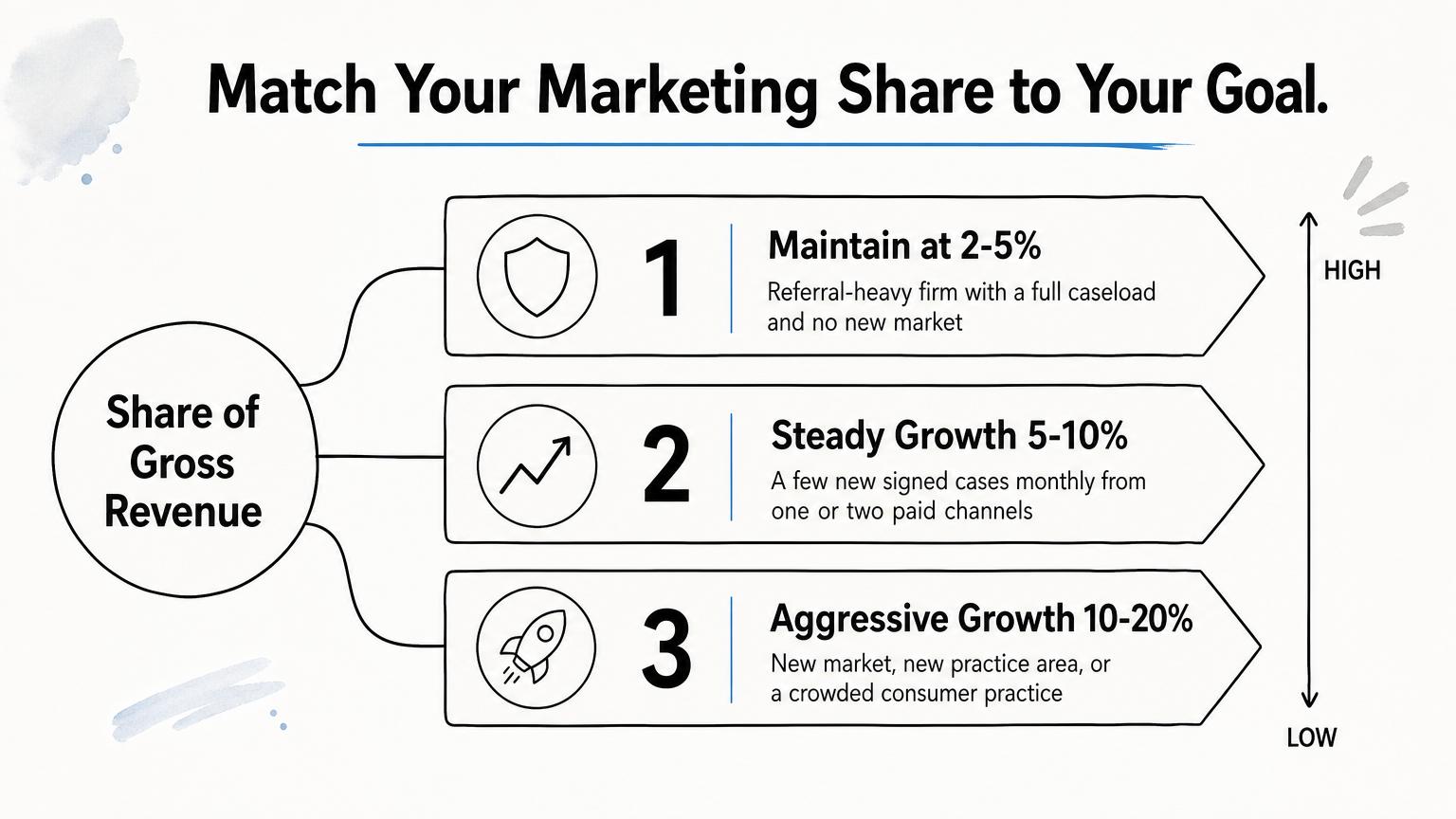
Your growth goal, not the industry average, sets your percentage.
These are planning bands. For modelled ranges by practice area and market size, see GavelGrow's law firm marketing report. It uses modelled benchmark ranges, not measured results from client accounts.
Benchmarks by practice area
Case value and competition push practice areas into different parts of the range. A personal injury firm bidding against a dozen others for the same searches needs a bigger share than an estate planning firm that gets most clients by referral.
Mass tort and class action firms often run nationwide campaigns with lumpy spend. They should plan around cost per signed case instead of a flat percentage.
What firm size changes
Firm size changes the dollars, not the percentage. A solo lawyer grossing $350,000 who spends 8% has $28,000 a year, about $2,333 a month. That funds one channel done well, not four done thinly. A firm grossing $4 million at 8% has $320,000 a year, about $26,667 a month. That can support paid search, local SEO and a conversion program at once.
Step 1. Pick your number from revenue and goal
Multiply your trailing 12-month gross revenue by the percentage that fits your goal, then divide by 12. For a firm grossing $1.2 million that wants steady growth, that gives you a monthly budget you can plan against.
Run the math
- Take gross revenue for the last 12 months: $1,200,000.
- Choose a percentage from the goal table. This firm picks 8%.
- Multiply: $1,200,000 × 0.08 = $96,000 a year.
- Divide by 12: $8,000 a month.
If your revenue swings with contingency settlements, use a trailing 12-month average so one large settlement does not inflate your number. If you are launching a new practice area, add a one-time launch amount on top of the monthly figure.
Start with a number you can defend, then let results move it.
Adjust for capacity and cash
A bigger percentage only helps if your office can handle the leads it buys. If you have one intake person and you are already behind on callbacks, fix capacity before you raise spend. Otherwise you pay for leads that go cold.
Cash timing matters too. Contingency firms pay for marketing today and collect fees months or years later. If that describes you, set the budget at a level your reserves can carry for at least two quarters without a signed case coming back as cash.
Step 2. Split the budget across channels
Put the largest shares into channels that already produce signed cases, and hold about 10% for tests. The sample below applies that logic to the $8,000 monthly budget from Step 1. Treat the shares as a starting point and adjust them to your practice area.

A sample monthly split
Fund what already signs cases, and ring-fence a small share for testing.
Paid search sits at the top because it produces cases soonest. SEO takes longer but compounds. The tools line matters because without call and intake tracking you cannot see which channel earned a signed case.
Using the 70/20/10 rule
The 70/20/10 rule is a common marketing framework: about 70% on proven channels, 20% on promising ones you are building, and 10% on experiments. It is a useful check on any split. If your plan has no testing line, you will never find the next channel. If most of it is experiments, you are gambling.
What to ask about ad spend
If you hire an agency, separate ad spend from management fees in the budget. Ask whether ad spend carries a markup and whose name the ad accounts are in. GavelGrow's managed services charge no markup on ad spend, and ad accounts and tracking numbers stay in the firm's own name. Whatever you spend, keep your ads inside your state bar's rules, and never promise outcomes.
Step 3. Test the budget against cost per signed case
Divide your monthly budget by the signed cases you need, and compare the result to your average fee. If the numbers do not work, change the budget or the goal before you spend. The example below uses assumptions you should replace with your own.
Work backwards from signed cases
- Signed cases wanted per month: 3
- Monthly budget: $8,000
- Cost per signed case: $8,000 ÷ 3 = about $2,667
- Assumed average fee: $9,000
- Fee value per dollar spent: (3 × $9,000) ÷ $8,000 = about 3.4 to 1
- Assumed lead-to-signed rate: 1 in 8, so you need 24 leads a month
- All-in cost per lead you can afford: $8,000 ÷ 24 = about $333
The $333 is an all-in ceiling. Your ad platforms see only part of the budget, so the cost per lead you can afford inside Google Ads is lower. Run your own figures through GavelGrow's cost-per-acquisition calculator. If the fee-to-spend ratio looks thin, you either need a higher lead-to-signed rate, a higher-value case mix, or a smaller budget.
Account for how long cases take
Cost per lead is not the finish line. A lead costs money today, but a contingency fee may arrive in a year or two. Judge channels on signed retainers per dollar, then check closed fees later.
Judge every channel on cost per signed case, not cost per lead.
Step 4. Review and reallocate every quarter
Review spend every 90 days against cost per signed case by channel, and move money from the weak channels to the strong ones. A budget you never revisit is last year's habits with a new date.

Track cost per signed case by channel
You need attribution from click to signed retainer, including the leads that only phoned. Call tracking numbers per campaign credit each call to the channel that rang the phone. GavelGrow's platform puts call tracking, intake and attribution in one dashboard. Track is $199 a month and Optimize is $599 a month, both with a 7-day free trial and no card required. See pricing for what each plan includes.
Move money by fixed rules
Set the rules before the quarter starts, so you are not deciding on instinct.
- Judge channels on signed retainers, not clicks or rankings.
- Fix or cut a channel when its cost per signed case stays above your ceiling for two straight quarters.
- Give SEO and content longer than paid ads, since they usually take months to build.
- Move freed dollars to the channel with the lowest cost per signed case that can still scale.
- Keep the 10% test line every quarter.
The 80/20 rule, or Pareto principle, describes how a small share of sources often produces most of the results. Check it against your data. If two channels sign most of your cases, those two deserve most of the budget.
Fix leaks before adding budget
Before you raise spend, check intake. The Lead Response Management Study found that leads contacted within five minutes are far more likely to be qualified than those first reached at thirty minutes. It measures the odds of qualifying a lead, not signed cases. Still, slow follow-up and missed calls quietly raise your cost per signed case.
Put your number to work
Start with a percentage of gross revenue that matches your goal, turn it into monthly dollars, and split it across channels that already sign cases. Then check the plan against cost per signed case and review it every 90 days. That sequence turns a budget from a guess into something you can defend to your partners.
You do not need a perfect benchmark to begin. You need a number, a split, and a way to see which dollars produced signed retainers. If you want a second set of eyes on your figures, book a free 45-minute strategy call with GavelGrow.