How to Build a Law Office Marketing Plan
Categories: Legal Marketing Strategies
 Abram Ninoyan
Founder & Senior Performance Marketer
Credentials: Google Partner, Google Ads Search Certified, Google Ads Display Certified, Google Ads Measurement Certified, Google Analytics (IQ) Certified, HubSpot Inbound Certified, HubSpot Social Media Marketing Certified, Conversion Optimization Certified
Expertise: Google Ads, Meta Ads, Conversion Rate Optimization, GA4 & Google Tag Manager, Lead Generation, Marketing Funnel Optimization, PPC Management
LinkedIn Profile
Most law firms don't fail at marketing because they lack budget. They fail because they never wrote anything down. A solid law office marketing plan, the kind of attorney marketing plan you can hand t...
Key Takeaways
- How to Build a Law Office Marketing Plan
- Why does your law firm need a marketing plan?
- Step 1. Set your marketing goals and budget
- Step 2. Define your target audience and practice focus
How to Build a Law Office Marketing Plan
Most law firms don't fail at marketing because they lack budget. They fail because they never wrote anything down. A solid law office marketing plan, the kind of attorney marketing plan you can hand to your team, turns scattered ad spend, referral hopes, and a neglected Google Business Profile into a system you can actually measure against signed cases, not just clicks or form fills.
Building one isn't complicated, but it does require a specific order of operations: pick your practice area focus, set a realistic budget tied to your cost per signed case, choose the channels that actually work for that practice area, and put intake and follow-up systems in place before you spend a dollar on ads. Skip that sequence and you end up with the classic problem this audience knows well: leads coming in with no way to prove which ones turned into retainers.
This guide walks through each step in order, from setting goals and budget to choosing between Google Ads, Local Services Ads, SEO, and referral programs, plus how to track everything from first click to signed retainer so your plan gets sharper every quarter instead of going stale.
Why does your law firm need a marketing plan?
Without a marketing plan, most firms default to reactive spending. A slow month hits, a partner panics, and suddenly there's a $5,000 Google Ads campaign live with no landing page built for it and no way to track which leads actually signed. Marketing without a plan almost always turns into marketing by mood, and mood is a terrible budget strategy. A written plan forces you to decide, in advance, what you're spending, on whom, and how you'll know if it worked.
The cost of running your firm without one
Firms that skip this step tend to hit the same wall eventually, and it's rarely subtle. Watch for these warning signs in your own practice:
- Referral dependency: new cases dry up the moment referral sources go quiet, with no paid channel ready to fill the gap.
- Guesswork budgeting: ad spend gets set by what's left in the checking account, not by what a signed case is actually worth.
- Channel chasing: the firm jumps from Facebook ads to SEO to a billboard based on whatever a vendor pitched last, never sticking with anything long enough to know if it works.
- No attribution: leads come in from three or four sources at once and nobody can say which campaign, which practice area, or which intake step actually produced the retainer, which is exactly the gap marketing attribution for law firms closes.
- Compliance drift: intake forms and follow-up sequences get built ad hoc, with no consistent TCPA consent tracking across campaigns.
Spotting your firm in that list isn't a failure. It's the normal state for a practice that's been growing through word of mouth and hasn't formalized how it acquires clients.
What a documented plan actually changes
A plan changes the questions you ask. Instead of "did the ads bring in leads," you start asking "what did it cost us to sign a case from this campaign, compared to that one." That single shift, from cost per lead to cost per signed case, is usually the biggest financial unlock in this whole process, because a channel that produces cheap, unqualified leads is worse than one that costs more per lead but converts at a much higher rate.
A marketing plan is what turns lead volume into a number you can actually manage: cost per signed case.
Ownership follows naturally once you have a plan. When goals, budget, channels, and KPIs are all written down, everyone on the team, from the intake coordinator to the managing partner, knows what they're responsible for and what "working" looks like. That accountability disappears the moment marketing lives only in someone's head or in a loose folder of invoices from three different vendors.
Getting this consolidated view is also where a lot of firms get stuck, because they're running Google Ads in one dashboard, call tracking in another, and intake in a spreadsheet or a generic CRM that was never built for legal timelines. A platform built specifically for legal marketing attribution, like GavelGrow's dashboard for click-to-signed-case tracking, pulls that full-funnel view, from ad click to signed retainer, into one place, so the plan you write down actually has real numbers behind it instead of estimates pieced together from four different tools.
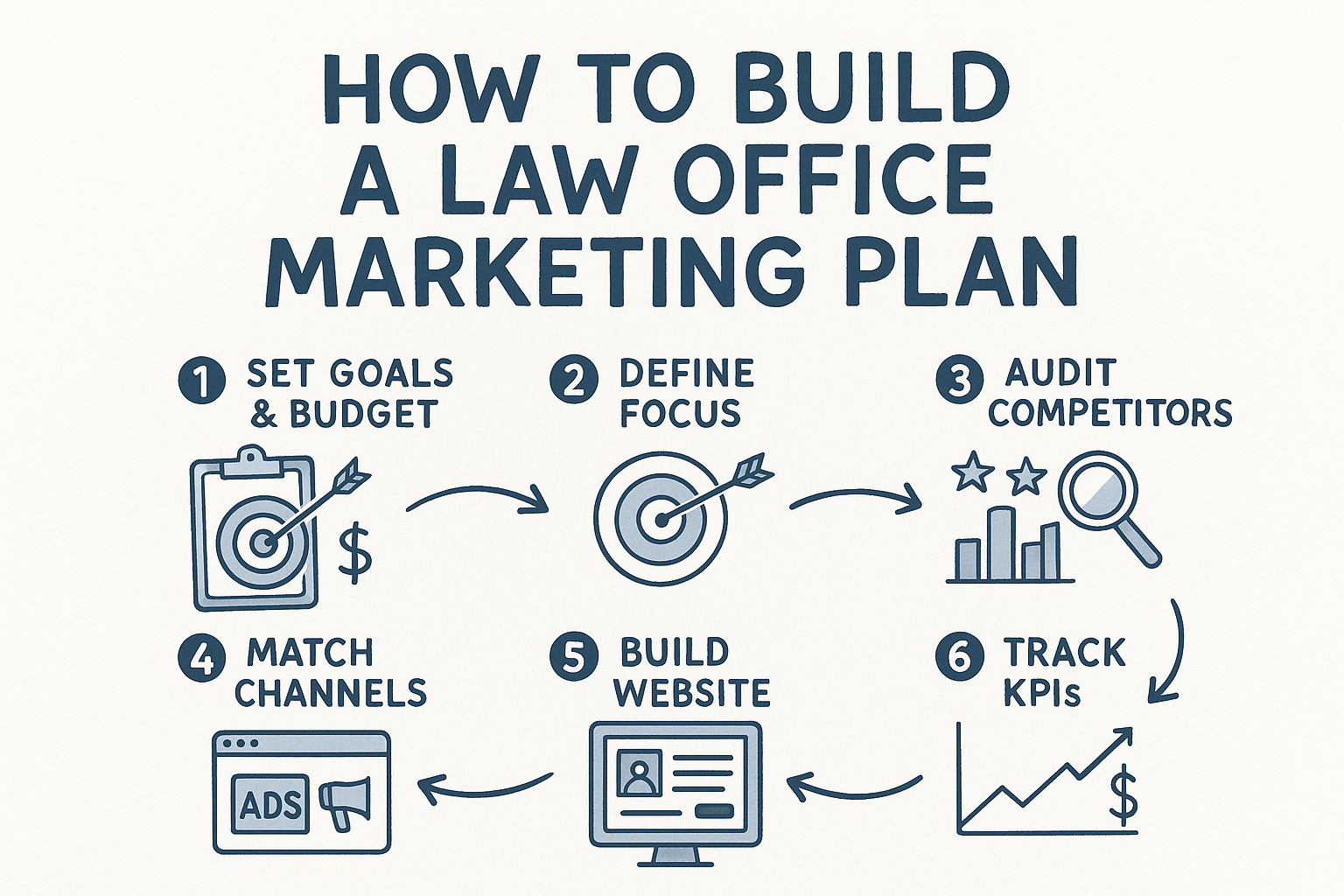
The rest of this guide walks through the six steps that make up that plan, in the order they actually need to happen. Skip a step or do them out of order, and you end up rebuilding your budget or your website halfway through the year. Follow them in sequence, and each step sets up the next one cleanly.
Step 1. Set your marketing goals and budget
Every law office marketing plan starts with a number, not a channel. Before you pick Google Ads over Local Services Ads or decide to double down on SEO, decide what a signed case is actually worth to your practice and work backward from there. A personal injury firm signing cases worth $8,000 in average fees can afford a very different cost per signed case than a family law practice averaging $2,500 per retainer, and that difference should drive every dollar you commit.

Set goals that tie to case value
Goals belong in writing, and they need a number attached, not a vague wish to "get more cases." Try something like: sign 15 new personal injury cases per month at a cost per signed case under $1,800, or grow immigration case signings by 20% over the next two quarters without increasing total spend. Vague goals produce vague budgets, and vague budgets get cut the first time cash flow tightens.
Set your budget from cost per signed case, not from what's left over at the end of the month.
Build a budget around cost per signed case
Budgeting works backward from that goal. If you want 15 signed cases a month and your modelled benchmark range for cost per signed case in your practice area and market sits between $1,200 and $2,200, you're looking at a monthly marketing spend somewhere between $18,000 and $33,000, split across media, platform costs, and any agency fees. That's a rough planning range, not a guarantee, but it beats guessing.
Ranges like these are illustrative starting points for planning rather than published budget and conversion benchmarks, and your own numbers will vary by market. Once you've got a working figure, decide how you'll split it between paid media, platform or agency fees, and content or SEO work, and revisit the split every quarter as real cost-per-signed-case data comes in from your campaigns. If you'd rather not build that tracking from scratch, compare GavelGrow's plan tiers, all of which include a 7-day free trial so you can see real numbers before committing a full quarter's budget to them.
Step 2. Define your target audience and practice focus
A marketing plan built around "personal injury victims" or "anyone who needs a will" is too broad to spend against. Narrow practice focus does two things at once: it tells your ad platforms who to target, and it tells your intake team what a qualified lead actually sounds like on the phone. Firms that market to everyone usually end up paying premium bid prices for clicks from people who were never going to sign, because the algorithm has no signal about who your real client is.
Pick the practice areas your plan will fund
Start by ranking your practice areas by case value and current capacity, not by what you enjoy practicing most. A firm juggling personal injury, family law, and estate planning can't fund all three at a competitive level on a modest budget, so pick one or two to lead the plan, using the practice-area marketing pages as a guide, and treat the rest as secondary. Questions worth answering before you write a dollar figure next to any channel:
- Which practice area has the highest average case value relative to acquisition cost?
- Where do you have attorney capacity to take on new matters right now?
- Which practice area already gets steady referrals, and which one needs paid demand to survive?
- Does your firm have geographic exclusivity concerns, meaning you'd rather not compete head-on with a firm you refer cases to?
Pick the practice area with the best combination of case value and open capacity, and build the plan around that first.
Build a client profile for each practice area
Once you've picked the practice area, describe the client you're trying to reach in specific terms: age range, income level, whether they're searching on mobile at 11pm after an accident or researching calmly during business hours, and what language they search in. A DUI client typing frantically from a phone at midnight needs a different landing page and a faster callback than someone comparing estate planning attorneys over a weekend. Immigration and mass tort practices often need bilingual intake and separate ad copy entirely, which changes both your budget allocation and which channels make sense.
Write this profile down alongside your goals from Step 1, because it directly shapes Step 4's channel decisions. A firm targeting elderly estate planning clients skews toward organic search and referral programs; a firm chasing DUI or personal injury leads skews toward Local Services Ads and call tracking, since those clients call before they ever fill out a form. GavelGrow's practice-area benchmark ranges give you a starting point for what cost per lead and conversion rate look like for your specific practice area and market size, so this step isn't just guesswork.
Step 3. Analyze your local competitors
Before you commit budget to any channel, find out what the firms already ranking and running ads in your market are doing. A competitor audit tells you where the paid search prices are getting bid up, which firms dominate the local map pack, and whether your practice area is already saturated in your city or still wide open. Skipping this step means you set your budget in a vacuum, and you'll find out the hard way when your cost per click comes in three times higher than you planned.
Find out who you're actually competing against
Running the searches yourself is the fastest way to see reality instead of assumptions. Search your top practice area plus your city from an incognito browser and record what shows up:
- Paid ads: which firms appear above the organic results, and how many rotate through over a week of checking, which the Google Ads Transparency Center can confirm
- Local Services Ads: which firms carry the Google Screened badge and sit at the top of mobile results
- Map pack: which three firms Google surfaces for "[practice area] lawyer near me," and how many reviews each one has
- Organic results: which firms rank without paying, since that signals long-term SEO investment you'll eventually need to match
Doing this once a quarter, not once, matters because paid rankings shift as firms turn budgets on and off.
Audit what they're spending and where
Look past rankings and study the actual client experience your competitors deliver. Click into their landing pages and time how long it takes to find a phone number or fill out a contact form. Call the number listed and note how fast someone answers, whether you get a live person or voicemail, and how quickly a text follow-up arrives if you leave your information. Check their Google Business Profile for review volume, average rating, and how recently they responded to a negative review, since that response pattern often reveals how seriously a firm takes its intake process.
If a competitor's intake beats yours, no amount of ad spend will close that gap.
GavelGrow's platform won't hand you a competitor's internal numbers, but the modelled practice-area benchmark ranges let you see where your own cost per lead and intake conversion rate sit relative to comparable firms in your market size, which is a fair proxy for how competitive your category has gotten. Use what you learn here to set realistic expectations for Step 1's budget range before you finalize it, then carry these findings straight into Step 4, where channel selection depends heavily on how crowded each platform already is in your city.
Step 4. Choose your marketing channels and tactics
Channel selection comes after Steps 1 through 3, not before, because the practice area you funded, the client profile you wrote, and the competitive gaps you found all point toward specific platforms and toward the best lead sources for law firms in your market. A personal injury or DUI practice chasing clients who search in a panic needs managed Local Services Ads and strong call tracking more than it needs a blog. An estate planning or business law practice selling to a calmer, research-driven buyer often gets better long-term returns from organic SEO and referral programs. Picking channels based on what a vendor is pitching this month, instead of what your Step 2 client profile actually does when they need a lawyer, is how budgets get wasted.

Match channels to how your client searches
Start with intent. Someone searching "[practice area] lawyer near me" from a phone at midnight is ready to call now, and that behavior favors Local Services Ads and Google Ads with click-to-call extensions. Someone comparing "how to choose an estate planning attorney" three weeks before they need one is still researching, and that favors content marketing, organic SEO, and Google Business Profile optimization. Paid social, particularly Facebook and Instagram, tends to work best for mass tort intake and practice areas where you're creating awareness rather than capturing existing demand.
Choose the channel your client already uses to search, not the channel your competitor happens to be running.
Layer in supporting tactics, not just ad spend
Tactics fill in around your primary channel rather than replacing it. Review and reputation management, referral programs, and Google Business Profile optimization all compound over time and cost far less per signed case than paid media once they're built out. Reputation work in particular pays off slowly, so treat it as a permanent line item rather than a campaign you turn on and off. If your firm doesn't have the internal bandwidth to run paid search, local SEO, and reputation management simultaneously, done-for-you marketing run by a legal-only team covers all of it under one roof instead of splitting the work across separate vendors who never compare notes.
Step 5. Build a website that converts visitors to leads
Your website is where every channel from Step 4 eventually sends traffic, so a weak site quietly wastes the budget you just built in Step 1, which is why lifting your site's conversion rate belongs in the plan. A law office marketing plan that funds Local Services Ads or paid social but funnels clicks to a slow, generic homepage is paying to lose leads at the last step, right when the client is most ready to act. Treat the website as its own line item, not an afterthought you'll get to once the ads are running.

Design for the client who's already decided to call
Most legal searches end in a phone call, not a form fill, so your mobile-first design has to make calling effortless before it asks for anything else. Put a click-to-call phone number in the header on every page, keep it visible while scrolling, and test your load speed on an actual phone on a weak connection, not just on office wifi.
If a visitor has to hunt for your phone number, you've already lost them to the next firm in the search results.
Specific things to check before you launch a campaign against a page:
- Phone number and click-to-call button visible above the fold on mobile
- Page loads in under three seconds on a mid-range phone
- Practice-area-specific landing page for each channel, not one generic homepage for everything
- Clear next step above the fold: call, text, or fill out a short form
Turn form fills into signed cases, not just leads
Every form on your site should ask for the minimum needed to start intake, then get out of the way, which is the core of conversion optimization for law firm intake. Longer forms feel thorough, but they cost you leads who would have called instead if the form had taken thirty seconds instead of three minutes. Once someone submits, an instant email and text confirmation matters almost as much as the form itself, because silence after a submission reads as a firm that isn't paying attention.
TCPA consent language needs to sit on every form, logged in a way you can produce later if a client disputes it. GavelGrow's hosted and embeddable intake forms handle that consent audit log automatically, along with duplicate detection and carrier-level phone validation, so a bad number or a repeat submission doesn't slip through and skew the cost-per-signed-case numbers you're tracking back in Step 1.
Step 6. Track your KPIs and assign ownership
A plan without measurement drifts back into the guesswork you started this whole process to escape. Every step so far, from your Step 1 budget to your Step 5 website, only earns its keep if you're tracking whether it actually produces signed cases, not just leads or clicks. Building a legal marketing tracking system now, before you scale spend, so every ad click can be traced to the case it signed, means you catch a broken campaign in week two instead of discovering it three months later when the invoice arrives.
Pick the KPIs that actually predict revenue
Skip vanity numbers like impressions and raw lead count, since neither one tells you if a campaign is worth funding next month. Track these instead, at the campaign and practice-area level:
- Cost per signed case by channel and practice area, not just cost per lead
- Intake conversion rate, meaning the percentage of leads that become signed retainers
- Speed to first contact, since the Lead Response Management Study found leads contacted within five minutes are far more likely to be qualified than those first reached at thirty minutes
- Call answer rate and missed-call callback rate, especially for personal injury and DUI practices where most leads call first and most never get a callback at all
- Review volume and rating trend on your Google Business Profile, tracked monthly
The only KPI that matters at the end of the quarter is cost per signed case. Everything else is a leading indicator.
Assign ownership so nothing falls through
Every KPI needs a name attached to it, or it quietly stops getting reviewed after the first month. Assign a single owner for ad spend and campaign performance, another for intake speed and follow-up sequences, and a third, often the managing partner, for the monthly review meeting where you actually decide what to cut and what to scale. Write these assignments into the plan document itself, not into a separate memo nobody rereads.
Reviewing this marketing performance dashboard monthly, rather than quarterly, catches problems while they're still cheap to fix. GavelGrow's marketing dashboard pulls cost per signed case, call outcomes, and intake conversion into one view per campaign, so your monthly review takes twenty minutes instead of an afternoon spent reconciling numbers from three separate logins. Whoever owns that meeting should walk in already knowing which channel earned more budget and which one needs a harder look before the next spend cycle starts.
Putting your plan to work
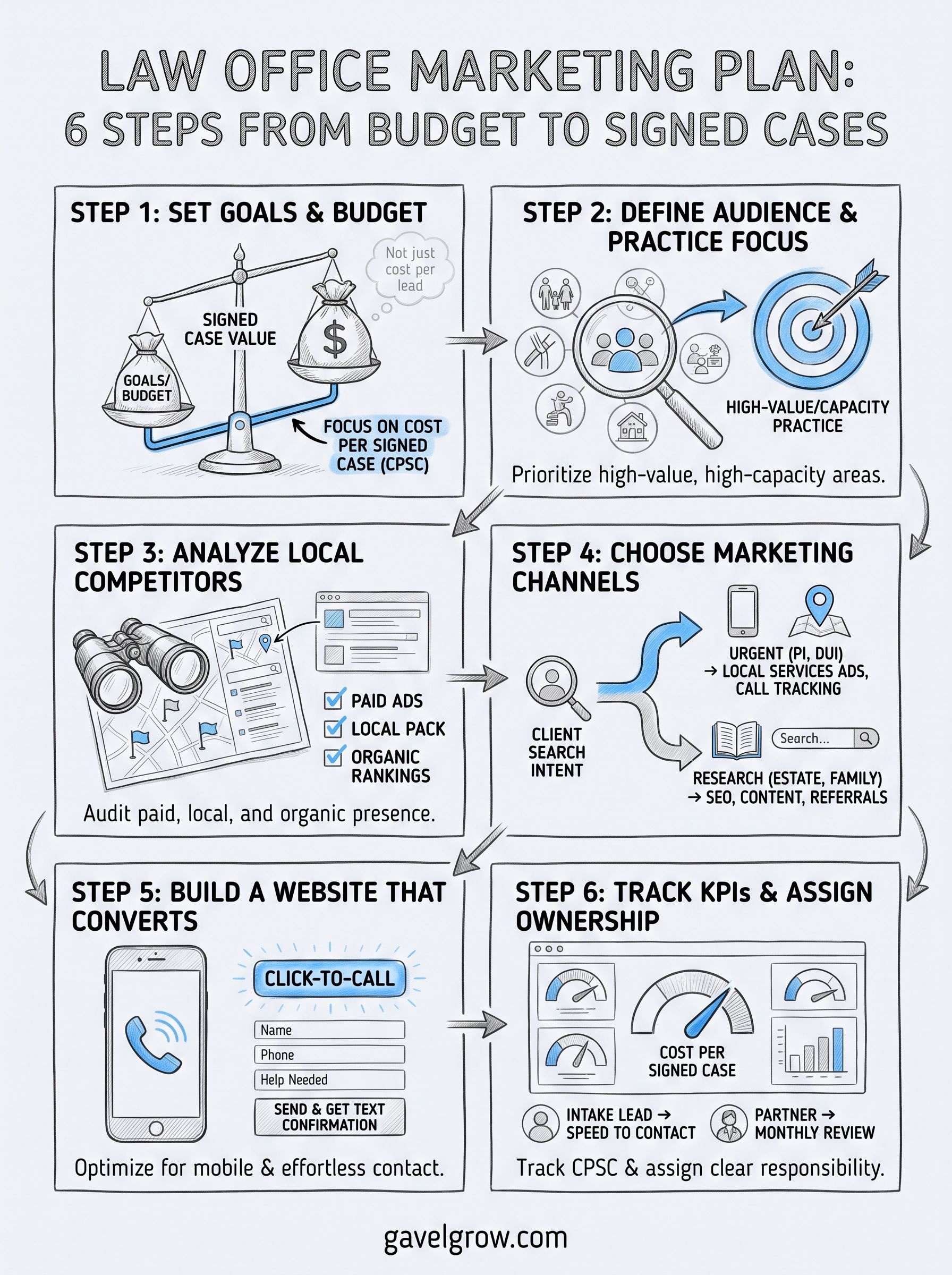
Six steps, done in order, beat a hundred scattered tactics done at random. Set your budget from cost per signed case, define who you're actually trying to reach, study what your local competitors are already doing, pick channels that match how your client searches, build a website that makes calling easy, and track everything against ownership you've written down. Skip a step and you'll end up rebuilding it mid-year anyway, so do the sequence once and do it properly.
Your law office marketing plan only stays useful if you keep feeding it real numbers instead of guesses, quarter after quarter. That's the whole point of tying every channel back to signed cases rather than clicks. If you'd rather talk through your specific practice areas and budget before you commit spend, book a free 45-minute call with GavelGrow's legal-only marketing team and walk through the plan with someone who's only ever worked in legal marketing.
Frequently Asked Questions
What is the difference between a marketing plan and a marketing strategy?
The strategy is the thinking; the plan is the commitment. Strategy decides who you are targeting, which practice areas you are growing, and why a prospect should pick you. The plan turns that into specifics: budget, channels, owners, deadlines, and the numbers you will judge it by. Firms most often have a vague strategy in a partner’s head and no plan at all, which is why spending happens reactively when a slow month arrives.
Who should own the marketing plan at a small firm?
One named person, even if marketing is not their whole job. At firms without a marketing hire, that is usually the managing partner or an office administrator who owns the calendar, the budget, and the monthly numbers review. What fails is shared ownership: when the plan belongs to everyone, nobody pulls the reports or notices a channel has quietly stopped producing. Assign each KPI to a person, not a role.
How often should you revisit a law firm marketing plan?
Review the numbers monthly and revisit the plan itself quarterly. Monthly is frequent enough to catch a channel going sideways while the fix is still cheap; quarterly is the right cadence for reallocating budget, since legal sales cycles are too long to judge a channel on four weeks of data. A full rebuild once a year is usually enough unless your practice areas or market change materially.
Do you need a separate marketing plan for each practice area?
Not a separate plan, but separate targets within one plan. A personal injury case and an estate planning matter have different case values, different sales cycles, and different buyer behavior, so a single blended cost-per-lead goal hides which side is working. Keep one plan with per-practice-area goals, budgets, and cost-per-signed-case targets, otherwise a profitable practice area subsidizes an unprofitable one invisibly.
How long before a new marketing plan shows results?
Paid channels can produce calls within days, though it takes a few weeks to tune bidding and intake. SEO, content, and reviews compound more slowly, usually four to six months before rankings move meaningfully, and signed cases trail leads by however long your sales cycle runs. Plan for the first full quarter to be about instrumentation and learning rather than results, and judge the plan at two to three quarters.
Why do most law firm marketing plans fail?
Rarely because the tactics were wrong. They fail because nothing was written down, no one owned the numbers, or the firm tracked leads instead of signed cases and so kept funding whichever channel produced the cheapest unqualified inquiries. The plans that survive are specific about who does what by when, and they measure the one number that ties marketing to revenue: what a signed case actually costs.
Frequently Asked Questions
What is the difference between a marketing plan and a marketing strategy?
The strategy is the thinking; the plan is the commitment. Strategy decides who you are targeting, which practice areas you are growing, and why a prospect should pick you. The plan turns that into specifics: budget, channels, owners, deadlines, and the numbers you will judge it by. Firms most often have a vague strategy in a partner’s head and no plan at all, which is why spending happens reactively when a slow month arrives.
Who should own the marketing plan at a small firm?
One named person, even if marketing is not their whole job. At firms without a marketing hire, that is usually the managing partner or an office administrator who owns the calendar, the budget, and the monthly numbers review. What fails is shared ownership: when the plan belongs to everyone, nobody pulls the reports or notices a channel has quietly stopped producing. Assign each KPI to a person, not a role.
How often should you revisit a law firm marketing plan?
Review the numbers monthly and revisit the plan itself quarterly. Monthly is frequent enough to catch a channel going sideways while the fix is still cheap; quarterly is the right cadence for reallocating budget, since legal sales cycles are too long to judge a channel on four weeks of data. A full rebuild once a year is usually enough unless your practice areas or market change materially.
Do you need a separate marketing plan for each practice area?
Not a separate plan, but separate targets within one plan. A personal injury case and an estate planning matter have different case values, different sales cycles, and different buyer behavior, so a single blended cost-per-lead goal hides which side is working. Keep one plan with per-practice-area goals, budgets, and cost-per-signed-case targets, otherwise a profitable practice area subsidizes an unprofitable one invisibly.
How long before a new marketing plan shows results?
Paid channels can produce calls within days, though it takes a few weeks to tune bidding and intake. SEO, content, and reviews compound more slowly, usually four to six months before rankings move meaningfully, and signed cases trail leads by however long your sales cycle runs. Plan for the first full quarter to be about instrumentation and learning rather than results, and judge the plan at two to three quarters.
Why do most law firm marketing plans fail?
Rarely because the tactics were wrong. They fail because nothing was written down, no one owned the numbers, or the firm tracked leads instead of signed cases and so kept funding whichever channel produced the cheapest unqualified inquiries. The plans that survive are specific about who does what by when, and they measure the one number that ties marketing to revenue: what a signed case actually costs.