7 Lead Generation Strategies for Lawyers That Fill Your Pipeline
Categories: Legal Marketing Strategies
 Abram Ninoyan
Founder & Senior Performance Marketer
Credentials: Google Partner, Google Ads Search Certified, Google Ads Display Certified, Google Ads Measurement Certified, Google Analytics (IQ) Certified, HubSpot Inbound Certified, HubSpot Social Media Marketing Certified, Conversion Optimization Certified
Expertise: Google Ads, Meta Ads, Conversion Rate Optimization, GA4 & Google Tag Manager, Lead Generation, Marketing Funnel Optimization, PPC Management
LinkedIn Profile
Lead generation for lawyers works best when you pair the right channels with a system that actually tracks which leads turn into signed cases, not just which ones fill your intake form. Most firms don...
Key Takeaways
- 7 Lead Generation Strategies for Lawyers That Fill Your Pipeline
- 1. Track every lead from click to signed case
- 2. Strengthen local SEO and your Google Business Profile
- 3. Run targeted Google Ads and Local Services Ads
7 Lead Generation Strategies for Lawyers That Fill Your Pipeline
Lead generation for lawyers works best when you pair the right channels with a system that actually tracks which leads turn into signed cases, not just which ones fill your intake form. Most firms don't have a lead problem. They have a follow-up and attribution problem that quietly drains the budget spent getting those leads in the first place.
If you're searching for law firm lead generation tactics that go beyond "run more Google Ads," you're in the right place. This article breaks down seven approaches that consistently produce signed retainers, not just form fills, drawing on what actually moves cost per signed case for practice areas like personal injury, family law, and immigration.
You'll get a practical mix of paid, organic, and referral strategies, plus what to measure at each step so you know what's working. We'll also touch on where intake speed and call tracking fit into the equation, since a firm's best lead source means little if nobody answers the phone fast enough to sign the case.
1. Track every lead from click to signed case
Before you spend another dollar on ads, fix the measurement problem. Most lead generation for lawyers campaigns get judged on cost per lead, which tells you almost nothing about which channel actually produces signed clients. A campaign that generates cheap leads that never sign is worse than one with expensive leads that close at a high rate. You need attribution from the click to the signed case that follows a lead from the ad click, through the phone call or form fill, all the way to a signed retainer.
A cheap lead that never signs costs you more than an expensive one that closes.
How it works
Every inbound lead gets a source tag at the moment it arrives, whether it's a Google Ads click, an organic search visit, or a phone call from your Google Business Profile. A law firm marketing platform with call tracking and lead attribution like GavelGrow's assigns tracking numbers per campaign, records and transcribes calls, and matches them automatically to the right lead record. From there, you tag outcomes (qualified, callback, unqualified, spam) and connect each lead to case status, so you see cost per signed case, not just cost per click.
Who it's for
This fits any firm running more than one marketing channel at once, especially personal injury, mass tort, and family law practices where case value varies widely and a single missed attribution point can hide which campaign is actually profitable. Solo practitioners running one ad account still benefit, but the payoff grows fast once you're juggling Google Ads, Local Services Ads, and organic traffic together.
What it costs
GavelGrow's Track plan starts at $199/month for one connected ad account and two call tracking numbers, enough for a firm testing a single channel. Firms running multiple campaigns typically move to Optimize at $599/month, which adds unlimited ad accounts, ten tracking numbers, and Smart Conversions feeding signed cases back into your bidding. Both plans include a 7-day free trial with no credit card required. See the full breakdown on the GavelGrow pricing page.
How to get started
- Connect your primary ad account and assign a tracking number to each active campaign
- Tag every lead outcome as it moves through your pipeline
- Review cost per signed case weekly, not monthly, for your first 90 days
2. Strengthen local SEO and your Google Business Profile
When someone searches "personal injury lawyer near me," your Google Business Profile and local rankings decide whether you show up before they ever visit your website. This is one of the cheapest forms of legal lead generation because you're not paying per click, but it takes consistent work to earn the visibility.
How it works
Google ranks local results using proximity, relevance, and prominence, so ranking in the map pack depends on profile completeness, review volume, and citation consistency across directories. Keep your practice areas, hours, and photos current, post updates regularly, and respond to every review, since Google's own guidance treats engagement as a ranking signal. Pair that with on-site local SEO, city-specific landing pages, schema markup, and consistent name-address-phone data across legal directories.
Your Google Business Profile often gets seen before your homepage does.
Who it's for
Solo and small firms with a defined service area benefit most, especially family law, criminal defense, and estate planning practices where clients search locally rather than nationally. Mass tort and multi-state firms should still claim and optimize profiles for every office location.
What it costs
Local SEO is mostly time investment rather than ad spend, though many firms budget $500 to $2,500 monthly for ongoing optimization. That work can be handled in-house or through a service like GavelGrow's local SEO and Google Business Profile management.
How to get started
- Claim and fully complete your Google Business Profile
- Add city-specific pages for each practice area and location
- Ask every client for a review and respond to each one publicly
3. Run targeted Google Ads and Local Services Ads
Paid search puts your firm in front of people actively searching for a lawyer right now, which makes it one of the fastest ways to generate volume when local SEO alone isn't enough. Between Google Ads and Local Services Ads, most firms doing legal services lead generation this way run both, since LSA leads pay per lead and Ads leads pay per click, giving you two different cost structures to test.
How it works
Google Ads bids you into search results for keywords like "car accident lawyer," while how Local Services Ads rank and bill for law firms comes down to a Google-screened badge next to your listing and charges only when someone contacts you. Both channels reward relevance and quality score, so tight ad groups, matching landing pages, and fast response times all lower your cost per signed case over time.
Paid search only pays off when your cost per signed case beats what you'd spend elsewhere to win the same client.
Who it's for
Personal injury, criminal defense, and immigration firms with competitive local markets see the strongest returns here, since search volume for these practice areas is high and clients tend to search urgently.
What it costs
Budgets vary widely by market and practice area; use the cost-per-acquisition calculator for law firms to model cost per signed case against your current numbers before committing spend.
How to get started
- Claim your Local Services Ads profile and pass the screening process
- Build one tightly themed Google Ads campaign per practice area
- Route every click through a tracked landing page
4. Optimize your website and intake forms for conversions
Every dollar you spend on ads or local SEO gets wasted the moment a visitor lands on a slow page or gives up on a clunky form. Mobile traffic tends to convert worse than desktop traffic for most firms, and a form that takes three minutes to fill out on a phone makes that gap wider. Many legal lead generation services focus on driving more traffic and never touch what happens after the click, which means you keep paying for the same leaky bucket.

How it works
Conversion optimization starts with a mobile-first intake form that loads fast, asks for the minimum information up front, and confirms submission instantly by email and text. Multi-step forms with progress indicators outperform long single-page forms, and adding carrier-level phone validation and duplicate detection stops spam and bad numbers before they ever reach your team. GavelGrow's hosted and embeddable intake forms handle TCPA consent logging and auto-reply automatically, so speed doesn't come at the cost of compliance.
The form your ad traffic lands on decides whether your ad spend was worth it.
Who it's for
Any firm running paid traffic benefits, but personal injury and immigration firms with high-intent, urgent searchers see the sharpest drop-off from slow or confusing forms.
What it costs
Redesigning a form or landing page runs anywhere from a few hundred dollars for a DIY fix to a few thousand for a full site rebuild, depending on scope, and conversion optimization for law firm intake forms and landing pages can be handled for you if in-house testing stalls.
How to get started
- Shrink your form to five fields or fewer for the first step
- Add instant email and SMS confirmation on submission
- Test your intake form on a phone before assuming it works
5. Publish content that answers client questions
People rarely hire the first lawyer they find. They search "what happens if I'm hit by an uninsured driver" or "can I file for divorce without a lawyer in my state," then bookmark whoever answers clearly. Content marketing builds that trust before someone ever fills out a form, and it compounds over time instead of stopping the moment you cut ad spend, which makes it one of the more durable legal lead generation services a firm can run in-house.
How it works
Start with the questions clients actually ask during consultations, then write straightforward answers on your site, one page per question or practice-area topic. Add local relevance where it fits, filing deadlines by county, court-specific procedures, and update pages when laws change rather than letting them go stale.
The blog post that answers a client's exact question often outperforms the ad that cost you money to run.
Who it's for
Family law, estate planning, and immigration firms benefit most, since these practice areas involve long research phases before someone ever calls a lawyer.
What it costs
Expect $1,000 to $4,000 monthly for consistent content production, or a comparable investment in staff time if you write in-house rather than using done-for-you legal content production.
How to get started
- List the ten questions your intake team hears most often
- Publish one clear answer page every two weeks
- Track which pages generate leads through your marketing dashboard
6. Build trust with reviews and referral programs
A prospective client comparing three firms almost always checks reviews before picking up the phone. Online reviews work like word-of-mouth at scale, and a steady stream of them does more for conversion than another few thousand dollars in ad spend. Referral programs extend that same trust network, turning past clients and referring attorneys into a repeatable source of legal lead generation that costs far less per case than paid channels.
How it works
Ask every client for a review after their case closes, not just the ones you're confident were happy. Resolve any complaints directly with the client rather than routing them around public review sites, and respond professionally to every review you get, good or bad. Google's own guidance is clear that incentivizing or filtering reviews puts your Google Business Profile at risk. For referrals, build a simple system: track which attorneys and past clients send you cases, and thank them in a way that doesn't run afoul of your state bar's rules on referral fees.
Reviews close cases that ads only started.
Who it's for
Family law, criminal defense, and personal injury firms benefit most, since clients in these practice areas lean heavily on social proof before committing.
What it costs
Review and referral programs cost mostly staff time; a review and reputation management system for lawyers runs alongside your existing intake workflow.
How to get started
- Add a review request to your closing checklist for every case
- Respond to every public review within 48 hours
- Ask referring attorneys how they'd like to be credited or thanked
7. Use pay-per-lead services for immediate case volume
Sometimes you need cases in the pipeline this month, not three months from now once SEO or content starts working. Pay-per-lead services sell you leads directly, often shared with other firms, and you only pay for leads delivered rather than clicks or impressions. It's the fastest lever in legal lead generation, but it's also the one with the widest range of quality, so you need a way to judge whether those leads actually sign.
Buying leads only works if you can prove which ones turn into cases.
How it works
A lead vendor generates traffic through its own ads or content, then sells the resulting contact information to one or more firms, sometimes exclusively, sometimes shared. You pay a set price per lead regardless of outcome, so your cost per signed case depends entirely on how fast and well your team follows up.
Who it's for
Firms opening a new practice area, entering a new market, or covering a slow stretch between other campaigns lean on this most, particularly mass tort and personal injury shops that can absorb volume quickly.
What it costs
Prices vary widely by practice area and exclusivity, often running from $30 to several hundred dollars per lead, so it helps to know what law firms actually pay per lead by practice area before you sign a vendor contract.
How to get started
- Vet vendors by asking for a trial batch before signing a contract
- Route every purchased lead through your own call tracking and intake system so you can measure real conversion
- Cut vendors that consistently produce leads your team can't reach or qualify
Putting these strategies to work for your firm
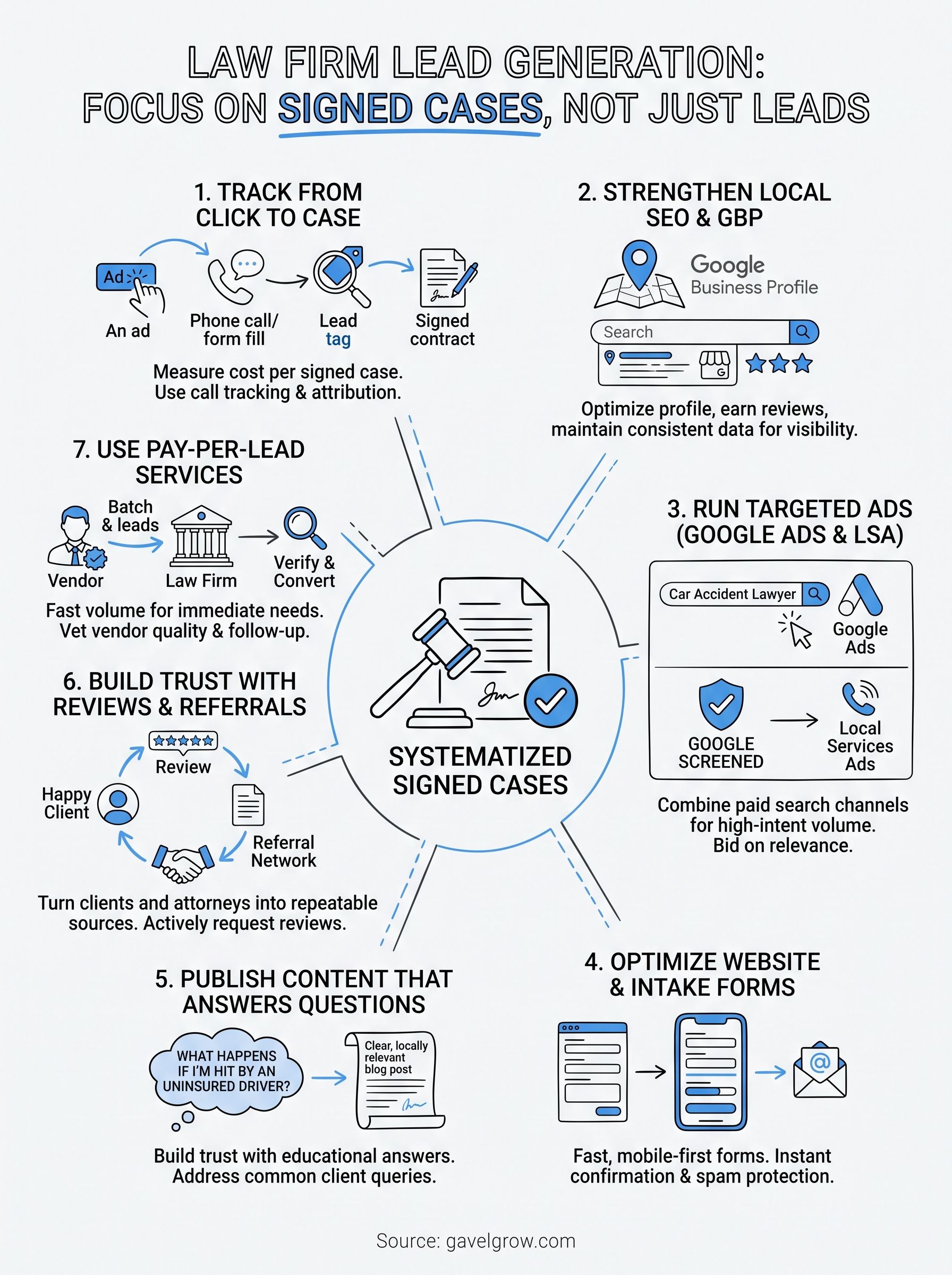
None of these seven strategies work in isolation. Local SEO builds the audience your Google Ads campaigns later retarget, referrals fill gaps between paid pushes, and none of it matters if your intake form loses half the leads it captures. The firms that grow fastest don't chase the newest channel, they build a system that tells them which channels already work and double down there.
Start small if you have to. Pick one or two strategies from this list that match your practice area and current budget, then put a tracking system in place before you spend more on traffic. Otherwise you're just guessing at what's working, and guessing gets expensive fast.
If you want a second opinion on where your lead generation for lawyers budget should go next, book a free 45-minute lead generation strategy call and walk through your numbers with someone who works exclusively in legal marketing.
Frequently Asked Questions
How much should a law firm spend to generate a lead?
The number that matters is not cost per lead but cost per signed case, because a cheap lead that never retains is more expensive than a costly one that does. Lead costs swing enormously by practice area and market, with personal injury at the high end and estate planning far lower. Set a target by working backwards from your average case value and your lead-to-signed conversion rate, then judge every channel against that figure.
Are purchased leads worth it for law firms?
They buy speed, not quality. Pay-per-lead services deliver volume immediately, which helps a firm with idle intake capacity, but leads are often shared with competing firms, arrive with mixed intent, and stop the moment you stop paying. Leads you generate yourself cost more upfront and take longer to build, but they are exclusive and compound. Many firms run both and compare them on cost per signed case rather than volume.
How fast do you need to respond to a new legal lead?
Within minutes, ideally under five. Legal prospects typically contact several firms at once, and the firm that answers first usually wins the case. A widely cited Lead Response Management study found that reaching a lead within five minutes makes it far more likely to qualify than waiting even half an hour. An automated text or call the moment a lead arrives protects the money you already spent acquiring it.
Which lead generation channel works best for a law firm?
It depends on urgency of intent. Google Search and Local Services Ads capture people ready to hire now, which suits injury, criminal, and family matters. Local SEO and reviews compound over time and keep producing after ad spend stops. Content and referrals reach people earlier in their decision. Most firms need a mix, and the right one is whichever combination produces the lowest cost per signed case in your market.
How many leads does a law firm need each month?
Work backwards rather than guessing. Take your signed-case goal, divide by your lead-to-consultation rate, then by your consultation-to-retainer rate, and you have the lead volume required. Most firms discover the problem is not lead count but conversion: doubling the percentage of existing leads that sign is usually cheaper and faster than doubling lead volume.
How do you know which lead generation efforts are actually working?
Connect every lead, including phone calls, back to the campaign that produced it, then follow it through intake to a signed retainer and report cost per signed case by channel. Counting form fills or call volume tells you nothing about revenue, and a channel that looks cheapest on cost per lead is frequently the most expensive per case. Without that link, budget decisions are guesses.
Frequently Asked Questions
How much should a law firm spend to generate a lead?
The number that matters is not cost per lead but cost per signed case, because a cheap lead that never retains is more expensive than a costly one that does. Lead costs swing enormously by practice area and market, with personal injury at the high end and estate planning far lower. Set a target by working backwards from your average case value and your lead-to-signed conversion rate, then judge every channel against that figure.
Are purchased leads worth it for law firms?
They buy speed, not quality. Pay-per-lead services deliver volume immediately, which helps a firm with idle intake capacity, but leads are often shared with competing firms, arrive with mixed intent, and stop the moment you stop paying. Leads you generate yourself cost more upfront and take longer to build, but they are exclusive and compound. Many firms run both and compare them on cost per signed case rather than volume.
How fast do you need to respond to a new legal lead?
Within minutes, ideally under five. Legal prospects typically contact several firms at once, and the firm that answers first usually wins the case. A widely cited Lead Response Management study found that reaching a lead within five minutes makes it far more likely to qualify than waiting even half an hour. An automated text or call the moment a lead arrives protects the money you already spent acquiring it.
Which lead generation channel works best for a law firm?
It depends on urgency of intent. Google Search and Local Services Ads capture people ready to hire now, which suits injury, criminal, and family matters. Local SEO and reviews compound over time and keep producing after ad spend stops. Content and referrals reach people earlier in their decision. Most firms need a mix, and the right one is whichever combination produces the lowest cost per signed case in your market.
How many leads does a law firm need each month?
Work backwards rather than guessing. Take your signed-case goal, divide by your lead-to-consultation rate, then by your consultation-to-retainer rate, and you have the lead volume required. Most firms discover the problem is not lead count but conversion: doubling the percentage of existing leads that sign is usually cheaper and faster than doubling lead volume.
How do you know which lead generation efforts are actually working?
Connect every lead, including phone calls, back to the campaign that produced it, then follow it through intake to a signed retainer and report cost per signed case by channel. Counting form fills or call volume tells you nothing about revenue, and a channel that looks cheapest on cost per lead is frequently the most expensive per case. Without that link, budget decisions are guesses.