Conversion Rate Optimization Consultant: What They Do for Law Firms
Categories: Legal Marketing Strategies
 Abram Ninoyan
Founder & Senior Performance Marketer
Credentials: Google Partner, Google Ads Search Certified, Google Ads Display Certified, Google Ads Measurement Certified, Google Analytics (IQ) Certified, HubSpot Inbound Certified, HubSpot Social Media Marketing Certified, Conversion Optimization Certified
Expertise: Google Ads, Meta Ads, Conversion Rate Optimization, GA4 & Google Tag Manager, Lead Generation, Marketing Funnel Optimization, PPC Management
LinkedIn Profile
Your Google Ads spend is fine. Your website traffic looks healthy. But your intake pipeline still isn't converting visitors into signed cases, and you can't figure out why. That's usually the moment f...
Key Takeaways
- Conversion Rate Optimization Consultant: What They Do for Law Firms
- Why your firm needs a CRO consultant
- How does a CRO consultant improve your intake funnel?
- What a conversion rate optimization expert does for firms
Conversion Rate Optimization Consultant: What They Do for Law Firms
Your Google Ads spend is fine. Your website traffic looks healthy. But your intake pipeline still isn't converting visitors into signed cases, and you can't figure out why. That's usually the moment firms start searching for a conversion rate optimization consultant.
A conversion rate optimization expert studies where potential clients drop off between clicking your ad and submitting an intake form, then tests specific changes (form length, page layout, call-to-action placement, mobile friction) to fix it. For law firms, that means someone who understands a 6-12 month sales cycle, state-bar advertising rules, and the difference between a lead and a signed retainer, not a generalist who treats your firm like an e-commerce store selling shoes.
This article breaks down exactly what a CRO consultant does day to day, what separates a legal-specific expert from a general marketing hire, what results you should expect, and how to evaluate one before you sign a contract. We'll also cover what you can fix in-house with the right tools, including intake automation and attribution tracking for law firms built directly into GavelGrow's platform.
Why your firm needs a CRO consultant
Most firms treat conversion rate optimization basics as a nice-to-have, something you get to after the ad budget is sorted. That's backwards. Your ad spend only pays off at the point where a visitor becomes a signed client, and that handoff is where most law firm websites quietly leak money. A conversion rate optimization consultant exists specifically to find and close that gap, because a firm that doubles its traffic without fixing its intake funnel just doubles the number of people who leave without calling.
The math behind cost-per-signed-case
Here's why this matters more than another ad spend increase. Generic contact forms convert far worse on mobile than forms built for mobile-first intake, a gap GavelGrow's modelled benchmarks show consistently across legal campaigns. If your firm spends $10,000 a month on Google Ads and your mobile conversion sits at the bottom of that gap instead of the top, you're throwing away cases every month, not because your ads are bad, but because your form is.
Fixing your funnel is almost always cheaper than buying more traffic to compensate for it.
Speed matters just as much as form design. Firms that respond to a new lead within 5 minutes are far more likely to qualify that lead than firms that wait 30 minutes or more, a gap documented in the widely cited Lead Response Management study on sales response time. A CRO expert looks at both sides of this equation: how many people start your intake process, and how fast your team responds once they do.
Where firms lose cases without noticing
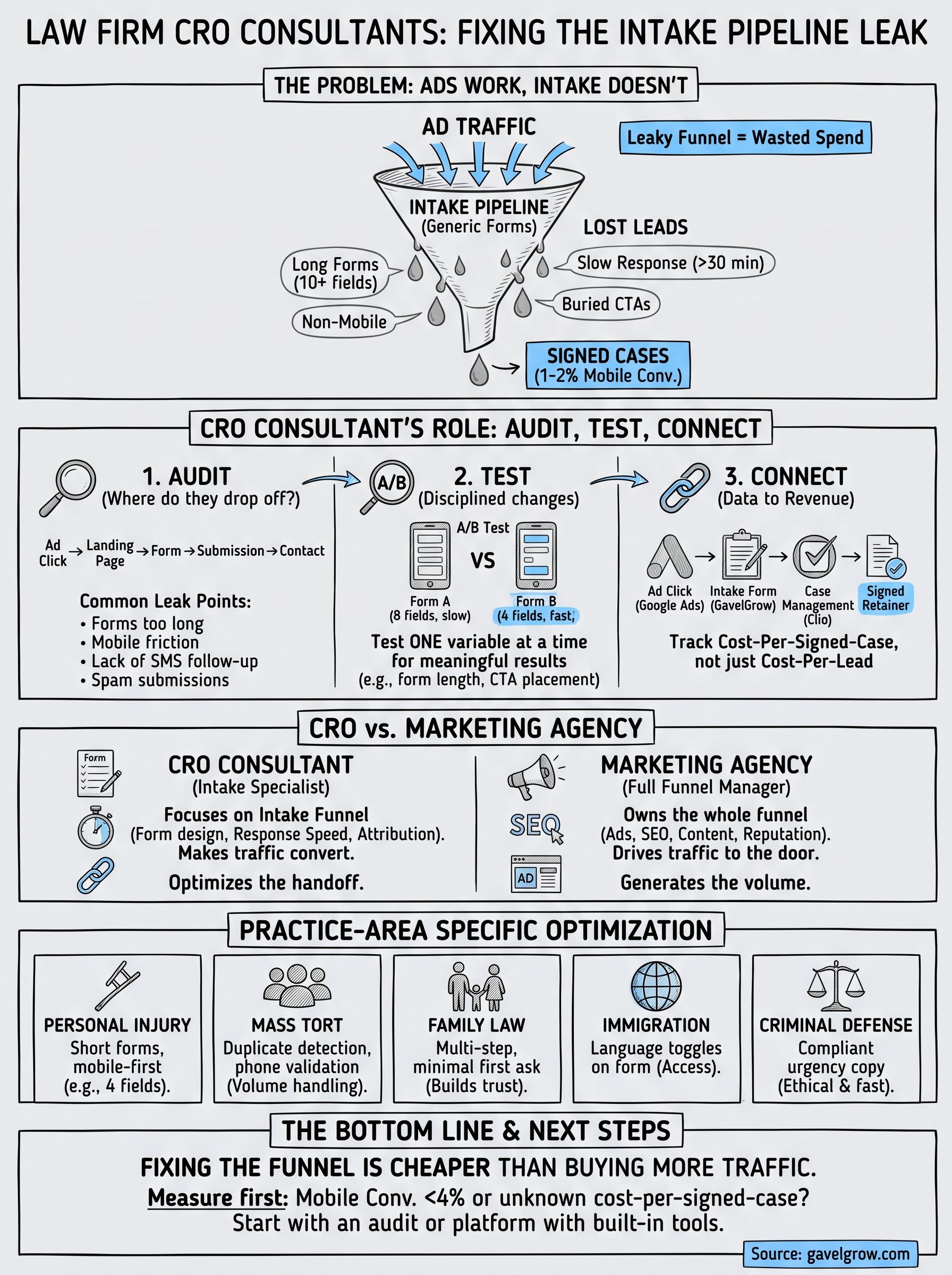
Most firms don't realize how much friction they've built into their own intake process until someone diagnoses a broken law firm funnel end to end. Common leak points a consultant will flag include:
- Intake forms with 10+ fields when 4 would do
- No mobile-specific layout, so users pinch and zoom to submit
- CTAs buried below the fold on practice-area pages
- No instant confirmation, so leads assume the form failed and leave
- Missing SMS follow-up, relying only on email that goes unread for hours
- Duplicate or spam submissions clogging the pipeline your intake staff has to sort through manually
Any one of these can shave off a meaningful chunk of your conversion rate. Stack three or four together and you're losing a large share of the leads you already paid for.
What happens if you don't fix it
Without that outside perspective, firms tend to default to the same response every quarter: increase ad spend and hope volume covers for a leaky funnel. It doesn't. Raising spend without fixing conversion just raises your average cost per signed case benchmark, because you're paying more to generate the same trickle of actual retainers. Practice-area competition makes this worse over time, since your cost-per-click keeps climbing while your intake process stays frozen in place.
Solo and small firms sometimes assume CRO is only worth it once you're spending tens of thousands a month, but the math holds at almost any budget. A firm spending $3,000 a month on ads that improves mobile conversion from 2% to 5% doesn't need a bigger budget to see more signed cases, it needs the funnel fixed. That's the case for bringing in a specialist, whether that's a dedicated consultant or a platform with intake automation workflows and ROI tracking that build these fixes in from the start.
How does a CRO consultant improve your intake funnel?
A conversion rate optimization consultant doesn't guess. They map every step of the attorney lead funnel a visitor takes from ad click to signed retainer, then measure drop-off at each stage before touching a single button or field. That mapping usually starts with an audit, moves into a hypothesis-driven test plan, and ends with a rebuilt funnel that gets re-measured against the original baseline, not against industry averages that don't apply to your practice area.
Auditing the funnel stage by stage
Before changing anything, a good consultant documents where you stand today. The audit typically covers:
- Landing page load speed and mobile rendering
- Form field count and required-vs-optional fields
- CTA visibility above the fold on mobile and desktop
- Time between form submission and first contact from your team
- Call tracking data showing which campaigns produce qualified leads versus spam
You can't fix a leak you haven't measured.
Running tests instead of guessing
Once the audit is done, the consultant runs controlled tests rather than making sweeping redesigns. Changing five things at once tells you nothing about which one moved the needle. A disciplined CRO expert will test one variable, such as cutting a form from eight fields to four, measure the result over a statistically meaningful sample, then move to the next variable, the same discipline behind most practical CRO tips for law firms. This is slower than a full redesign, but it's the only way to know what actually caused the improvement, which matters when you're deciding whether to roll the change out across every practice-area page.
Connecting intake data to attribution
Form and call data mean little in isolation. The consultant needs to see which campaigns, keywords, and landing pages produce leads that actually become signed cases, not just leads that fill out a form. That requires attribution from ad click to signed retainer, something most firms cobble together across separate tools. Platforms built for legal intake, including GavelGrow's marketing dashboard, tie call tracking, form data, and case outcomes together automatically, so a consultant (or your own team) can see cost-per-signed-case by campaign instead of estimating it from spreadsheets. Without that connection, even the best-designed form change is a guess dressed up as a strategy.
What a conversion rate optimization expert does for firms
A conversion rate optimization expert working with law firms wears more hats than the title suggests. The job blends data analysis, copywriting, design feedback, and enough legal-marketing context to know why a bankruptcy intake form needs different fields than a personal injury one. It's not a single deliverable, it's an ongoing practice of testing, measuring, and refining how your website and intake process turn visitors into signed clients.
Day-to-day responsibilities
On any given week, a consultant working your account is likely doing some combination of the following:
- Reviewing heatmaps and session recordings to see where visitors hesitate or abandon a form
- Writing and testing new headlines, CTAs, and page layouts for high-traffic practice-area pages
- Auditing call tracking data to separate qualified leads from spam or wrong numbers
- Coordinating with your intake staff to shorten response times on new submissions
- Reporting cost-per-signed-case by campaign, not just cost-per-lead
A CRO expert's job is to turn traffic you're already paying for into cases you can actually bill.
Legal-specific judgment calls a generalist misses
Beyond the checklist, a conversion rate optimization consultant who specializes in legal makes judgment calls a generalist wouldn't think to make. Immigration intake forms need language options a personal injury firm never considers. Mass tort campaigns need mobile-first forms built for volume, since a single viral ad can produce thousands of submissions overnight. Criminal defense pages often need urgency-driven copy without crossing into state-bar advertising violations. These aren't edge cases, they're the daily reality of running intake for a law firm, and they shape every test a specialist runs.
Reporting back in terms that matter
Finally, a good consultant reports results in the metric your managing partner actually cares about: signed cases, not click-through rate. Vanity metrics like page views or bounce rate might move in the right direction without a single extra retainer to show for it. Tools like GavelGrow's lead pipeline make this reporting straightforward by attaching case status directly to the campaign and form that originated the lead, so a consultant's test results tie back to revenue instead of guesswork.
How much does a CRO consultant cost?
Pricing for a conversion rate optimization consultant varies more than most firms expect, and the range tells you almost as much as the number itself. Freelance consultants doing project-based audits often charge $2,500 to $7,500 for a single funnel audit and set of recommendations, with no ongoing testing included. Retainer-based consultants who run continuous tests typically bill $3,000 to $8,000 a month, depending on how many pages and campaigns they're managing. Agencies that fold CRO into a broader marketing retainer usually price it into a package billed as a monthly retainer. GavelGrow's done-for-you marketing tier is scoped on a strategy call for firms that want the work fully outsourced.
What drives the price up or down
Several factors push a quote higher or lower, and it's worth asking about each one before you sign anything:
The cheapest CRO consultant on paper often costs more once you factor in the ad spend wasted while your funnel stays broken.
Weighing cost against what you're already losing
Here's the number that actually matters: compare the consultant's fee against your current cost-per-signed-case. If your firm spends $15,000 a month on Google Ads and a consultant's $4,000 monthly retainer improves mobile conversion enough to add even two or three extra signed cases, the retainer pays for itself several times over in a personal injury or mass tort practice. Ignoring that math is how firms end up paying premium agency rates for a service that a purpose-built platform handles at a fraction of the cost.
Most self-serve firms can skip a dedicated consultant entirely if their platform already ships with tested, mobile-first intake forms, call tracking, and attribution built in. GavelGrow's plans start at $199 a month and include the same intake-form conversion improvements a consultant would charge thousands to implement, which is why some firms treat the platform as the first fix and only bring in a consultant later for deeper, ongoing testing work.
Is a CRO consultant different from a marketing agency?
Yes, and the distinction matters more than most firms realize before they sign a contract. A conversion rate optimization consultant focuses narrowly on what happens after a visitor lands on your site: form design, page layout, response speed, and the data connecting a click to a signed case. A legal marketing agency typically owns the whole funnel, from ad creative and keyword bidding down to SEO and reputation management, with conversion work as one line item among many. Hiring the wrong one for the job you actually need is how firms end up paying for services they don't use while the real leak stays unfixed.
What each one actually owns
Understanding the split helps you know which specialist to call first.
Why the overlap causes confusion
Confusion sets in because some full-service agencies, including GavelGrow's managed services team, bundle CRO work into a broader retainer rather than selling it separately. That's not a bad thing, but it means you need to ask specifically what conversion testing looks like inside the package, not assume it's happening because the agency handles your ads. Plenty of agencies run campaigns for years without ever touching the intake form those campaigns feed into, which means your traffic keeps growing while your conversion rate stays exactly where it started.
A marketing agency drives traffic to your door. A CRO expert makes sure people walk through it.
Deciding which one your firm needs
Narrow this down before you shop for either one. If your traffic volume looks healthy and your cost-per-click is reasonable but signed cases haven't grown to match, you need conversion work specifically, whether that's a standalone consultant or a platform with tested intake forms and attribution already built in. If traffic itself is the problem, a broader agency relationship makes more sense, since no amount of form optimization fixes a campaign nobody sees. Most firms eventually need both, just not necessarily from the same vendor or on the same timeline.
How to choose the right CRO consultant for your firm
Picking the wrong consultant costs you two things you can't get back: months of testing time and the ad spend you kept running while nothing improved. Before you sign anything, treat this like hiring an associate, not buying a software subscription. You want proof of legal-specific results, not a generic portfolio of e-commerce landing pages that happened to convert well for a shoe brand, so it helps to compare CRO consulting firms that work with law firms side by side first.
Questions to ask before you sign a contract
Use these questions in the first call. A consultant worth hiring answers all of them specifically, not with vague reassurances.
- Can you show before-and-after conversion data from another law firm, not just an e-commerce client?
- How do you handle state-bar advertising rules when testing urgency-driven copy?
- Do you test one variable at a time, or roll out multiple changes together?
- How will you measure results, cost-per-lead or cost-per-signed-case?
- What tools do you need access to, and do they integrate with our existing call tracking and case management?
If a consultant can't explain how they'll measure signed cases, not just leads, keep looking.
Red flags that predict a wasted retainer
Several warning signs show up before you've paid a dollar, if you know to look for them, and they mirror the expensive mistakes firms make when hiring marketing help. Vague reporting is the biggest one: a consultant who talks about "engagement" and "user experience improvements" without tying either to signed cases is optimizing for metrics that don't pay your bills. Watch for anyone who promises a specific conversion lift before running an audit; real numbers come after they've seen your actual funnel, not before. A consultant unfamiliar with TCPA consent requirements or two-party call recording laws is a liability disguised as a hire, since a compliance mistake in your intake process costs far more than any conversion gain.
Matching the consultant to your firm size
Solo and small firms rarely need a dedicated consultant on retainer. If your intake forms, call tracking, and attribution already come tested and mobile-first inside your platform, you've solved most of what a consultant would charge to fix. Mid-market and larger firms running multiple practice areas or high-volume mass tort campaigns get more value from a specialist who can run continuous tests across dozens of pages. GavelGrow's modelled practice-area benchmarks give either type of firm a shortcut here, showing where your conversion rate sits against typical ranges before you spend a dollar on outside help, so you have a sense of how much room for improvement exists.
What conversion optimization looks like for law firms
Examples make this concrete faster than another list of tactics. Law firm conversion optimization fixes look different depending on practice area, because the fear, urgency, and paperwork a potential client faces at the moment they land on your page changes what actually moves them to submit a form.
Personal injury and mass tort intake
Personal injury firms typically see the biggest lift from cutting form length and adding instant SMS confirmation, one of several intake and follow-up changes that convert more leads into retained clients, since injured leads are often filling out a form one-handed from a hospital waiting room. Mass tort campaigns face a different problem: a single viral ad can drive thousands of submissions in a day, so the fix is less about form length and more about duplicate detection and carrier-level phone validation that keeps spam and bad numbers from burying the qualified leads underneath. GavelGrow's intake forms build both fixes in by default, which is why mass tort clients lean on the platform instead of hand-building validation logic themselves.
The right fix depends on the practice area, not a one-size-fits-all template.
Family law, immigration, and criminal defense intake
Family law intake often converts better with a shorter first step, asking only for a name, phone number, and a single sentence about the situation, then collecting details later once someone on your staff has called. Immigration firms frequently need language toggles on the form itself, since a form that only renders in English filters out qualified leads before they ever reach your intake staff. Criminal defense pages need urgency without crossing into anything that reads as a guarantee, since state-bar rules restrict how aggressively you can promise outcomes.
Turning one-off fixes into a system
Specific fixes matter, but a conversion rate optimization consultant worth the fee turns these into a repeatable testing cadence rather than a one-time cleanup. Quarterly reviews against your own baseline, not generic industry benchmarks, keep the funnel improving as your ad mix and practice areas shift.
Where law firms go from here
Hiring a conversion rate optimization consultant only makes sense once you know where your funnel actually leaks, not before. Some firms need a specialist running continuous tests across dozens of practice-area pages. Others just need forms, call tracking, and attribution that work correctly out of the box, without paying a monthly retainer to fix problems a better platform would have prevented.
Start by measuring what you have now. If your mobile conversion rate sits below 4%, or you can't say what your cost-per-signed-case looks like by campaign, that's your answer before you sign anything with a consultant. Fix the measurable gaps first, then decide whether ongoing testing justifies the added cost.
GavelGrow builds the intake forms, call tracking, and attribution a consultant would charge thousands to set up directly into the platform. Book a free 45-minute funnel review to see where your intake stands before you commit to anything bigger.
Frequently Asked Questions
How long before a CRO engagement shows results?
Expect months, not weeks. A statistically valid test usually needs two to four weeks per variant at moderate traffic, and legal sales cycles stretch the feedback loop further, since a form improvement made in January may not show up as a signed retainer until spring. Early wins on obvious friction, a shorter form or a faster page, can land within weeks; proving the change lifted signed cases takes a full cycle.
Does conversion optimization work if your firm doesn't get much traffic?
Classic A/B testing needs volume most solo and small firm sites do not have, so a consultant running split tests on a low-traffic site will be waiting a long time for significance. That does not mean CRO is useless at low volume, it means the work shifts from statistical testing to fixing known friction: form length, mobile layout, page speed, and follow-up speed. Be wary of anyone selling a testing program to a site with a few hundred visitors a month.
Should you fix conversion before spending more on ads?
Usually yes, because conversion work multiplies every dollar you already spend. Doubling conversion has the same effect as doubling ad budget, without the added spend, and it compounds across every channel at once. Pouring more budget into a funnel that loses visitors at the form just buys the same leak at a larger scale, which is why most firms should tighten intake first and then scale.
What does a CRO consultant need from your firm to start?
At minimum: analytics access, ad account access, and the ability to see what happens after the form submission. That last one is where most engagements stall. A consultant who can only see form fills will optimize for form fills, so give them visibility into which leads became consultations and signed cases, even if that means exporting from your intake system manually for the first month.
Can a law firm do conversion optimization in-house instead of hiring a consultant?
Much of it, yes. Shortening intake forms, making the phone number tappable on mobile, speeding up the page, and responding to leads faster are changes a firm can make without outside help, and they account for a large share of the available gain. A consultant earns their fee when the obvious fixes are done and you need structured testing, or when nobody internally has time to run the process consistently.
How do you know whether the CRO work actually paid off?
Judge it on cost per signed case, not on lift percentages. A test that raises form completions by 40% but attracts unqualified leads can leave you worse off, while a smaller lift on a page that produces retained clients is worth far more. Track the change through to intake and signed retainers, and ask the consultant to report against that number rather than a conversion-rate chart.
Frequently Asked Questions
How long before a CRO engagement shows results?
Expect months, not weeks. A statistically valid test usually needs two to four weeks per variant at moderate traffic, and legal sales cycles stretch the feedback loop further, since a form improvement made in January may not show up as a signed retainer until spring. Early wins on obvious friction, a shorter form or a faster page, can land within weeks; proving the change lifted signed cases takes a full cycle.
Does conversion optimization work if your firm doesn't get much traffic?
Classic A/B testing needs volume most solo and small firm sites do not have, so a consultant running split tests on a low-traffic site will be waiting a long time for significance. That does not mean CRO is useless at low volume, it means the work shifts from statistical testing to fixing known friction: form length, mobile layout, page speed, and follow-up speed. Be wary of anyone selling a testing program to a site with a few hundred visitors a month.
Should you fix conversion before spending more on ads?
Usually yes, because conversion work multiplies every dollar you already spend. Doubling conversion has the same effect as doubling ad budget, without the added spend, and it compounds across every channel at once. Pouring more budget into a funnel that loses visitors at the form just buys the same leak at a larger scale, which is why most firms should tighten intake first and then scale.
What does a CRO consultant need from your firm to start?
At minimum: analytics access, ad account access, and the ability to see what happens after the form submission. That last one is where most engagements stall. A consultant who can only see form fills will optimize for form fills, so give them visibility into which leads became consultations and signed cases, even if that means exporting from your intake system manually for the first month.
Can a law firm do conversion optimization in-house instead of hiring a consultant?
Much of it, yes. Shortening intake forms, making the phone number tappable on mobile, speeding up the page, and responding to leads faster are changes a firm can make without outside help, and they account for a large share of the available gain. A consultant earns their fee when the obvious fixes are done and you need structured testing, or when nobody internally has time to run the process consistently.
How do you know whether the CRO work actually paid off?
Judge it on cost per signed case, not on lift percentages. A test that raises form completions by 40% but attracts unqualified leads can leave you worse off, while a smaller lift on a page that produces retained clients is worth far more. Track the change through to intake and signed retainers, and ask the consultant to report against that number rather than a conversion-rate chart.