10 Best Law Firm Website Design Companies to Consider
Categories: Legal Marketing Strategies
 Abram Ninoyan
Founder & Senior Performance Marketer
Credentials: Google Partner, Google Ads Search Certified, Google Ads Display Certified, Google Ads Measurement Certified, Google Analytics (IQ) Certified, HubSpot Inbound Certified, HubSpot Social Media Marketing Certified, Conversion Optimization Certified
Expertise: Google Ads, Meta Ads, Conversion Rate Optimization, GA4 & Google Tag Manager, Lead Generation, Marketing Funnel Optimization, PPC Management
LinkedIn Profile
Your website is often the only chance a prospective client gets to decide if your firm is worth calling. Search for law firm website design and you'll find hundreds of agencies promising the fastest,...
Key Takeaways
- 10 Best Law Firm Website Design Companies to Consider
- 1. PaperStreet
- 2. The Modern Firm
- 3. iLawyerMarketing
10 Best Law Firm Website Design Companies to Consider
Your website is often the only chance a prospective client gets to decide if your firm is worth calling. Search for law firm website design and you'll find hundreds of agencies promising the fastest, most modern sites in the industry, but few show real intake numbers or explain how design choices affect whether a visitor actually picks up the phone.
The short answer: the best attorney website design companies combine the design choices that actually turn visitors into signed clients, fast load times, mobile-first layouts, and clear calls to action, with a track record of building sites specifically for the legal industry, not templates borrowed from restaurants or roofers. Below, you'll find ten firms worth requesting quotes from, along with what each one does well and where they fall short for solo practices versus multi-attorney firms.
This list covers pricing ranges, turnaround times, and the specific practice areas each company handles best, whether you run a personal injury shop or a small family law practice. Once your new site is live, the next challenge is proving it works. That's where call tracking and full-funnel attribution on a platform like GavelGrow come in, connecting every visitor to a signed retainer instead of just a bounce rate.
1. PaperStreet
PaperStreet has built websites for law firms since 2001, and it shows in the portfolio: thousands of legal sites across personal injury, criminal defense, and business litigation. If you want a law firm website design agency with a long track record and a reputation for winning industry design awards, this is usually one of the first names that comes up in any search for top law firm website design.
What makes it stand out
Custom design work is the core of PaperStreet's pitch. Every site starts from scratch rather than a shared template, which means your homepage won't look like the firm down the street that used the same builder. The agency also handles the full stack in-house, design, development, copywriting, and ongoing SEO, so you're not juggling three vendors to launch one site. Their portfolio leans heavily toward personal injury and mass tort firms, but they've shipped sites for family law, immigration, and corporate practices too.
A custom-built site signals investment to a visiting client the same way a well-kept office does.
Turnaround tends to run longer than template-based competitors, often several months from kickoff to launch, because every page is designed and coded individually rather than assembled from pre-built blocks. Firms that have used PaperStreet often mention responsive support after launch, which matters more than most firms expect once a plugin breaks or a page needs an update six months in.
Best fit for
PaperStreet fits firms that already have marketing budget allocated and want a site built to last three to five years without a redesign. It suits mid-size to large practices, especially personal injury and mass tort shops competing in crowded metro markets where a generic template won't cut it against firms spending heavily on brand.
Solo practitioners and very small firms may find the process slower and pricier than they need. If your firm just needs a clean, professional presence to support a handful of practice areas, some of the other companies on this list move faster and cost less.
Pricing approach
Expect a five-figure investment for a custom PaperStreet build, with the final number depending on page count, custom illustration or video work, and whether you add ongoing SEO retainers. The agency doesn't publish a flat rate publicly, so getting an accurate quote means booking a consultation and describing your scope: number of attorney bios, practice area pages, and whether you want blog or content infrastructure built in from day one.
One thing worth asking upfront: does the quote include copywriting, or will your firm need to supply attorney bios and practice area content? Some firms budget for the design and get surprised by a separate content fee. Whatever you spend on the build, remember that design is only half the equation. A beautiful site with no way to measure which pages actually generate signed cases leaves you guessing where your marketing dollars work, which is exactly the gap GavelGrow's tracking and attribution software for law firms is built to close once the new site is live.
2. The Modern Firm
The Modern Firm built its reputation on serving solo and small-firm attorneys who want a professional site without a six-month project timeline. Founded by a lawyer-turned-marketer, the agency positions itself squarely as small law firm website design done right: templates that look custom, backed by legal-specific content and SEO baked into the build rather than sold as an add-on later.
What makes it stand out
Speed and legal-industry focus define this shop. Rather than starting every project from a blank canvas, The Modern Firm uses a library of attorney website design templates that it customizes with your branding, photos, and practice areas, which keeps launch timelines closer to weeks than months. Content is written by people who understand legal terminology and state-bar advertising rules, so you're less likely to get generic business copy that needs a full rewrite before it can go live. The company also bundles basic SEO and Google Business Profile setup into most packages, which matters for solo practitioners who don't have a separate marketing hire to manage that piece.
A fast, legal-focused template beats a slow custom build for firms that need a working site now, not in six months.
Support after launch leans toward hands-on account management. You get a point of contact rather than a ticket queue, which smaller firms tend to appreciate when they need a quick page update or a new attorney bio added.
Best fit for
Solo attorneys, two-to-five-attorney firms, and practices in family law, estate planning, or criminal defense tend to get the most value here, especially those working from a small law firm marketing budget plan. If your firm needs attorney website design that looks polished without the price tag or timeline of a fully custom build, this is a reasonable stop before you request quotes elsewhere.
Larger firms with complex multi-office structures or heavy content marketing ambitions may outgrow the template approach faster than they'd like.
Pricing approach
The Modern Firm publishes package pricing rather than hiding it behind a sales call, which is unusual in this space. Plans typically run in the low thousands for the initial build, with monthly hosting and maintenance fees on top. Ongoing SEO or content packages cost extra and scale with how aggressively you want to compete in local search.
3. iLawyerMarketing
iLawyerMarketing pitches itself as a full-funnel legal marketing shop where website design is one piece of a bigger paid-traffic and SEO strategy. Firms that already run Google Ads or aggressive local SEO campaigns often land here because the agency builds sites with conversion tracking and landing pages baked in from day one, not bolted on after launch. Searches for law firm website design companies that also handle paid media tend to surface this name repeatedly.
What makes it stand out
Integration is the selling point. Rather than handing you a finished site and walking away, iLawyerMarketing designs pages meant to work alongside its own PPC and SEO services, with landing pages built specifically to match ad campaigns for practice areas like personal injury or DUI defense. The agency also runs its own video production arm, which shows up in attorney bio pages and homepage hero sections more often than with most competitors on this list.
A site built to match your ad campaigns converts better than one designed in isolation from your marketing spend.
Reporting is another strength. Clients get dashboards showing how landing pages perform against each other, which helps firms decide where to keep spending. That said, the design aesthetic leans more corporate-marketing than boutique-creative, so firms chasing an award-winning visual identity may want to look elsewhere.
Best fit for
iLawyerMarketing suits firms already running or planning to run paid search and social campaigns alongside their website redesign. Personal injury, criminal defense, and mass tort practices that need landing pages built for specific campaigns get the most value from the combined approach. Firms that just want a standalone site with no paid media component may find the sales process pushes toward a bundled package they don't need.
Pricing approach
Pricing follows a custom-quote model tied to scope, with website costs often bundled into a broader marketing retainer rather than sold as a standalone line item. Firms should ask directly what portion of the quote covers design versus ongoing ad management, since the two get blended in proposals more often here than with pure design shops. If your firm wants that same design-plus-media combination handled by a legal-only team with transparent cost-per-signed-case reporting, GavelGrow's fully managed campaign management works on a similar model without folding platform fees into ad spend.
4. Justia Elevate
Justia Elevate is the website and marketing arm of Justia, the legal information publisher that also runs one of the largest free case law and attorney directory sites on the internet. That dual identity shapes the pitch: build your site with Justia, and it sits inside an ecosystem already indexed by search engines and visited by millions of people researching legal questions every month. For firms weighing best attorney website design options against a company with genuine reach beyond paid ads, Justia's name comes up often.

What makes it stand out
Distribution is the real differentiator here. Justia Elevate sites get built on a platform tied to the Justia directory and its legal answers content, which can feed referral traffic a standalone agency site never sees. Design itself uses a semi-custom approach: attorney-tested templates adapted with your firm's branding and photography, kept simple and fast-loading rather than heavy on animation. Justia also throws in free legal blog content and a business listing across its network, which smaller firms often pay separately for elsewhere.
A site tied to an existing legal-content network starts with visibility a brand-new domain has to earn from zero.
The tradeoff shows up in visual distinctiveness. Because so many firms use the same underlying platform, sites can look similar to one another once you strip away the logo and colors, which matters more for firms trying to stand out in a crowded metro market.
Best fit for
Solo attorneys and small firms in practice areas like estate planning, family law, and general litigation get the most value, especially firms that want free directory exposure alongside the site itself. Firms chasing a distinctive, award-caliber visual identity or heavy custom development should look toward a law firm website design company built around fully bespoke work instead.
Pricing approach
Justia Elevate publishes flat monthly pricing rather than requiring a sales call, and the packages bundle hosting, basic SEO, and directory listing into one fee. That transparency makes budgeting easier for solo practitioners comparing options without a marketing staff to negotiate custom quotes.
5. JurisPage
JurisPage specializes in boutique-style sites for attorneys who want their website to look like a design agency built it, not a legal-directory template with a new logo. The company keeps its client roster smaller than some competitors on this list, which shows up in how closely each project gets managed from kickoff through launch. Firms searching for modern law firm website design with a distinct visual identity, rather than a recycled layout, tend to land here after comparing a few boutique shops.
What makes it stand out
Design quality is JurisPage's whole pitch. Every site starts as a custom law firm website design built around your firm's brand, photography, and practice areas, with an emphasis on clean typography and generous white space instead of stock imagery and busy hero sliders. The team also builds in mobile-first layouts by default, since most prospective clients now find a firm through a phone search rather than a desktop browser. Content strategy gets folded into the design process too, so practice area pages get built around the search terms real clients type, not generic legal boilerplate.
A site that looks distinct from every competitor in your practice area gives a visiting client one less reason to keep searching.
Communication throughout the build tends to be more direct than with larger agencies, since projects run through a smaller team rather than a rotating account roster.
Best fit for
JurisPage suits solo attorneys and small firms in personal injury, family law, and estate planning who care as much about visual polish as functionality. Firms that have outgrown a DIY builder and want their next site to look meaningfully better than the last one get strong value here. Larger firms needing multi-office architecture or heavy content marketing infrastructure may need a bigger production team than a boutique shop can offer.
Pricing approach
JurisPage works on a custom-quote model based on page count and design complexity, typically landing in the low-to-mid four figures for a standard small-firm site. Ongoing hosting and maintenance run as a separate monthly fee, and firms should ask upfront whether copywriting and photography are included or billed separately, since scope creep on content is where boutique projects most often run over budget.
6. LawLytics
LawLytics takes a different approach than most names on this list: instead of handing you a finished site and disappearing, the company built its business around teaching attorneys how their own marketing works while doing the technical heavy lifting for them. The platform grew out of the founders' own law practice, and that history shows up in how the product gets pitched, less as a design agency and more as a law firm website design company that also functions as an ongoing marketing education resource.
What makes it stand out
Content strategy sits at the center of everything LawLytics builds. The company argues that a site's writing, not its visual flourishes, is what actually persuades a client to call, so projects lean heavily on structured practice area pages and a content strategy framework designed to answer the exact questions prospective clients search for. LawLytics University, a library of video training and webinars, comes bundled with every account, which matters for firms that want to understand why a page performs the way it does rather than just trusting an agency's word for it. The platform itself runs on proprietary software rather than WordPress, which some firms see as a security advantage and others see as a lock-in risk if they ever want to switch vendors.
A firm that understands why its own site converts will make better marketing decisions long after the agency stops answering the phone.
Best fit for
Solo attorneys and small firms comfortable taking an active role in their own content strategy get the most out of LawLytics, especially in practice areas like personal injury, estate planning, and family law where a steady blog cadence pays off in local search. Firms that want a fully hands-off vendor relationship, where someone else writes everything and you never log in, may find the education-heavy model asks more of their time than they want to give.
Pricing approach
LawLytics runs on a monthly subscription model that covers hosting, the website platform, and access to the training library, with design and setup fees charged separately depending on how much custom work your build requires. Firms should ask directly how much ongoing content writing is included versus expected to come from in-house staff, since the subscription price alone doesn't guarantee a fully staffed content team behind it.
7. Postali
Postali built its name on brand-first marketing for personal injury and mass tort firms, treating a website as one piece of a larger identity system that includes video, print, and courtroom-ready trial graphics. Firms that already have a recognizable logo and want a site that matches a bigger brand campaign, rather than the other way around, tend to find this shop through referrals more than cold searches for best law firm website design companies.
What makes it stand out
Brand cohesion for a law firm drives every Postali project. The agency treats your website, billboards, TV spots, and courtroom exhibits as one connected system, so a custom law firm website design from Postali usually launches alongside matching print and broadcast assets rather than as a standalone deliverable. Their in-house video team shoots firm commercials and testimonial content that gets embedded directly into the site, which raises production quality above what most web-only agencies can offer.
A website that matches your billboard and your TV spot builds recognition faster than one designed in isolation.
Design work leans bold and image-heavy, built to grab attention rather than whisper professionalism, which fits firms competing in loud, ad-saturated markets like personal injury and mass tort.
Best fit for
Postali suits mid-size to large personal injury and mass tort firms that already invest in television, billboard, or radio advertising and want their digital presence to reinforce that brand rather than exist separately from it. Firms building a recognizable regional or national identity get the most value from the combined approach. Solo practitioners or small firms without a broader ad budget may find the pitch, and the pricing, aimed at a bigger operation than theirs.
Pricing approach
Postali works on custom quotes tied to the full scope of a brand engagement, and website costs typically get folded into a larger package that includes video production and creative direction. Firms should ask what happens if they only want the site without the broader branding work, since the agency's strength and its pricing structure both assume you want the bundle. Once that site is live, tracking which brand touchpoint actually drove the call, TV, billboard, or organic search, is where GavelGrow's call tracking and pipeline features earn their keep.
8. Scorpion
Scorpion operates as a large, multi-industry marketing platform that happens to have a dedicated legal division, built for firms that want website design bundled with paid media, SEO, and reputation management under one vendor. The company runs its own proprietary technology stack rather than WordPress, and that scale shows up in how firms find it: searches for law firm website design companies with national reach and enterprise-level support tend to surface Scorpion early.

What makes it stand out
Scale and integration set Scorpion apart from boutique competitors on this list. The agency builds sites on its own proprietary CMS, paired with call tracking, chat, and paid-ad management inside a single dashboard, so firms get one login instead of stitching together separate vendors for design, ads, and analytics. Scorpion also serves industries far beyond law, from home services to healthcare, which means its legal division draws on marketing tactics tested across a much broader client base than a legal-only shop ever sees.
A single vendor handling design, ads, and tracking removes the finger-pointing that happens when three separate agencies blame each other for a slow month.
Design quality tends toward polished and conversion-focused rather than boutique-creative, with heavy use of the agency's own lead-capture and chat widgets built directly into every template.
Best fit for
Mid-size to large firms that want one vendor accountable for the entire digital funnel, not just the website, get the most value from Scorpion. Personal injury, mass tort, and multi-location firms with enough budget to run design and paid media through the same shop tend to fit best. Solo practitioners or firms that already have marketing tools they like elsewhere may find the all-in-one pitch pushes them toward a bigger commitment than a standalone site requires.
Pricing approach
Scorpion works entirely on custom quotes built around bundled service packages, and pricing typically runs into the thousands per month once design, hosting, and ad management get combined. Firms should ask specifically what portion of the monthly fee covers the website itself versus the marketing services layered on top, since the two rarely get broken out clearly in a proposal. Firms that want that same bundled design-and-media model with cost-per-signed-case reporting instead of a black-box dashboard can read the GavelGrow vs Scorpion comparison before signing a longer-term contract.
9. Custom Legal Marketing
Custom Legal Marketing runs as a smaller, relationship-driven agency that pairs website design with ongoing SEO and content work rather than treating the build as a one-time project. The firm markets itself as a hands-on alternative to the bigger names on this list, the kind of law firm website design firms where you talk to the same account manager on every call instead of getting routed through a support queue. Solo attorneys and small partnerships who got burned by a bigger agency's turnover tend to find their way here through referrals.
What makes it stand out
Continuity is the real pitch. Custom Legal Marketing builds sites with an eye toward the SEO and content work that follows launch, so practice area pages get structured around search terms from day one rather than retrofitted six months later. The team keeps its client list small enough that most firms deal with a dedicated project lead through design, launch, and the maintenance work that follows, instead of a rotating cast of freelancers. Design output leans clean and functional over flashy, with mobile-first layouts built as the default rather than an afterthought.
A small agency that keeps the same team on your account for years often catches problems a rotating roster misses.
Best fit for
Solo attorneys and small firms in family law, estate planning, and criminal defense get the strongest value here, especially practices that want a long-term marketing partner rather than a vendor they hear from once a year at renewal time. Firms chasing a bold, brand-forward visual identity or heavy video production should look toward a shop built around that kind of creative output instead.
Pricing approach
Custom Legal Marketing quotes projects individually based on page count, content needs, and whether ongoing SEO gets bundled into the build. Expect a consultation before any number gets attached, and ask directly whether the quote covers copywriting for attorney bios and practice area pages or whether that falls back on your staff. Firms comparing this model against a platform-plus-agency approach can check what GavelGrow charges per month to see how a transparent, published rate structure compares to a custom-quote build.
10. MeanPug Digital
MeanPug Digital works exclusively with law firms and describes itself as a design-first shop that treats a website as a sales tool first and a portfolio piece second, which is ultimately a question of how many visitors your site turns into clients. Founded by a team with backgrounds in both legal marketing and web development, the agency positions itself as a law firm website design company built for firms that want a modern look without signing away control of their own content management system. Solo attorneys and small partnerships researching best law firm website design companies often find MeanPug through word of mouth rather than paid ads, which fits the agency's smaller, boutique client roster.
What makes it stand out
Ownership matters most here. MeanPug builds every site on standard WordPress rather than a proprietary platform, so firms keep full control of hosting, plugins, and content even if they part ways with the agency later, a real advantage over vendors that lock your site inside their own closed system. The team also emphasizes modern law firm website design trends, bold typography, generous imagery, and streamlined navigation, aimed at firms tired of the templated look that dominates smaller legal directories. Turnaround runs faster than a fully custom agency build since designers work from a flexible design system rather than starting from a blank page every time.
Owning your own platform means a design vendor's exit never becomes your firm's emergency.
Support after launch includes ongoing maintenance packages, and clients frequently mention direct access to designers rather than being routed through account managers for small change requests.
Best fit for
Solo attorneys and small to mid-size firms in practice areas like personal injury, family law, and criminal defense get the strongest fit, especially firms that value platform ownership as much as visual polish. Practices planning to bring content marketing in-house down the road benefit from staying on WordPress rather than a vendor-locked system.
Pricing approach
MeanPug quotes projects individually based on page count and design complexity, with most small-firm builds landing in the low-to-mid four figures plus a separate monthly maintenance fee. Ask upfront whether the quote includes copywriting and stock photography licensing, since those line items get billed separately more often than firms expect going in.
Frequently asked questions about law firm website design
How long does a law firm website redesign take?
It depends on whether the build is custom or template-based. Agencies that design and code every page individually often run several months from kickoff to launch, while shops working from a legal-specific template library typically measure timelines in weeks. Ask for the timeline in writing before signing, and confirm what happens to your current site during the build.
What should a law firm expect to pay for website design?
Most legal-industry agencies do not publish flat rates, because the number moves with page count, custom photography or video, and whether copywriting is included. Fully custom builds commonly reach five figures; template-based packages cost meaningfully less. The figure that matters is the all-in one, so ask each vendor what is billed separately.
Does a law firm need a custom website, or is a template enough?
A template is usually enough for a solo or small practice that needs a clean, credible presence quickly. Custom design earns its cost in crowded markets, where a firm competes against practices spending heavily on brand and a recognizable template can undercut the impression the site is trying to make.
What should a firm ask before hiring a website design company?
Four things: whether copywriting is included or billed separately, who owns the domain and the site files, whether hosting and maintenance ride along or arrive as later line items, and what happens if you leave. Firms that cannot export their own site discover the cost of that at the worst possible moment.
Do law firm websites have to follow bar advertising rules?
Yes. Attorney advertising is regulated, and the specifics vary by state — several jurisdictions have rules covering disclaimers, past-results claims, and testimonials. Check your state bar's advertising guidance before launch, and confirm your agency has handled legal clients before rather than assuming a general-purpose designer knows the rules.
Choosing the right design partner for your firm
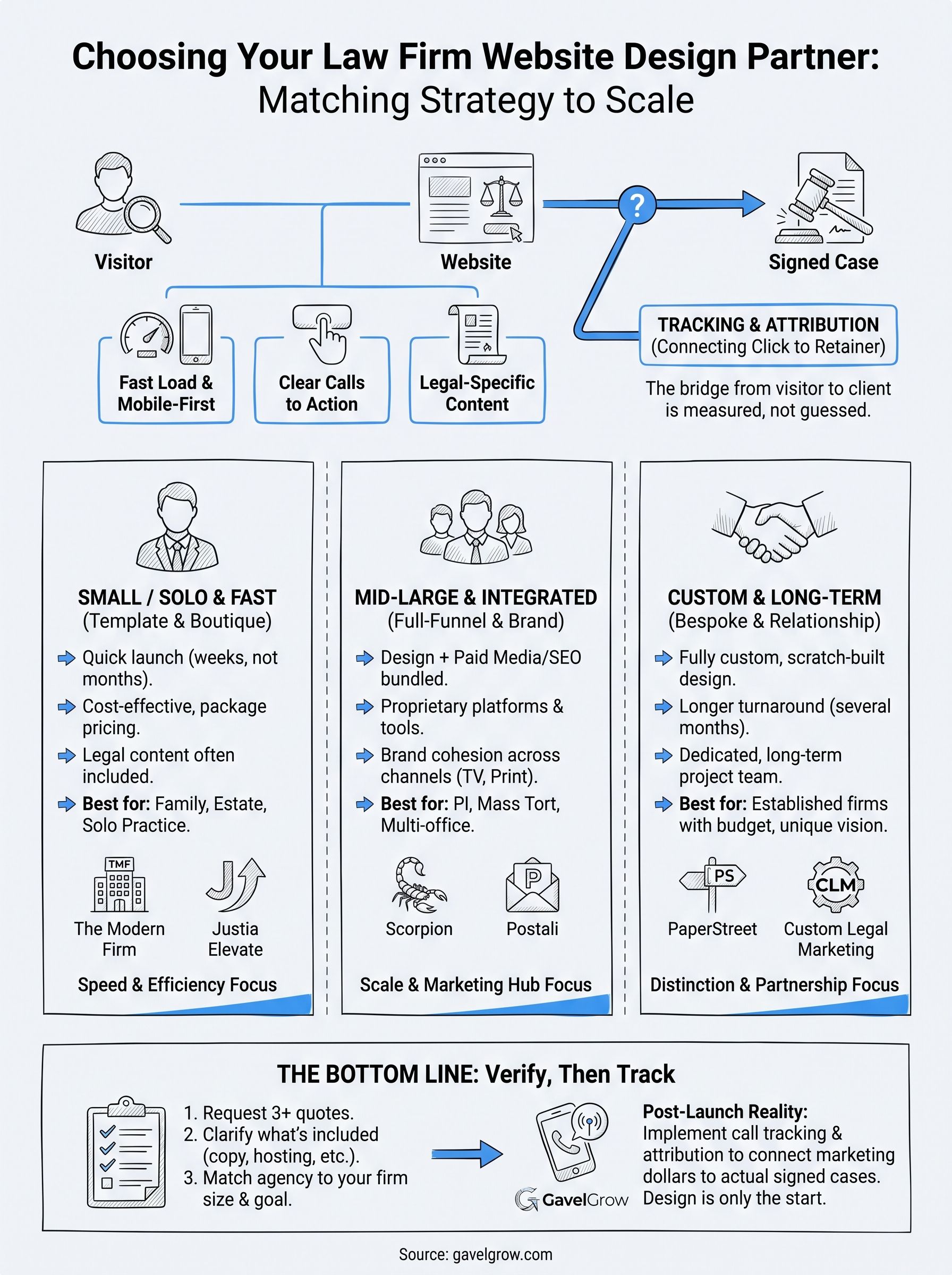
Match the agency to your firm's size and ambition rather than the flashiest portfolio. A solo practice in family law needs speed and clean templates from a shop like The Modern Firm or Justia Elevate, while a personal injury firm running television ads needs the brand cohesion Postali or Scorpion can deliver. Request quotes from at least three companies, ask each one directly what's included versus billed separately, and check whether copywriting, hosting, and maintenance ride along or arrive as surprise line items later.
A great law firm website design gets visitors in the door, but design alone can't tell you which pages turn clicks into signed cases. Once your new site launches, you need attribution that follows a visitor from that first click through the retainer, including calls that never touched a contact form. Book a free 45-minute call with GavelGrow's legal marketing team to see how call tracking and case-level reporting fit alongside whichever design partner you choose.
Agency capabilities, timelines, and pricing approaches reflect publicly available information as of August 2026 and may change; verify current terms directly with each vendor. Product names and trademarks are the property of their respective owners, and no affiliation with or endorsement by GavelGrow is implied.
Frequently Asked Questions
How long does a law firm website redesign take?
It depends on whether the build is custom or template-based. Agencies that design and code every page individually often run several months from kickoff to launch, while shops working from a legal-specific template library typically measure timelines in weeks. Ask for the timeline in writing before signing, and confirm what happens to your current site during the build.
What should a law firm expect to pay for website design?
Most legal-industry agencies do not publish flat rates, because the number moves with page count, custom photography or video, and whether copywriting is included. Fully custom builds commonly reach five figures; template-based packages cost meaningfully less. The figure that matters is the all-in one, so ask each vendor what is billed separately.
Does a law firm need a custom website, or is a template enough?
A template is usually enough for a solo or small practice that needs a clean, credible presence quickly. Custom design earns its cost in crowded markets, where a firm competes against practices spending heavily on brand and a recognizable template can undercut the impression the site is trying to make.
What should a firm ask before hiring a website design company?
Four things: whether copywriting is included or billed separately, who owns the domain and the site files, whether hosting and maintenance ride along or arrive as later line items, and what happens if you leave. Firms that cannot export their own site discover the cost of that at the worst possible moment.
Do law firm websites have to follow bar advertising rules?
Yes. Attorney advertising is regulated, and the specifics vary by state — several jurisdictions have rules covering disclaimers, past-results claims, and testimonials. Check your state bar's advertising guidance before launch, and confirm your agency has handled legal clients before rather than assuming a general-purpose designer knows the rules.