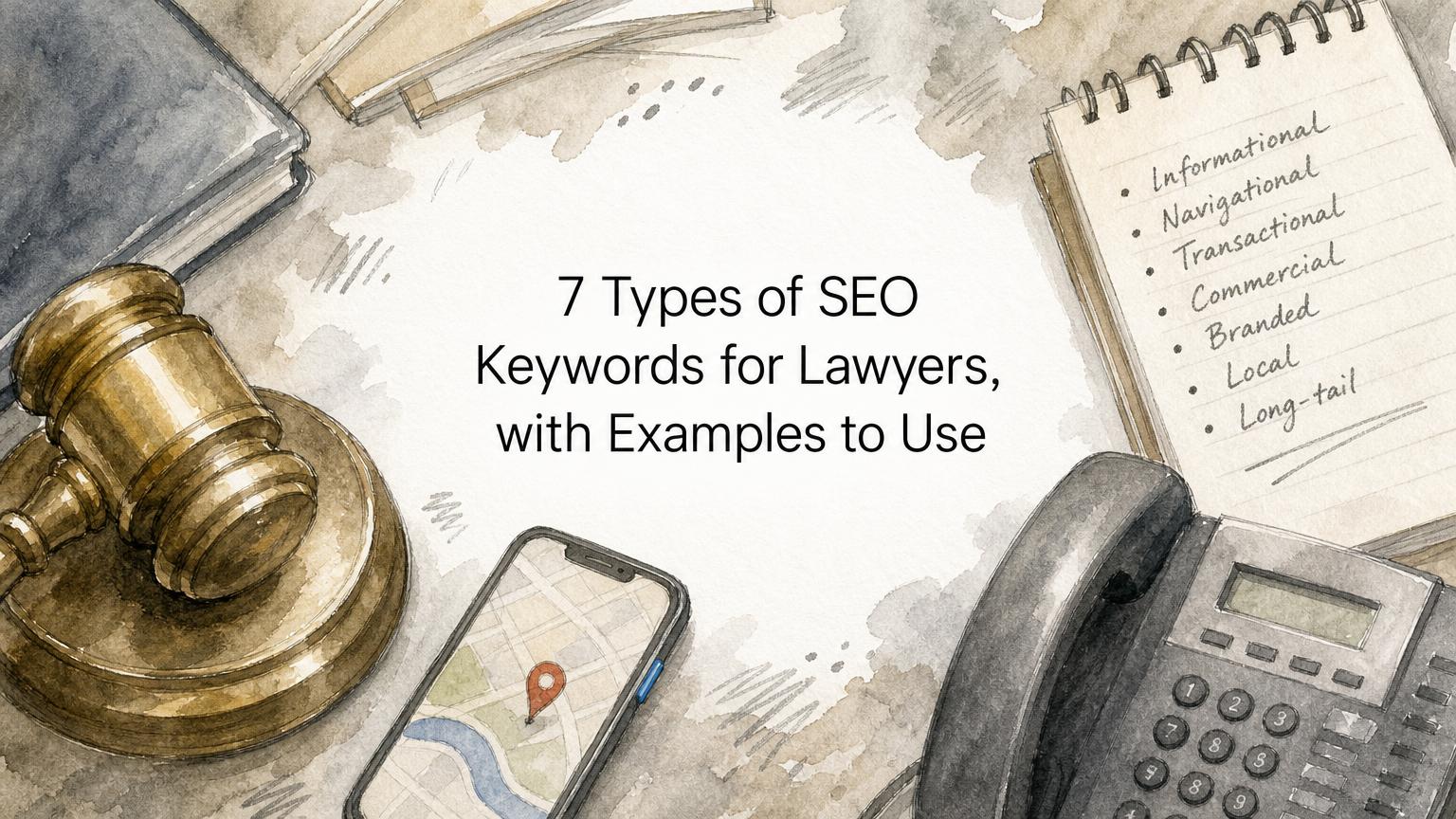
7 Types of SEO Keywords for Lawyers, with Examples to Use
Categories: Legal Marketing Strategies
 Abram Ninoyan
Founder & Senior Performance Marketer
Credentials: Google Partner, Google Ads Search Certified, Google Ads Display Certified, Google Ads Measurement Certified, Google Analytics (IQ) Certified, HubSpot Inbound Certified, HubSpot Social Media Marketing Certified, Conversion Optimization Certified
Expertise: Google Ads, Meta Ads, Conversion Rate Optimization, GA4 & Google Tag Manager, Lead Generation, Marketing Funnel Optimization, PPC Management
LinkedIn Profile
The most effective SEO keywords for lawyers pair a practice area with a place and a signal that the searcher is ready to hire, such as "divorce attorney [city] free consultation." Practice-a...
Key Takeaways
- 7 Types of SEO Keywords for Lawyers, with Examples to Use
- 1. Practice-area keywords
- 2. City and "near me" keywords
- 3. Hiring-intent modifier keywords
7 Types of SEO Keywords for Lawyers, with Examples to Use
The most effective SEO keywords for lawyers pair a practice area with a place and a signal that the searcher is ready to hire, such as "divorce attorney [city] free consultation." Practice-area and city keywords suit any firm building its core pages. Hiring-intent modifiers suit firms that want phone calls, not just traffic. Question and branded keywords suit firms that win clients through trust and referrals.
The trouble is that most lists of law firm SEO keywords hand you a pile of phrases with no sense of who is typing them. Someone searching "how long do I have to file a claim" wants information. Someone searching "criminal defense lawyer [city]" wants a name to call tonight. Treat both the same and you rank for traffic that never signs a retainer.
This article sorts keywords into seven types, with examples, search intent, and placement advice for each. It then shows you how to build your own list and measure it. GavelGrow has marketed only for law firms since 2015, so the focus throughout is on keywords that end in signed cases, not clicks.
1. Practice-area keywords
Practice-area keywords name the legal service you sell, and every other type on this list builds on them. They are short and competitive, and they are one of the clearest ways Google learns what your firm does.
Examples
Write each matter you want more of in the words a client would use, not the words on your bar card. List both the "lawyer" and "attorney" forms and check which one the results favor in your market.
- car accident lawyer
- divorce attorney
- criminal defense attorney
- estate planning attorney
- workers' compensation lawyer
- immigration lawyer
- bankruptcy attorney
Search intent
These searches mix two groups. Some people are comparing firms, while others are still deciding whether they need a lawyer at all. That makes broad terms high in volume but uneven in value, so you rarely want to stop here.
Search the phrase yourself and read page one. If it is full of firm practice pages, a practice page is the right match. If guides and directories dominate, the keyword is informational and you need a different page type.
How to use them
Give each practice area its own page with one primary keyword and a few close variations. One primary keyword per page keeps your pages from competing with each other. The page should be deep enough to stand alone: who you help, how the process works, and what happens next. GavelGrow publishes practice-area pages for personal injury, family law, criminal defense, immigration, and estate planning if you want to see how marketing differs across them.
Mass tort and class action firms work differently. They swap the city for the product or injury and aim at the whole country, with phrases like "[product name] lawsuit." Expect national competition and plan your content depth accordingly.
Start with practice-area keywords, but never stop there, because the broadest terms attract the least certain searchers.
2. City and "near me" keywords
Location keywords add a city, county, or neighborhood to a practice area, and they are where a single-location firm wins most of its local clients. "Near me" works differently, because Google reads the searcher's location rather than the words on your page.

Examples
Place modifiers should follow the way people in your market actually talk. In a large metro that often means suburbs and neighborhoods, while in a smaller market it may be the county that clients name.
- divorce attorney [city]
- [county] criminal defense lawyer
- personal injury lawyer [neighborhood]
- estate planning attorney [suburb]
- immigration lawyer near me
Search intent
Searchers who add a place want a firm they can reach. For these queries Google often shows a map pack above the organic results, so your Google Business Profile competes for the same click as your page.
Do not try to rank for "near me" by writing it into your copy. Instead, make your location unmistakable: a full address, a local phone number, and accurate business categories on your profile that match your site.
How to use them
Put the city in the title and H1 of the practice page, and mention neighborhoods or courthouses you really serve in the body. Build a location page only for a place where you practice or serve clients. Near-identical pages with the city name swapped are what Google's spam policies call doorway pages, and they put your rankings at risk.
Reviews matter here too. Ask every client for a review, resolve complaints with the client directly, and reply professionally to every public review.
For local keywords, a clear address and an honest service area beat a dozen thin city pages.
3. Hiring-intent modifier keywords
Modifier keywords add words like "free consultation," "cost," or "contingency fee" to a practice area, and they signal that the searcher is close to calling. They draw fewer searches than broad terms, but the people typing them are further along.
Examples
Think about what a person types after they have decided they need help and start checking terms.
- personal injury lawyer free consultation
- divorce attorney cost
- contingency fee car accident lawyer
- hire a bankruptcy attorney
- 24 hour criminal defense lawyer
- DUI lawyer payment plan
Search intent
Cost searches tell you the visitor is price-checking before they call. Most firms dodge the topic, which leaves room for you to explain how your fees work: flat, hourly, or contingency, and what a first consultation covers.
Searchers also type "best divorce lawyer" and similar phrases. Most state bars limit how a firm may describe itself with superlatives, so prove your strengths with plain facts instead of repeating the word on your pages. Check your own state bar's advertising rules before you publish.
How to use them
Add the modifier to an H2, an FAQ entry, or the meta description of the matching practice page, not to a separate thin page. Promise a free consultation only if you offer one, and keep any fee language consistent with your state's rules.
Modifier keywords are small in volume and large in intent, so give them a visible home on your practice pages.
4. Situation-based long-tail keywords
Long-tail keywords describe the client's circumstance in their own words, and they are the most efficient way for a small or mid-size firm to rank. They are longer and less contested, and the need behind them is specific.

Examples
These read less like marketing terms and more like what a worried person says out loud.
- first offense DUI lawyer [city]
- rear-ended by uninsured driver, do I need a lawyer
- landlord kept my security deposit attorney
- divorce when my spouse owns a business
- employer cut my pay without notice employment lawyer
- visa denied immigration attorney
Search intent
The person typing these phrases already has a problem and is looking for proof that you have handled it. A generic practice page rarely satisfies them, while a page that names their exact situation does.
A solo attorney in a mid-size market can compete for these phrases far more easily than for the broad practice-area term. That is why long-tail pages often outperform their search volume.
How to use them
Your intake team already holds the list. Read intake notes and listen to recorded calls, then write down the first sentence callers say about their problem. Turn the common ones into a dedicated page or a detailed section, but only for situations you really take. A page for a case type you refer out wastes the click and the caller's time.
The best long-tail keywords come from your own intake calls, not from a keyword tool.
5. Question keywords
Question keywords start with how, what, can, or do, and they catch people before they have chosen a lawyer. They rarely convert on the first visit, but they build the trust that makes a later call to your firm more likely.
Examples
Look for the questions a client asks in the first ten minutes of a consultation.
- what happens at a DUI arraignment
- how long does a divorce take in [state]
- do I need a lawyer after a car accident
- can I sue for a slip and fall
- how does workers' compensation work
Search intent
These searchers want an answer, not a sales pitch. Google may answer many of them directly in the results, so your page needs something a summary cannot supply: your experience handling the situation, a realistic picture of the process, and a clear next step.
Search your practice area and note the People Also Ask boxes and autocomplete suggestions. They show the exact wording people use.
How to use them
Publish a guide or an FAQ section that answers in the first two or three sentences, then adds detail. Legal information can affect people's decisions in serious ways, so have an attorney write or review it, show the author's name, and add a review date. Link each guide to the matching practice page and place a contact option near the end, so an interested reader can act.
A question keyword earns a reader's trust first and a phone call later, so write for both moments.
6. State, county, and court-specific keywords
Jurisdiction keywords tie a legal question to the law or court that governs it, such as "how to file for divorce in [state]." They matter because rules differ by state and county, and clients search that way.
Examples
These phrases come from people already facing a procedure.
- how to file for divorce in [state]
- [county] family court forms
- DUI penalties in [state]
- [state] workers' compensation filing deadline
- expungement requirements [state]
Search intent
These searchers are local and informational, and often further into their case than a general question asker. National publishers cannot answer state by state with local depth. You can, and that gap is your opening.
How to use them
Accuracy decides whether these pages help or hurt. State the rule correctly, link to the court's own resources where useful, and put a review date on the page. Revisit it when the law or the forms change, because an out-of-date deadline is worse than no page.
If you practice in several states, give each state its own page written for that state's rules. Do not copy one page and swap the name. Check your state bar's advertising rules for any statement about outcomes or specialization.
Jurisdiction keywords reward the firm that knows its local courts and keeps its pages current.
7. Branded keywords
Branded keywords include your firm name and attorney names, and they capture people who already heard of you from a referral, an ad, or a billboard and now want to check you out. They are few in number, and almost every one is a hot lead.
Examples
Referral clients usually search before they call.
- [firm name]
- [firm name] reviews
- [attorney name] [city]
- [firm name] phone number
- [attorney name] [practice area]
Search intent
These searchers are verifying you. They want to see your bio, your reviews, and a way to reach you without hunting. If a directory or an unrelated lawyer holds those results, you lose someone who was already inclined to hire you.
How to use them
Own the whole results page. Keep your firm name, address, and phone number identical on your site, your Google Business Profile, and every directory listing. Give each attorney a real bio page, and respond to every public review.
In Search Console, separate branded queries from non-branded ones. Branded growth can make SEO look healthier than it is, and the non-branded line shows whether new clients are finding you cold.
Branded keywords are free insurance, so make sure the results for your own name say what you want them to say.
How do you find and use the right keywords for your firm?
Build your list from practice areas, places, and client phrases. Check what Google ranks for each, assign one primary keyword to one page, and judge the result by signed cases. That process works for any list of law firm SEO keywords.
Build the list
Start with your own knowledge, then let tools fill gaps.
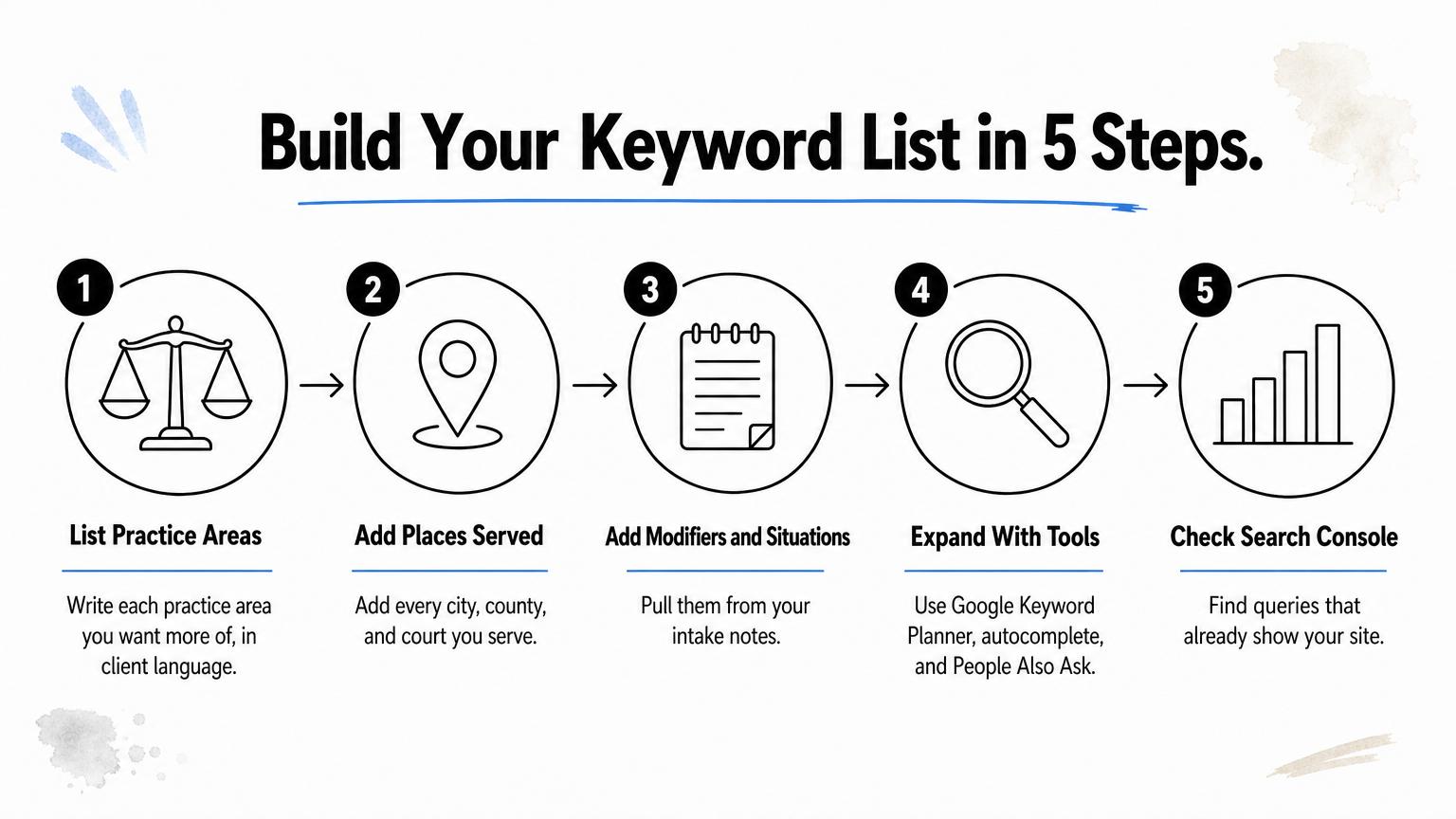
- Write each practice area you want more of, in client language.
- Add every city, county, and court you serve.
- Add modifiers and situations from your intake notes.
- Expand with Google Keyword Planner, a free tool inside Google Ads, plus autocomplete and People Also Ask.
- Check Google Search Console for queries that already show your site.
Check intent before you commit
Search each phrase and sort it by what ranks. Firm pages mean a commercial keyword, and guides mean an informational one. A moderately searched phrase with hiring intent usually beats a high-volume term where most searchers want free information. Google's own SEO Starter Guide makes the same point: use the words people would actually type.
Map keywords to pages
Give every keyword a home before you write anything. The table shows how one criminal defense firm could map all seven types.
Put the primary keyword in the title tag, the H1, the first paragraph, one subheading, the URL, and the meta description. Write it naturally. Keep titles under about 60 characters so Google does not cut them off.
Measure signed cases, not rankings
Rankings and traffic do not pay your bills. Track which pages produce calls and form fills, then which of those become retainers. GavelGrow's platform does this with built-in call tracking numbers and hosted intake forms. It shows cost per signed case by campaign and source, from the first click to the signed retainer. Track and Optimize each include a 7-day free trial with no credit card.
A keyword is only worth targeting if it produces signed cases, so measure it that way from the first week.
Where to start with your keyword list
Good keyword choice comes down to intent. Practice-area and city keywords name what you do and where. Modifiers and situations catch people ready to hire, questions and jurisdiction pages build trust, and branded searches close referrals. Pick a handful from each type, map them to pages, and measure what turns into signed cases.
If you would rather hand this work to a team that works only with law firms, GavelGrow's done-for-you law firm SEO covers organic and local SEO and Google Business Profile optimization.