Law Firm Website Design Cost: What to Budget For
Categories: Legal Marketing Strategies
 Abram Ninoyan
Founder & Senior Performance Marketer
Credentials: Google Partner, Google Ads Search Certified, Google Ads Display Certified, Google Ads Measurement Certified, Google Analytics (IQ) Certified, HubSpot Inbound Certified, HubSpot Social Media Marketing Certified, Conversion Optimization Certified
Expertise: Google Ads, Meta Ads, Conversion Rate Optimization, GA4 & Google Tag Manager, Lead Generation, Marketing Funnel Optimization, PPC Management
LinkedIn Profile
You're staring at three agency quotes that range from $3,000 to $60,000, and none of them explain why. That gap is normal in this industry, and it's exactly why law firm website design cost questions...
Key Takeaways
- Law Firm Website Design Cost: What to Budget For
- Why does law firm website design cost vary so much?
- How to budget for your law firm's website project
- What are the typical pricing tiers for law firm websites?
Law Firm Website Design Cost: What to Budget For
You're staring at three agency quotes that range from $3,000 to $60,000, and none of them explain why. That gap is normal in this industry, and it's exactly why law firm website design cost questions are so hard to answer with a single number. The truth is your budget depends on scope, not on which vendor sounds most polished on a sales call, and firms that skip this math often end up paying twice: once for the site, again for the redesign two years later.
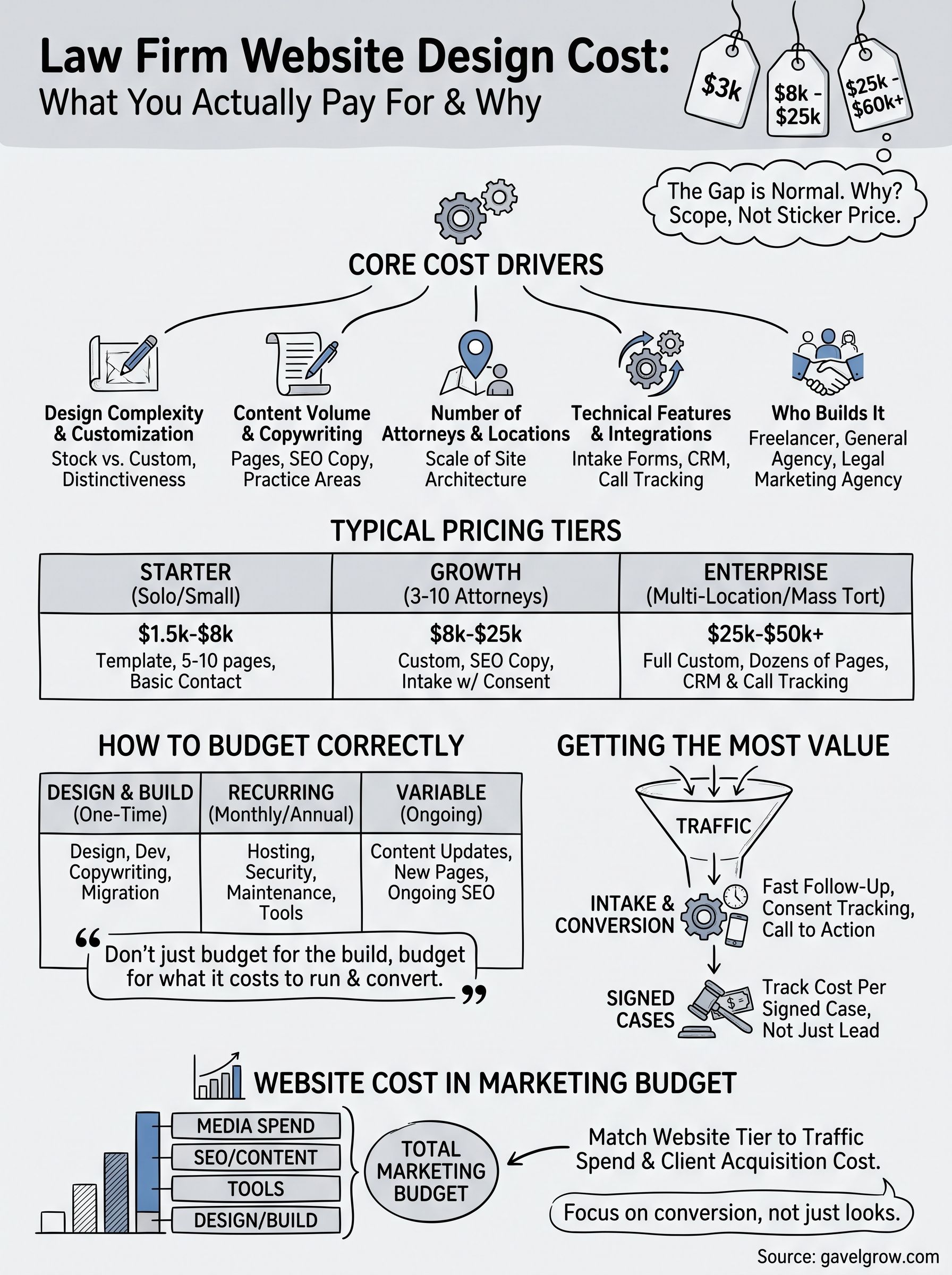
Here's the direct answer: a basic template site for a solo practitioner runs $1,500 to $5,000, a custom site for a small firm typically lands between $8,000 and $25,000, and a large multi-attorney or mass-tort site with heavy content and intake integration can push past $50,000. What you pay for matters more than the sticker price: design, copywriting, hosting, and ongoing maintenance are often quoted separately, and firms get burned when they aren't.
This article breaks down the real cost drivers, what separates a cheap site from one built to convert visitors into signed cases, and how to budget so your website supports your intake process instead of working against it.
Why does law firm website design cost vary so much?
The range exists because "website design" means something different depending on who's quoting it. A freelancer selling you a template with your logo swapped in is doing fundamentally different work than an agency building custom intake flows tied to your case management system. Both call it a website. Only one of them is building an asset that generates signed cases. Before you compare quotes, you need to understand what's actually driving the price up or down.
Design complexity and customization
A stock template built for attorney sites with a color change costs less because there's no original design work happening. Custom design, where a designer builds your layout, navigation, and visual identity from scratch, costs more because it requires actual hours from a skilled person. Firms that want a site that doesn't look like every other personal injury practice in their metro area need to pay for that distinctiveness. Cutting corners here is fine for a solo practitioner just getting started, but it becomes a liability once you're competing for the same search terms as five other firms running the same theme.
Content volume and copywriting
A five-page site with generic "About Us" copy costs far less to produce than a 40-page site with individual pages for each practice area, each attorney, and each city you serve. Mass tort and multi-office firms often need dozens of location and practice pages written to rank locally, and that copywriting labor adds up fast. If you're writing the content yourself, you save money upfront but spend your own time, and most managing partners don't have spare hours for SEO-optimized legal copywriting.
The gap between a $3,000 quote and a $30,000 quote almost always comes down to how much original content and custom design work is actually included.
Number of attorneys, practice areas, and locations
A solo estate planning attorney needs a fraction of the site architecture that a 12-attorney personal injury and mass tort firm with four office locations needs. Every additional attorney bio, every additional practice area page, and every additional location page adds design and content hours. This is one of the biggest reasons law firm web design pricing scales the way it does: it's not really the design template driving cost at that point, it's the sheer surface area of the site.

Technical features and integrations
A basic contact form is cheap. A mobile-first, multi-step intake form with TCPA consent tracking, duplicate detection, and instant SMS auto-reply is not, because it requires development work beyond what a page builder handles out of the box. The same goes for integrations with your call tracking numbers, your case management software, or your ad platforms. If your site needs to talk to other systems rather than just sit there looking nice, budget more. This is also where a lot of firms get surprised after launch: the site looked complete, but the intake form dumps leads into an inbox nobody checks, with no lead pipeline to triage them by urgency or campaign source.
Who builds it: freelancer, agency, or in-house team
The vendor you hire changes the price as much as the scope does, so it's worth comparing law firm website design companies before you sign anything. A solo freelancer on a marketplace site charges less per hour than one of the top legal marketing agencies, but you're also getting less strategic input, slower turnaround, and often no ongoing support once the invoice is paid.
A general agency with no legal experience might build a beautiful site that still converts poorly, because they don't understand how long a personal injury case takes to close or why your intake form needs consent language baked in from the first click.
How to budget for your law firm's website project
Most firms budget backward: they get a quote, panic at the number, and ask an agency to strip out whatever gets it under a target price. That approach guarantees you cut the wrong things. Budgeting correctly means starting with what your firm actually needs, ideally written down in a law office marketing plan, before you ever ask for a number, then treating the cost to build a law firm website as three separate line items instead of one lump sum: design and build, content, and the systems that turn visitors into signed cases.
Match your budget to your case value, not your competitor's site
A firm that signs a personal injury case worth $15,000 in fees can justify a bigger website investment than a firm handling $500 traffic tickets, because the payback math works differently. Look at your average case value and your current close rate before you set a number. Don't copy a competitor's budget just because their site looks nice; you don't know if it's actually converting, and a firm three times your size can absorb a $50,000 build in ways a two-attorney shop can't.
Separate the one-time build from the ongoing run cost
Every website quote should split cleanly into what you pay once and what you pay every month after. Hosting, security updates, content refreshes, and any intake tooling you layer on top are recurring costs that don't show up in the headline number but absolutely show up on your card statement.
A website budget that only accounts for the build, and not what it costs to run and maintain afterward, is an incomplete budget.
- One-time: design, development, initial copywriting, migration from an old site
- Recurring: hosting, domain, SSL, plugin or CMS licensing, security monitoring
- Variable: content updates, new practice area pages, ongoing SEO work
Ask for an itemized quote, not a single number
Request a breakdown before you sign anything. If a vendor won't itemize design, copywriting, and technical integration separately, that's a sign the quote is padded somewhere you can't see. An itemized quote also lets you negotiate individual pieces instead of accepting or rejecting the whole package, and it tells you exactly what you're losing if you decide to trim scope later. Firms that skip this step often discover after the invoice clears that
What are the typical pricing tiers for law firm websites?
Most law firm sites fall into three rough tiers, and knowing which one matches your firm keeps you from overpaying for features you don't need or underbuying a site that can't grow with you. Pricing tiers aren't rigid, but they map closely to firm size, practice area count, and how much the site needs to do beyond looking professional.
Solo and small firm sites
A solo practitioner or two-attorney firm in a single practice area, think estate planning or a small family law shop, typically spends $1,500 to $8,000. This tier covers a handful of pages, a template or lightly customized design, basic contact forms, and enough copy to explain what you do and where you're located. It's the right tier if you're just establishing a web presence and your case volume doesn't yet justify heavier intake infrastructure.
Custom sites for growing firms
Firms with three to ten attorneys, multiple practice areas, or a single office competing in a crowded metro tend to land between $8,000 and $25,000. This is where custom design, dedicated practice-area pages, attorney bios written for SEO, and a proper intake form with consent tracking start earning their keep.
Once your firm has more than one practice area or attorney bio to manage, a template site stops being cheap and starts being a bottleneck.
This tier is also where firms typically add call tracking numbers and their monthly cost or a basic lead pipeline so intake staff can see where a lead came from before picking up the phone.
Large multi-location and mass tort sites
Multi-office firms, mass tort shops, and firms running aggressive national ad campaigns often spend $25,000 to $50,000 or more. These builds need dozens of location and practice pages, heavier technical work to integrate with case management and call tracking systems, and content teams producing ongoing pages rather than a one-time batch.

| Tier | Typical firm profile | Cost range | What's included | |---|---|---| | Starter | Solo or two-attorney, single practice area | $1,500-$8,000 | Template design, 5-10 pages, basic contact form | | Growth | 3-10 attorneys, multiple practice areas | $8,000-$25,000 | Custom design, SEO copy, consent-tracked intake form | | Enterprise | Multi-location, mass tort, national campaigns | $25,000-$50,000+ | Full custom build, dozens of pages, CRM and call tracking integration |
Wherever your firm lands, resist the urge to buy up a tier just because a competitor did. Match the tier to your current caseload and revisit it once your intake volume outgrows what the site was built to handle.
What ongoing costs should you plan for after launch?
Launching the site is the easy part financially. Ongoing website costs are where firms get blindsided, because most quotes only cover the build and leave you to figure out what happens in month two. Budget for these recurring line items the same way you budget for rent or payroll software, because a site you stop maintaining starts losing rankings and leaking leads within a year.
Hosting, security, and maintenance
Every site needs somewhere to live, and that hosting bill is separate from whatever you paid to build the thing. Expect $20 to $200 a month depending on traffic volume and whether you're on shared hosting or a managed platform built for law firms. Security monitoring, SSL certificate renewal, and CMS or plugin updates typically run another $50 to $300 a month if you hire someone to handle them, or cost you nothing but your own time if you do it in-house. Skipping this isn't optional: an outdated plugin is one of the most common ways a law firm site gets hacked, and Google flags compromised sites in search results, which tanks traffic overnight.

A site nobody maintains isn't a one-time expense anymore, it's a liability that grows more expensive the longer you ignore it.
Content updates and SEO
Search rankings don't hold still once you publish. Firms that want to keep ranking for competitive practice-area terms need to budget for ongoing content, whether that's new blog posts, updated attorney bios, or additional location pages as the firm expands. Plan for $500 to $3,000 a month if you're paying for continued SEO and copywriting work, less if you're producing content internally. Neglecting this is why so many firms end up back in redesign territory two years after launch: the site didn't get worse, it just stopped growing while competitors kept publishing.
Intake and marketing tooling costs
The website itself is only half the system. Once leads start coming in, you need somewhere for them to go, which means budgeting for call tracking numbers, an intake form that captures TCPA consent, and a place to see which campaign actually produced a signed case rather than a dead lead. Here's a rough breakdown of what firms typically add on top of the site itself:
- Call tracking numbers: $10-$30 per number, per month
- SMS/email intake sequences: often bundled into a marketing dashboard subscription rather than billed separately
- CRM or case management software: $50-$150 per user, per month
- Conversion tracking setup: usually a one-time cost, though it needs revisiting whenever you change ad platforms
Treat these as part of your website budget from day one, not as an afterthought you discover three months after launch.
How do you get the most value from your website investment?
A website only pays for itself if it turns visitors into signed cases, so design choices that sign clients matter more than any visual trend. Put your phone number and intake form above the fold on every page, not just the homepage, and make sure the call to action is obvious whether someone lands on a practice-area page from a Google ad or a blog post from organic search. Firms that treat design as decoration instead of a sales tool end up with a beautiful site that still underperforms a plain one built around a clear next step.
The best-looking law firm website is worthless if the visitor can't find the button that turns them into a client.
Track what actually happens after a click
Budgeting for the build without budgeting for measurement means you're flying blind six months in. Every dollar you spend on Google Ads, Local Services Ads, or SEO should trace through to whether it produced a signed case, not just a form submission or a phone call that never went anywhere. That's the gap a lot of firms hit: their site captures leads fine, but nobody can say which campaign actually paid off. A dashboard that ties ad spend to signed retainers, rather than stopping at cost per lead, is what makes the rest of your website spend defensible when a partner asks what the site actually returned.
Treat the site as part of your intake system
Conversion doesn't end when someone submits a form. Fast follow-up matters: the Lead Response Management Study found that leads contacted within five minutes are far more likely to be qualified than those first reached thirty minutes later, which is why so many law firm leads never get a callback and why a beautifully designed site paired with a slow intake process is still leaking value. Speed only works if your team can see the lead the moment it arrives, so pair your build with automated intake that flags new submissions by urgency and source instead of dropping them into a shared inbox.
Last, resist the temptation to judge value by page count or design awards. Measure it against cost-per-signed-case benchmarks, not cost per click or cost per lead, because those numbers tell you whether the site is actually working rather than whether it looks the part. A $10,000 site that produces five signed cases a month is worth more than a $40,000 site that produces two, and that math only becomes visible once you're tracking the right end of the funnel.
How does website cost fit into your firm's marketing budget?
Firms too often treat the website as a one-time capital expense, separate from the monthly ad spend, SEO retainer, and intake tooling that actually put visitors on it. That's the wrong frame. Marketing budget planning works better when the site is one line item inside a bigger system, sized against how much your firm should be spending on marketing overall, and that line item should scale with how much traffic you're paying to send there.
Match your website tier to your traffic spend
Spending heavily on Google Ads or Local Services Ads while running that traffic through a bare-bones template site wastes most of the ad budget on a page that can't hold up its end of the deal. A firm putting $10,000 a month into paid search needs an intake experience that matches the volume, not a five-page site built for a solo practitioner with no ad spend at all. The reverse is also true: a two-attorney shop running a modest local campaign doesn't need a $40,000 enterprise build to support it.
A website should scale with the traffic you're sending it, not sit disconnected from the ad budget that feeds it.
Think in total client acquisition cost, not site cost alone
Allocating the whole marketing budget to media spend and treating the website as a sunk cost from months ago misses how the two numbers interact. A slow, poorly designed intake flow can quietly raise your cost per signed case even when your ad spend and click-through rates look healthy, because leads land on a page that doesn't convert them. A reasonable planning approach is to size your website investment relative to your annual digital marketing spend rather than in isolation, run the cost-per-acquisition math for your firm, then revisit that ratio once a year as your ad budget or caseload changes.
- Design and build: treat as an upfront investment amortized over two to three years
- Paid media (Google Ads, Local Services Ads, paid social): the ongoing spend the site needs to convert
- SEO and content: the layer that keeps the site earning traffic without paying per click
- Intake and reporting tools: the layer that proves which channel actually paid off
Organizing your spend this way also makes it easier to compare against agency proposals, since many done-for-you legal marketing engagements bundle design, media management, and reporting into one contract rather than billing them as separate vendors. If your firm runs everything in-house, the same math still applies: check what a marketing platform costs per month against how much media spend the site actually needs to support before you commit to a platform or a build.
Whatever split you land on, revisit it. A budget built around last year's ad spend and last year's caseload stops making sense the moment either one changes.
Frequently asked questions about law firm website design cost
Who owns a law firm website after an agency builds it?
Not always the firm — and this is the question most worth asking before signing. Some agencies build on a proprietary platform you licence rather than own, so leaving means rebuilding from scratch. Get it in writing that your firm owns the domain, the content, and the site files, and ask specifically whether you can export and host elsewhere.
Is redesigning an existing site cheaper than building a new one?
Usually, but not always. Refreshing design, templates, and content on a sound platform costs less than starting over. If the site runs on an outdated system, has no clean way to add practice-area pages, or was built on a platform you cannot export from, a rebuild is often cheaper than working around those limits.
How long should a law firm website last before it needs replacing?
Most firms get three to five years out of a well-built site before design and platform age enough to justify replacing it. Sites on a maintained platform with regular content updates last longer. The signal to replace is rarely how it looks — it is a site that cannot support the practice areas, locations, or intake flows the firm now needs.
Do cheap template sites hurt a law firm's SEO?
Not inherently. Search performance depends far more on site speed, mobile usability, content depth, and technical health than on whether a design started from a template. Where cheap builds cause problems is when they ship slow, bloated pages, cannot support unique content per practice area, or block basic technical fixes.
Do agencies expect the full website cost upfront?
Rarely all at once. Most structure payment across milestones — a deposit at kickoff, then payments at design approval and launch. Ask how the schedule works before signing, and confirm what happens if the project stalls, since a build tied to your content can sit unfinished while payments continue.
Putting your website budget to work
The number you land on matters less than what's behind it. A $6,000 site with a fast, consent-tracked intake form and someone watching cost per signed case will outperform a $40,000 site nobody measures. Budget by scope, not by sticker price, split one-time build costs from recurring ones, and treat the site as the front door to your intake system, not a standalone brochure.
Once the site is live, the harder question is whether it's actually converting the traffic you're paying for. That's where most firms lose money quietly, long after the build invoice is paid. If you want a clear read on where your cost per lead and cost per signed case actually stand before you commit another dollar to design or ad spend, walk through your numbers on a free strategy call with someone who's done this for 500+ law firms.
Price ranges reflect typical U.S. legal-industry quotes as of August 2026 and vary considerably by market, practice area, and scope; treat them as a starting point for comparison rather than a quote, and request itemized pricing for your own numbers.
Frequently Asked Questions
Who owns a law firm website after an agency builds it?
Not always the firm — and this is the question most worth asking before signing. Some agencies build on a proprietary platform you licence rather than own, so leaving means rebuilding from scratch. Get it in writing that your firm owns the domain, the content, and the site files, and ask specifically whether you can export and host elsewhere.
Is redesigning an existing site cheaper than building a new one?
Usually, but not always. Refreshing design, templates, and content on a sound platform costs less than starting over. If the site runs on an outdated system, has no clean way to add practice-area pages, or was built on a platform you cannot export from, a rebuild is often cheaper than working around those limits.
How long should a law firm website last before it needs replacing?
Most firms get three to five years out of a well-built site before design and platform age enough to justify replacing it. Sites on a maintained platform with regular content updates last longer. The signal to replace is rarely how it looks — it is a site that cannot support the practice areas, locations, or intake flows the firm now needs.
Do cheap template sites hurt a law firm's SEO?
Not inherently. Search performance depends far more on site speed, mobile usability, content depth, and technical health than on whether a design started from a template. Where cheap builds cause problems is when they ship slow, bloated pages, cannot support unique content per practice area, or block basic technical fixes.
Do agencies expect the full website cost upfront?
Rarely all at once. Most structure payment across milestones — a deposit at kickoff, then payments at design approval and launch. Ask how the schedule works before signing, and confirm what happens if the project stalls, since a build tied to your content can sit unfinished while payments continue.